
 List Your Land
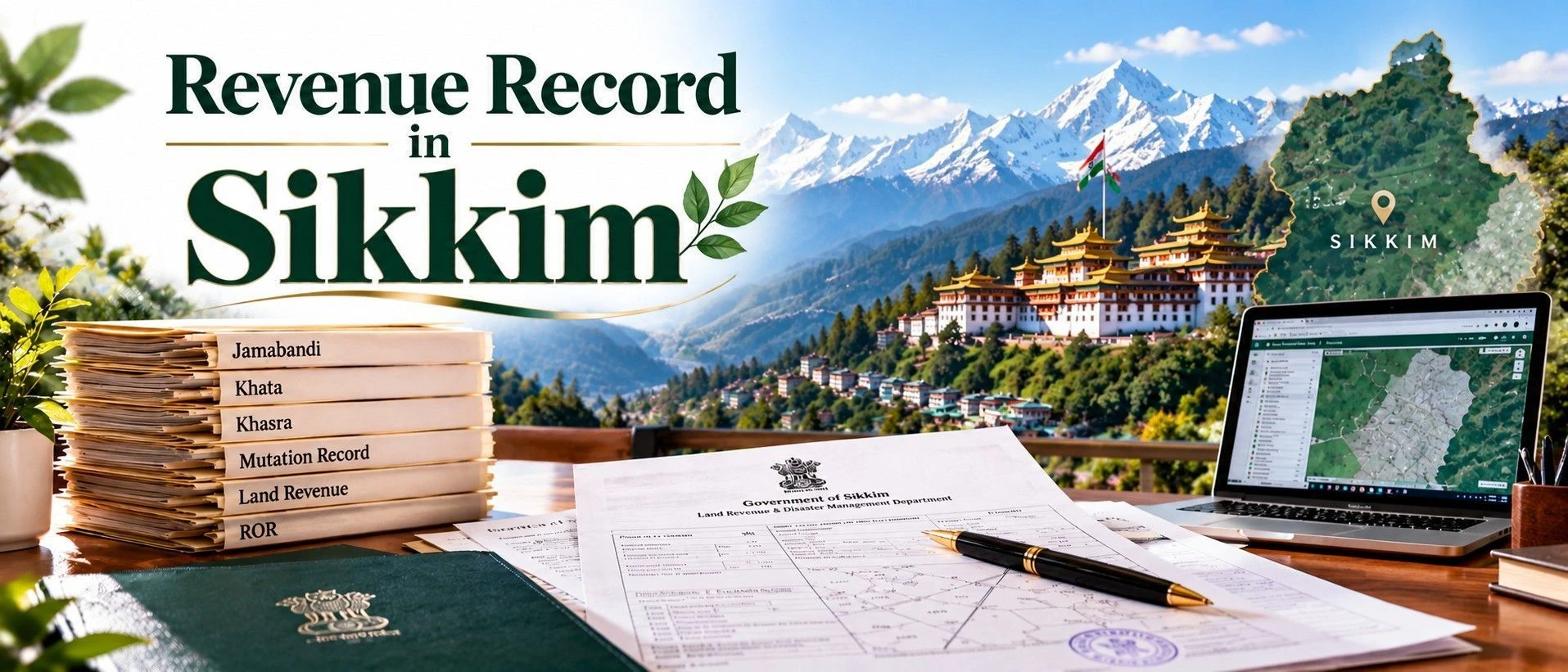
A revenue record is the government's official record of a piece of land, who holds it, what category it falls under, and what dues are attached to it, maintained by the Land Revenue & Disaster Management Department. It's the foundation document that every other land transaction in Sikkim, from a sale to a mortgage, ultimately traces back to. This guide covers what a revenue record contains, how to access it through Sikkim's online land record system, and what to check before relying on one during a purchase. Whether you're buying a plot, verifying inherited land, or preparing to sell, this is the record that confirms what the state itself has on file about a piece of land.
Section 1 — What is a Revenue Record in Sikkim?
Anyone seriously considering land for sale in Sikkim should treat the revenue record as the starting point of due diligence, not an afterthought; it's what actually confirms the land matches what the seller is describing.
Definition: a revenue record is the government-maintained record showing a plot's ownership, classification, boundaries, and revenue dues, compiled and updated by the Land Revenue & Disaster Management Department.
It's often used interchangeably with "parcha" or "RoR," and functionally they're closely related; the parcha is the physical document that reflects what's captured in the underlying revenue record. What separates it from a sale deed is scope: the sale deed records a single transaction, while the revenue record tracks the land's full standing over time, including ownership history, land classification, and khazana (land revenue) status. A buyer needs this specifically because Sikkim's terrain and periodic cadastral surveys mean boundaries and classifications sometimes shift, and the revenue record is the only source that reflects the current, government-recognised position.
State-specific note: Sikkim's Land Revenue & Disaster Management Department also handles land tax collection, cadastral surveys, and the state's Land Bank Scheme, so its revenue records carry more administrative weight than a simple ownership register; they're tied directly to how the state tracks and allocates land.
Expert Tip: When pulling up a revenue record through the ILRMS portal's "Know Your Property" search, cross-check the khatiyan number against the physical parcha the seller shows you. Occasionally, a plot's record hasn't been updated after a boundary correction from a cadastral survey, and catching that mismatch early saves a lot of back-and-forth later in the transaction.
Section 2 — How to Get Revenue Records Online in Sikkim?
There are two practical ways to access revenue records in Sikkim, depending on whether you need a quick check or a formal, signed copy.
Method | Cost | Time | Legally valid for transactions? |
Online view via ILRMS "Know Your Property" | Free | Instant | For reference/verification, not a substitute for a signed parcha |
Requesting a fresh/certified parcha online | ROR/parcha fee | 1–3 weeks | Yes |
Offline (Revenue Office) | ROR/parcha fee | 1–4 weeks | Yes |
Go to the ILRMS portal — Access ilrms.sikkim.gov.in and select the "Know Your Property" feature.
Enter location details — Choose the district, subdivision, revenue circle, and revenue block where the land is located.
Search by plot or owner — Look up the record using the khatiyan/plot number, or search by owner name if the plot details aren't known.
Review the record online — Check ownership, classification, and boundary details as reflected in the system.
Request a certified copy if needed — For a formal parcha to use in a transaction, submit a request through the portal or proceed to the Revenue Office.
Visit the Revenue Office — Go to the Revenue Section covering the district where the land is located.
Provide plot or khatiyan details — Give the Revenue Supervisor the khatiyan number and revenue circle to pull the relevant record.
Pay the applicable fee — Submit the ROR/parcha fee via bank receipt as prescribed.
Collect the signed parcha — Once the Revenue Officer verifies and signs off, collect the physical parcha reflecting the current revenue record.
Offline requests typically take one to four weeks depending on whether the record needs updating first. Before relying on any copy, whether digital or physical, check that the khatiyan number, boundary description, and classification are internally consistent and match the seller's other documents; a revenue record that doesn't line up with the parcha being shown is a signal to dig deeper before proceeding.
Section 3 — What Does a Revenue Record Contain?
If you've spotted an appealing plot in Sikkim listed on real estate websites, checking the underlying revenue record before you get attached to the listing can save considerable time later.
Field | What it means | What to check |
Khatiyan/khasra number | Unique identifier for the land parcel | Matches the parcha and any sale documents |
Owner's name | Current registered holder of the land | Matches the seller or applicant |
Land classification | Agricultural, non-agricultural, or other category | Consistent with the land's actual intended use |
Boundary description | North, south, east, west details | Matches ground reality and adjoining plots |
Khazana status | Land revenue payment history | No long-pending dues attached |
Good sign: A properly maintained revenue record shows a classification and boundary description that match the physical parcha exactly, a khatiyan number consistent across every related document, and no unresolved khazana dues sitting against the parcel.
Section 4 — Common Issues & How to Fix Them?
Most confusion around revenue records in Sikkim traces back to outdated entries or mismatches following a cadastral survey. You can check current details directly on the Revenue Record on the Sikkim official website through ILRMS before assuming a discrepancy is a red flag.
Record not updated after mutation — A sale or inheritance completed years ago sometimes hasn't been reflected in the current revenue record. Fix: File a mutation application at the Revenue Office if the online record still shows the previous owner.
Boundary mismatch after cadastral survey — Periodic surveys occasionally shift recorded boundaries. Fix: Request a corrected parcha reflecting the latest survey if discrepancies are found.
Khatiyan number confusion — Old and new khatiyan numbers sometimes coexist during a transition period, causing search errors. Fix: Cross-check both old and new numbers with the Revenue Office if an online search returns no result.
Outstanding khazana dues — Unpaid land revenue can complicate mutation or resale. Fix: Clear pending khazana before initiating a sale or mutation application.
Land classification outdated — A plot converted from agricultural to non-agricultural use might still show the old classification if NA conversion wasn't formally recorded. Fix: Confirm whether a change in land use/pattern application was filed and completed.
Discrepancy between online record and physical parcha — Digital records occasionally lag behind physical office updates. Fix: Confirm directly with the Revenue Office if the online and offline versions don't match.
Section 5 — Recent Changes in 2026
Sikkim's Land Revenue & Disaster Management Department has continued strengthening the ILRMS platform under the Digital India Land Records Modernisation Programme, including features like Aadhaar seeding against khatiyan numbers and an online Revenue Calculator for checking land tax dues. No major changes have been reported as of August 2026 beyond this continued digitisation and integration effort.
Section 6 — Why Revenue Record Matters for Land Buyers?
It's the primary source confirming who actually holds a piece of land according to the government, not just what a seller claims.
It reveals the land's classification, which determines whether it can legally be used for construction or must stay agricultural.
It shows khazana payment history, flagging any pending dues that could become the buyer's problem.
Banks require a current, verified revenue record before processing a loan against the property.
It's essential for resolving boundary disputes, since it reflects the state's own surveyed data.
For inherited land, it's the record mutation that ultimately updates, making it central to settling ownership cleanly.
Section 7 — Revenue Record vs. Sale Deed
These two documents work together but capture very different things.
Aspect | Revenue Record | Sale Deed |
What it shows | The land's ongoing standing — ownership, classification, dues | A single transaction transferring ownership |
Maintained by | Land Revenue & Disaster Management Department | Registered at the Sub-Registrar's office at the time of sale |
When it's checked | Throughout ownership, and before/after any transaction | At the point of purchase or transfer |
If you're planning on selling agricultural land in Sikkim, keeping the revenue record current and mutation up to date makes the eventual sale considerably smoother; buyers doing due diligence will almost always cross-check the seller's parcha against the ILRMS record before moving forward. The same applies if you're looking to buy farmland in Sikkim: a clean, current revenue record is one of the clearest signals that a plot is transaction-ready.
Section 8 — Related Documents
Parcha and RoR verification guides for confirming ownership
Mutation guides for updating the revenue record after a transfer
Encumbrance certificate guides for checking a property's transaction history
NA conversion guides for land classification changes
State-wise land record search guides for buyers
