
 List Your Land
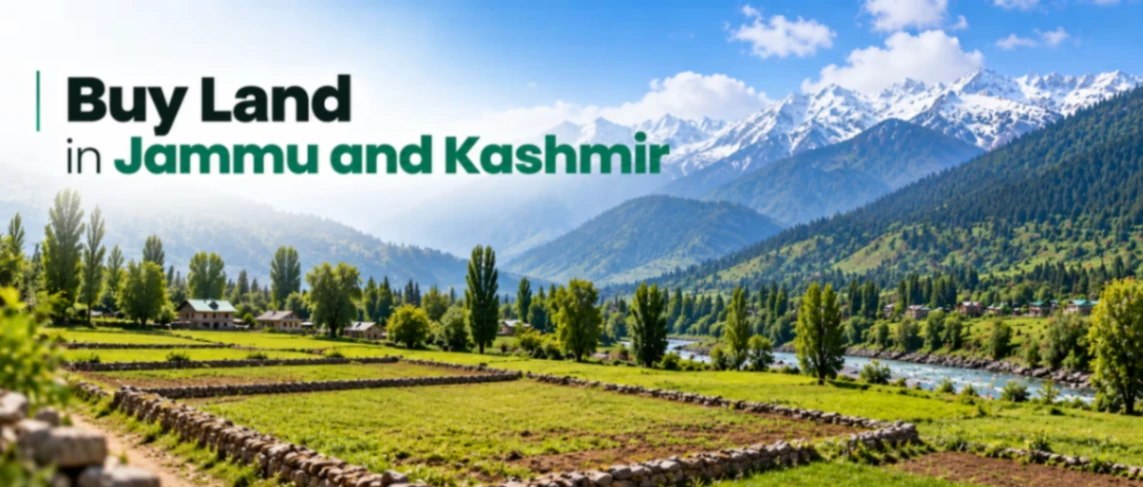
Purchasing land in Jammu and Kashmir now is totally different from what it used to be a decade back, because there have been many changes in the guidelines for purchasing property in this region after 2020. Anybody looking out for lands for sale in Jammu or for lands for sale in Kashmir needs to know the documents that need to be considered, the authorities who will be involved, and the tests that will prevent any future disputes. What needs to be verified at each step and where the new buyers often falter. Whether you are trying to purchase a plot for residential purposes or investigating agricultural land in India in general, taking Kashmir as an example, or simply comparing plots in Kashmir with those in cities, this is the procedure you have to go through.
Section 1 — What Should You Know Before Buying Land in J&K?
A brief understanding is required before moving forward: The laws for land purchase in Jammu and Kashmir are now differentiated by the type of land because non-agricultural property is available for purchase to a larger base of people than agriculture land.
Definition: Acquisition of land in J&K means the act of purchasing land by executing a sale deed after carrying out the necessary processes like determination of ownership and classification of the land.
This is different from buying property in most other states, since land in Jammu and Kashmir carries specific eligibility conditions tied to residency and land classification that were introduced after the 2019 reorganisation. Non-agricultural land can generally be purchased by any Indian citizen, while agricultural land largely remains reserved for domiciles unless converted through the proper NA process. Anyone browsing jammu plots for sale in city areas is usually dealing with non-agricultural classification already, while rural parcels advertised as farmland for sell may still carry agricultural status that needs closer checking.
State-specific note: Properties in certain notified zones, including strategic defence areas and the Saffron Belt in Kashmir, follow separate rules and cannot be purchased through the standard process regardless of classification.
Expert Tip: Before finalising any deal, ask specifically whether the land classification shown in the Jamabandi matches what the seller describes it as — a plot marketed for residential use may still be legally classified as agricultural until formal conversion is completed.
Section 2 — How to Buy Land in J&K Step by Step?
This section covers the actual buying process, since a typical transaction moves through document verification, deed preparation, and registration before ownership formally transfers.
Stage | Cost | Time | Legally binding? |
Document verification (Jamabandi, EC, survey map) | Nominal fee for certified copies | A few days | Informational, protects the buyer |
Deed preparation and stamp duty payment | Stamp duty as per buyer category | A few days | Preparatory |
Registration at Sub-Registrar office | 1.2% registration fee | 4–5 working days | Yes, once registered |
Search available listings — Browse a reliable land marketplace or trusted buy and sell land platform to shortlist plots matching your budget and location.
Verify the Jamabandi online — Check ownership and classification on landrecords.jk.gov.in using the khasra or khewat number.
Check the survey map — Confirm the plot's boundary and shape against the seller's description.
Request an encumbrance certificate — Verify there are no pending loans or disputes tied to the property.
Coordinate registration through NGDRS — Book an appointment for deed execution once documents are confirmed clean.
Visit the local Revenue Office — Get a certified Jamabandi copy and confirm current ownership in person.
Consult a property lawyer — Have the ownership chain and any past mutations reviewed before proceeding.
Negotiate and prepare the sale deed — Engage a deed writer to draft the document with accurate details.
Register at the Sub-Registrar office — Complete stamp duty payment and formal execution with both parties present.
From the start of the verification till the issuance of the document, the entire procedure generally takes a couple of weeks, depending upon the efficiency with which documents are collected and the cooperation of the seller. Before finalizing the entire payment, it is advisable to ensure that all these three documents reflect the same khasra number and boundaries.
Section 3 — What Should You Verify Before Buying?
Buyers often want a clear checklist of what genuinely needs confirming before committing money, especially when comparing multiple plots in Jammu city or rural options side by side.
Field | What it means | What to check |
Ownership record | Current recorded owner in the Jamabandi | Should match the seller's ID exactly |
Land classification | Agricultural vs non-agricultural status | Should match the intended use |
Encumbrance status | Any pending loans or legal claims | Should show no active encumbrance |
Zone restrictions | Strategic, Saffron Belt, or other notified areas | Should not fall under any restricted classification |
Mutation history | Past ownership transfer records | No pending or disputed mutation entries |
Good sign: A clean parcel shows a matching owner name, correct classification for your intended use, no encumbrance, no zone restriction, and a fully updated mutation history.
Section 4 — Common Issues & How to Fix Them?
Even with a fairly structured process, buyers across Jammu and Kashmir run into a specific set of recurring problems tied to documentation gaps and classification mismatches. Most of the delays have been attributed to incomplete verification before an offer is made rather than any flaw in the government process itself. For getting updated information regarding land records and registration procedure, the best site to visit would be the How to Buy Land in J&K official website
Agricultural land assumed to be residential-ready – Buyers sometimes purchase land expecting to build immediately, only to find it needs NA conversion first. Fix: confirm classification in the Jamabandi and factor in conversion time before finalising the purchase.
Seller unable to produce a clean ownership chain – Older properties sometimes changed hands through informal documents. Fix: get the full chain of past transfers reviewed by a lawyer before proceeding.
Boundary shown on the ground not matching the survey map – Physical boundaries can drift from old cadastral records over time. Fix: request a fresh demarcation from the Patwari before finalising payment.
Land falling under a restricted or notified zone – Some parcels near defence areas or the Saffron Belt cannot be purchased through the standard process. Fix: verify zone status directly with the Revenue Department before making any commitment.
Pending mutation from a previous transaction – The Jamabandi may still show an earlier owner if mutation was never completed. Fix: confirm mutation status is current before treating the ownership record as final.
Registration delayed beyond the buyer's expected timeline – Document gaps or appointment backlogs can push registration back. Fix: keep all documents ready in advance and book the Sub-Registrar appointment early.
Section 5 — Recent Changes in 2026
No major changes have been reported as of August 2026 regarding the core eligibility rules for buying land in Jammu and Kashmir. The framework allowing non-domicile Indian citizens to purchase non-agricultural land, introduced after 2020, has remained stable, while agricultural land purchase continues to follow domicile-based restrictions. Buyers are advised to check the official portal periodically for any district-specific procedural updates.
Section 6 — Why Careful Verification Matters for Land Buyers
It confirms the seller genuinely has the right to sell the specific parcel being offered.
It prevents costly surprises tied to land classification after the purchase is complete.
It protects buyers exploring online land selling platforms from relying only on a listing description without independent checks.
It reduces the risk of buying into a disputed or notified restricted zone unknowingly.
It supports smoother resale later, since a clean, verified purchase history reassures future buyers.
It matters for anyone conducting a broader farmland search across districts, since classification and eligibility can vary noticeably by location.
Section 7 — Buying Non-Agricultural Land vs. Agricultural Land: What's the Difference?
Basis | Non-Agricultural Land | Agricultural Land |
Who can buy | Any Indian citizen | Largely restricted to domiciles |
Construction rights | Generally permitted subject to local rules | Requires NA conversion before construction |
Common confusion | Assumed automatically buildable without checks | Assumed purchasable by any buyer without restriction |
Verification focus | Ownership, encumbrance, zone status | Same checks plus classification and domicile eligibility |
People often confuse the two because both are simply called "land" in casual conversation, but the buying eligibility and construction rights differ significantly. If you are ready to make a purchase, using a reliable land marketplace or a platform built for buy and sell land transactions can help you find verified listings faster than relying only on informal local contacts, and if you are on the selling side, choosing to sell land in Jammu Kashmir through a documented platform tends to attract more serious buyers.
Section 8 — Related Documents
Revenue Record in Jammu and Kashmir: Jamabandi and Fard Guide
Title Deed in Jammu and Kashmir: Registration Process Explained
Mutation in Jammu and Kashmir: Dakhil Kharij Process Explained
NA Conversion in Jammu and Kashmir: Complete Guide
Survey Map in Jammu and Kashmir: Bhunaksha Verification Guide
