
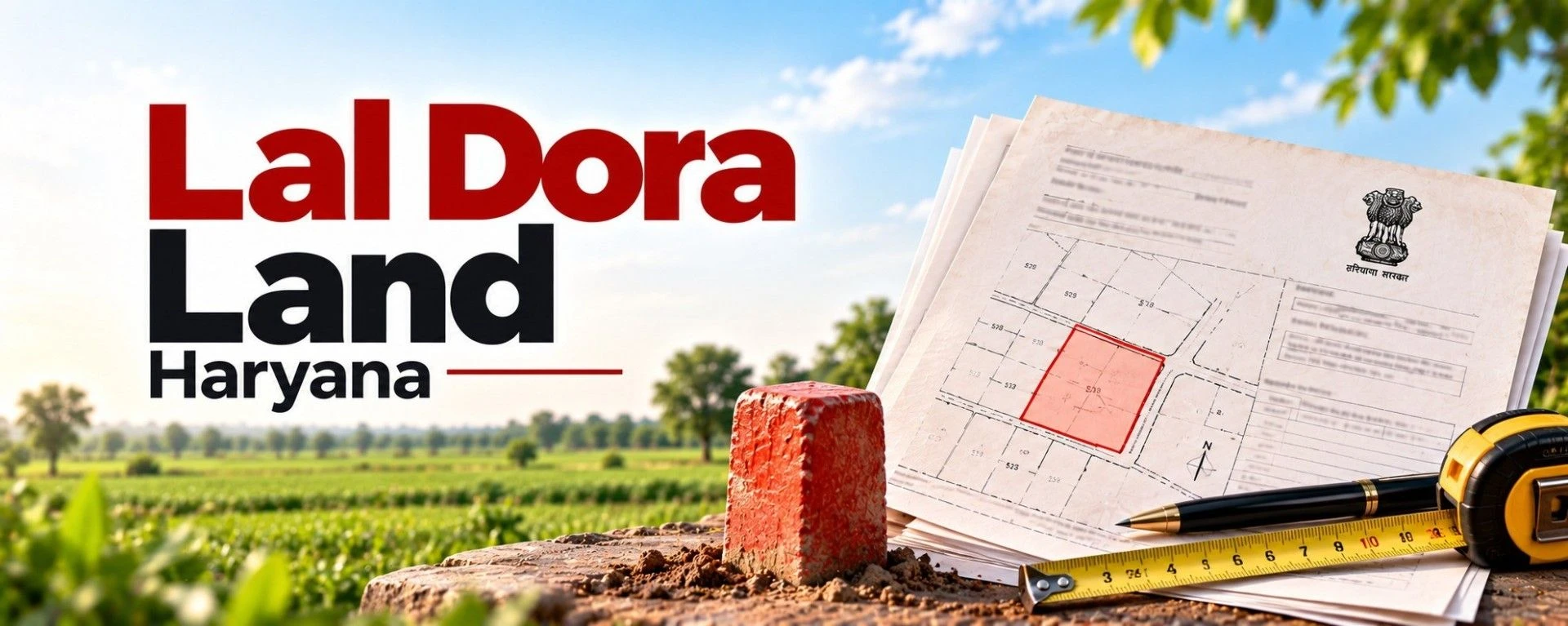
"Lal Dora" is the name given to the boundary drawn around the habitation area (abadi) of any village which originated from the revenue maps of British times. To put it simply, this is the red line drawn around the habitation land of the village on the revenue map which marks the boundary between the habitation land and the adjacent agricultural land. It is important for any person working on Lal Dora land in Haryana since it will determine what you can construct there legally, how easy it would be for you to sell this plot and how banks/authorities will perceive this while issuing loans or registering the property. This guide provides information on Lal Dora land, procedures of proving the ownership, documents required and things that should be kept in mind by both the buyer and seller before making the final decision. Whether you plan to buy some small plot of land in the village or look for agriculture land for sale in Haryana near it or sell your old ancestral property in the abadi of the village, this is the document you will be asked for.
Section 1 — What is Lal Dora Land in Haryana?
One who is looking to buy land in Lal Dora Haryana must first consider the layout of land in village areas before seeing what is available. The 2Bigha website offers a live map of Haryana where you can find plots from different districts along with prices and area details.
Definition: Lal Dora is that part of the village where people live and which is demarcated by a red line drawn around it on the old revenue map.Properties falling inside this line were historically kept outside regular municipal building rules.
Lal Dora land is different from regular agricultural land because it was never meant for crop cultivation — it was set aside for housing, cattle sheds, and village-related structures. This is also where the confusion starts for first-time buyers. A plot sitting just outside the red line is agricultural, governed by strict land-use rules, while a plot inside is treated as habitation land with fewer construction restrictions. A buyer needs this distinction clear because a lal dora property does not always come with a standard registered sale deed the way city plots do — many transactions historically happened through unregistered documents like a Special Power of Attorney (SPA) or an affidavit, which changes how the buyer should approach due diligence.
Haryana-specific note: Over the years, many parts of Lal Dora near Gurugram, Faridabad and Sonipat have been partially regularised, and hence it is recommended to find out from the respective municipal/panchayat office if your particular plot has been regularised through any recent scheme.
Expert Advice: You should not merely look at the boundaries on a paper map. Check the recent Lal Dora in Haryana Extract from Patwari and compare it with the actual boundary walls on the ground — there could be a mismatch between the two in many cases.
Section 2 — How to Get Lal Dora Records in Haryana?
Once the basic boundary is understood, the next step is actually pulling the record, either from home or by visiting the office in person.
Method | Cost | Time | Legally valid for registration? |
Online (unsigned view) | Free | Instant | No, view-only |
Online (digitally signed) | Small portal fee | Same day | Yes, in most cases |
Offline (Talathi/Tehsildar office) | Nominal fee | 3–7 days | Yes |
Visit the Haryana land records portal — Go to jamabandi.nic.in from a browser.
Select the location details — Choose district, tehsil, and village name from the dropdown menus.
Search by Khewat or owner name — Enter the khewat number or the owner's name to pull up the record.
View or download the record — The Jamabandi/record extract will show up on screen; download it as a PDF for reference.
Get a digitally signed copy if needed — Pay the small applicable fee to get a version that is accepted for official use.
Visit the local Tehsildar or Patwari office — Carry your ID proof and the plot's khewat/survey number.
Submit a written request — Fill out the application form asking for the abadi/Lal Dora record extract.
Pay the applicable fee — This is usually a small, fixed government fee.
Collect the signed copy — It is generally ready within a week.
It usually takes anywhere between three and seven working days for the offline copy to be ready. Before collecting it, check that the survey number, owner name, and area mentioned match what was told to you at the time of the deal — small clerical mismatches are common and easier to fix before the document is finalised.
Section 3 — What Does a Lal Dora Record Contain?
Buyers researching a plot often want to know what the actual lal dora land sale Haryana paperwork should show once verified. You can compare general property listing formats and see how details are structured by browsing the 2Bigha platform, which lists verified agricultural and residential land across India.
Field | What it means | What to check |
Owner name | Current recorded holder of the property | Should match the seller's ID exactly |
Khewat/Khata number | Unique identifier for the land parcel | Should match the physical plot boundary |
Area | Size of the residential/abadi plot | Should match what is being sold |
Mutation entries | History of ownership transfers | No pending or disputed mutation |
Remarks column | Any court case, encumbrance, or dispute note | Should ideally be blank |
Good sign: A clean record shows a single, clearly named current owner, no pending mutation requests, and no remarks about litigation or government acquisition. If the remarks column mentions anything unusual, it is worth asking a local lawyer before moving forward.
Section 4 — Common Issues & How to Fix Them
Unregistered ownership chain – Many old Lal Dora properties changed hands through unregistered SPA/GPA documents over the years. Fix: Ask for the complete chain of past transfer papers and get them reviewed by a property lawyer before purchase.
Mismatch between map and ground boundary – The old paper-based Lal Dora line sometimes does not match current physical walls. Fix: Request a fresh demarcation from the Patwari before finalising the deal.
Property inside disputed or notified acquisition zone – Some abadi land near expanding towns falls under government acquisition notices. Fix: Check with the local development authority for any pending notification on the plot.
Incomplete mutation after inheritance – Family-owned Lal Dora plots often have mutation pending after the original owner's death. Fix: Ensure mutation is completed, and the current legal heir's name reflects correctly before any sale.
No formal registered sale deed – Older transactions inside the abadi area were often done without registration. Fix: Insist on a properly registered sale deed for the current transaction, even if past transfers were informal.
Confusion between Lal Dora and adjoining agricultural land – Buyers sometimes assume a plot is residential when it is actually just outside the red line. Fix: Confirm the exact land classification from the revenue record before assuming construction rights.
Section 5 — Recent Changes in 2026
No changes have been made till date as per August 2026 about the procedure of Lal Dora classification in Haryana state. The digitisation of the records of Jamabandi at the village level has been happening in a gradual manner in the different districts of the state and this process is more convenient now as compared to what it was a few years back.
Section 6 — Why Lal Dora Records Matter for Land Buyers
They confirm whether a plot legally falls inside village abadi land or outside it.
They help avoid disputes over unregistered ownership chains common in older village properties.
Banks often ask for a clear revenue extract before approving a loan against such property.
They protect buyers looking at lal dora land investment from unknowingly purchasing disputed or notified land.
They clarify what kind of construction, including any lal dora land commercial use, is actually permissible on the plot.
They make future resale smoother since a clean record reduces buyer hesitation later.
Section 7 — Lal Dora vs. Agricultural Land (7/12 or Jamabandi Classified)
Basis | Lal Dora (Abadi) Land | Regular Agricultural Land |
Purpose | Housing, cattle sheds, village structures | Farming and crop cultivation |
Construction rules | Fewer restrictions historically | Strict, needs land-use conversion approval |
Common documentation | Often informal SPA/GPA in older cases | Standard Jamabandi/khasra record |
Sale process | Can be simpler but needs careful title check | Usually more standardised |
These are often confused by people since both come under the same village revenue map, but there is a vast difference in their use and regulations. In case you are planning to list property for free, then it would be better if you could get the listings done for free where buyers who are really looking for these pieces of land are already searching for farm land in haryana.
Section 8 — Related Documents
7/12 Extract & Jamabandi Guide for Haryana
Haryana Bhu Naksha: How to View Land Maps Online
CLU Permission and Agricultural Land Conversion in Haryana
Mutation of Property in Haryana: Step-by-Step Process
Khasra Number vs Khewat Number: What's the Difference?
