
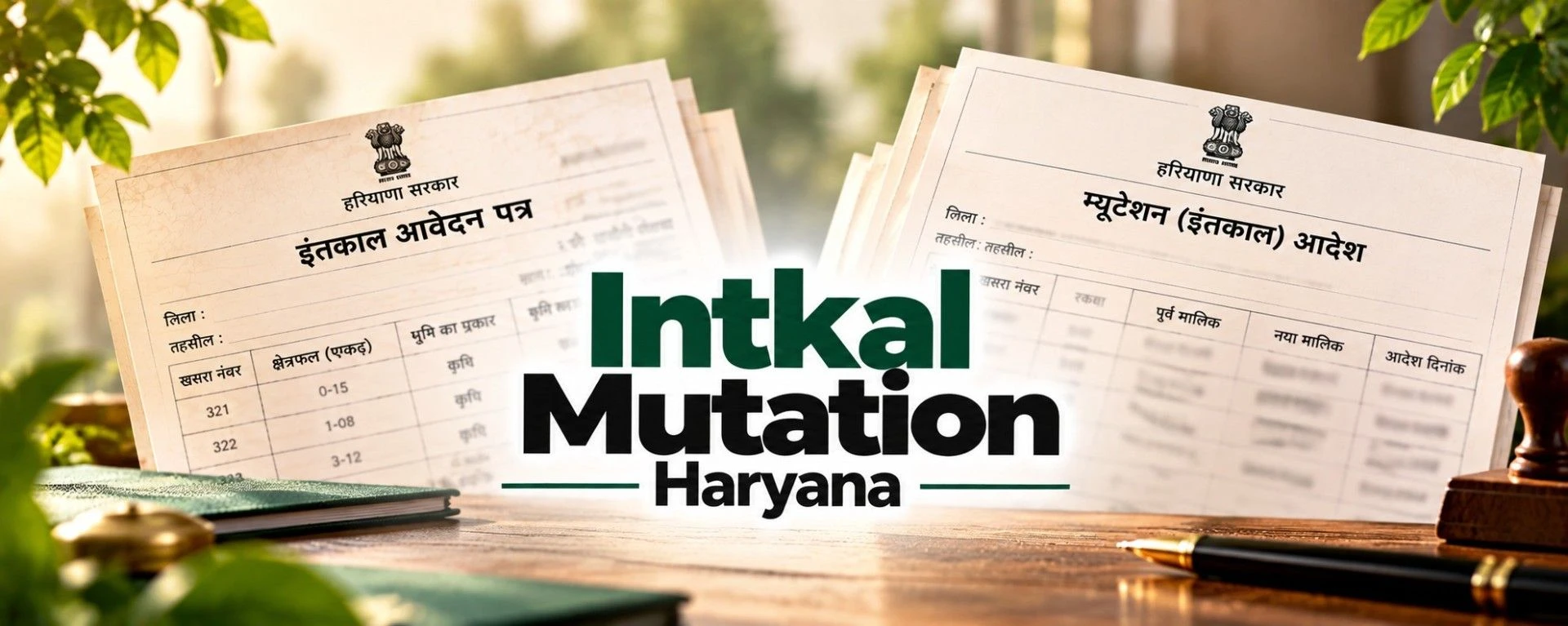
Intkal important since the registration of the sale deed is just an indicator of your right in the eyes of law – until the process of mutation is carried out, even the records held by the revenue department will recognize the previous owner as its rightful owner. This guide talks about the mutation process in Haryana, its process on the Jamabandi website, and the steps that you should undertake before accepting a mutation record as authentic. If you have purchased agriculture land for sale in Haryana or have inherited one, this is the process of making it officially yours in the eyes of the government.
Section 1 — What is Intkal Mutation in Haryana?
Definition: Intkal is the Haryana revenue term for mutation — the process of updating the Jamabandi to show the new legal owner's name after a sale, inheritance, or transfer.
A registered sale deed and a completed mutation are two different things, and buyers who conflate them often run into trouble later. The sale deed makes you the legal owner under the Registration Act; the mutation is what makes the revenue department's own Jamabandi records agree with that fact. Until Intkal is sanctioned, the Jamabandi still shows the previous owner, tax and procurement records point the wrong way, and any future sale or bank loan against the land can hit an unexpected wall. This distinction matters just as much for plot in Haryana listings involving recent inheritance as it does for a fresh purchase.
Haryana's land records run under the Haryana Automated Rural Information System, or HARIS, which powers the Jamabandi NIC portal. The Jamabandi itself is only revised once every five years by the Patwari, so between revisions, every ownership change rides on top through individual mutation entries — meaning the record you download always reflects the last full revision plus whatever mutations have been sanctioned since.
State-specific note: Under the Haryana Revenue Rules, a mutation is meant to be decided within about 30 days of application, though in practice many cases take 30 to 45 days, and longer if any party files an objection during the process.
Expert Tip: Once a mutation order is sanctioned, download and save the PDF the same day it appears on the portal rather than waiting. The Jamabandi site does experience both scheduled and occasional unscheduled downtime, and banks often ask for this exact document at short notice during loan processing.
Section 2 — How to Get Intkal Mutation Done in Haryana?
Mutation can be tracked and, in many cases, initiated through the Jamabandi portal, or filed directly through the Patwari's office. Here's how the paths compare:
Method | Cost | Time | Legally valid for registration? |
Online (Jamabandi portal tracking/initiation) | Nominal fee | 30–45 days typically | Yes |
Offline (Patwari/Tehsil office) | Prescribed fee | 30–45 days | Yes |
Auto-initiated (post-registration, where applicable) | Included in registration process | Varies, appears on registration paperwork | Yes |
Visit the Jamabandi portal. Go to jamabandi.nic.in and log in using your mobile number and OTP.
Access the mutation section. Select "Check Mutation of Deed and Raise Objection" or the equivalent mutation tracking option.
Search using the mutation number. If you have it from your registration paperwork, use it directly; otherwise, search by village and the date of your deed.
Track the status. Follow the case through the sanctioned stages until the mutation order appears.
Download the sanctioned order. Save the PDF as soon as it's available, since this is the document banks typically request for loan disbursement.
Visit the Patwari's office. Approach the office covering the village where the land is located.
Submit a mutation application. Provide the sale deed, Khasra number, and any inheritance or succession documents.
Attend verification if required. The Patwari may conduct a field check or hold a hearing if there's a competing claim.
Collect the sanctioned mutation order. Once approved, the Jamabandi reflects the updated ownership.
As of May 2026, the portal has integrated with the Integrated Grievance Redressal System, which has helped cut mutation processing time from weeks down toward days in many straightforward cases. Before treating any mutation as complete, always cross-check the sanctioned order against the latest Jamabandi Nakal to confirm the new name has actually replaced the old one.
Section 3 — What Does a Mutation Record Contain?
A sanctioned Intkal carries specific details establishing the updated ownership.
Field | What it means | What to check |
Mutation Number | Unique reference for the case | Appears on registration paperwork for auto-initiated cases |
New Owner Name | The updated Bhumiswami on record | Must match the buyer's or heir's ID proof |
Khasra/Khewat Number | Identifies the specific plot | Must match the sale deed exactly |
Basis of Transfer | Sale, inheritance, or court decree | Should match the underlying transaction type |
Sanction Date | When the mutation order was approved | Confirms when the change became official |
Remarks | Any pending objection or hold | Should be clear before relying on the record |
Good sign: A properly sanctioned mutation shows the correct new owner's name, a Khasra number matching the sale deed, a clear sanction date, and no pending objection noted against the entry.
Section 4 — Common Issues & How to Fix Them?
Buyer assumes mutation happens automatically after registration – Registration alone doesn't update the Jamabandi. Fix: always file a separate mutation application, or confirm one was auto-initiated, right after registration is complete.
Old owner's name still showing weeks later – Given the 30 to 45 day typical timeline, this is often just processing delay rather than an error. Fix: track the case on jamabandi.nic.in using the mutation number before assuming something's gone wrong.
Mutation number missing or lost – Without it, tracking the case becomes harder. Fix: search using the village name and the date of your deed, which the portal can usually match even without the mutation number.
Objection filed by another party – A competing claim can freeze the mutation indefinitely. Fix: attend the hearing, present your documents clearly, and resolve the dispute before expecting the mutation to proceed.
Jamabandi and mutation registers don't align – Since the Jamabandi itself only updates every five years, buyers sometimes miss more recent sanctioned mutations sitting on top of it. Fix: always check the live mutation register separately, not just the base Jamabandi Nakal.
Sanctioned order not saved in time – Portal downtime has caused buyers to lose access to a document a lender urgently needs. Fix: download and store the sanctioned mutation PDF the same day it becomes available.
Section 5 — Recent Changes in 2026
As of August 2026, Haryana's Jamabandi portal continues rolling out Bhu-Aadhaar (ULPIN), a 14-digit geo-referenced parcel ID under the central DILRMP scheme, alongside its May 2026 integration with the Integrated Grievance Redressal System that has meaningfully reduced mutation processing delays in many districts.
Section 6 — Why Mutation Matters for Land Buyers?
Makes the revenue department's own records agree with your legal ownership, closing the gap a sale deed alone leaves open
Required before banks will sanction loans against the property in most cases
Prevents tax and procurement records from continuing to point to the previous owner
Supports a smoother process for online land selling, since a clean mutation history reassures the next buyer
Reduces friction during a future farmland search by any buyer reviewing your land's ownership chain
Adds real credibility when selling property online in Haryana, since verified mutation status is one of the first things serious buyers check
Section 7 — Jamabandi vs. Mutation (Intkal)
These two terms are often used together but describe different things.
Aspect | Jamabandi | Mutation (Intkal) |
What it is | The periodic Record of Rights | The entry updating ownership between revisions |
Update frequency | Revised once every five years | Filed individually after each transaction |
Confirms | The land's overall record as of last revision | The most recent ownership change |
Best used | As the baseline record | Checked alongside the Jamabandi for anything current |
The Jamabandi is the five-year snapshot; the mutation is what keeps that snapshot current in between. Buyers browsing plots for sale near me should always check both together, since relying on the Jamabandi alone can miss a transfer sanctioned after the last revision.
Section 8 — Related Documents
Property Document Checklist guide for complete pre-purchase verification
Encumbrance Certificate guide for checking claims against the property
Land Registration guide for completing a legally valid transfer
Gift Deed guide for voluntary family property transfers
Legal Heir Certificate guide for inherited agricultural land
