
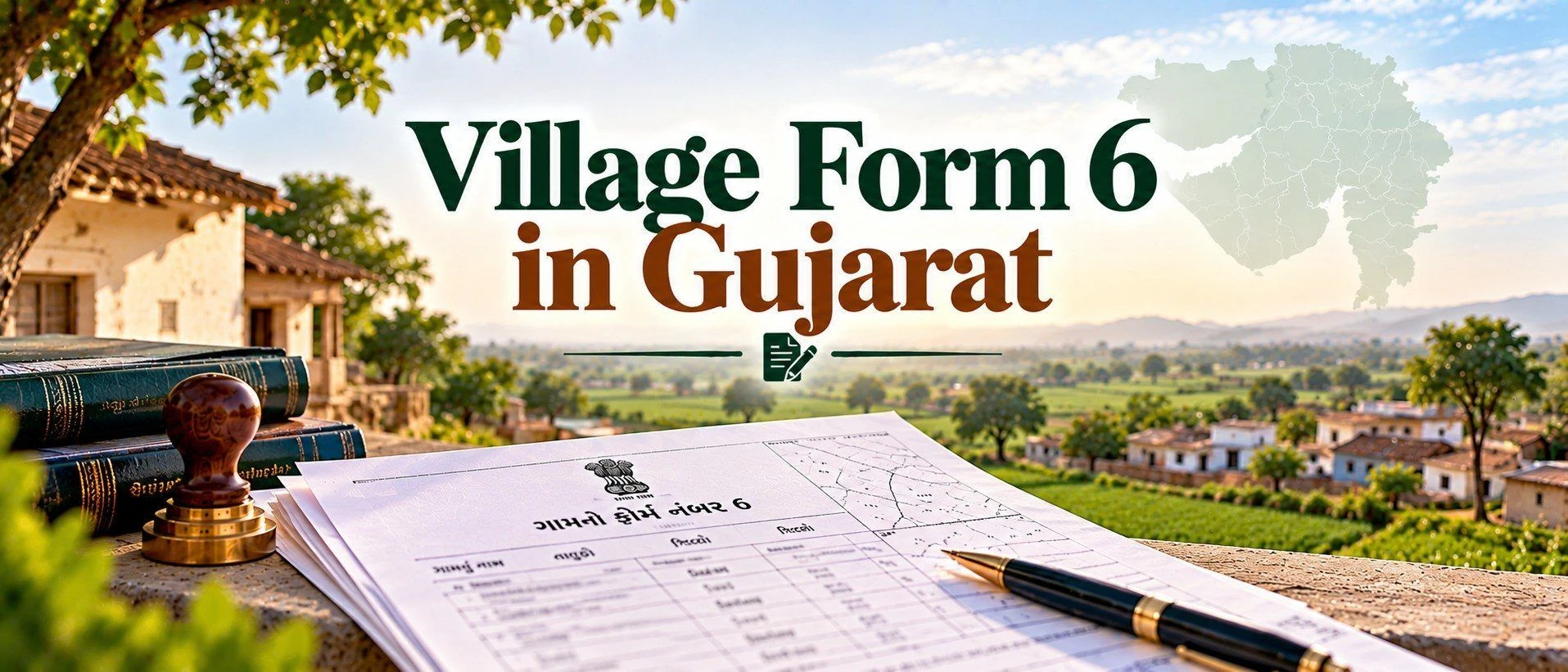
Village Form 6 (VF-6) is the mutation register maintained by the Talathi, recording every change in land ownership, rights, or interest for a survey number — sales, inheritances, gifts, mortgages, and court orders.
It matters because it's the running history behind your 7/12 Utara — it shows you exactly how and when ownership changed, and whether any pending mutation could still affect the current record.
This guide covers how to check Village Form 6 online in Gujarat, what a mutation entry contains, and why it's essential alongside the 7/12 and 8A for serious due diligence.
Whether you're buying land, resolving an inheritance, or verifying a recent sale, this is the document that shows the paper trail behind current ownership.
Section 1 — What is Village Form 6 in Gujarat?
When you're about to buy agricultural land in Gujarat, Village Form 6 is what shows you the actual sequence of ownership changes behind the name currently sitting on the 7/12.
In simple terms, Village Form 6 is the Talathi's mutation register — a chronological log of every ownership or rights change recorded against a survey number, each entry known as a Ferfar.
Village Form 6 is frequently confused with the 7/12 Utara itself, but they serve different roles. The 7/12 shows the current, final position — who owns the land right now. VF-6 shows the history behind that position — every mutation entry that led to the current owner being recorded, including ones still pending confirmation.
For a buyer, VF-6 is where you catch a mutation that's technically still 'pending' — recorded but not yet finalised — which the 7/12 alone might not make obvious at a glance. A pending mutation means the current 7/12 entry could still be challenged or reversed until the process concludes, which is a meaningful risk if you're about to pay for the land.
It's also the document that shows a 135-D Notice — the formal notice the Talathi issues inviting objections to a proposed mutation, most commonly triggered before an ownership change is finalised across generations through inheritance.
State-specific note:
AnyROR Gujarat provides both current Ferfar (mutation) entries and old Ferfar (6A) records separately, so if you're tracing an older ownership change, make sure you're checking the correct historical form rather than only the current one.
Expert Tip:
Don't stop at reading the latest mutation entry — read backward through the last two or three entries on VF-6 as well. A recently 'cleaned up' 7/12 can still be sitting on a chain of mutations that includes an unresolved family dispute a few entries back, which only the fuller mutation history reveals.
Section 2 — How to Get Village Form 6 in Gujarat?
Village Form 6 is available through the same AnyROR system as the 7/12 and 8A, with a similar cost and turnaround — and it's worth pulling whether you're buying, inheriting, or selling property online, since a listing site will never show you this history.
Method | Cost | Time | Legally valid for registration? |
|---|---|---|---|
Online (unsigned view) | Free | Instant | No — for reference only |
Online (digitally signed) | ₹15-₹50 approx. | Instant to same-day | Yes |
Offline (Talathi/Taluka office) | ₹15-₹50 approx. | 1-3 working days | Yes |
1. Visit AnyROR: Go to anyror.gujarat.gov.in and select 'View Land Record — Rural.'
2. Choose district, taluka, village: Navigate to the correct location for the land in question.
3. Select the mutation/Ferfar option: Choose the option for Village Form 6 or Ferfar entries, and select current or old (6A) as needed.
4. Enter survey number: Input the survey/block number to view the mutation history.
5. Download the certified copy: Solve the captcha and download the digitally signed copy if you need it for a transaction.
1. Visit the Talathi's office: Take your ID and survey number to the village Talathi or e-Dhara Kendra.
2. Request the VF-6 extract: Ask specifically for the mutation register/Ferfar entries for your survey number.
3. Pay the fee and collect: Pay the nominal fee and collect the signed, stamped copy.
Typical turnaround: Typically same-day to 3 working days depending on the Taluka office workload.
Before you collect it, check: Check that the most recent mutation entry is marked as finalised (not pending), and that there's no unresolved 135-D notice against the survey number.
Section 3 — What Does Village Form 6 Contain?
Village Form 6 reads like a log, with each entry (Ferfar) representing one change — here's what to focus on.
Field | What it means | What to check |
|---|---|---|
Ferfar/mutation number | Sequential entry number for each recorded change | Entries are sequential and complete, with no unexplained gap |
Nature of change | Sale, inheritance, gift, mortgage, court order, etc. | Matches your understanding of the property's history |
Date of entry and finalisation | When the mutation was recorded, and when (if) it was confirmed | The most recent relevant entry is finalised, not still pending |
135-D Notice status | Whether objections were invited on a proposed change | No unresolved objection outstanding against the current entry |
Parties involved | Names of those party to each recorded change | Consistent with the ownership chain shown on the 7/12 and Title Deed |
Good sign:
A clean VF-6 shows a complete, sequential mutation history with the latest relevant entry marked finalised, no outstanding 135-D objection, and party names consistent with your other documents.
Section 4 — Common Issues & How to Fix Them
Always cross-check the entry directly on the Village Form 6 in Gujarat - official website before acting on any of the issues below.
Mutation still pending confirmation — A recorded change hasn't been finalised, meaning the current 7/12 entry isn't yet fully settled. Fix: Wait for finalisation, or get written confirmation of the expected timeline from the Talathi before proceeding with payment.
Unresolved 135-D objection — An objection was raised against a proposed mutation and hasn't been formally resolved. Fix: Ask for the objection's resolution status in writing, and avoid finalising a purchase until it's cleared.
Gap in the mutation sequence — Entry numbers skip or don't align with the visible ownership history. Fix: Flag the gap at the Talathi's office for clarification — it can indicate a missing or unrecorded transaction.
Old Ferfar entries not digitised — Historical mutations from before digitisation may not appear on AnyROR's current view. Fix: Check the old Ferfar (6A) records separately, or visit the Talathi's office for pre-digitisation history.
Discrepancy between VF-6 and the current 7/12 — The mutation history doesn't fully explain how the current 7/12 owner came to be recorded. Fix: Request a reconciliation from the Talathi before relying on the current 7/12 as final.
Section 5 — Recent Changes in 2026
AnyROR has continued improving access to both current and old Ferfar entries across districts through 2026, supporting Gujarat's broader digitisation of rural land records. No major change to the mutation process or VF-6 format has been reported as of August 2026.
Section 6 — Why Village Form 6 Matters for Land Buyers
It reveals whether the current recorded owner's title is fully settled or still pending confirmation.
It exposes unresolved 135-D objections that a 7/12 snapshot alone won't show.
It traces the complete ownership history behind a survey number, useful for inheritance and dispute checks.
It's essential when the land has recently changed hands through sale or inheritance.
It supports lenders and lawyers doing full due diligence beyond a single-point-in-time record.
It helps identify whether a family holding has been genuinely and completely partitioned.
Section 7 — Village Form 6 vs. 7/12 Utara
Because VF-6 and the 7/12 both live on the AnyROR portal for the same survey number, buyers often assume checking one covers the other — or that a real estate website listing will surface the same detail — it doesn't.
Aspect | Village Form 6 | 7/12 Utara |
|---|---|---|
What it shows | The complete history of ownership changes (mutations) | The current, final ownership and cultivation snapshot |
Best used to | Catch pending mutations, objections, and the full ownership trail | Confirm who currently holds the land and its area |
When it matters most | Recently sold, inherited, or disputed land | Every transaction, as the baseline ownership check |
The 7/12 tells you where things stand today; VF-6 tells you how they got there — and whether 'today's' entry is actually settled. If you're preparing to sell agricultural land in Gujarat, make sure your last mutation entry is fully finalized before you list, since buyers doing proper due diligence will check exactly this.
Section 8 — Related Documents
7/12 Utara Gujarat — the current ownership snapshot that VF-6 explains the history behind
8A Extract Gujarat — the khata-level summary to cross-check against the mutation trail
Legal Heir Certificate Gujarat — often the trigger for a mutation entry after inheritance
Title Deed Gujarat — the registered deed that a sale-related mutation entry should match
Encumbrance Certificate Gujarat — complements VF-6 by covering registered loans and claims
