
 List Your Land
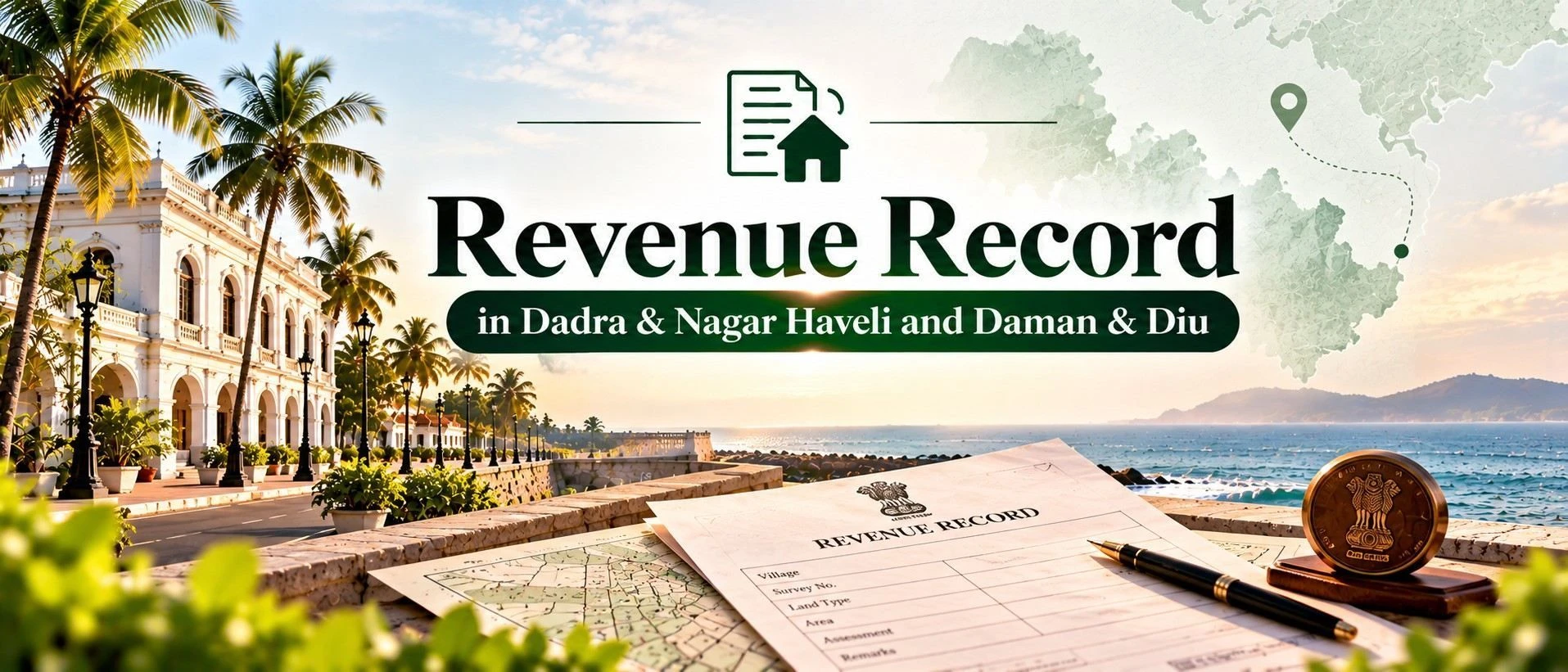
A Revenue Record, known here as the Record of Rights (RoR) — the 7/12 extract in DNH, or Form I & XIV in Daman and Diu — is the official document showing a plot's survey/plot number, area, classification, and current registered owner.
It matters because this record, not a separate title certificate, is what the UT's own land administration relies on to confirm ownership — getting the wrong regional format or reading it incorrectly means missing what it's actually telling you.
This guide covers how to request the correct revenue record for your specific region, what each field means, and where this UT's record-keeping genuinely differs from the Bhulekh-style live portals common elsewhere in India.
Whether you're planning to buy agriculture land in Daman, browsing farmlands near me, or preparing to sell land in Daman, this is the record every other check in your due diligence builds on.
Section 1 — What is Revenue Record in Dadra & Nagar Haveli and Daman & Diu?
Before requesting any record, it helps to confirm what's genuinely on the market if you're planning to buy land in Daman. Browse verified listings on 2Bigha's Dadra & Nagar Haveli and Daman & Diu land map to compare regions before you start pulling records on a specific plot.
A Revenue Record is the official Record of Rights (RoR) showing a plot's survey/plot number, area, land classification, and current registered owner — the 7/12 extract in DNH, or Form I & XIV in Daman and Diu.
This record is genuinely central to the system: internal UT documentation on the registration process confirms that ownership and title verification across all three districts is done through the RoR itself, not a separate title registry. That makes getting the correct, current RoR the single most important land-record check you can run here.
The revenue record is often confused with the sale deed or title deed. The RoR reflects the current administrative ownership record maintained by the Revenue Department; the sale deed is the private legal instrument, registered separately at the Civil Registrar-cum-Sub-Registrar's office, that actually creates or transfers ownership. The RoR gets updated (mutated) based on that registered deed — but the deed itself is a distinct document you need to check on its own terms.
This matters for anyone evaluating agriculture land or farmlands near me in this UT, because the RoR is also where region-specific transfer conditions — tribal protections in DNH, occupancy class restrictions in Daman — actually show up, well before you get anywhere near a collector permission or deed registration.
State-specific note: DNH's revenue record is called the 7/12 (Saat-Bara) extract, while Daman and Diu's equivalent is Form I & XIV — these aren't interchangeable formats, so always request the correct document type for the specific region your land sits in, rather than assuming one form works UT-wide.
Expert Tip: In Daman, cross-check the RoR's occupancy class carefully, not just the owner's name. Land recorded under different occupancy classes carries different transfer conditions—a Class II occupant typically needs Collector permission to transfer, unlike a Class I Occupant — and this distinction won't necessarily stand out on a casual read of the record.
Section 2 — How to Get Revenue Record in Dadra & Nagar Haveli and Daman & Diu?
Revenue records here can be checked through a mix of form-based downloads, registration-linked document search, and in-person Certified Copy requests. Here's how they compare:
Method | Cost | Time | Legally valid for registration? |
|---|---|---|---|
Online (ddd.gov.in Revenue Services, Form I & XIV/RoR link) | Free or nominal | Instant to a few days | Certified/signed copy: yes |
Online (NGDRS document search, ngdrs.dnh.gov.in, for registered documents) | Nominal | Instant to a few days | Yes, for registration-linked records |
Offline (Mamlatdar/Talathi office, Certified Copy) | Nominal fee | Days to a couple of weeks | Yes |
1. Confirm the correct region.
Determine whether your property falls under DNH, Daman, or Diu, since the record format and requesting process differ.
2. Visit ddd.gov.in's Revenue Services page
Select the Form No. I & XIV (RoR) link, or the region-appropriate equivalent, from the Revenue Department's service listing.
3. Enter village and survey/plot details
Provide the required location and survey/plot information, or use NGDRS's document search for records tied to a registered deed.
4. Review the displayed record
Check the owner's name, area, classification, and any remarks shown against the plot.
5. Request a Certified Copy where needed
For a legally valid document, request the signed Certified Copy rather than relying on a basic online view.
1. Visit the concerned Mamlatdar/Talathi office.
Go to the office covering your specific region — DNH, Daman, or Diu.
2. Request the RoR/Certified Copy
Provide the survey/plot number or owner's name to request a certified copy of the current revenue record.
3. Pay the nominal fee
A small fee applies for the certified, signed copy.
4. Cross-check against the online version
Compare the certified copy with what's available through ddd.gov.in to confirm consistency.
Typically days to a couple of weeks, depending on the regional office's workload and whether manual verification is needed.
Before relying on the record, check that the survey/plot number and owner's name match your expectations exactly, confirm the occupancy class or land classification is current, and verify there are no unresolved remarks pointing to a pending mutation.
Section 3 — What Does Revenue Record Contain?
A revenue record packs several region-specific details into a fairly compact document. For more on how due diligence is handled on verified listings, see 2Bigha's home page.
Field | What it means | What to check |
|---|---|---|
Survey/plot number | Uniquely identifies the specific parcel | Match it precisely against the deed and physical site. |
Owner's/occupant's name | The current recorded Bhumiswami, or occupant | Confirm it matches the ID and any deed documents exactly. |
Area and land classification | The recorded size and category of the land | Cross-check against actual use and intended purpose |
Occupancy Class (Daman) / Tenure Type (DNH) | Region-specific transfer conditions attached to the plot | Check whether this classification requires Collector permission to transfer. |
Mutation entry/remarks | Notes on pending or recent ownership changes | Confirm nothing remains unresolved before relying on the record. |
Good sign:
A reliable revenue record shows the survey/plot number and owner's name matching your other documents exactly, the correct region-specific format (7/12 or Form I & XIV), an occupancy class or tenure type consistent with a straightforward transfer, and no unresolved mutation remarks.
Section 4 — Common Issues & How to Fix Them
Most revenue record confusion in this UT comes from treating it like a single-format, single-portal state system. Confirm the correct process directly on the Revenue Record DNH Daman & Diu official website before relying on any document.
Confusing 7/12 (DNH) with Form I & XIV (Daman/Diu)
These are two distinct record formats tied to different pre-merger legal systems, and requesting the wrong one wastes time and returns no useful result.
Fix: Confirm your property's region before requesting a specific record format.
Assuming a live online parcel-search portal exists
Unlike Bhulekh-style systems in many states, this UT's online services are largely form-based downloads and Certified Copy requests rather than a live, searchable map interface.
Fix: Use ddd.gov.in's Revenue Services page or NGDRS's document search directly, rather than looking for a parcel map tool that may not exist in the form you expect.
Missing Occupancy Class restrictions in Daman
A Class II occupant typically needs Collector permission to transfer land, a condition easy to overlook if you only check the owner's name.
Fix: Read the Occupancy Class field carefully and confirm any required permission before assuming a straightforward sale is possible.
Relying on the revenue record alone without checking the deed chain
The RoR shows current ownership, but confirming the seller's legal right to transfer the land requires checking the registered deed history as well.
Fix: Cross-check the RoR against NGDRS's document search for the property's registered deed history.
Outdated record after a recent, unmutated sale
A revenue record may still show the previous owner if mutation hasn't been completed following a recent transaction.
Fix: Verify mutation status separately rather than assuming the RoR is automatically current.
DNH tribal land shown without confirming legal protections
Land connected to DNH's tribal communities is protected under the Dadra & Nagar Haveli Land Reforms Regulation, 1971, and this status may not be obvious from the RoR alone.
Fix: Confirm tribal-linked status and any applicable protections with the Mamlatdar or Collector's office before proceeding.
Section 5 — Recent Changes in 2026
The National Generic Document Registration System (NGDRS) at ngdrs.dnh.gov.in continues to serve as the UT's platform for registration-linked document search, alongside the UT Administration's ongoing tender process for a broader inter-departmental digital land records system. No further major changes to revenue record access have been reported as of August 2026.
Section 6 — Why Revenue Record Matters for Land Buyers
Confirms current ownership and classification using the document this UT's own administration relies on for verification
Reveals region-specific transfer conditions — Occupancy Class, tribal protections — before they complicate a deal
Helps catch outdated records that haven't been updated through mutation after a recent sale
Required for bank loans and most formal transactions involving agriculture land
Provides the documented basis for cross-checking a seller's claimed ownership against the registered deed chain
Reduces the risk of requesting the wrong regional document format and wasting time
Section 7 — Revenue Record vs. Sale Deed / Title Deed
The revenue record and the sale deed are companion documents, but they come from different processes and answer different questions.
Aspect | Revenue Record | Sale Deed / Title Deed |
|---|---|---|
What it is | The administrative Record of Rights (7/12 or Form I & XIV) | The private legal instrument transferring ownership |
Maintained by | Revenue Department, via the Talathi/Mamlatdar | Registered at the Civil Registrar-cum-Sub-Registrar's office |
Shows | Current recorded owner, area, classification, occupancy class | The specific transaction terms and parties involved |
Updated by | Mutation, filed after a registered transaction | Not updated — remains a fixed historical record of that transaction |
Checking both together gives real confidence whether you're buying or preparing to move a property through selling property online in this UT.
Section 8 — Related Documents
Title Deed Dadra Nagar Haveli Daman Diu 2026: Complete Guide
Mutation Dadra Nagar Haveli Daman Diu 2026: Complete Guide
How to Buy Land in Odisha: Complete 2026 Buyer Guide
Tribal Land Chhattisgarh 2026: Complete Guide
Encumbrance Certificate: A Complete Buyer's Guide
