
 List Your Land
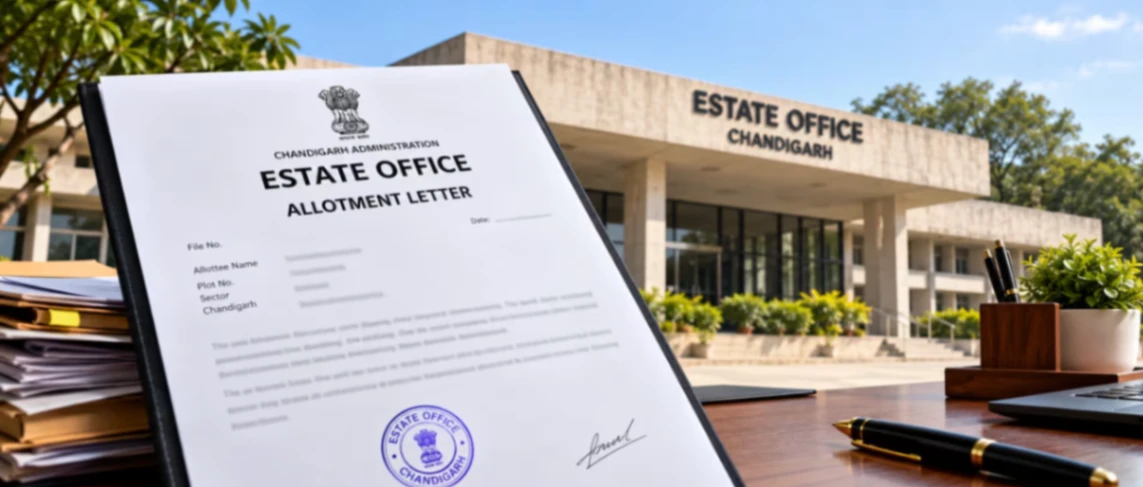
An Allotment Letter is the Estate Office's (or Chandigarh Housing Board's) formal document confirming that a specific site or dwelling unit has been allotted to an applicant, setting out the price, payment schedule, and conditions of that allotment. It matters because most property in Chandigarh didn't begin life as an ordinary open-market sale — it originated through direct government allotment or auction, often on leasehold tenure, under the city's unique planned-development framework. This guide covers what an allotment letter of property actually establishes in Chandigarh, how leasehold and freehold status work here, and why checking this document matters more than in most Indian cities. Whether you're buying a residential site, verifying a commercial property, or exploring land for sale in Chandigarh, this is the document your chain of title traces back to.
Section 1 — What is Estate Office Allotment Letter in Chandigarh?
Before getting into how allotment and tenure work here, it's worth seeing what's actually available — you can browse land for sale in Chandigarh on the 2Bigha map, though it's worth knowing upfront that genuine agricultural or farm land within the Union Territory itself is limited, for reasons explained below.
In simple terms, an Allotment Letter is the Estate Office's or CHB's formal confirmation that a specific site or dwelling unit has been allotted to an applicant, along with the price, payment terms, and conditions attached to that allotment.
This is frequently confused with a conventional sale deed, but Chandigarh's property history works differently from most Indian cities. As a planned capital city developed under the Capital of Punjab (Development and Regulation) Act, 1952, most residential, commercial, and institutional sites were originally allotted or auctioned directly by the Estate Office — and initially on leasehold tenure, not outright freehold ownership. The Allotment Letter is the foundational document from that original allotment; a Deed of Conveyance is the separate document executed later, if and when the property is converted to freehold.
Leasehold-to-freehold conversion has been a genuinely significant, evolving policy area in Chandigarh. Most residential leasehold properties have already been converted to freehold following earlier Administration decisions, but commercial and industrial leasehold conversion was a long-pending issue — repeatedly proposed and rejected over the years — until the Chandigarh Administration approved a policy in 2026 finally allowing conversion of leasehold industrial and commercial properties as well. This means a meaningful share of Chandigarh property is genuinely in transition, and current tenure status needs to be individually confirmed rather than assumed.
A buyer needs the Allotment Letter, and any subsequent conversion documentation, specifically because it establishes the property's actual origin and tenure history — whether original allotment conditions like the payment schedule and construction timeline were met, and whether the property has been converted to freehold or remains under leasehold, which materially affects what a buyer can do with it.
Land ownership note: Genuine agricultural or farm land within the Chandigarh Union Territory itself is limited — the UT is a compact, largely urban planned city, and its few rural villages fall under separate rural bylaws (including restrictions such as building height limits) rather than the standard sector-based Estate Office allotment system. Much of the 'farmland near Chandigarh' search interest in practice points to adjoining areas in Punjab (such as Mohali) or Haryana (such as Panchkula), which fall under entirely different state land systems. Always confirm which jurisdiction a specific rural-sounding listing actually falls under before assuming it's part of the Chandigarh UT at all.
Expert Tip: Before relying on an Allotment Letter alone, check whether the property has since been converted to freehold — which would mean a separate Deed of Conveyance exists — or remains leasehold. Also confirm the original construction-start timeline was met: historically, delayed construction attracted escalating extension fees calculated against collector rates the longer construction was postponed, and unresolved cases can carry real financial exposure for a new buyer.
Section 2 — How to Get Estate Office Allotment Letter in Chandigarh?
Chandigarh's Estate Office has moved several key services onto time-bound, trackable processing, though the original Allotment Letter itself remains a foundational paper record tied to the property's history.
Method | Cost | Time | Legally valid for registration? |
|---|---|---|---|
Online (property/status check via Property Management System) | Free | Instant | Reference only — confirm formally with the Estate Office for any transaction |
Online (No Dues Certificate / NOC / freehold conversion application) | Applicable conversion charges and fees | 15 days (NDC), 35 days (freehold conversion), 50 days (NOC for sale/gift/transfer of lease rights) | Yes, once formally issued under the time-bound service commitment |
Offline (concerned Estate Office branch) | Applicable fees and charges | Varies by case complexity | Yes, once issued and signed |
1. Visit the Property Management System — Go to estateoffice.chd.gov.in and check available status information for your Sector and Site/Plot number.
2. Confirm current tenure status — Determine whether the property is currently leasehold or has already been converted to freehold.
3. Apply for the relevant service — Depending on your need, apply for a No Dues Certificate, an NOC for sale/gift/transfer of lease rights, or freehold conversion.
4. Track your application against the time-bound standard — Reference the applicable service timeline — 15, 35, or 50 days — under the Punjab Right to Service Act as extended to Chandigarh.
1. Visit the concerned Estate Office branch — Bring your original Allotment Letter, ID proof, and site details.
2. Submit the relevant application — Specify whether you need dues clearance, an NOC, or freehold conversion.
3. Pay the applicable fee or conversion charge — Pay as calculated for your specific request.
4. Collect the processed document — Verify the site details, tenure status, and any conditions before treating the transaction as complete.
The 2026 time-bound service standards give a genuine benchmark to hold the Estate Office to for these specific services, though the original allotment history itself is a matter of paper record that may require some manual verification for older properties. Before finalizing any purchase, confirm both the tenure status and that no outstanding dues or unmet conditions remain attached to the site.
Section 3 — What Does Estate Office Allotment Letter Contain?
An Allotment Letter and any related conversion documents carry specific details worth checking carefully. For property with a clearer, more conventional ownership history, browse the 2Bigha homepage.
Field | What it means | What to check |
|---|---|---|
Allottee name and site details | Confirms who the property was originally allotted to and which Sector/Site number | Matches current ownership documentation and any subsequent transfer chain |
Allotment price and payment terms | States the original cost and schedule agreed at allotment | Consistent with what was actually paid, with no unresolved penal interest |
Tenure type | Confirms whether the property is leasehold or freehold | Matches current status — check for any conversion since the original letter was issued |
Construction/use conditions | States any timeline or use conditions attached to the allotment | Confirmed as met, or any extension fees confirmed as cleared |
Good sign: A property with a clean documentation trail has a clear original Allotment Letter matching the current claimed ownership, confirmed current tenure status (with a Deed of Conveyance if freehold conversion occurred), and no outstanding dues or unmet allotment conditions. If the tenure status is unclear, or there's no record of the original construction timeline being met, treat that as something to resolve before proceeding, not a formality.
Section 4 — Common Issues & How to Fix Them?
Most issues around Chandigarh property documentation trace back to Chandigarh's distinctive allotment-and-conversion history, rather than errors in the process itself.
For a query specific to your property, the Estate Office Allotment Letter Chandigarh official website is the right place to start.
Treating the Allotment Letter as equivalent to full freehold title
Issue: Many properties were originally allotted on leasehold tenure, which carries different rights than outright freehold ownership. Fix: Confirm current tenure status and, if leasehold, check whether conversion to freehold has occurred or is needed.
Unpaid extension fees for delayed construction
Issue: Historically, failing to start construction within the stipulated period attracted escalating extension fees calculated against collector rates. Fix: Check for any unresolved extension fee history before purchase, since unpaid amounts can carry forward as a liability.
Outstanding dues blocking a No Dues Certificate
Issue: Any pending dues on the property will prevent issuance of an NDC, which is often required for other transactions. Fix: Clear all outstanding dues and confirm the NDC is issued before relying on the property as dues-free.
Applying for freehold conversion without confirming current eligibility
Issue: Commercial and industrial leasehold conversion was only recently approved in 2026, so eligibility and process details are still being finalized in some cases. Fix: Confirm current eligibility and process specifics with the Estate Office before assuming conversion will proceed exactly like the established residential process.
GPA (General Power of Attorney)-based transfers left incomplete
Issue: Property transferred via GPA historically required a separate process to formally convert into the actual holder's name. Fix: Confirm any GPA-based transfer has been fully formalized with the Estate Office, not just informally acted upon.
Confusing rural village land with standard sector allotment
Issue: Chandigarh's limited village areas follow separate rural bylaws distinct from the sector-based Estate Office system. Fix: Confirm whether a specific property falls under standard Estate Office allotment or the separate rural village framework before assuming standard processes apply.
Section 5 — Recent Changes in 2026
The Chandigarh Administration approved a policy in 2026 allowing conversion of leasehold industrial and commercial properties into freehold ownership — a long-pending issue that had previously been proposed and rejected multiple times over the past two decades. Separately, as of an April 2026 notification, the Estate Office now processes freehold conversion applications within 35 days, NOCs for sale, gift, or transfer of lease rights within 50 days, and No Dues Certificates within 15 days, as part of 90 additional time-bound services notified under the Punjab Right to Service Act as extended to Chandigarh. Property owners and buyers should confirm current implementation details directly with the Estate Office, since rollout of the new commercial/industrial conversion policy was still recent as of this writing.
Section 6 — Why Estate Office Allotment Letter Matters for Land Buyers?
It establishes the property's actual origin and original allotment terms, which every subsequent transaction builds on.
It's the starting point for confirming current tenure status — leasehold or freehold — which materially affects a buyer's rights.
Unresolved allotment conditions, like unmet construction timelines, can carry real financial exposure that a new buyer would otherwise inherit.
A No Dues Certificate and, where relevant, a Deed of Conveyance are what actually protect a buyer from a property's leasehold-era liabilities.
Understanding Chandigarh's leasehold-to-freehold transition helps buyers ask the right questions before committing to any specific property.
Section 7 — Estate Office Allotment Letter vs. Deed of Conveyance
Aspect | Estate Office Allotment Letter | Deed of Conveyance |
|---|---|---|
What it establishes | The original allotment terms — price, payment schedule, and conditions | Formal freehold ownership, executed upon conversion from leasehold |
When it's issued | At the time of original allotment by the Estate Office or CHB | Only if and when the property is converted from leasehold to freehold |
What it confirms alone | The property's allotment history — not, by itself, current freehold status |
Property with clearly documented allotment history and confirmed current tenure status is significantly easier to move — if that's true of your Chandigarh property, you can sell land in Chandigarh through 2Bigha platform.
