
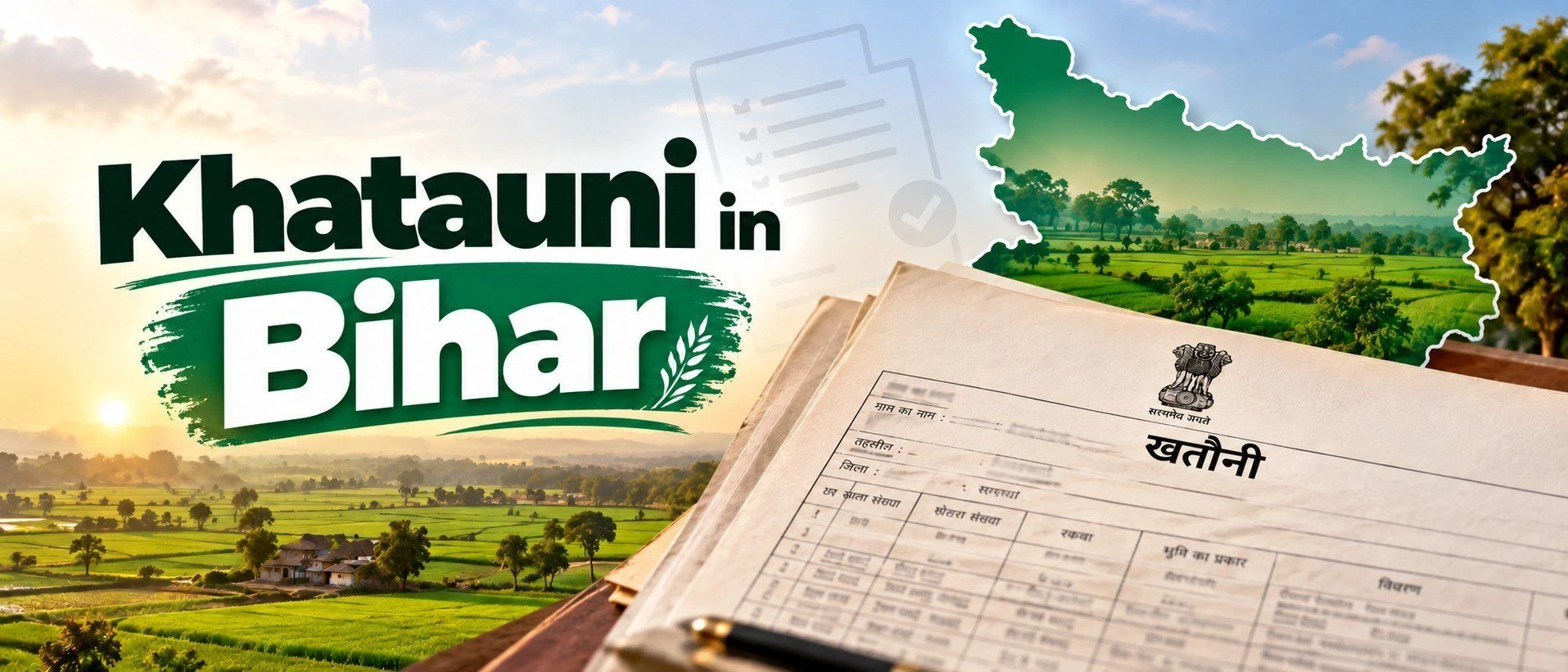
A khatauni is the detailed record showing all the khasra (plot) numbers linked to a khata, along with the land type, area, and owner details for each — essentially the full field-level breakdown behind a khata.
It matters because it's the record that connects an owner's name to the exact plots they hold, which is what a bank, buyer, or revenue office actually checks before accepting a khata number at face value.
This guide covers what a khatauni actually shows, how to check it online through Bihar's land portals, what it costs, and how it differs from the khata and khasra records it's often confused with.
Whether you're buying agricultural land, applying for a crop loan, or confirming a family's landholding before a partition, this is the record you'll be asked to produce.
Section 1 — What is a Khatauni in Bihar?
If you're comparing several khatas across different villages while shortlisting land in Bihar, it can help to see the plots geographically first — the 2Bigha interactive map for Bihar lets you browse listed land location by location.
Definition: A khatauni is the record that lists every khasra (plot) number falling under a particular khata, along with each plot's area, land type, and the owner(s) recorded against it.
It's easy to confuse with a khata or a khasra alone. A khata identifies an owner's overall landholding grouping in a village; a khasra identifies one specific plot; a khatauni is the combined document that lays out, plot by plot, exactly what makes up that khata. Think of the khata as the folder name and the khatauni as the full list of documents inside it.
A buyer or landholder needs this specifically when applying for a crop loan (banks want to see the full khatauni, not just a khata number), when settling an inheritance where the family's land is spread across several plots, or when verifying a seller's claimed landholding before a purchase.
State-specific note: In Bihar, the khasra-khatauni search on biharbhumi.bihar.gov.in lets you search by khata number, khasra number, or owner name — searching by owner name is often the fastest way to see a person's entire landholding across a village in one result.
Expert tip: When checking a khatauni for a crop loan or purchase, don't just confirm the owner's name matches — check that the total area across all listed khasra numbers matches what's being represented to you. Sellers sometimes reference only the most valuable plot in a khata while leaving out smaller, disputed, or already-mortgaged plots from the conversation.
Section 2 — How to Get Khatauni Details in Bihar?
Khatauni details are available free online, with a certified copy available on request from the Circle Office. Here's the comparison:
Method | Cost | Time | Legally valid for registration? |
Online (view/print on portal) | Free | Instant | Good for reference; not a substitute for a certified copy where one is required |
Online (digitally signed copy, where available) | Nominal fee | A few hours to days | Yes, where digitally signed |
Offline (Circle Office certified copy) | Nominal fee | A few days | Yes |
Go to the Khasra-Khatauni section
Visit biharbhumi.bihar.gov.in and select "Khasra-Khatauni" under Online Services.
Select the location
Choose the district, sub-division, circle, and mauza where the land is located.
Search by khata number, khasra number, or owner name
Use whichever reference you already have — owner name is often the most useful if you want the full picture of someone's holdings in that village.
Review and download
Check the full list of khasra numbers, areas, and land types shown, then download or print for your records.
Visit the Circle Office
Go to the Anchal (Circle) office covering the mauza and ask for the khasra-khatauni record counter.
Provide the reference details
Give the khata number or owner's name to the revenue clerk for lookup.
Request a certified copy
Pay the nominal fee for a signed, certified extract covering the full khatauni.
This usually takes a few days depending on office workload. Before relying on it, check that every plot expected to be part of the holding is actually listed, and that none show a pending or disputed mutation status.
Section 3 — What Does a Khatauni Contain?
A khatauni is essentially a table of plots — bihar khasra khatauni records list each field under a khata with its own area and status, so it's worth checking the record row by row rather than just the summary.This level of detail is also what you'll want ready if you're selling property online, since buyers on real estate portals often expect a clear, plot-by-plot breakdown before they'll take a listing seriously.
Field | What it means | What to check |
Khata number | The overall landholding group this khatauni belongs to | Confirm it matches the owner's other records and the land tax receipt |
List of khasra numbers | Every individual plot under the khata | Confirm the count and numbers match what's being represented to you |
Area per plot | Size of each individual field | Add these up and compare against the total area claimed |
Land classification per plot | Agricultural, homestead, or other type, plot by plot | Relevant for tax rate and any future land-use conversion |
Owner/raiyat name(s) | Who is recorded against the khata | Confirm it matches the current seller or an already-completed mutation |
Good sign: A trustworthy khatauni lists every khasra number consistently under the correct mauza, shows a total area that matches what's being claimed, and reflects a current, undisputed owner name — with no plots left out of the record that the seller or family has separately mentioned to you.
Section 4 — Common Issues & How to Fix Them
Khatauni shows fewer plots than the family claims to hold — some plots may be recorded under a different khata or an ancestor's name. Fix: search by the ancestor's name or check family partition records at the Circle Office.
Owner name differs from the current seller — mutation from a previous sale or inheritance was never completed. Fix: complete Dakhil Kharij before proceeding with any new transaction.
Area totals don't add up correctly — a data entry error from an old survey. Fix: raise a correction request through Parimarjan with supporting documents.
One or more khasra numbers show a pending dispute or court case flag. Fix: get details of the specific case from the Circle Office before proceeding — this can materially affect the land's usability.
Khatauni not found under the expected mauza — village name spelling or boundary changes over time. Fix: confirm the exact, currently used mauza name and circle with the local revenue office.
Record appears outdated compared to a recent transaction — normal delay before an update reflects online. Fix: allow the standard processing time for mutation before treating the record as final, and follow up if it's overdue.
Section 5 — Recent Changes in 2026
No major changes have been reported as of August 2026.
Section 6 — Why Khatauni Matters for Land Buyers
Gives the complete plot-by-plot picture behind a khata, rather than a single number that could hide other issues
Required by banks when assessing a crop loan or loan against agricultural land
Helps confirm a seller's full landholding before a partition or family settlement
Useful for cross-checking that no plot within a khata carries an undisclosed dispute or mutation issue
Supports accurate area verification when buying organic farmland or agriculture land for purchase
Forms the basis for correctly calculating land tax (lagaan) across all plots an owner holds
Section 7 — Khatauni vs. Jamabandi
These two are closely related but not identical, and the difference matters when you're deciding which one to ask for.
Document | What it focuses on | Best used for |
Khatauni | Plot-by-plot (khasra-wise) breakdown of land under a khata | Verifying the full extent of a landholding, plot by plot |
Jamabandi | The formal Record of Rights showing ownership and tenancy status | Confirming legal ownership status for registration, mutation, or dispute purposes |
In practice, most buyers should check both together rather than relying on just one. If you're selling property online, having a clean khatauni ready alongside the Jamabandi and mutation record makes your listing far more credible on real estate websites, especially for buyers specifically searching for farmlands near me or plots for sale in Bihar.
Section 8 — Related Documents
Khasra Bihar Land Records
Dakhil Kharij (Mutation) Bihar
Lagaan Receipt Bihar
Encumbrance Certificate Bihar
Title Deed Bihar
