
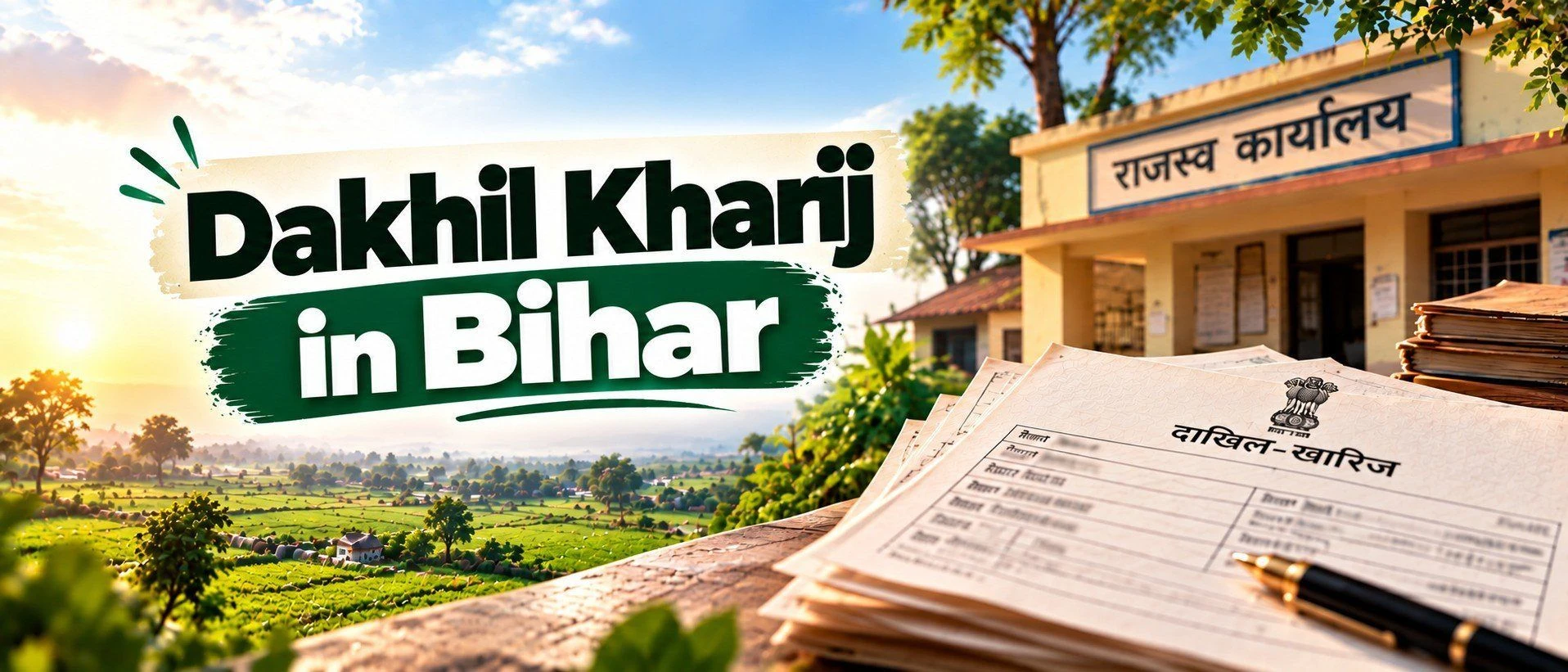
Dakhil Kharij — also called land mutation — is the process of updating the government's land revenue records to show the new owner's name after a sale, inheritance, gift, or partition.
It matters because a registered sale deed alone doesn't update the revenue record; without mutation, land tax, future sale, and loan applications keep pointing to the old owner's name, which creates disputes down the line.
This guide covers what Dakhil Kharij actually changes, how to apply for it online through the Bihar Bhumi portal, what it costs, and the most common reasons applications get rejected. Whether you've just bought land, inherited a family plot, or received land as a gift, this is the step that comes right after registration — and it's often skipped by mistake.
Section 1 — What is Dakhil Kharij in Bihar?
If you're comparing plots for sale or farmlands near me in Bihar before you buy, remember that mutation is a step for after the purchase, not before — but it helps to first confirm a plot's location and listing details on the 2Bigha interactive map for Bihar.
Definition: Dakhil Kharij is the official process of entering a new owner's name into the government's revenue records (the Jamabandi) after a change in ownership, so tax and legal records reflect who actually owns the land today.
It's often confused with the sale deed itself — the sale deed is the legal instrument that transfers ownership between buyer and seller, registered at the Sub-Registrar's office, while mutation is the follow-up step that updates the separate revenue record maintained by the Circle Officer. A registered sale deed proves the transaction happened; mutation proves the revenue department has caught up with it.
A buyer needs this specifically after any land purchase, after inheriting land following a death in the family, after receiving land as a gift, or after a court-ordered partition — in every case, until mutation is done, the land tax receipt and revenue records still show the previous owner.
State-specific note: Bihar's mutation system runs on the biharbhumi.bihar.gov.in portal, and applicants can now file suo motu (on their own) without visiting the Circle Office in person for routine sale-based mutations. Status can be tracked separately on the Parimarjan portal.
Expert tip: Before applying, double-check that the khata and khasra numbers on your sale deed exactly match the numbers in the seller's existing Jamabandi entry. A mismatch here — even a single digit — is one of the most common reasons mutation applications sit unresolved for months rather than being cleanly approved or rejected.
Section 2 — How to Get Dakhil Kharij in Bihar?
Bihar's mutation process is largely online now, though an offline route still exists at the Circle Office. Here's how the options compare:
Method | Cost | Time | Legally valid for registration? |
Online (application submission) | Nominal fee (~₹40, confirm current rate) | 30–90 days to approval | Yes, once approved and reflected in Jamabandi |
Offline (Circle Office / Anchal) | Same nominal fee + possible service charge | 30–90+ days | Yes, once approved |
Register and log in
Create an account on the Dakhil Kharij in Bihar – Official Website using your mobile number and email, or log in if you already have one.
Select Online Mutation
Choose the "Online Mutation" (Online Dakhil Kharij) option and select your district, circle, and mauza (village).
Fill in transaction details
Enter seller and buyer information, khata/khasra numbers, and the type of transaction — sale, inheritance, gift, or partition.
Upload documents
Scan and upload the sale deed or relevant transfer document, ID proof, and the latest land tax receipt, all in PDF format.
Submit and track
Submit the application to receive a Mutation Request Number, and track status through the Parimarjan portal's mutation status page.
Visit the Circle Office
Go to the Anchal (Circle) office that has jurisdiction over the land, and ask for the Dakhil Kharij application counter.
Submit application and documents
Fill out the physical application form and attach the same set of documents used for the online route.
Pay the fee
Deposit the nominal government fee at the counter and collect your receipt with an application/case number.
This usually takes 30–90 days depending on the circle's backlog and whether a field-level verification (khanapuri) is required. Before treating the mutation as final, check that your name and correct khata/khasra numbers appear in the updated Jamabandi (Register-II) entry — not just in the mutation order.
Section 3 — What Does the Dakhil Kharij Record Contain?
A completed mutation updates a specific set of fields in the revenue record, and it's worth knowing what to check keyword-wise when your bihar bhumi khata khasra details come back — a plain mutation order alone doesn't confirm the record is fully updated.
Field | What it means | What to check |
New owner name | The person now recorded as the raiyat (landholder) | Confirm spelling matches Aadhaar and the sale deed exactly |
Khata & khasra number | Identifies the specific land parcel | Confirm it's unchanged from the sale deed and matches the map |
Mutation case/order number | Reference for the specific mutation order | Keep this for any future dispute or resale |
Date of mutation | When the change was approved | Should be recent relative to the date of the transaction |
Updated Jamabandi entry | The revenue register reflecting the new owner | Confirm it shows on the Register-II/Parimarjan search, not just the order copy |
Good sign: A properly completed mutation shows a clear case number, the correct new owner's name matching official ID, and — most importantly — an updated Jamabandi/Register-II entry that you can independently pull up on the Bihar Bhumi portal, not just a mutation order sitting in a file.
Section 4 — Common Issues & How to Fix Them
Application rejected for document mismatch — khata/khasra numbers on the sale deed don't match existing records. Fix: get the discrepancy corrected via Parimarjan (record correction) before reapplying for mutation.
Mutation stuck at field verification — a khanapuri/site visit hasn't happened yet. Fix: follow up directly with the Circle Officer's office and ask for the verification to be scheduled.
Registry done but mutation skipped entirely — a common mistake where buyers of land in Bihar assume registration alone is enough. Fix: file the mutation application separately; it doesn't happen automatically.
Dispute from other legal heirs during inheritance mutation — a sibling or relative objects to the mutation. Fix: the Circle Officer may refer the matter for a hearing; unresolved disputes may need a civil court decision.
Old, pre-digitisation Jamabandi entry not showing correctly online — records from before computerisation can be incomplete. Fix: request a manual record check at the Circle Office rather than relying only on the online search.
Payment made but application not visible in dashboard — a portal sync delay. Fix: keep the transaction receipt and application number, and follow up after 24–48 hours before resubmitting.
Section 5 — Recent Changes in 2026
No major changes have been reported as of August 2026.
Section 6 — Why Dakhil Kharij Matters for Land Buyers
Confirms the revenue record actually reflects your ownership, not just the sale deed sitting in your file
Needed to pay land tax (lagaan) correctly in your own name going forward
Required before you can sell the land again — a buyer's due diligence will check the current Jamabandi entry
Reduces the risk of a dispute with other legal heirs surfacing years later, since mutation creates an official record at the time of transfer
Often required by banks as supporting proof alongside the sale deed when sanctioning a loan against the property
Protects against a previous owner (or their heirs) contesting possession, since an approved mutation is documented evidence of the transfer being formally recognised by the state
Section 7 — Dakhil Kharij vs. Sale Deed
These two documents are easy to confuse because they both relate to the same transaction, but they serve different purposes at different offices.
Document | Issued by | What it proves | When it's needed |
Sale Deed | Sub-Registrar's office (Registration Department) | The legal transfer of ownership between buyer and seller | At the time of purchase, before mutation can be filed |
Dakhil Kharij (Mutation) | Circle Officer (Revenue Department) | The government's revenue record now reflects the new owner | After the sale deed, to update land tax and ownership records |
If you're preparing land for selling property online or listing it on real estate websites, having a completed mutation alongside the sale deed makes your listing far more credible — buyers researching land for sale in Bihar increasingly ask for the current Jamabandi entry, not just the old registry papers.
Section 8 — Related Documents
Khasra & Khatauni Bihar Land Records
Lagaan Receipt Bihar
Encumbrance Certificate Bihar
Title Deed Bihar
Legal Heir Certificate Bihar
