
 List Your Land
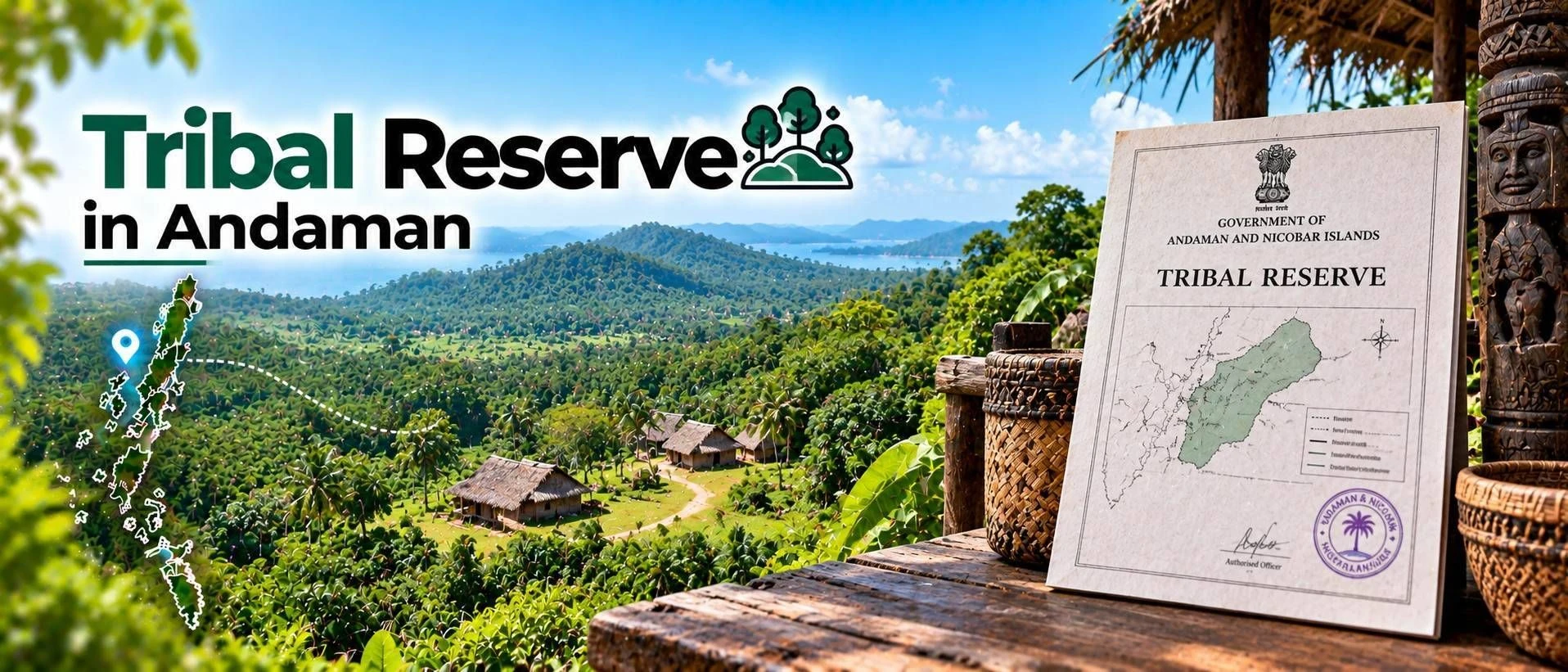
A Tribal Reserve in Andaman & Nicobar is an area the Chief Commissioner has formally declared under the Andaman and Nicobar Islands (Protection of Aboriginal Tribes) Regulation, 1956 (ANPATR) as predominantly inhabited by one of six protected indigenous tribes — and land within these reserves cannot be allotted, sold, or mortgaged to outsiders under any circumstances. It matters because this isn't a matter of extra paperwork or fees like other land restrictions here — entering a tribal reserve without an authorised pass is a criminal offence, and any land transaction touching reserve boundaries is void from the outset, protecting communities whose population in some cases numbers in the dozens. This guide covers what tribal reserve rules in the Andaman Islands actually prohibit, how reserve boundaries are declared and enforced, and how this affects land anywhere near these areas. Whether you're evaluating agricultural land cost in Andaman, checking a rural parcel's proximity to a reserve, or simply want to understand why some islands are entirely off-limits, this is the framework you need to respect before anything else.
Important context before you read further:
Please read this before anything else: six indigenous tribal groups — the Great Andamanese, Onge, Jarawa, Sentinelese, Nicobarese, and Shompen — are protected under ANPATR 1956, and their reserves cover substantial areas of the archipelago, including almost the entirety of some islands. Land within a declared reserve cannot legally be sold to anyone outside the tribe, entry without an authorised pass is a criminal offence for Indian citizens and foreign nationals alike, and enforcement has had serious real-world consequences, including fatalities. This guide explains the actual legal and ethical framework rather than treating tribal reserve land as a workaroundable obstacle to property investment.
Section 1 — What is Tribal Reserve Check in Andaman & Nicobar Islands?
Before you look into land for sale in Andaman and Nicobar Islands, it helps to first browse verified listings — you can see this on the 2Bigha map by opening the map, typing 'Andaman & Nicobar Islands' into the search box, and using the state-level results that come up.
In simple terms, a Tribal Reserve is a formally declared geographic area — gazetted by the Chief Commissioner — where land, resources, and access are protected specifically for one of six recognised indigenous tribal groups, with private outsider transactions and unauthorised entry both prohibited by law.
It differs from the general land restrictions that apply elsewhere in Andaman & Nicobar — DC Sale Permission delays, forest classification, CRZ rules — because those are procedural hurdles a legitimate transaction can eventually clear, while a tribal reserve is an absolute prohibition with no permission pathway for private land purchase at all, regardless of price, patience, or paperwork.
Anyone researching agricultural land cost in Andaman needs to understand this specifically because certain islands, particularly in the Nicobar group like Car Nicobar and much of Great Nicobar, are described by land-market sources themselves as 'almost entirely tribal reserve' and 'not recommended for private buyers' — meaning the honest starting point for these areas isn't a price comparison, it's confirming whether private purchase is even a legal category that applies there.
State-specific note: Following a 2012 amendment to ANPATR, a buffer zone contiguous to the Jarawa tribal reserve additionally bans all commercial and tourism establishments within 5 km of the reserve boundary — this means land just outside the formal reserve can still carry serious use restrictions, so proximity alone, not just being technically outside the gazetted line, matters for any evaluation.
Expert Tip: Don't rely on informal claims that Restricted Area Permit relaxations for certain islands (a 2018 policy change affecting 29 islands) mean tribal reserve protections have loosened — RAP and ANPATR are two separate legal instruments, and the Ministry of Home Affairs has specifically reaffirmed that areas like North Sentinel Island remain restricted under the 1956 Regulation regardless of any RAP change; always check current ANPATR status independently rather than assuming one relaxation implies another.
Section 2 — How to Get Tribal Reserve Check in Andaman & Nicobar Islands?
There's no purchase or application process to describe here in the conventional sense — the only 'methods' relevant to tribal reserves are how to check whether an area is one, and how the (entirely separate) authorised pass system works for anyone with a legitimate non-commercial reason to enter.
What you're checking | Cost | Time | Result |
Official reserve boundary notifications (and.gov.in / Gazette) | Free to access | Varies by record availability | Confirms whether a specific area is gazetted as a reserve |
Section 7 pass application (for authorised, non-commercial purposes only) | As prescribed by the Administration | Varies, subject to approval | A pass permitting limited, authorised entry — not a land right |
Land purchase inquiry within or bordering a reserve | Not applicable | Not applicable | No lawful private land transaction is possible within a declared reserve |
Check current official notifications. Review and.gov.in and official Gazette publications for the current, formally declared boundaries of tribal reserves relevant to your area of interest.
Cross-reference with Form-F land records. Where you're evaluating a specific parcel, check its Dweep Bhoomi Form-F record for any tribal or reserve-related classification flag.
Check buffer zone status for Jarawa-adjacent land. Confirm whether a parcel outside the formal reserve still falls within the 5 km commercial/tourism-restricted buffer zone established by the 2012 amendment.
Do not treat RAP relaxation as ANPATR relaxation. Verify tribal reserve status independently of any Restricted Area Permit news, since the two legal frameworks operate separately.
Contact the Deputy Commissioner's office directly. For any specific area, seek written confirmation of reserve status rather than relying on informal local knowledge or a broker's assurance.
Consult the Andaman Adim Janjati Vikas Samiti (AAJVS), where relevant. This is the specialised body involved in tribal welfare and interaction matters and can be a useful reference point for boundary-related questions.
Never attempt entry without an authorised pass. A Section 7 pass is required for lawful entry into any reserved area, and this is enforced as a criminal matter, not a civil formality.
Seek independent legal advice for any borderline parcel. If a parcel's proximity to a reserve boundary is unclear, get this confirmed by a lawyer rather than proceeding on assumption.
There's no standard 'processing time' to quote for tribal reserve verification, since the goal is confirmation of a legal status, not approval of a transaction. Before any inquiry into land near a reserve, check the area against current official notifications, and treat any ambiguity as a reason to stop and verify further, not a reason to proceed.
Section 3 — What Does the Tribal Reserve Check Contain?
Where you're evaluating land that borders or sits near tribal reserve territory, understanding what actually gets documented matters — this is fundamentally different from a standard land record check. For a broader look at land documents across India, visit the 2Bigha homepage.
Element | What it means | What to check |
Gazette notification of reserve boundary | The Chief Commissioner's formal declaration under Section 3 of ANPATR | Current and specific to the area you're evaluating |
5 km Jarawa buffer zone (2012 amendment) | Area where commercial/tourism establishments are separately banned | Distance from your parcel to the nearest reserve boundary |
Form-F tribal/reserve classification flag | Revenue Department record showing the land is reserve-linked | Absence of this flag, confirmed independently, not just assumed |
Section 7 pass status (if entry is genuinely needed) | Authorisation for limited, non-commercial entry only | Not confused with any form of land right or purchase eligibility |
Good sign:
There is no 'good sign' that makes land within a declared tribal reserve purchasable — that's not how this framework works. For land near but outside a reserve, the closest to a good sign is written confirmation from the Deputy Commissioner's office that the specific parcel falls outside both the gazetted boundary and any applicable buffer zone, paired with a Form-F record that carries no tribal or reserve classification.
Section 4 — Common Issues & How to Fix Them
Given how absolute this restriction is, most issues people encounter aren't fixable technicalities — they're situations where proceeding at all is the mistake. For the most accurate, current procedure, always cross-check against the Tribal Reserve Check in Andaman & Nicobar Islands "official website".
Assuming RAP relaxation means reserve access is open – A 2018 Restricted Area Permit relaxation for 29 islands is mistaken for a loosening of tribal reserve protections. Fix: Understand these are separate legal frameworks — the Ministry of Home Affairs has specifically reaffirmed that reserves like North Sentinel remain restricted under ANPATR regardless of RAP status.
Land marketed as 'near' a reserve without disclosing the buffer zone – A parcel just outside the formal reserve boundary is sold without mentioning the 5 km Jarawa buffer zone restricting commercial and tourism use. Fix: Check the exact distance to the nearest gazetted reserve boundary independently — don't rely on a seller's characterisation of 'outside the reserve' as sufficient.
Entering a reserve without a pass, even unknowingly – A buyer or their representative visits an area without confirming it isn't a reserve requiring Section 7 authorisation. Fix: This is treated as a criminal offence, not a civil oversight — always confirm an area's status with the Administration before any visit, especially in the Nicobar group.
Treating Car Nicobar or Great Nicobar as standard investment areas – Land in these predominantly tribal-reserve islands is approached like any other agricultural land cost comparison. Fix: Recognise that these areas are described even by land-market sources as largely off-limits to private buyers — treat any listing claiming otherwise with serious skepticism.
Assuming a broker's local knowledge substitutes for official verification – Reliance on informal assurance that a specific plot is 'definitely outside' reserve boundaries. Fix: Get written confirmation from the Deputy Commissioner's office, since Gazette-declared boundaries are the only authoritative source.
Photographing or filming near tribal areas without understanding the law – Well-meaning tourism or research activity inadvertently violates ANPATR provisions. Fix: Understand that photographing or filming tribe members is a specific offence under the Regulation, independent of any land transaction context.
Section 5 — Recent Changes in 2026
ANPATR 1956 remains the governing framework, last substantively amended in 2012 to add the 5 km Jarawa buffer zone provision. A 2018 policy decision relaxed Restricted Area Permit requirements for 29 islands, including some inhabited by Particularly Vulnerable Tribal Groups — a decision that drew significant concern from tribal welfare advocates and anthropologists, and which the Ministry of Home Affairs has clarified does not override ANPATR's own reserve restrictions on islands like North Sentinel. No relaxation of the core ANPATR prohibition on tribal land transactions has been confirmed as of August 2026.
Section 6 — Why Tribal Reserve Check Matters for Land Buyers
It protects some of the world's most vulnerable indigenous populations, some numbering only in the dozens, from land alienation and outside contact.
Any land transaction touching a reserve is void, with no permission pathway that can make it valid.
Unauthorised entry is a criminal matter with real enforcement history, not a low-risk technical violation.
Understanding buffer zones (like the 5 km Jarawa zone) matters even for land technically outside the formal reserve boundary.
It shapes which islands are realistic to consider at all for anyone evaluating land for sale in Andaman and Nicobar Islands.
Respecting this framework is both a legal requirement and a matter of basic ethical responsibility toward communities with a documented history of exploitation by outsiders.
Section 7 — Tribal Reserve Restriction vs. Forest / CRZ Restriction
These are often mentioned together as reasons land in Andaman & Nicobar can't be purchased, but they're legally distinct. Here's the difference.
Aspect | Tribal Reserve (ANPATR) | Forest / CRZ Restriction |
Basis | Protection of specific indigenous tribal communities | Environmental and coastal zone protection |
Possibility of clearance | None — an absolute prohibition on private transactions | Reserved Forest generally cannot be de-reserved except by lengthy Central Government process; CRZ has graded, zone-specific rules |
Entry consequence | Criminal offence without an authorised pass | Regulatory violation, generally civil/administrative rather than criminal |
Both restrictions can make land unbuyable, but for very different reasons and with very different legal consequences — a forest classification might theoretically change over decades through a Central Government process, while a tribal reserve prohibition on private sale does not have an equivalent pathway. For land genuinely clear of both restrictions and available to sell land in Andaman & Nicobar Islands elsewhere, the process looks completely different from anything involving reserve-adjacent territory — always establish which restriction, if any, actually applies before treating a parcel as a serious option.
Section 8 — Related Documents
Title Deed Andaman & Nicobar 2026 — covers how Form-F classification, including tribal/reserve status, affects deed registration
How to Buy Land in Andaman & Nicobar 2026 — the fuller land-buying process this tribal reserve guide fits into
