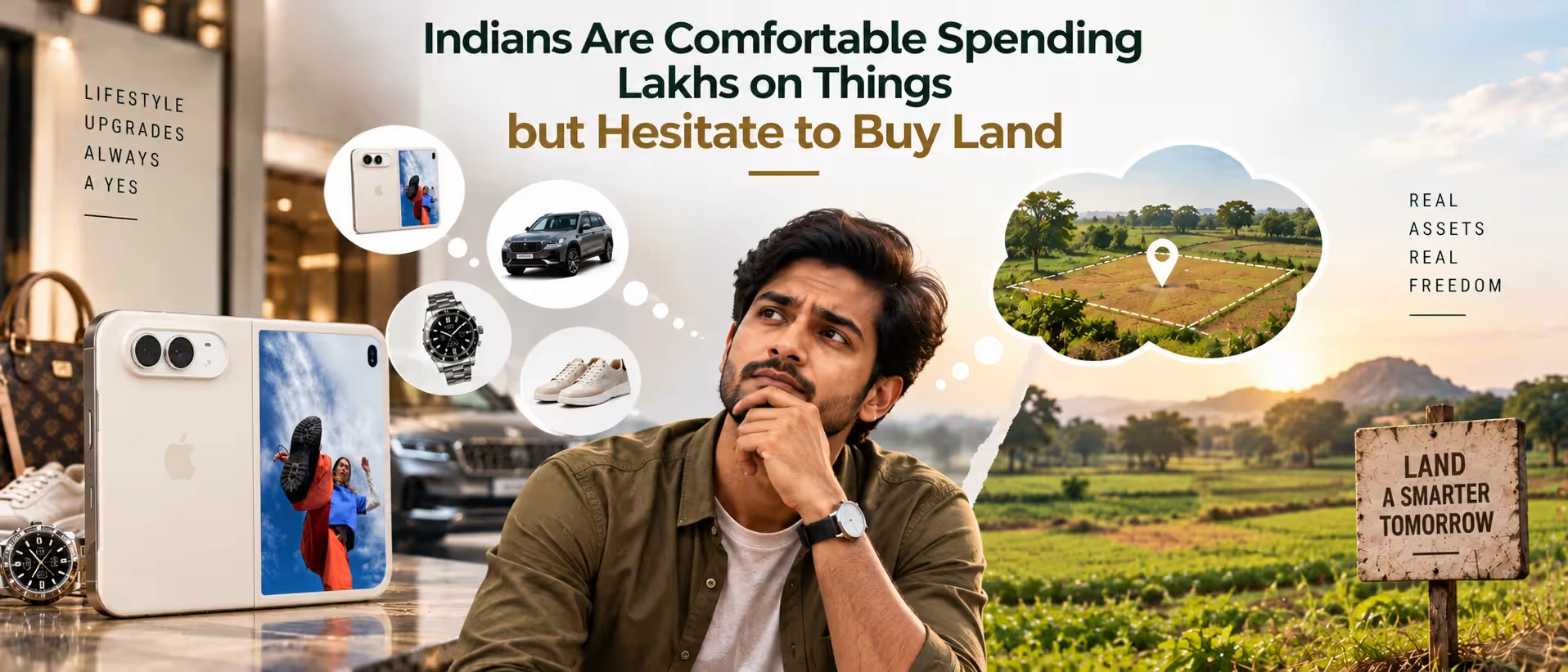
Walk into any car showroom on a Sunday, and you'll see it: families signing off on an ₹8 lakh SUV within an hour, sometimes less, barely blinking at the number. Wedding season rolls around, and lakhs go out the door for jewellery, catering, décor, without anyone sitting on the decision for more than a week. Yet mention buying a piece of land, even something modest, and suddenly everyone wants six site visits, three lawyers, and a month to "think about it." It's a strange contradiction when you actually sit with it. The car depreciates the moment it leaves the showroom. The land, if anything, tends to go up in value over the years. So why does one purchase feel effortless and the other feel like defusing a bomb?
The Money Isn't the Problem — The Trust Is
If you ask most people directly why they haven't bought land, very few say "I don't have the money." Land for sale, especially in smaller towns and on the outskirts, is often cheaper per square foot than the SUV sitting in their driveway. What actually holds people back is trust, or more specifically, the lack of it.
A car comes with a fixed price tag, a warranty, and a company you can call if something's wrong. Land doesn't come with any of that built in. The buyer has to build the trust themselves, checking the title, confirming the seller actually owns it, making sure there's no dispute buried somewhere in the family history of that plot. That's a lot of homework for something that, on paper, looks like a simple transaction. So it's less that Indians don't value land. It's that buying land asks for a kind of diligence that buying a phone or a car simply doesn't.
A Quick Look at Why One Feels Easy, and the Other Doesn't
| Purchase | Why It Feels Easy | Purchase | Why It Feels Hard |
|---|---|---|---|
| Car | Fixed price, brand trust, instant paperwork | Land | Price varies, no single "brand" to trust |
| Phone | Warranty, return policy, known company | Farmland | No standard warranty, seller-dependent trust |
| Jewellery | Instant possession, resale value known | Plot of land | Value depends on location, title, and future zoning |
| Wedding expenses | Emotionally driven, social pressure to spend | Agricultural land | Emotionally distant unless there's a farming background |
Look at that table for a second. Almost every "easy" purchase has some external system backing it up, a brand, a warranty, a fixed MRP. Land has none of that. Every plot is basically its own investigation.
The Generational Gap in How Land Is Seen
There's also a quieter shift happening across generations that doesn't get talked about enough. Older generations, especially anyone with roots in a village, grew up seeing land as the ultimate form of security. Owning farm land for sale near me wasn't an investment decision back then; it was just what stability looked like. You had land, you had food, you had something to pass down.
Somewhere along the way, that instinct got diluted for a lot of urban, younger Indians. Land started feeling distant, almost old-fashioned, something their grandparents cared about but they didn't need to. Meanwhile, spending on things you can see and use daily, a car, a phone, a nice apartment interior, became the new marker of having "made it."
What's interesting is that this is reversing again, just for slightly different reasons. Rising city rents, unstable job markets, and a general sense that owning something tangible feels safer than it used to have brought land back into conversations it had quietly left. People are once again searching agriculture land for sale near me, except this time it's less about tradition and more about wanting a backup plan.
What Actually Makes People Hesitate, Beyond Just Trust?
It's not only about trust in the seller. A few other things genuinely slow people down when land enters the picture:
- The paperwork feels intimidating — most people have never read a sale deed and don't know what to check for
- There's no quick way to verify a seller's claim, unlike a car's registration certificate
- Land doesn't give instant gratification — you can't drive it home or show it off the same evening
- Stories of fraud travel fast, and one bad experience shared by a relative can put people off for years
- The decision feels irreversible, more so than most other big purchases, because reselling land can take time
None of these are irrational concerns. They're actually fair. The issue isn't that people are being overly cautious about land; it's that the tools to make that caution easier haven't always existed.
How is the Process Slowly Getting Less Intimidating?
This is where things have genuinely improved over the last few years, and it's worth giving credit where it's due. Selling property online has pushed a lot of sellers toward being more transparent than they used to be, with clearer photos, upfront pricing, and documentation shared before a buyer even visits. That alone removes a chunk of the hesitation, because buyers aren't walking in completely blind anymore.
On the seller's side, land selling has also become less of a purely local, word-of-mouth affair. A farmer trying to sell part of his land no longer has to depend entirely on whichever broker happens to know the area. Listing it properly, even just on a basic platform, opens it up to buyers who'd never have found it otherwise, including people specifically looking for farm-for-sale listings outside their home city. That shift matters more than it sounds. When a transaction moves from "you have to know someone" to "anyone serious can find and verify this," a lot of the fear naturally drops away.
What Would Actually Help People Feel More Confident?
If you ask people what would make them more comfortable buying land, the answers are usually pretty consistent:
- A way to verify ownership without needing a lawyer for every single step
- Clear, upfront documentation shared before a site visit, not after
- Honest pricing instead of the usual "final price after negotiation" approach
- Some kind of background check on the seller, similar to how a buyer checks a car's history
- A platform that doesn't disappear after the deal, somewhere to go back to if questions come up later
None of this is asking for much, honestly. It's the same basic trust infrastructure that already exists for cars and phones, just applied to land.
Where does 2Bigha fit into closing this Gap?
This is essentially the gap 2Bigha exists to close. Buying land shouldn't require the same nervous energy as defusing a bomb, and it doesn't have to, once there's a system doing the background verification that used to fall entirely on the buyer. 2Bigha brings ownership checks, clear documentation, and transparent listings to a process that's historically depended on trusting a stranger's word.
Whether someone is searching for farm land for sale near me for the first time, comparing a few agricultural land for sale near me options before deciding, or a landowner exploring land selling on their own for the first time, 2Bigha's platform is built to make that decision feel closer to buying a car than gambling on a stranger.
Disclaimer: This article is for informational purposes only and should not be considered investment, legal, financial, or property advice. Real estate regulations, infrastructure plans, market conditions, and government policies may change over time. Readers are advised to verify information with relevant authorities and consult qualified professionals before making any investment or property-related decisions.