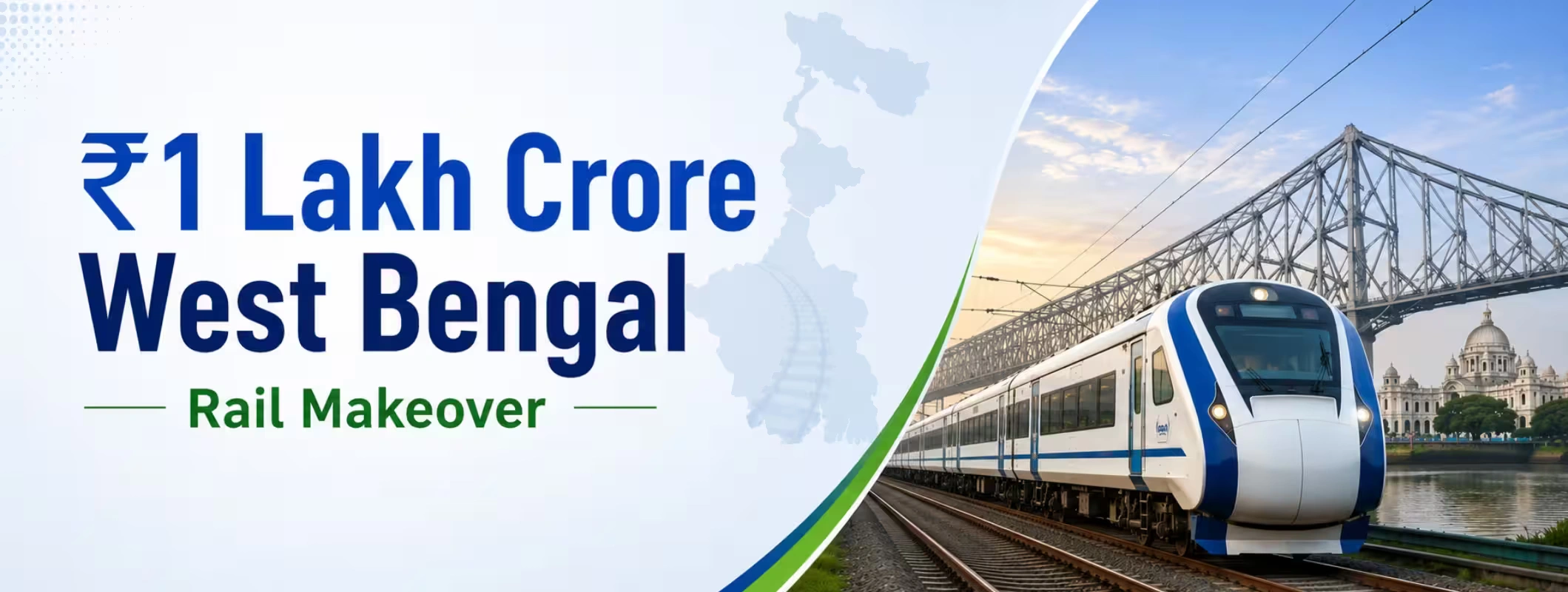
West Bengal is considered to be at the very last stage of railway transformation after many years. On June 6, 2026, Railway Minister Ashwini Vaishnaw met Chief Minister Suvendu Adhikari at the state secretariat in Kolkata. They conducted a joint press conference that created a completely different vision: INR 1 lakh crore in railway investment, 102 station redevelopments, 538 flyovers and underpasses, a Delhi-Siliguri bullet train, a brand-new freight corridor, and 60 new train services over five years of the duration. For West Bengal, where rail development had been largely delayed or stopped for years, this is not a small step at all.
Below is a brief elaboration of the very important initiatives taken, the numbers behind them, and what they mean for commuters, businesses, and the broader economy of West Bengal.
What Is the Railway Development Plan for West Bengal?
West Bengal railway development plan, declared in June 2026, is a multiple-layered infrastructure plan that addresses the years of connectivity gaps between the various states, from the ones that are considered highly populated districts of South Bengal to the ones that are not of North Bengal and Jangalmahal.
The plan basically includes station upgrades under the Amrit Bharat Station Scheme, road-over-bridge construction, high-speed rail development, dedicated freight corridors, and the expansion of Kolkata Metro, all of which are financed by the various sources of money that have already been arranged, according to Railway Minister Vaishnaw.
CM Suvendu Adhikari has clearly mentioned the announcement pointedly: "During the previous government, there was a situation of war between the state and the Centre. As a result, railway development in West Bengal had come to a standstill. With the change in government, that problem will be resolved." He directed all district magistrates, including those attending virtually, to actively help and manage the Railway Ministry in land acquisition for pending projects.
How Much Is Being Invested in Bengal's Rail Infrastructure?
The headline number is INR 1 lakh crore in total railway investment for West Bengal. But this happened in various steps.
- The Union Budget 2026–27 has already allocated INR 14, 205 crore specifically for railway modernisation and expansion in the state.
- Earlier, the Budget 2025–26 had marked INR 13, 955 crore for West Bengal rail expansion.
- The total pipeline investment, if all land and NOCs are provided by the state, could unlock an additional INR 1 lakh crore on top of the current commitment.
- The state has already provided land for at least 60 projects and issued 40 No Objection Certificates (NOCs) for foot overbridges and underpasses.
The below-mentioned table consists of the investment overview:
| Investment Component | Amount / Detail |
| Total planned railway investment | INR 1 lakh crore |
| Union Budget 2026–27 allocation for WB | INR 14,205 crore |
| Stations under the Amrit Bharat Scheme | 102 stations (₹3,600 crore) |
| Flyovers and underpasses planned | 538 |
| Projects already approved by the Centre | 61 |
| NOCs issued by the state government | 70+ (road overbridges & underpasses) |
| Land provided for projects | 60+ projects |
| Additional potential investment (if land provided) | INR 1 lakh crore more |
This scale of investment signals a very important shift in how the Centre and Bengal's state government are approaching rail development, from confrontation to collaboration.
Which Railway Stations Are Being Redeveloped in West Bengal?
Station redevelopment is one of the most common starting points of the plan. Under the Amrit Bharat Station Scheme (ABSS), 102 railway stations across West Bengal are slated for modernisation.
The Amrit Bharat Station Scheme transforms ordinary stations into modern commuter hubs with larger waiting halls, digital passenger information systems, better lighting and ventilation, improved ticket counters, Wi-Fi connectivity, lifts, ramps, and upgraded platforms. The basic idea behind this is not to make it visually attractive, but; it's operational efficiency and passenger dignity.
Six stations have already been inaugurated in an earlier phase: Kamakhyaguri, Tamluk, Haldia, Barabhum, Anara, and Siuri. Ten Amrit Bharat stations are already working in the state, and the program is now in the increasing stage, dramatically covering 102 locations.
| Station Redevelopment Status | Details |
| Total stations planned under ABSS | 102 |
| Stations already completed (Phase 1) | 10 functional; 6 recently inaugurated |
| Key inaugurated stations | Kamakhyaguri, Tamluk, Haldia, Barabhum, Anara, Siuri |
| Estimated scheme cost | ₹3,600 crore |
| Amenities included | Wi-Fi, lifts, ramps, digital info systems, upgraded platforms |
These redevelopments are particularly important for smaller towns and district headquarters that currently have outdated, underfunded stations despite heavy passenger traffic.
How Will 538 Flyovers Change Rail Connectivity in Bengal?
One of the most striking numbers in the entire announcement is 538 flyovers and underpasses. To put that in perspective, this is among the largest single-state road-over-bridge construction programs in Indian railway history.
These structures serve a very important dual purpose: they remove the unmanned and manned level crossings (which are major causes of accidents), and they decongest road traffic that is otherwise put at busy rail crossings. For cities, towns, and rural areas in Bengal where railway lines bisect major roads, flyovers and underpasses are a direct quality-of-life upgrade.
The state has already issued NOCs for more than 70 railway overbridges and underpasses, and the Chingrihata flyover in Kolkata is on track to be completed within its given duration of the time. This early momentum suggests the 538-figure is not as inspiring; it has administrative groundwork already laid. The following breakdown shows the current status of road-over infrastructure:
| Infrastructure Type | Status |
| Total flyovers/underpasses planned | 538 |
| NOCs issued (overbridges & underpasses) | 70+ |
| Chingrihata flyover (Kolkata) | On track, to be completed on schedule |
| Purpose | Eliminate level crossings, reduce accidents, and ease road congestion |
What Are the Key Railway Projects Announced for West Bengal?
Beyond stations and flyovers, the announcement encompasses several transformative infrastructure projects. The below mention is a detailed overview of the major initiatives:
1. Delhi–Siliguri Bullet Train Corridor
The major announcement is the Delhi–Lucknow–Varanasi–Patna–Siliguri high-speed rail corridor. Railway Minister Vaishnaw stated that a bullet train would cover the entire Delhi to Siliguri distance in just six hours, a journey that currently takes more than 10 hours by the fastest express trains.
The corridor is designed for speeds that will eventually accommodate bullet train operations, and there are plans to extend it further to Guwahati, creating a continuous high-speed backbone connecting Delhi, eastern India, and the Northeast.
2. Dankuni–Surat Dedicated Freight Corridor
A landmark logistics project, the Dankuni–Surat East-West Dedicated Freight Corridor, was announced in Budget 2026–27 and has already entered the fast-track phase. The corridor is approximately 2, 100 kilometres long and will pass through West Bengal, Jharkhand, Odisha, Maharashtra, and Gujarat.
For West Bengal, Dankuni basically serves as the eastern anchor, connecting the state's industrial and port infrastructure to markets in the different regions of western India. Indian Railways has clearly mentioned that all pre-construction activities be fast-tracked with simultaneous preparation of contract documents.
3. Sivok–Rangpo Railway Line
The long-stalled Sivok–Rangpo Railway Line, which connects West Bengal to Sikkim, is finally moving forward. The state government has allocated 20 acres of land for afforestation as compensatory green cover, a key environmental clearance requirement that had been blocking the project.
4. 60 New Train Services
Railway Minister Vaishnaw announced 60 new train services for West Bengal over the next five years. This includes both intercity and inter-regional connectivity improvements.
5. 60 New Kolkata Metro Rakes
Kolkata Metro, already one of India's oldest metro systems, is set for a very significant increase. 60 new-generation metros are planned to be added over the next five years, improving the level of frequency, reducing the level of overcrowding, and expanding usable capacity across the network's growing lines. The table below provides clear, concise information about all major project announcements:
| Project | Key Detail |
| Delhi–Siliguri Bullet Train Corridor | Via Lucknow, Varanasi, Patna; 6 hours travel time; extensible to Guwahati |
| Dankuni–Surat Freight Corridor | 2,100 km; passes through 5 states; fast-track initiated |
| Amrit Bharat Station Redevelopment | 102 stations in WB |
| Flyovers and Underpasses | 538 planned across the state |
| New Train Services | 60 new services over 5 years |
| Kolkata Metro Expansion | 60 new metro rakes in 5 years |
| Sivok–Rangpo Railway Line | Land allocated; environmental clearance progressing |
| Approved Projects (Centre) | 61 projects across the state |
| Vande Bharat Trains | 9 already operational in WB |
| Amrit Bharat Trains | Multiple operational; first flagged from Malda |
Which Districts Will Be Connected for the First Time?
One of the most important and human aspects of this plan is the hope of bringing every district of West Bengal onto the railway map, including areas that have been functionally rail-dark for decades.
Chief Minister Adhikari specifically named districts and towns that will now be included: Karimpur, Tehatta, Jalangi, Gopiballabhpur, Nayagram, and Hili. These are basically considered to be rural and semi-urban areas where the absence of a railway link has limited economic opportunity to a very vast extent, healthcare access, and mobility for generations. The plan also includes three distinct geographic regions of the state, which are clearly mentioned below.
- North Bengal, including the tea garden belts and foothills of the Himalayas
- South Bengal, the densely populated deltaic heartland
- Jangalmahal, the tribal-dominated forest region spanning Jhargram, Purulia, and Bankura
These three distinct geographic features are what separates this plan from previous announcements that were created to prioritise major corridors and urban centres.
Why Did Bengal's Railway Development Stall, And Why Is It Moving Now?
The West Bengal state government (under the Trinamool Congress) and the Union government were a bit rough. Railway projects require land acquisition, NOCs, and administrative cooperation from state governments, and without those, even sanctioned projects remain on paper.
With the change in state government, CM Adhikari clearly said the confrontational period is over. The state has already provided land for 60 projects and is prepared to provide more. Railway Minister Vaishnaw's visit to the state secretariat and the joint press conference that followed is itself a symbolic break from the recent past.
The administrative machinery is already in motion: district magistrates have been directed to coordinate directly with the Railway Ministry, and the Chief Secretary confirmed to the meeting that key infrastructure like the Chingrihata flyover will be completed on schedule.
What Does This Mean for Bengal's Economy and Commuters?
The economic implications of a ₹1 lakh crore railway overhaul extend well beyond the construction phase. Better rail connectivity will help with the points listed below.
- Faster goods movement: The Dankuni–Surat freight corridor alone will dramatically cut logistics costs for Bengal's exporters, manufacturers, and port users.
- Tourism and regional growth: High-speed rail and improved connectivity to North Bengal and the Northeast open up tourism corridors.
- Employment: Large-scale infrastructure construction directly generates tens of thousands of jobs in civil works, electrical systems, and logistics.
- Urban decongestion: 538 flyovers and Kolkata Metro expansion together target the chronic traffic-rail interface problems in urban Bengal.
- Last-mile connectivity: First-time rail access to districts like Jalangi and Hili means healthcare, education, and commerce become meaningfully more accessible.
For the everyday commuter, the combination of upgraded Amrit Bharat stations, new train services, and faster metro rakes means a materially better travel experience, not just in Kolkata, but across the state.