List Your Land
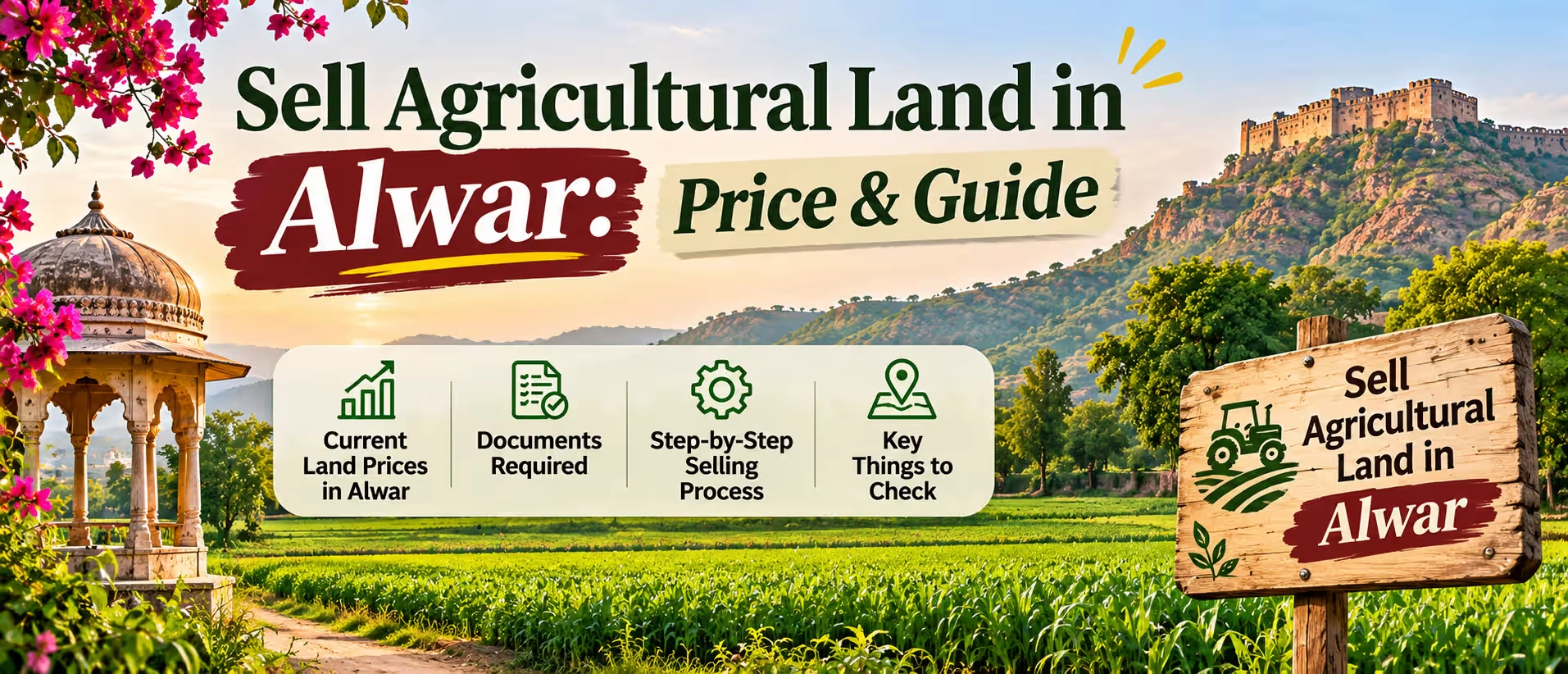
Most owners who decide to sell agricultural land in Alwar are not in a hurry; they have usually been holding a few bighas for years, and what they want to know is whether this is a good time, what the paperwork looks like, and how to avoid the usual traps. Alwar sits within reach of Delhi NCR; it is cheaper than Gurugram and Sohna, and it has Neemrana and Behror growing on one side and a new highway upgrade on the other, so buyer interest is real, though it is uneven from village to village. This guide walks through each stage of the sale in the order you will actually face it. It is general information and not legal or tax advice, so please confirm the final details with a local lawyer and a chartered accountant.
Why Sell Agricultural Land in Alwar Now?
Owners tend to sell for practical reasons, such as a family partition, a loan to clear, or a wish to move the money into a smaller parcel that is easier to manage, and the current market gives these owners a few things to work with. Buyers who find land in Alwar attractive are mostly NCR investors and farmhouse seekers comparing it with costlier belts near Gurugram, and that comparison is what keeps enquiries coming.
| Reason to sell | What it means for you |
| Buyers priced out of Gurugram and Sohna | More enquiries from NCR buyers looking for larger parcels at lower entry prices |
| New road and rail plans in the region | Parcels near confirmed projects can attract better offers |
| Family or inheritance settlement | A clean sale can end disputes between co-owners |
| Wish to reinvest | Proceeds can go into other farmland, subject to tax rules |
A word of caution is useful here: rail timelines for the Delhi to Alwar corridor have been reported with dates that are not firmly confirmed, so it is safer to price your land on its road access and water than on a promised train line.
How to Sell Agricultural Land in Alwar Step by Step?
The process is not complicated, but doing the steps out of order is what creates delays. Most smooth sales follow this sequence.
- Download your latest jamabandi and khasra details and check that your name, area, and land category are correct.
- Fix any record error, pending mutation, or co-owner issue before you list, since buyers will find it anyway.
- Find the DLC rate for your village so you know the floor value for registration.
- Measure the parcel and confirm the bigha size in your records, because the bigha varies across regions and many disputes begin with a mismatch in area.
- List the land with clear photos, the khasra number, road width, and water source on a trusted platform such as 2Bigha, where verified buyers can see the details directly.
- Meet serious buyers on site, share documents only with those who are genuinely interested, and sign an agreement to sell with a token amount.
- Register the sale deed at the sub-registrar office with both parties, two witnesses, and identity proof.
- Make sure the buyer applies for mutation so the revenue record shows the new owner.
Documents to Check Before Receiving Payment When You Sell Agricultural Land in Alwar
If you plan to sell farmland in Alwar, the strongest protection is a clean set of papers before any large payment reaches your account, because a gap discovered afterwards is usually the seller's problem to solve. The table lists what to check and what can go wrong if you skip it.
| Document | Why check it | What happens if you skip it |
| Jamabandi (latest) | Confirms you are the recorded owner and the area matches | The buyer's lawyer finds a mismatch and the deal stalls or the price drops |
| Mutation history | Shows how the land reached you | A broken chain can raise doubt about your title |
| Khasra and map | Fixes the exact boundary and area | Boundary disputes after the sale can come back to you |
| Co-owner consent or NOC | Every co-owner must agree | A co-owner can challenge the sale later |
| Loan or mortgage clearance | The land must be free of charges | The buyer cannot get a clean deed |
| Land use and conversion status | Agricultural land and converted land are taxed and priced differently | The wrong category can change the stamp duty value |
| Tenant or cultivator check | Confirms nobody else has a claim on the land | A cultivating tenant can complicate possession |
| ID and PAN of seller | Needed for registration and banking | Delays at the sub-registrar office |
Documents to Check After Receiving Payment Before You Sell Agricultural Land in Alwar Is Complete
A sale is not truly finished when the money arrives, because the records and receipts that follow are what protect you years later. Check each of these once payment is made.
| Step or document | Why check it | What happens if you skip it |
| Registered sale deed copy | It is the legal proof that you transferred the land | You cannot prove the sale if a dispute arises |
| Mutation in the buyer's name | Updates the revenue record | The land can still show your name, which can create tax or legal confusion |
| Updated jamabandi | Shows the change in ownership | Old records may keep you linked to the land |
| Payment proof through bank | Records the sale price | Cash dealings above the legal limit can attract penalties |
| Capital gains record | Needed for your tax return | Wrong reporting can lead to a notice later |
Under current Indian rules, accepting cash of ₹2 lakh or more in a property deal can attract a penalty, so insist on bank transfers for the full amount.
Taxes, Stamp Duty and Charges When You Sell Agricultural Land in Alwar
Buyers who search for land for sale in Alwar usually ask about stamp duty first, and as a seller, it helps to understand it because it affects what a buyer is willing to offer. In Rajasthan, stamp duty is generally charged on the higher of the sale price and the DLC rate, and by common practice the buyer pays it along with a registration fee of around 1%. Different sources quote slightly different percentages for agricultural land and surcharges, so check the current figure on the e-Panjiyan portal rather than relying on a blog.
| Charge | Who usually pays | Note |
| Stamp duty | Buyer | Based on the higher of the sale price or the DLC rate; confirm the current rate |
| Registration fee | Buyer | Around 1% according to most published guides |
| Capital gains tax | Seller | Depends on whether the land counts as rural agricultural land and how long you held it |
| Legal and drafting fees | Shared by agreement | Depends on the lawyer and the deal |
There is one recent change worth knowing about. A July 2026 news report said that in peri-urban areas, small agricultural plots above 1,000 square metres may now be valued at the residential DLC rate, which in some cases is far higher than the agricultural rate. If your land lies near a municipal limit, ask the sub-registrar office which rate applies before you fix your price.
On tax, rural agricultural land that lies beyond the prescribed distance from a municipality is generally not treated as a capital asset, so there may be no capital gains tax, whereas land inside those limits can attract it, and a reinvestment exemption may be available if you buy other agricultural land. These rules turn on distance and population figures that a chartered accountant should check for your exact village.
Land Price Trends in 2026 for Those Who Sell Agricultural Land in Alwar
Anyone who tries to price land from internet listings will notice that the numbers do not agree, and that is because listings show asking prices, not registered sale prices. Across portals in 2026, ordinary farmland around Alwar appears with asks that run from roughly ₹6 lakh to ₹18 lakh per bigha, while parcels on the highway or beside townships ask far more, and developer farmhouse projects around Naugaon price by the square yard at a much higher level.
| Land type | What drives the price |
| Interior farmland with no direct road | Lower demand, mostly farmer buyers |
| Land on a wide approach road | Better access, wider buyer pool |
| Highway or township-adjacent land | Commercial interest and higher asks |
| Farmhouse-style plots near Naugaon | Priced per square yard, driven by developer projects |
A practical way to set your price is to compare three recent registered deals in your own village, check the DLC rate, and then adjust for road width, water, and shape of the land. Asking slightly above that range leaves room to negotiate without scaring off buyers.
How Infrastructure and Connectivity Affect Prices When You Sell Agricultural Land in Alwar?
Road projects change buyer behaviour faster than almost anything else, and the Alwar to Bharatpur four-lane upgrade, reported at about ₹667 crore, is one that sellers along that stretch should watch. People looking to buy agricultural land in Alwar often compare it with nearby markets before deciding, and this is where the Neemrana vs Sohna vs Alwar land investment question comes up most.
Neemrana vs Sohna vs Alwar Land Investment
Factor | Neemrana | Sohna | Alwar |
| State and rules | Rajasthan | Haryana | Rajasthan |
| Main demand driver | Industrial belt and expressway access | Closeness to Gurugram | City, farmland and farmhouse buyers |
| Entry price | Moderate to high near industrial areas | Higher, because of Gurugram's reach | Generally lower for farmland |
| Typical buyer | Investors and businesses | NCR homebuyers and investors | Farmland and farmhouse buyers |
| Main risk | Speculation near project announcements | High entry cost | Slower appreciation away from highways |
None of the three is better in every case; Sohna suits buyers who want proximity and can pay for it, Neemrana suits those betting on industrial growth, and Alwar suits buyers who want more land for the money, which is the strength you can use when you talk to a buyer.
Common Mistakes When You Sell Agricultural Land in Alwar
Most problems come from rushing, and the mistakes below show up again and again in land deals.
- Listing before fixing a mutation or co-owner issue, which gives buyers a reason to cut the price.
- Quoting the price per bigha without stating the exact bigha size in square yards.
- Accepting a large cash payment, which creates legal and tax trouble.
- Handing over originals before the registered deed is complete.
- Ignoring the DLC rate and then being surprised when the registration value is higher than the agreed price.
- Skipping a written agreement to sell, so the token amount and deadline are only a verbal promise.
- Forgetting to ask whether a tenant or cultivator is on the land.
Conclusion: Sell Land in Alwar With Clean Papers and a Realistic Price
If you want to sell land in Alwar at a fair price, the formula is not complicated: keep the records clean, price against registered deals in your own village, accept payment through banks, and finish mutation after registration. Buyers in this belt are paying attention to roads, water, and legal clarity, so a well-documented parcel will usually move faster than a larger one with open questions. When you are ready, you can list your land on 2Bigha and let verified buyers contact you directly.
Disclaimer: This article is for informational purposes only and should not be considered investment, legal, financial, or property advice. Real estate regulations, infrastructure plans, market conditions, and government policies may change over time. Readers are advised to verify information with relevant authorities and consult qualified professionals before making any investment or property-related decisions.