List Your Land
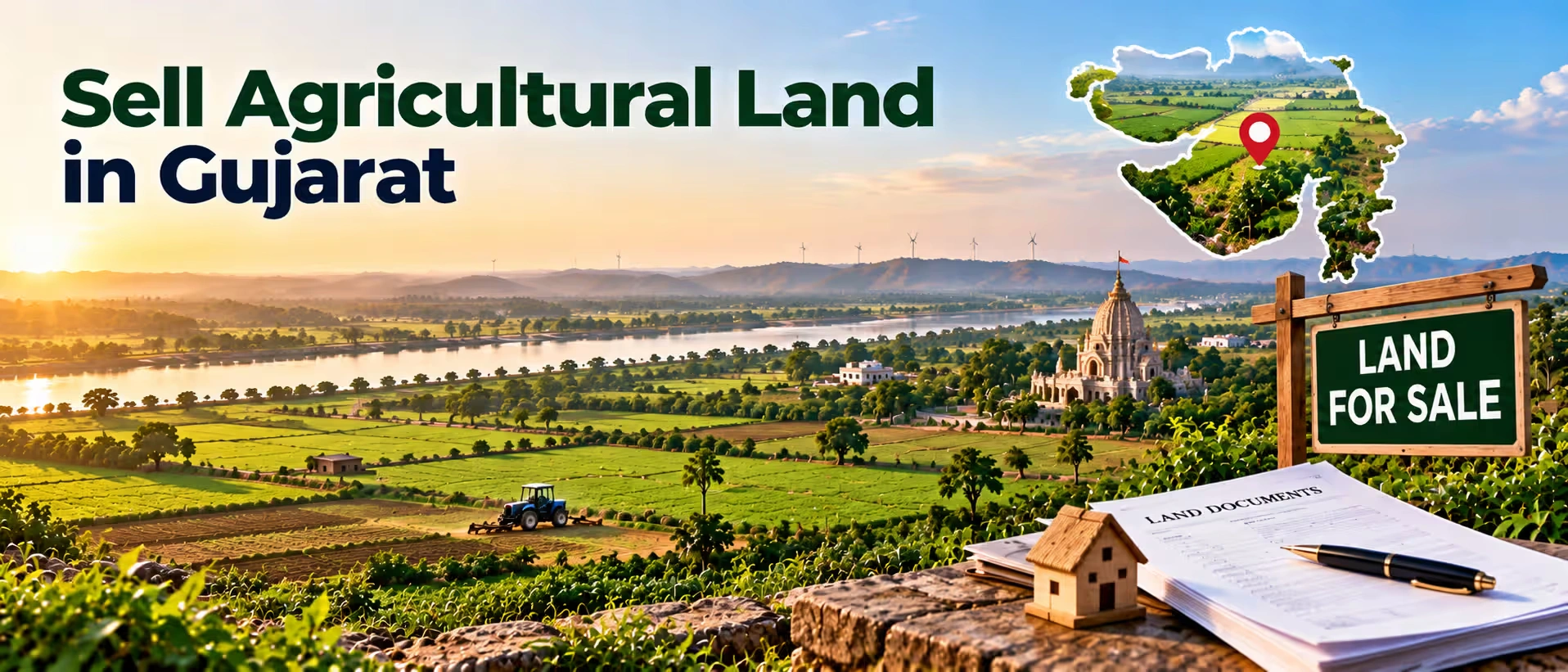
There are a few things to be considered when selling a farm in Gujarat that may not apply while selling farms in other states. One major thing is that the buyer is just as important as the price that is fixed. The tenancy law in Gujarat restricts the people who are allowed to purchase agricultural land. This means that if the seller has a suitable buyer and a favorable deal but the buyer does not qualify, then the sale is bound to get cancelled or even become void. On top of that comes the issue of whether the land is under old or new tenure, the condition of the 7/12 paper, and the entries that are pending for mutation.
Who Can Legally Buy Your Land?
The first thing every owner of land in Gujarat should understand is Section 63 of the Gujarat Tenancy and Agricultural Lands Act, 1948. It says that no sale, gift, exchange, lease, or mortgage of agricultural land is valid in favour of someone who is not an agriculturist, unless the Collector has given prior permission. The Act defines an agriculturist as someone who cultivates land personally, and the Collector rarely grants permission for general farming use.
This has a practical implication for the seller. Before signing any contract, ensure that the buyer produces evidence that he/she is a farmer in Gujarat, typically in the form of a 7/12 extract in his/her own name and a farmer certificate wherever necessary. In case the buyer is not an agriculturist, the land will have to be changed to non-agricultural with the payment of the prescribed premium prior to executing the sale deed. This is essential since the Mamlatdar has the power to declare such a transfer as invalid under Section 84C and the land vests in the State Government.
Check Whether Your Land Is Free to Sell
Even if the buyer qualifies, there could be conditions on your property itself. See if there are any of these.
- Old/new tenure: Lands allocated or restricted under new tenure cannot be freely sold and need the Collector's permission and premium. According to the 2024 amendment, agricultural lands that have been in use for over 15 years will be converted from new tenure to old tenure without paying the conversion charge, subject to conditions. However, the premium for conversion to non-agriculture would apply. You can get the tenure details of your survey number from the Mamlatdar's office.
- Tribal land: Tribal lands have their own restrictions on transfer, and Section 73AA requires permission for transfer of such lands.
- Joint ownerships: In case the 7/12 has more than one khatedar, all should sign or give their written consent, as the sale by one co-owner can be contested.
- Bank loans and charges: Get your crop loan or mortgage cleared and obtain the bank's no-dues letter.
- Pending disputes: See if there are any pending cases of litigation, tenancy, or acquisition relating to your survey number.
Records and Documents You Need
Buyers exploring agricultural land purchase in Gujarat should ensure all village records and ownership documents are accurate and up to date. Those searching for land for sale in Gujarat are more likely to find confidence in properties with clear ownership records, helping avoid delays and build trust during the transaction.
| Document | What it shows | Where to get it |
|---|---|---|
| 7/12 extract (VF-7) | Owner, survey number, area, crops, and encumbrances | AnyROR portal, which lets you view it for free, or Talati office |
| 8A extract (VF-8A) | All holdings of the owner in the village | AnyROR portal, Talati |
| Mutation entries (VF-6) | How you acquired the land | AnyROR portal, village office |
| Earlier sale, gift or partition deed | Chain of ownership | Your own records |
| Heirship or succession papers | Inheritance proof where relevant | Mamlatdar or court |
| Farmer certificate of buyer | Buyer's eligibility under Section 63 | Buyer's village or taluka office |
| Aadhaar and PAN | Identity of seller and buyer | Own documents |
| Bank no dues letter | Loans are cleared | Your bank |
Check that the name, survey number, and area on your 7/12 match your deed exactly, and fix any mismatch through the revenue office before listing the land.
Pricing Your Land Properly
Price is where the seller either misses out on money or scares away the buyer, so use actual figures. See how recent registered transactions have been affected by factors like road accessibility, irrigation, soil quality, and proximity to a town or highway.
The Jantri rate fixed by the government is another factor to consider. The stamp duty is paid on the higher value of the actual sale price or the Jantri rate, so an agreement made at a much lower Jantri rate will not save the buyer any stamp duty.
| Factor | Effect on price |
|---|---|
| Road frontage and approach | Better access raises value |
| Water source | Borewell, canal, or tube well irrigation helps |
| Soil and crop pattern | Fertile, productive land sells higher |
| Distance from town, highway or industrial area | Closer parcels command a premium |
| Tenure and records | Old tenure and clean records ease the sale |
| Shape and size | Compact, regular plots are easier to sell |
Finding Genuine Buyers
Since buyers are restricted by law in number, your best buyers would be neighboring farmers and their families living in villages around you who are qualified. Local agents and villagers can provide leads in a timely manner, whereas online channels should be utilized when you wish to reach out to farmers from other talukas. In an online search for agricultural land available for sale in Gujarat, the survey number, acreage, accessibility, irrigation, and cost become priority information, so make sure you mention them all with good photographs.
Provide copies of your documentation to avoid losing time on negotiations that will not end up in an actual legal transaction with the buyer.
Agreement for Sale and Advance
As soon as the price is fixed, put it down in writing in an agreement which mentions the survey number, area, price, advance paid, payment schedule, and the date for registration. Include a clause to the effect that the purchaser is an agriculturist under the Tenancy Act and will provide the required documents, and mention the consequences of withdrawal by either party. Take the advance through bank transfer, keep it small until you have verified your papers, and keep copies signed by two witnesses.
Registering the Sale Deed
The sale is complete only when the deed is registered at the Sub-Registrar office that covers the land. The buyer normally pays stamp duty and registration fees online through the state's e-stamping and registration system, on the higher of the deal value or the Jantri value, so check the current rates on the official portal before registration day.
| Step | What happens | Who is involved |
| Draft the deed | Parties, survey details, and price are written | Seller, buyer, advocate or document writer |
| Pay duty and fees | Stamp duty and registration fee paid online | Buyer |
| Book an appointment | Slot fixed at the Sub-Registrar office | Either party |
| Present documents | IDs, 7/12, proof of eligibility and witnesses | Seller, buyer, witnesses |
| Registration | Deed signed, photographed and registered | Sub-Registrar |
| Collect the deed | Registered copy handed over | Buyer, with copy for seller |
Anyone planning to sell agricultural land in Gujarat should treat this stage as the point of no return, because after registration the legal transfer is complete, so make sure the balance payment reaches your account through banking channels before you sign.
After Registration: Mutation and Tax
Once the transaction gets recorded in the books of account, an entry called "Mutation Entry" is made in the village records such that the name of the buyer replaces your name in the 7/12 record. This entry will usually be followed by notice, and then objections will be considered for the period; thereafter, the entry will be confirmed. As the seller, see to it that your name is off in AnyROR a few weeks after the sale. If not, then approach the Talati and Mamlatdar offices.
Tax varies according to the type of land. The rural agricultural land beyond the prescribed distance from the municipal limits is never treated as a capital asset and therefore does not fall under capital gains tax. However, the land located within the prescribed limits is taxable like other assets. There is no withholding tax or one percent tax deduction at source for properties sold above 50 lakh rupees. But for rural agricultural lands, there is no TDS. The new tax provisions have recently been put together. So, talk to a CA before signing anything.
Listing Your Land on 2Bigha
If you want your parcel to reach farmers and investors beyond your own village, you can list it on 2Bigha through the farm listings page, adding the survey details, area, price, and photos. Buyers who want to buy farmland in Gujarat can ask for a Background Verification Report on the records and ownership, or use Book a Visit to inspect the land in person. Because Gujarat law restricts purchases to agriculturists, ask every interested buyer to share proof of eligibility early in the conversation, and confirm the legal position with a local advocate before signing anything.
Mistakes Sellers Should Avoid
- Undertaking the sale of the property to a non-farmer without verifying Section 63 or making the necessary conversion
- Neglecting the previous or present tenure status of the land
- Conducting the sale without the consent of all joint owners or heirs
- Receiving a hefty amount of money without an agreement in writing
- Providing a quotation without verifying the Jantri value or recent transactions
- Omitting to verify that mutation has been done after registration
Disclaimer: This article is for informational purposes only and should not be considered investment, legal, financial, or property advice. Real estate regulations, infrastructure plans, market conditions, and government policies may change over time. Readers are advised to verify information with relevant authorities and consult qualified professionals before making any investment or property-related decisions.