Key Takeaways
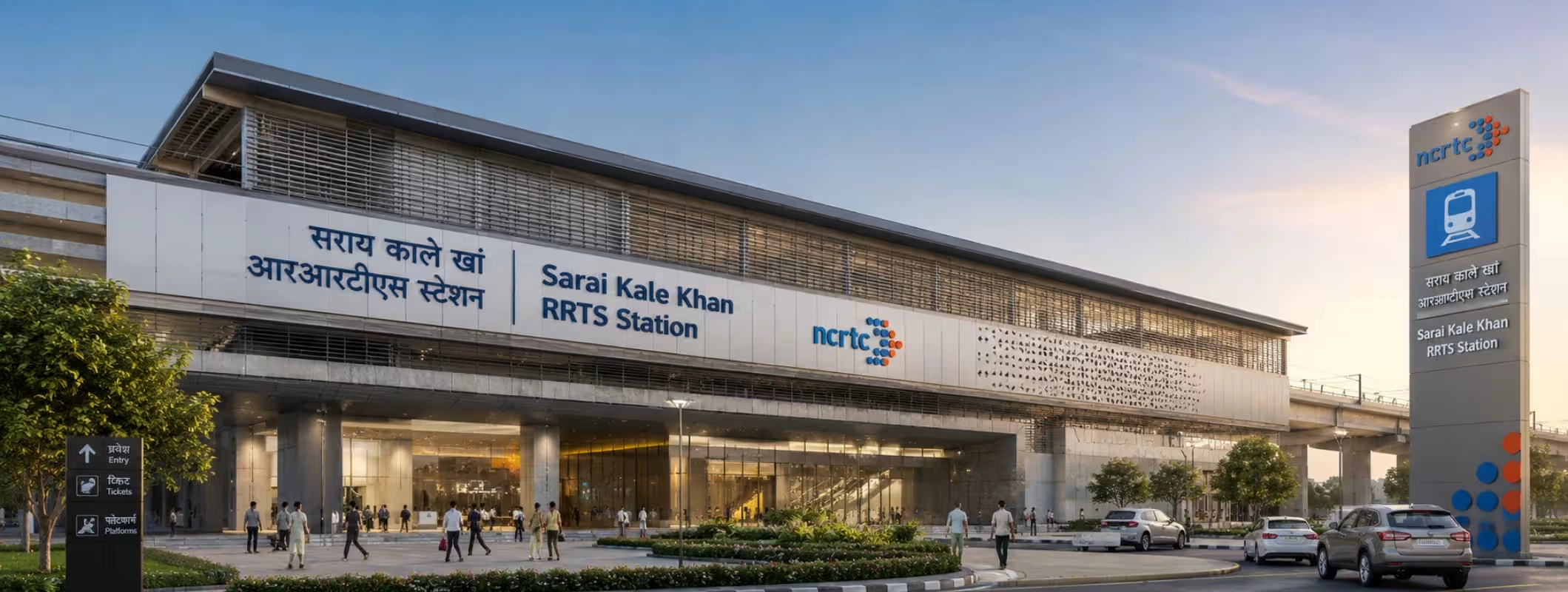
- The Sarai Kale Khan RRTS Station is now one of Delhi’s most important transport hubs because it connects Namo Bharat rapid rail with Delhi Metro, Hazrat Nizamuddin Railway Station, ISBT, city buses, and Ring Road connectivity. NCRTC describes the station as one of the largest stations on the corridor and a key multimodal integration point.
- The Delhi-Meerut RRTS corridor is fully operational from Sarai Kale Khan to Modipuram, with the full 82 km route covering 16 stations. The corridor allows travel from Sarai Kale Khan to Modipuram in about 58 minutes and to Begumpul in about 54 minutes.
- The station is important for real estate because transport-led growth can improve buyer interest in residential property, commercial shops, rental housing, and investment property near transit hubs. Housing.com’s 2026 price trend page lists Sarai Kale Khan’s average property price at ₹11,602 per sq. ft., with a reported 74.05% YoY rise, but buyers should treat portal data as an indicator, not a guaranteed market value.
- For buyers and sellers, the biggest opportunity is not just “near RRTS.” The real value comes from access, title clarity, legal documentation, approach road, rental demand, and proximity to actual interchange points.
Introduction: Why Sarai Kale Khan RRTS Station Matters
The Sarai Kale Khan RRTS Station is not just another railway stop in Delhi. It is becoming a serious mobility landmark for Delhi-NCR because it connects rapid rail, metro, railway, bus terminal, Ring Road, and future RRTS corridors in one place.
For daily commuters, this means faster movement between Delhi, Ghaziabad, and Meerut. For homebuyers, it means better location convenience. For investors, it means stronger demand visibility around a major transport hub. And for sellers, it creates a stronger reason to market property near Sarai Kale Khan with confidence.
In Indian real estate, infrastructure often changes how people view a locality. Delhi Metro did it earlier. Expressways did it in Noida, Gurgaon, Dwarka, and Greater Noida. Now, RRTS is creating a similar conversation around high-speed regional travel.
That is why searches like property near Sarai Kale Khan, real estate near RRTS station Delhi, buy flat near Sarai Kale Khan, and commercial property near Sarai Kale Khan are becoming more relevant.
What is Sarai Kale Khan RRTS Station?
Sarai Kale Khan RRTS Station is the Delhi-side terminal station of the Delhi-Meerut Namo Bharat corridor. It is part of India’s first Regional Rapid Transit System, also known as RRTS or Namo Bharat.
The station is located in South East Delhi and works as a major transport hub because it sits near:
- Hazrat Nizamuddin Railway Station
- Sarai Kale Khan-Nizamuddin Delhi Metro station on the Pink Line
- Veer Haqeeqat Rai ISBT
- Ring Road
- City bus services
- Taxi and private vehicle movement zones
NCRTC states that Sarai Kale Khan will also act as the convergence point for three Phase-1 Namo Bharat corridors: Delhi-Ghaziabad-Meerut, Delhi-Panipat-Karnal, and Delhi-Gurugram-SNB-Alwar. This future interoperability is important because commuters may be able to move between corridors without changing trains.
Sarai Kale Khan RRTS Route: Where Does It Go?
The Sarai Kale Khan rapid rail route currently connects Delhi with Ghaziabad and Meerut through the Delhi-Meerut RRTS corridor. The full corridor runs from Sarai Kale Khan in Delhi to Modipuram in Meerut.
Main Stations on the Delhi-Meerut RRTS Route
| Route Sequence | Station Name | Why It Matters |
| 1 | Sarai Kale Khan | Delhi terminal and multimodal hub |
| 2 | New Ashok Nagar | East Delhi connectivity |
| 3 | Anand Vihar | Metro, railway, and ISBT interchange |
| 4 | Sahibabad | Ghaziabad-side residential and industrial access |
| 5 | Ghaziabad | Major NCR city node |
| 6 | Guldhar | Residential catchment in Ghaziabad |
| 7 | Duhai | Priority corridor zone |
| 8 | Duhai Depot | Operational support area |
| 9 | Murad Nagar | Meerut Road belt connectivity |
| 10 | Modi Nagar South | Urban-industrial belt |
| 11 | Modi Nagar North | Growing NCR commute belt |
| 12 | Meerut South | Entry toward Meerut city |
| 13 | Shatabdi Nagar | Meerut Metro integration zone |
| 14 | Begumpul | Key Meerut business area |
| 15 | Modipuram | Major Meerut-side terminal |
| 16 | Modipuram Depot | Depot-side station |
Times of India lists the full corridor’s 16 stations and states that the 82 km route connects Sarai Kale Khan to Modipuram.
Also Read: Namo Bharat Rapid Rail: Connectivity & Real Estate Growth in NCR
Sarai Kale Khan RRTS Timings
As per current public reporting, Sarai Kale Khan RRTS timings generally start at 6:00 AM from Monday to Saturday, with Sunday services starting later at 8:00 AM. The last train is reported around 10:00 PM, with trains running roughly every 10 to 15 minutes.
Timing Summary
| Detail | Current Reported Information |
| First train, Monday to Saturday | Around 6:00 AM |
| First train, Sunday | Around 8:00 AM |
| Last train | Around 10:00 PM |
| Frequency | Around 10 to 15 minutes |
| Sarai Kale Khan to Begumpul | About 54 minutes |
| Sarai Kale Khan to Modipuram | About 58 minutes |
Always check the official Namo Bharat app, station display, or NCRTC journey planner before travel because timings, frequency, and operational rules can change due to maintenance, rush-hour planning, or special schedules.
Sarai Kale Khan Route Map: How to Understand the Connectivity
When people search for Sarai Kale Khan route map or RRTS route map, they usually want a simple answer: “Which areas can I reach faster from here?”
The route makes Sarai Kale Khan more powerful because it connects three layers of movement:
First, it gives direct rapid rail access toward Ghaziabad and Meerut.
Second, it connects with Delhi Metro’s Pink Line and helps passengers move toward South Delhi, East Delhi, North Delhi, and other metro-linked areas.
Third, it connects with Hazrat Nizamuddin Railway Station and ISBT, making Sarai Kale Khan a true regional transport hub rather than a standalone station.
NCRTC’s interactive map notes that Sarai Kale Khan is located close to Delhi Metro, Hazrat Nizamuddin railway station, and Vir Haqiqat Rai ISBT, creating seamless intermodal integration.
What Makes Sarai Kale Khan a Major Transport Hub?
Sarai Kale Khan already had strong transport value because of Nizamuddin railway station, ISBT, metro connectivity, and Ring Road access. The RRTS station has added a new high-speed regional layer to this location.
The station has also been designed for heavy commuter movement. Earlier reporting described it as the largest station on the corridor, with six platforms, four tracks, five entry-exit gates, 14 lifts, and 18 escalators.
A foot overbridge connecting Sarai Kale Khan Namo Bharat station with Hazrat Nizamuddin railway station has also opened for public use, improving safer and more direct movement between transport modes.
Connectivity Benefits for Commuters
- You can travel from Delhi to Meerut in under an hour.
- You can shift between rapid rail, metro, railway, and bus services more easily.
- You can reduce dependence on private cars for long NCR travel.
- You can access Ghaziabad and Meerut job markets more conveniently.
- You can use Sarai Kale Khan as a practical meeting point for regional travel.
Sarai Kale Khan Real Estate: Why Property Demand May Improve
The Sarai Kale Khan real estate story is directly linked with connectivity. When a location becomes easier to reach, more people consider living, renting, working, or investing there.
A buyer may choose property near Sarai Kale Khan because it offers:
- Better access to rapid rail
- Close connection to Delhi Metro
- Access to Hazrat Nizamuddin Railway Station
- Easy movement to Ghaziabad and Meerut
- Strong rental potential due to commuter footfall
- Commercial visibility around transport movement
This does not mean every property near the station will automatically increase in value. Real estate growth depends on building quality, legal status, location, parking, road access, property type, and buyer demand. But the infrastructure advantage is clearly stronger now.
Real Estate Near RRTS Station Delhi: What Type of Demand Can Grow?
The demand around Sarai Kale Khan may come from different buyer groups.
- Working professionals may look for flats near better transport links.
- Small investors may search for builder floors with rental potential.
- Business owners may evaluate commercial shops near commuter movement.
- Landlords may see better rental demand from frequent travellers.
- Sellers may get stronger enquiry volume because of the RRTS connectivity story.
- Developers may market residential projects near RRTS as connectivity-led assets.
For buyers looking to buy property in Sarai Kale Khan, the RRTS is a strong plus point. For owners planning to sell property in Sarai Kale Khan, the station can become a major selling angle if the property has clean documents and good access.
Sarai Kale Khan Property Price Snapshot
Property prices near transit hubs can move fast, but buyers should compare multiple sources before making a decision. Housing.com’s 2026 price trend page shows Sarai Kale Khan’s average property price at ₹11,602 per sq. ft., with a price range between ₹6,666 and ₹16,666 per sq. ft.
Magicbricks’ 2026 station guide also highlights nearby micro-markets such as Siddhartha Extension, Jangpura Extension, Sunlight Colony, and Nizamuddin East with different price bands and appreciation indicators.
| Location / Micro-Market | Buyer Profile | Real Estate Potential |
| Sarai Kale Khan | Commuters, investors, landlords | Strong transport-led visibility |
| Siddhartha Extension | Apartment buyers | Better access to transit and Central/South Delhi |
| Jangpura Extension | Premium floor buyers | Strong established locality value |
| Sunlight Colony | Budget-focused buyers | Rental and small-ticket investment potential |
| Nizamuddin East | Premium buyers | High-value residential demand |
Use these numbers as market indicators only. Before buying, check live listings, registry values, broker quotes, property condition, society quality, and actual transaction trends.
Why Investors are Looking Near Sarai Kale Khan
People searching for invest near Sarai Kale Khan are usually not looking only at one station. They are looking at a larger Delhi transport infrastructure story.
Sarai Kale Khan has three strong real estate signals:
1. Multi-Modal Connectivity
A location that connects metro, railway, rapid rail, bus terminal, and Ring Road has natural commuter demand. This improves both residential and commercial property interest.
2. Regional Mobility
The Delhi-Meerut RRTS reduces travel friction between Delhi, Ghaziabad, and Meerut. This can support people who live in one city and work in another.
3. Future Corridor Value
Sarai Kale Khan is planned as the convergence point for future RRTS corridors toward Panipat-Karnal and Gurugram-SNB-Alwar, which can increase its long-term strategic value.
Property Near Sarai Kale Khan: Residential vs Commercial
Both residential and commercial property can benefit from transport growth, but the investment logic is different.
| Property Type | Best For | What to Check |
| Residential flat | End-users and rental investors | Metro/RRTS access, parking, building age, society condition |
| Builder floor | Local buyers and small investors | Construction quality, registry status, floor legality |
| Commercial shop | Business owners and investors | Footfall, frontage, visibility, licensing |
| Office space | Consultants and small firms | Access, parking, lease demand |
| Land near RRTS station | Long-term investors | Title, zoning, access road, land-use approval |
A buyer searching for a buy flat near Sarai Kale Khan should focus on liveability, parking, safety, and daily commute. A buyer searching for a commercial shop near Sarai Kale Khan should focus on footfall, visibility, rent potential, and legal commercial usage.
Buyer Checklist Before Investing Near Sarai Kale Khan RRTS
| Checklist Point | Why It Matters |
| Check property title | Avoid ownership disputes |
| Verify registry and mutation | Confirms legal transfer history |
| Confirm land use | Residential and commercial usage must be clear |
| Check building approval | Avoid illegal construction risk |
| Measure real walking distance | “Near RRTS” in ads can be misleading |
| Check parking availability | Very important in dense Delhi locations |
| Visit during peak hours | Understand traffic, noise, and access |
| Compare nearby prices | Prevents overpaying during hype |
| Check rental demand | Important for investor returns |
| Use verified platforms | Helps reduce fake listing risk |
This is where 2Bigha can help buyers and sellers explore land and property opportunities with better listing clarity. For sellers, 2Bigha can also support visibility through a subscription plan while keeping the property discovery process more organized.
Benefits of Sarai Kale Khan RRTS Station for Real Estate
Faster Commute Means Better Location Value
People pay for convenience. A home near a strong transport hub saves time, reduces travel stress, and improves daily movement. That convenience can create stronger demand for both buying and renting.
More Footfall Can Support Commercial Activity
Transport hubs bring commuters. Commuters create demand for food outlets, convenience stores, small offices, service shops, paid parking, and rental accommodation. This can support commercial property near Sarai Kale Khan.
Better Regional Access Can Expand Buyer Interest
A buyer working in Meerut or Ghaziabad may now consider Delhi-linked living more seriously. Similarly, a Delhi-based professional may consider NCR travel more manageable.
Stronger Seller Positioning
If you want to sell land in Sarai Kale Khan, the RRTS station gives you a strong location advantage. But do not oversell. Mention real details: walking distance, road access, nearby metro, parking, property documents, floor details, and rental potential.
Sarai Kale Khan vs Other Delhi-NCR Transit Locations
| Factor | Sarai Kale Khan | Typical Metro-Only Location |
| Rapid rail access | Yes | Usually no |
| Metro access | Yes, Pink Line nearby | Yes |
| Railway access | Hazrat Nizamuddin nearby | Not always |
| ISBT access | Yes | Not always |
| Regional connectivity | Delhi-Ghaziabad-Meerut | Mostly city-level |
| Commercial footfall potential | High | Depends on station |
| Real estate appeal | Strong for commuters and investors | Depends on locality |
Sarai Kale Khan stands out because it is not only a metro-linked area. It is a combined rapid rail, railway, metro, bus, and road hub.
Who Should Invest Near Sarai Kale Khan?
You can consider property investment near RRTS if you fall into one of these categories:
- You want a rental property in a high-connectivity area.
- You want a small commercial unit near a transport hub.
- You want a flat with better access to Delhi, Ghaziabad, and Meerut.
- You already understand Delhi property documentation.
- You are comfortable with dense urban locations and traffic movement.
- You want long-term infrastructure-led appreciation rather than short-term speculation.
This area may not suit buyers who want quiet, low-density, gated township living. Sarai Kale Khan is a busy transport belt, so practical buyers should check noise, traffic, parking, and crowd movement before finalizing.
For Sellers: How to Market Property Near Sarai Kale Khan
If you are selling property in this area, do not write generic lines like “best location” or “prime property.” Serious buyers want useful details.
Mention these points clearly:
- Exact locality and landmark
- Walking or driving distance from RRTS station
- Distance from metro station and Nizamuddin railway station
- Property type and floor details
- Car parking availability
- Road width and access
- Registry status
- Rental income, if applicable
- Nearby commercial activity
- Expected price and negotiation scope
A clear listing gets better enquiries than an overhyped listing.
Final Thoughts
The Sarai Kale Khan RRTS Station has changed how people look at this part of Delhi. Earlier, Sarai Kale Khan was known mainly for traffic, ISBT, and railway access. Now, it is becoming a high-value multimodal transport hub with rapid rail, metro, railway, bus, and road connectivity in one zone.
For commuters, the station saves time. For urban land buyers, it improves convenience. For sellers, it creates a stronger location story. For investors, it opens a new way to look at real estate near RRTS station Delhi.
Still, smart investment needs discipline. Do not buy only because an ad says “near RRTS.” Check the paperwork, distance, access, property condition, and price comparison. Infrastructure gives the location a push, but due diligence protects your money.
FAQs - Sarai Kale Khan RRTS Station
1. What are Sarai Kale Khan RRTS timings?
Sarai Kale Khan RRTS services are publicly reported to start around 6:00 AM from Monday to Saturday and around 8:00 AM on Sunday, with the last train around 10:00 PM. Train frequency is generally reported around 10 to 15 minutes, but passengers should verify current timings before travel. (
2. What is the Sarai Kale Khan RRTS route?
The Sarai Kale Khan RRTS route connects Delhi with Ghaziabad and Meerut through the Delhi-Meerut Namo Bharat corridor. Major stations include Sarai Kale Khan, New Ashok Nagar, Anand Vihar, Sahibabad, Ghaziabad, Meerut South, Begumpul, and Modipuram.
3. Is Sarai Kale Khan RRTS Station connected to Delhi Metro?
Yes. Sarai Kale Khan RRTS Station is integrated with nearby Delhi Metro connectivity, Hazrat Nizamuddin Railway Station, ISBT, city buses, and Ring Road access. NCRTC highlights the station’s multimodal integration role.
4. Is it good to invest near Sarai Kale Khan RRTS Station?
Yes, it can be good for long-term investment if the property has clean title, legal approval, good access, parking, and realistic pricing. The RRTS improves connectivity, but buyers should not invest blindly based only on infrastructure hype.
5. What type of property is best near Sarai Kale Khan?
For end-users, flats and builder floors with parking and clean documents are practical. For investors, rental-ready residential units and small commercial spaces near high-footfall access points may be attractive. Always compare prices and verify documents before buying.