Key Takeaways
- The proposed Saket to Badarpur Border flyover and underpass project could become one of South Delhi’s most important road upgrades if executed as planned.
- The project focuses on the busy Mehrauli Badarpur Road, popularly known as MB Road, which connects Saket, Sangam Vihar, Khanpur, Pul Prahladpur, Tughlakabad, Lal Kuan and Badarpur Border.
- DMRC has been engaged for feasibility studies and detailed project report work for elevated corridors, underpasses, subways and road redesigns along this congested South Delhi belt.
- The broader MB Road elevated corridor project is estimated at around ₹1,471 crore, while DPR and feasibility work is expected to define the final design, traffic handling, utility shifting, environmental impact and construction approach.
- The proposed road improvement may reduce travel stress for daily commuters moving between South Delhi, Badarpur and Faridabad, but buyers should avoid assuming instant property appreciation until construction timelines, approvals and execution milestones become clearer.
- For real estate buyers, the most practical opportunity lies in studying micro-markets such as Saket, Khanpur, Sangam Vihar, Tughlakabad, Pul Prahladpur and Badarpur Border with proper due diligence instead of buying only on the basis of future infrastructure news.
Why Everyone Is Talking About the Saket to Badarpur Border Corridor
Anyone who regularly travels on MB Road knows one thing very clearly: this stretch can test your patience. A short drive from Saket towards Khanpur, Sangam Vihar, Tughlakabad or Badarpur Border often becomes slow because of signals, roadside parking, market movement, buses, autos, pedestrians, service-road traffic and interstate movement towards Faridabad.
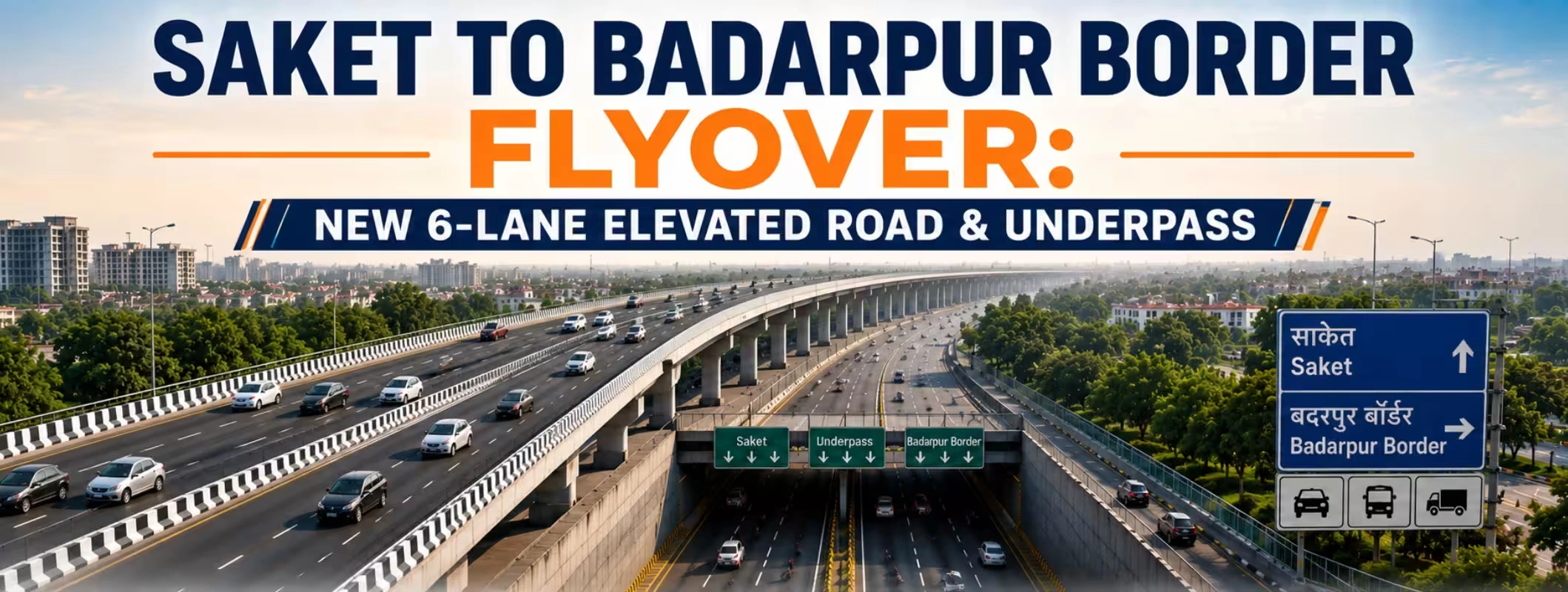
That is why the proposed Saket–Badarpur elevated corridor is getting strong attention from commuters, local residents, property buyers and real estate investors. The project is being discussed as a major South Delhi road connectivity upgrade, with a six-lane elevated flyover Delhi plan, underpasses, road redesign and better traffic movement along one of the city’s busiest corridors.
The idea is simple: separate through-traffic from local traffic wherever possible. Long-distance vehicles moving towards Badarpur Border and Faridabad should not get stuck at every local junction. At the same time, local commuters from Saket, Khanpur, Sangam Vihar, Pul Prahladpur and nearby areas need safer, cleaner and more organised road access.
The project is also drawing attention from the real estate market. Better road infrastructure often improves accessibility, reduces travel time and increases interest in surrounding micro-markets. As a result, buyers exploring residential plots, investment opportunities and land for sale in Saket are closely watching how this corridor develops and whether it can improve long-term connectivity across South Delhi.
If this project moves from planning to execution smoothly, it can change how South Delhi’s MB Road belt functions. But for property buyers and investors, the right approach is not blind excitement. The smart approach is to understand the route, timeline, project stage, local property conditions and risk factors before taking any decision. Infrastructure announcements can influence sentiment, but careful research remains essential—especially for those evaluating property or land for sale in Saket and nearby MB Road locations.
What Is the Saket to Badarpur Border Flyover Project?
The Saket to Badarpur Border flyover project refers to a proposed elevated corridor and underpass-based traffic improvement plan along the Mehrauli Badarpur Road corridor in South Delhi.
The broader project aims to improve road movement between Saket G Block, Sangam Vihar, Khanpur, Maa Anandmayee Marg, Pul Prahladpur and Badarpur. It includes elevated stretches, underpasses, road redesigns, subways and junction improvements. The project is being planned with DMRC involvement because the corridor needs to integrate road infrastructure with existing and proposed Delhi Metro infrastructure.
In simple words, this is not just one small flyover. It is a corridor-level traffic project. That matters because MB Road congestion is not caused by only one signal or one crossing. The entire belt has multiple pressure points. A proper solution needs elevated sections, surface road improvements, pedestrian planning, parking management and smoother merging points.
Project Snapshot: Saket Badarpur Elevated Corridor
| Particular | Details |
| Project Focus | MB Road elevated corridor and underpass project |
| Main Stretch | Saket G Block, Sangam Vihar, Khanpur, Maa Anandmayee Marg, Pul Prahladpur and Badarpur side |
| Key Road | Mehrauli Badarpur Road, also called MB Road Delhi |
| Proposed Infrastructure | Elevated roads, underpasses, subways, road redesign and junction improvements |
| Major Objective | Reduce congestion and improve South Delhi road connectivity |
| Estimated Broader Cost | Around ₹1,471 crore, as reported in recent updates |
| Planning Agency Involved | DMRC for DPR, feasibility and integrated planning work |
| Areas Likely to Benefit | Saket, Sangam Vihar, Khanpur, Tughlakabad, Pul Prahladpur, Lal Kuan, Badarpur Border |
| Real Estate Relevance | Better access may support residential and commercial demand over time |
| Current Caution | DPR, feasibility, construction planning and execution details still matter |
Why MB Road Needs a Major Traffic Upgrade
MB Road is not only a local South Delhi road. It acts as a connector between residential colonies, commercial activity, metro access points, institutional zones and the Faridabad side of Delhi NCR. Over the years, the pressure on this corridor has increased because nearby neighbourhoods have grown faster than the road’s practical carrying capacity.
Several types of traffic move together on this stretch:
- Office commuters travelling between South Delhi, Badarpur and Faridabad.
- Local residents from Sangam Vihar, Khanpur, Tughlakabad, Pul Prahladpur and nearby colonies.
- Market traffic around roadside shops and mixed-use pockets.
- Buses, autos, e-rickshaws, cabs and school vehicles.
- Heavy vehicles and delivery movement during certain hours.
- Pedestrians crossing at busy points where road design is not always comfortable.
This mix creates daily bottlenecks. Even when the road is wide in parts, the actual movement slows down because of signals, informal parking, sudden merging, bus stops, local entry-exit points and pedestrian crossings. During peak hours, a small disturbance can delay traffic for a long distance.
This is where the MB Road elevated corridor becomes important. A well-planned elevated road can carry faster through-traffic above the surface level, while local traffic continues below. Underpasses can reduce conflict at busy junctions. Road redesign can improve pedestrian safety, bus access and local circulation.
Route Understanding: Which Areas May Be Impacted?
The proposed South Delhi flyover project is expected to influence several localities along and around MB Road. These areas already have different property profiles, so the impact will not be equal everywhere.
Saket G Block
Saket G Block is important because it is already connected with established residential pockets, schools, hospitals, district courts, shopping zones and metro access. Any improvement around the Saket G Block flyover side can strengthen last-mile movement and make the location more attractive for residents who need both road and metro connectivity.
Saket is not a low-budget market. It is already a mature South Delhi location. So the corridor may not create a sudden “new market” here. Instead, it may add convenience value for existing residents and buyers who prioritise better road access.
Sangam Vihar
Sangam Vihar is one of the densest residential belts on this route. Traffic congestion, narrow internal roads and heavy local movement are common concerns. Better corridor planning can improve outward movement towards Saket, Khanpur, Tughlakabad and Badarpur.
For buyers, the key point is habitability. Better main-road access may help, but one should still check internal road width, water supply, drainage, legal status, construction quality and local connectivity before buying.
Khanpur Delhi
Khanpur sits directly on the busy movement line of MB Road. It has residential, rental and local commercial demand because of its position between Saket, Devli, Sangam Vihar and Tughlakabad. If the MB Road underpass project and elevated corridor reduce stoppages, Khanpur may benefit from smoother access.
However, buyers should not ignore the present ground reality. Congestion may reduce after the project, but during construction, Khanpur can also face temporary diversions and slow movement.
Tughlakabad and Lal Kuan
Tughlakabad and Lal Kuan are important because they sit closer to the industrial, metro and Badarpur movement side. The corridor may help people who travel between South Delhi, Faridabad and industrial/commercial pockets.
For property buyers, these areas need careful inspection. Some pockets have better connectivity, while others may have limitations related to approach roads, land use, documentation or infrastructure quality.
Pul Prahladpur
Pul Prahladpur is one of the major traffic pressure points on the corridor. If the Pul Prahladpur elevated corridor and road redesign components improve traffic flow, the location may become more convenient for people moving towards Badarpur, Tughlakabad, Okhla side and Faridabad.
This is also a location where local commercial activity can respond positively to better traffic circulation. But commercial property buyers should check visibility, entry-exit, parking and approved land use before investing.
Badarpur Border
Badarpur Border is the gateway movement point between Delhi and Faridabad. A large number of daily commuters pass through this belt. Any improvement in Badarpur Border connectivity can support both residential and rental interest in nearby pockets.
Still, border-side property decisions need proper verification. Connectivity is only one factor. Buyers should also check pollution exposure, traffic noise, road-facing access, parking and future widening or acquisition risks.
How the Elevated Corridor May Reduce Travel Time
The keyword many commuters are searching for is “Saket to Badarpur travel time.” That is understandable because people want one practical answer: will this project actually save time?
The honest answer is: it can reduce travel time if the final design, traffic diversion planning, construction quality and junction integration are handled properly. But exact time saving should not be claimed until the final DPR, construction schedule and traffic model are available.
The corridor may improve travel time in four ways:
First, elevated movement can reduce the number of signal stoppages for through-traffic. Vehicles going from Saket towards Badarpur or Faridabad may not need to mix with every local crossing.
Second, underpasses can remove traffic conflict at important junctions. This can reduce waiting time and improve flow during peak hours.
Third, road redesign can make surface-level movement more organised. Better service lanes, turning points and pedestrian movement can prevent sudden stoppages.
Fourth, integration with metro stations and public transport can reduce some pressure from private vehicles if last-mile movement improves.
This is why the project should be seen as a full mobility improvement, not only as a flyover.
DMRC’s Role: Why Metro Integration Matters
The DMRC elevated corridor South Delhi angle is important because this route has to work with Delhi Metro infrastructure. The nearby Lajpat Nagar to Saket G Block Metro corridor is also part of Delhi Metro Phase IV, and the wider South Delhi area already has important metro movement through Saket, Tughlakabad and other nearby stations.
A road project in such a corridor cannot be planned in isolation. If road pillars, metro pillars, drainage lines, utilities, pedestrian areas, station entries and traffic lanes are not coordinated, the final result can become messy.
DMRC’s role can help because the organisation has experience in elevated structures, corridor execution, traffic management during construction and integration with urban transit systems. The DPR stage is expected to look at technical issues such as traffic surveys, parking, road safety, land requirement, utility shifting and environmental impact.
For the public, this means the project is still at a stage where detailed planning matters. For investors, it means the project has serious institutional attention, but it is not yet the same as a fully completed asset.
What Will Change for Daily Commuters?
For daily commuters, the biggest expected benefit is predictability. In cities like Delhi, people do not only lose time because of long distance. They lose time because travel is uncertain. One day the same route takes 25 minutes, another day it takes 55 minutes.
If the Saket Badarpur elevated corridor is executed well, it may improve:
- Peak-hour movement from Saket towards Khanpur and Badarpur.
- Access between Sangam Vihar, Tughlakabad and Pul Prahladpur.
- Connectivity towards Faridabad border.
- Movement around MB Road junctions.
- Travel comfort for office commuters, students, cab users and local residents.
However, during construction, people should expect temporary inconvenience. Large road projects often bring barricading, diversions, narrowed lanes, dust, noise and slower movement. This phase can be frustrating, especially for shopkeepers and residents living right on the corridor. The long-term benefit depends on how efficiently authorities manage the construction stage.
Real Estate Impact: Will Property Near Saket Badarpur Corridor Gain Value?
Infrastructure does influence real estate, but not always in a straight line. A new flyover or underpass can improve access, reduce commute stress and increase buyer interest. But prices depend on many other factors too, including legal title, property type, neighbourhood quality, safety, metro access, parking, drainage, civic services and construction quality.
For the property near Saket Badarpur corridor, the impact may appear in three ways.
1. Better End-User Demand
Families usually prefer locations that reduce daily travel stress. If the corridor improves access between Saket, Khanpur, Tughlakabad, Pul Prahladpur and Badarpur, end-users may look more seriously at homes near MB Road Delhi.
This is especially relevant for people working in South Delhi, Okhla, Faridabad, Gurugram through connecting routes, or central areas via metro.
2. Stronger Rental Movement
Rental demand often follows connectivity. If a locality becomes easier to reach, tenants are more willing to consider it. Areas like Khanpur, Sangam Vihar, Tughlakabad and Badarpur already have rental activity due to affordability compared to premium South Delhi markets. Better travel flow may support rental confidence.
3. Commercial Visibility
Commercial property near MB Road may benefit if traffic becomes more organised. But this depends on whether vehicles can easily stop, park and access shops. A flyover can sometimes reduce visibility for surface-level shops if through-traffic moves above. So commercial buyers must study the exact location, not just the corridor name.
Indicative Property Market View Around the Corridor
Property prices vary sharply across this belt. Saket is a premium location, while Sangam Vihar, Khanpur, Tughlakabad, Pul Prahladpur and Badarpur are more mixed and affordable compared to core South Delhi. Recent real estate reporting shows a wide price range across these locations, which confirms that buyers need micro-market analysis instead of general assumptions.
| Location | Market Character | Buyer Consideration |
| Saket | Premium South Delhi residential and institutional area | Strong lifestyle value, higher entry cost |
| Khanpur | Mid-market, rental-friendly, close to MB Road | Check congestion, property legality and internal access |
| Sangam Vihar | Dense residential belt with affordability | Verify documentation, civic services and road width |
| Tughlakabad | Connectivity-driven mixed market | Check metro access, noise, traffic and title clarity |
| Pul Prahladpur | Important junction-side location | Useful for road access, but inspect traffic and parking |
| Badarpur Border | Delhi-Faridabad movement zone | Good for commuters, but check pollution and road-facing issues |
A buyer looking for flats near MB Road Delhi should not compare Saket and Sangam Vihar as if they are the same market. They serve different budgets and different buyer profiles. A premium buyer may prefer Saket for lifestyle and established infrastructure. A budget-conscious buyer may study Khanpur, Tughlakabad or Badarpur for affordability and rental utility.
Should You Buy Property Near South Delhi Flyover Project Now?
You can consider it, but only after proper due diligence. Infrastructure-led property investment works best when the buyer understands both opportunity and risk.
If you are buying for self-use, focus on daily comfort. Ask yourself:
- Will this location reduce my travel time even before the project is completed?
- Is the property legally clear?
- Is the lane wide enough for daily access?
- Are water, drainage, electricity and parking manageable?
- Will construction activity create short-term difficulty for my family?
If you are buying for investment, focus on fundamentals. A corridor can support growth, but it cannot fix a weak property. Avoid buying only because someone says “prices will double after flyover.” That is not serious advice.
A better approach is to compare location quality, approved land use, nearby metro access, rental demand, civic infrastructure, resale liquidity and documentation. Platforms like 2Bigha can help property seekers think more systematically about location, access, verification and long-term value, especially when comparing land or plot opportunities around growth corridors. Buyers who want structured support can also explore a subscription plan based on their property management and discovery needs.
Checklist Before Buying Property Near MB Road Delhi
Use this checklist before buying property in Saket, Khanpur, Sangam Vihar, Tughlakabad, Pul Prahladpur or Badarpur Border.
- Check whether the property title is clear and verified.
- Confirm land use and building approval status.
- Ask whether the property falls near any proposed road widening or infrastructure alignment.
- Visit the site during morning and evening peak traffic.
- Check distance from metro stations, bus stops and main road access.
- Inspect internal road width, parking and drainage.
- Speak with local residents about water supply, safety and traffic.
- Compare resale prices and rental demand in the same lane, not only the same locality.
- Avoid cash-heavy or unclear transactions.
- Do not rely only on broker claims about future appreciation.
For commercial property near MB Road, also check frontage, signage visibility, parking, footfall and whether the elevated road may shift through-traffic away from the shopfront.
Construction Phase: Temporary Pain Before Long-Term Gain
Large infrastructure projects in Delhi rarely move without disruption. If the MB Road elevated corridor project moves into full construction, residents and commuters may face diversions, dust, barricades, lane closures and slower travel for some time.
This is especially important for areas like Khanpur, Sangam Vihar entry points, Tughlakabad, Maa Anandmayee Marg, Pul Prahladpur and Badarpur side. These locations already handle heavy traffic. Construction activity can make the situation tighter in the short term.
Property buyers should factor this into their decision. If you are buying a home for immediate shifting, check whether the property is too close to the proposed construction zone. If you are buying for long-term investment, temporary inconvenience may be acceptable, but only when the legal and location fundamentals are strong.
How This Project Fits Into Delhi’s Bigger Infrastructure Push
Delhi is moving towards corridor-based planning because single junction fixes are no longer enough. Flyovers, underpasses, metro corridors, road redesign and pedestrian improvements now need to work together.
The MB Road project fits this larger urban pattern. The idea is not just to build a flyover, but to redesign movement across a heavily used South Delhi corridor. This is why underpasses, subways, UTTIPEC-style street planning, pedestrian movement, parking management and metro integration are important.
For real estate, this kind of infrastructure can change buyer perception. Areas that once felt difficult because of traffic can become more acceptable if travel becomes smoother. But the strongest gains usually happen in locations where infrastructure improvement meets clean documentation, good civic services, real demand and liveability.
Who May Benefit Most From the Saket Badarpur Elevated Corridor?
The project can benefit different groups in different ways.
Daily commuters may benefit from reduced stoppages and smoother movement between Saket, Khanpur, Tughlakabad, Pul Prahladpur and Badarpur Border.
Residents may benefit from better access to schools, hospitals, metro stations, offices and local markets.
Tenants may find more rental options if travel becomes more predictable.
Local businesses may benefit from better organised road movement, though the impact will vary depending on exact access and visibility.
Property owners may see better buyer interest if the corridor improves real daily convenience.
Investors may get better long-term confidence in selected micro-markets, provided they choose legally clear and well-located assets.
Practical Local Insight: Not Every Property on the Corridor Will Benefit Equally
This is the most important real estate point. A flyover does not automatically make every nearby property valuable.
- A property directly below an elevated corridor may face noise, dust and lower sunlight.
- A property with poor internal access may not benefit much even if the main road improves.
- A shop that depends on slow-moving traffic may not gain if through-traffic shifts to the elevated section.
- A flat near a metro station and main road may gain more than a similar flat deep inside a congested colony.
- A legally unclear property remains risky even if infrastructure improves around it.
So the correct question is not only “Is this near the Saket to Badarpur Border flyover?” The better question is “Does this property become easier, safer and more useful after the corridor improves?”
Future Outlook: What Buyers Should Track Next
Before making a major property decision based on the South Delhi elevated corridor project, track these updates:
- Final DPR approval.
- Construction start date.
- Phase-wise execution plan.
- Exact alignment and affected junctions.
- Underpass locations.
- Traffic diversion plan.
- Utility shifting and tree transplantation details.
- Completion timeline.
- Metro integration points.
- Impact on service roads and local access.
Once these details become clearer, buyers and investors can make more confident decisions. Until then, treat the project as a strong infrastructure trigger, not a guaranteed profit signal.
Conclusion: A Big Project With Real Potential, But Smart Buyers Must Stay Practical
The proposed Saket to Badarpur Border flyover and underpass project can become a major traffic relief project for South Delhi. MB Road has needed a serious upgrade for years, especially around Saket, Khanpur, Sangam Vihar, Tughlakabad, Pul Prahladpur and Badarpur Border.
If executed well, the Saket Badarpur elevated corridor may reduce daily travel stress, improve South Delhi road connectivity and support better real estate confidence around selected locations. It can also improve movement between Delhi and the Faridabad side, which matters for thousands of daily commuters.
But buyers should not rush only because the project sounds promising. Infrastructure improves potential; it does not replace due diligence. The best property decisions will come from combining corridor news with ground visits, documentation checks, price comparison, rental study and long-term location understanding.
For end-users, this project may mean smoother travel and better access. For investors, it may create a corridor to watch carefully. For South Delhi, it could be one more step towards better mobility in a city where every saved minute matters.