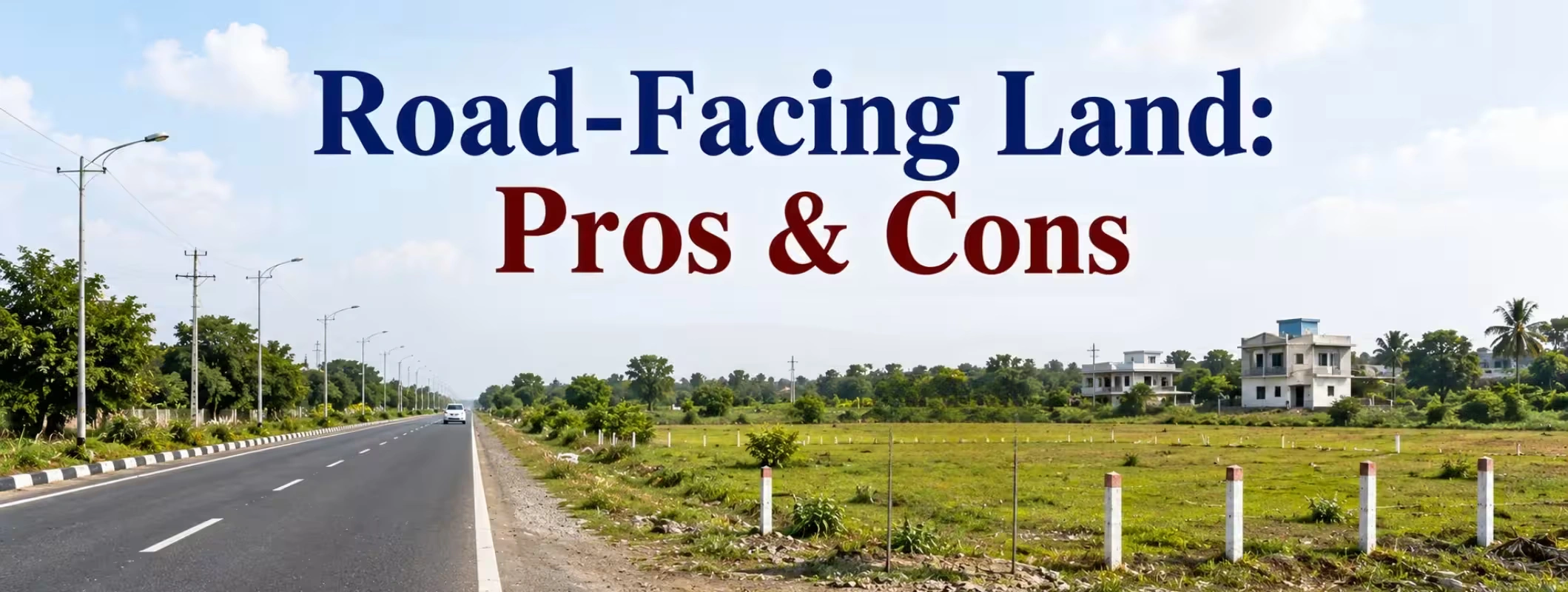
If you are planning to buy land, you must have looked at the land listings; you've probably noticed something. Road-facing plots always cost more than the ones situated away inside a village or behind other properties. Sellers usually mention "main road connectivity" in bold letters, and buyers often pay a premium for it without asking too many questions. But the real question is whether road-facing land is actually worth the extra money? Or are you just paying for the tag of the roadside land? This article answers this question honestly, so you can choose for yourself whether road-touch land fits your goals, or you're looking to buy rural land for farming, build a home, start a business, or simply hold it as an investment.
What Does "Road-Facing Land" Actually Mean?
Road-facing land is a plot that is directly connected to the road, so there is no need to pass through someone else's property to reach it. This road could be:
- A narrow village road
- A district road
- A state highway
- A national highway
The type of road directly impacts the pricing. A plot near a village lane is very different from one that is placed on a highway. Both get called "road-facing," but their value, use, and risks are not the same. This is one of the very important things to check whenever you see an Online Listing for a plot that you want to sell or farmland for sale that mentions road access. Always ask which road, how wide it is, and whether it's a government-maintained road or a private path that people are using for their daily work.
Why Buyers Are Drawn to Road-Facing Land?
There's a very simple answer to that question: road-touch plots sell faster. You don't need to ask for anyone's permission to enter or exit your own property. You are not required to negotiate with neighbors for a right of way. No risk of someone blocking your access years later. That alone makes a lot of people willing to pay more when they purchase land. But the reason for buying land near a road goes beyond convenience.
1. Easier to Sell Later
It is very simple: land that's hard to reach is hard to sell. Road-facing plots normally have more buyers because they're simpler to show, easier to develop, and don't come with the access headaches that landlocked plots often carry.
2. Better for Commercial Use
If you are someone who is willing to open a shop, warehouse, dhaba, fuel station, or storage unit, buying land near road access that is easily available is not a want; it's a need. Footfall and visibility depend on it.
3. Construction and Logistics Are Simpler
If you are planning on getting construction material, tractors, or machinery onto the plot it is far easier when there's direct road access. For farmland, this also means easier transport of crops to the market.
4. Utility Connections Are Often Quicker
Electricity poles, water lines, and other utilities are usually laid along roads. A road-facing plot often gets connected faster and at lower cost compared to land sitting deep inside plots.
Also Read: 7 Warning Signs That a Land Deal Could Be Risky
The Pros of Road-Facing Land
| Zone Type | Advantage | Why It Matters |
| Direct access | No dependency on neighbors or shared pathways | Provides independent entry and exit to the property. |
| Higher resale value | Buyers prefer plots with their own road access | Improves market demand and future appreciation. |
| Better visibility | Useful for commercial or mixed-use plans | Enhances business exposure and accessibility. |
| Easier utility connections | Power and water lines often run along roads | Reduces the cost and effort of obtaining utilities. |
| Simpler approvals | Some local bodies require road access for construction permits | Helps speed up the building approval process. |
| Flexible future use | Works for residential, commercial, or agricultural purposes | Allows multiple development options over time. |
These points explain why road-touch listings move quickly whenever someone wants to buy land in a growing area.
The Cons of Road-Facing Land
Road-facing land isn't automatically the better choice for everyone. There are real downsides worth thinking through.
1. Higher Price Per Unit
This is the most obvious one. Road-facing plots usually cost noticeably more than interior plots in the same area, sometimes 15–30% higher, depending on the road type and location.
2. Noise and Dust
A plot that is located right next to the highway might come with constant traffic noise and dust. This matters a lot if you're planning to build a home or a farmhouse and your basic needs are peace and quiet.
3. Road Widening Risk
Government road-widening projects are more common than people realize nowadays. If your land borders a road that is expected to get widened later, you could lose a strip of your property, sometimes without full compensation.
4. Setback Rules
Many local authorities require a specific amount of distance from the road before you can construct anything. This reduces your usable area, even though you're paying for the full plot size.
5. Security Concerns
Open access can be a double-edged sword. While it's convenient for you, it's also convenient for trespassers, especially on land that sits vacant for long periods, like farmland.
| Zone Type | Disadvantage | What to Watch For |
| Premium pricing | Higher purchase cost compared to interior plots | Compare rates with interior plots before deciding |
| Noise and pollution | Traffic noise and dust may affect livability | Worse near highways, less of an issue on village roads |
| Road expansion risk | Future widening may reduce usable land | Check government master plans for the area |
| Setback restrictions | Construction may be subject to minimum distance rules | Ask the local authority about minimum construction distance |
| Lower privacy | Constant movement of people and vehicles | More foot and vehicle traffic passing by |
Road-Facing Land for Different Purposes
Not every buyer has the same goal, so the pros and cons shift depending on what you're using the land for.
For Residential Use
If your priority is to get a peaceful home, a busy road-facing plot might not be what you should go for. A quieter road-touch plot, like one on a low-traffic village road, is often considered a good balance between access and calm.
For Commercial Use
In this case, direct access to the road is non-negotiable. Shops, restaurants, and warehouses depend on visibility and easy entry for customers and delivery vehicles.
For Agricultural Use
When you look at farmland for sale, road access mostly helps with transporting equipment, fertilizers, and harvested crops. It's useful, but you don't need a highway direct connection; a simple all-weather road is usually enough.
For Investment Purposes
If your main goal is to purchase rural land and sell it later at a profit, road-facing plots typically appreciate faster and attract buyers more easily, making them a reasonable choice for long-term investment.
Questions to Ask Before You Buy
Before you buy a plot of land one that is on a road you should go through this list:
- Is the road owned by the government, or is it a small local road?
- What is the width of the road, and will it be made wider?
- Is there a rule that says you have to leave some space between the road and your land?
- How is the plot from the part of the road where cars drive?
- Are there any problems with the road that people are arguing about?
- Does the land have all the right papers, and is it not connected to any road problems?
You can find out most of this information by visiting the land office or talking to the people in charge of the town.
How to Decide: Road-Facing or Interior Plot?
There is no one answer to this question. It depends on how much money you have, what you want to use the land for, and what is more important to you: you being close to the road or saving money.
- If you do not have a lot of money and the road is not an issue, you can buy a plot of land near a road-facing one, and it will be cheaper.
- If you want to use the land for a business,it is usually worth paying more for a road-facing plot.
- If you just want to farm the land, and you do not need a plot that's right on a big road, ad; a small road that is okay in all weather is fine.
The important thing is to choose a plot of land that's right for what you want to do with it; do not just buy it because it says "road-facing" in the description.
Buy and Sell Land Easily with 2Bigha
Finding the right plot, whether it's road-facing or not, takes time and research. This is where 2Bigha makes things very easy and simple for you. 2Bigha is a platform built for people who want to buy land, sell land, or explore various agricultural land and farmland for sale in various parts of India. Instead of relying on word-of-mouth or unreliable local agents, you get verified listings with clear details about road access, plot size, location, and pricing.
Whether you're looking to purchase land for farming, investment, or future construction, 2Bigha helps you compare road-facing and interior plots side by side, so you can make an informed decision instead of guessing. If you're a landowner, listing your property on 2Bigha also puts it in front of genuine buyers actively searching for plots for sale and farmland for sale options, without the usual back-and-forth of traditional land deals. For anyone serious about land investment in India, platforms like 2Bigha take a lot of the guesswork out of the process.
Conclusion
Road-facing land has advantages. It has access, better resale value, and more flexibility for commercial or residential use. It also comes with trade-offs. The land is more expensive. There is noise. There is also a risk of road-widening projects affecting your boundary. The smartest approach is to match the land to your needs. If you're buying for business or quick resale, road frontage is usually worth it. If you're after peace, privacy,y or pure farmland use an interior plot with road access might serve you just as well. This option is available, at a price. Whatever you decide, take time to verify the road type, legal status, and local rules before you buy land or commit your money.
Disclaimer: This article is for informational purposes only and should not be considered investment, legal, financial, or property advice. Real estate regulations, infrastructure plans, market conditions, and government policies may change over time. Readers are advised to verify information with relevant authorities and consult qualified professionals before making any investment or property-related decisions.