Key Takeaways
- The broader Ranchi flyover project aims to reduce pressure at major intersections and create faster links between residential areas, commercial centres and the Ring Road.
- Two major corridors—Argora Chowk to Dibdih Bridge and Karamtoli to Science City—have received Cabinet-level financial approval.
- Other reported corridors include elevated routes around Harmu, Hinoo, Kadru, Ashok Nagar, Jagannathpur and the Swarnarekha riverfront.
- Better connectivity may increase property interest in Argora, Harmu, Morabadi, Chiroundi, Kadru, Ashok Nagar and locations approaching the Ring Road.
- Property appreciation is not automatic. Buyers must evaluate ramp locations, road access, construction disruption, land titles, drainage and approved land use before investing.
- Project routes, lengths and completion schedules can change after detailed engineering, land acquisition, utility shifting and tendering.
Ranchi’s Five-Flyover Plan at a Glance
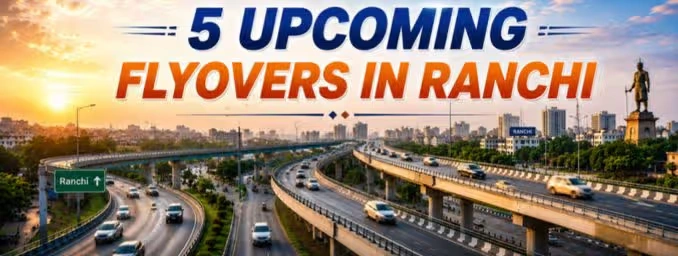
The announcement that Ranchi to get five new flyovers has attracted attention from commuters, businesses, developers, property buyers, and land buyers in Ranchi across Jharkhand’s capital. The proposed elevated corridors are intended to address recurring congestion on routes connecting Harmu, Argora, Morabadi, Hinoo, Kadru, Ashok Nagar, Jagannathpur and the Ring Road.
The programme is not simply about building isolated bridges over busy junctions. It represents a wider attempt to improve cross-city movement, redirect through-traffic and reduce pressure on narrow surface roads. The planned infrastructure upgrades are also being closely monitored by land buyers in Ranchi seeking locations with stronger future connectivity and long-term growth potential.
Two important projects have already moved beyond the early discussion stage. In April 2026, the Jharkhand Cabinet approved approximately ₹820 crore for an elevated road from Argora Chowk to Dibdih Bridge and another corridor from Karamtoli to Science City. Other proposed routes remain at varying stages of planning and design.
For residents, property buyers, and land buyers in Ranchi, the immediate question is simple: will the five new flyovers in Ranchi genuinely reduce daily travel time? The answer will depend not only on flyover construction but also on junction design, service roads, pedestrian movement, drainage, parking control and traffic management below the elevated structures.
Quick Answer: Why Is Ranchi Building Five New Flyovers?
Ranchi is planning new elevated corridors to separate through-traffic from local traffic at heavily used intersections. The projects are expected to improve movement between established neighbourhoods, growing residential areas and the Ring Road.
The proposed flyovers may help by:
- Removing a portion of through-traffic from crowded surface junctions
- Providing alternative routes around busy commercial areas
- Improving access between eastern, central and western Ranchi
- Reducing pressure on internal roads in Harmu, Kadru and Ashok Nagar
- Supporting faster movement towards the Ring Road
- Creating better connections between residential and employment areas
However, flyovers alone cannot solve Ranchi traffic congestion. Their long-term success will depend on coordinated road widening, public transport, parking enforcement, safe pedestrian facilities and last-mile connectivity.
Why Ranchi Needs Better Elevated Road Connectivity
Ranchi has expanded beyond its older urban core. Residential construction, educational institutions, hospitals, retail establishments, offices and government facilities now generate traffic across several directions at the same time.
Local roads that once handled moderate traffic are now carrying private cars, two-wheelers, auto-rickshaws, buses, delivery vehicles and commercial traffic. Congestion becomes particularly visible around important junctions where vehicles from multiple neighbourhoods merge into a limited road space.
Locations such as Argora, Harmu, Hinoo, Karamtoli and Morabadi are not merely passing points. They connect homes, offices, markets, hospitals, schools and major outbound routes. A disruption at one junction often creates a chain reaction across nearby roads.
The proposed Ranchi traffic improvement project attempts to address this network-level problem. Instead of improving only one intersection, the broader strategy seeks to create multiple elevated links that can distribute vehicles across alternative corridors.
This approach could improve urban mobility in Ranchi, but only when the flyovers operate as part of an integrated road system rather than independent structures.
Proposed and Approved Flyover Corridors in Ranchi
The reported programme includes a combination of approved projects and corridors still under planning. Public descriptions of the five-project package have varied over time, particularly where twin riverfront flyovers are counted as one corridor or separate structures.
The following table summarises the main routes associated with the broader plan.
| Reported corridor | Areas likely to benefit | Main transport purpose | Current position |
| Argora Chowk–Dibdih Bridge corridor | Argora, Harmu, Dibdih and adjoining eastern areas | Reduce pressure around Argora and improve east–west movement | Cabinet approval and funding reported |
| Kartik Oraon Chowk–LPN Shahdeo Chowk | Harmu Road, Kanke Road and nearby residential pockets | Provide an elevated alternative along the Harmu-side corridor | Reported at planning or DPR stage |
| Karamtoli–Science City via Morabadi | Karamtoli, Morabadi, Chiroundi and Ring Road approach | Improve movement from central Ranchi towards western growth areas | Cabinet approval and funding reported |
| Swarnarekha riverfront elevated corridor | Hinoo, Jagannathpur and Ring Road-side locations | Create a longer bypass-style link along the river corridor | Proposed within the wider riverfront plan |
| Harmu Muktidham–Radisson Blu corridor | Harmu, Kadru, Ashok Nagar and Hinoo | Divert through-traffic from crowded internal neighbourhood roads | Proposed and reported in planning documents |
The final engineering alignment may differ from earlier descriptions. Flyover lengths can also change after surveys, utility mapping, land acquisition reviews and junction-level design modifications.
1. Argora Chowk to Dibdih Bridge Elevated Road
The Argora side is one of the most important parts of the proposed network. The latest approved alignment has been reported as an approximately 3.8-kilometre elevated road from Argora Chowk in Harmu towards Dibdih Bridge.
This corridor matters because Argora connects several busy residential and commercial directions. Vehicles approaching from Harmu, Hinoo, Dibdih, Kathal More and adjoining neighbourhoods frequently meet around a limited number of junctions.
An elevated route could allow through-traffic to bypass some surface intersections. This may improve travel reliability for commuters moving between eastern Ranchi and central locations.
The project could also reduce traffic pressure on roads used by residents for short local trips. That distinction is important. A flyover works best when long-distance vehicles use the elevated section while the road below remains available for neighbourhood access, pedestrians, public transport and local businesses.
From a property perspective, Argora is already an established residential market. Better connectivity may strengthen buyer interest, but properties located immediately beside ramps or pillars may face noise, privacy and access concerns.
2. Kartik Oraon Chowk to LPN Shahdeo Chowk
A three-kilometre one-way elevated corridor has been discussed between Kartik Oraon Chowk and LPN Shahdeo Chowk. The route is expected to support movement around Harmu Road and adjoining connections towards Kanke Road and Ratu Road.
Harmu carries a mix of residential, institutional and commercial traffic. Many commuters use the area not as their final destination but as a connection between different parts of the city. Diverting this through-traffic could reduce repeated stopping at local intersections.
The design has been associated with supporting infrastructure such as drainage, utility corridors, footpaths and landscaping. These elements are not cosmetic extras. Poor drainage beneath elevated structures can create waterlogging, while unplanned utility work can lead to repeated digging after the road opens.
The real test will be whether the project protects local access. Shops, houses and smaller lanes should remain approachable without forcing drivers to make long diversions.
3. Karamtoli to Science City via Morabadi
The Karamtoli–Science City corridor is among the most closely watched upcoming flyovers in Ranchi. The latest approved proposal has been reported at around 3.2 kilometres, although earlier planning reports described a shorter elevated section combined with additional ground-level road connectivity.
The route is expected to pass through or serve Morabadi and improve movement towards Science City, Chiroundi and the Ring Road side.
This corridor has substantial strategic value because Morabadi is already a prominent residential and institutional area. It attracts daily movement related to housing, education, recreation, government activity and commercial services.
Connecting this zone more directly with the Ring Road could reduce the need for some vehicles to pass through crowded inner-city roads. It may also make western and north-western residential areas more accessible to people working in central Ranchi.
For property buyers, the corridor could make locations beyond the established Morabadi market more practical. However, purchasing solely on the basis of a proposed road alignment is risky. Buyers should confirm the sanctioned route and access points rather than relying on broker claims that a property is “five minutes from the flyover”.
4. Swarnarekha Riverfront Elevated Corridor
The broader plan has discussed twin one-way elevated structures along the Swarnarekha riverfront, beginning around the Hinoo side and extending towards Jagannathpur and the Ring Road.
This is potentially more transformative than a conventional junction flyover. Instead of crossing one congested intersection, a riverfront corridor could function as a longer alternative route for vehicles that currently pass through internal neighbourhood roads.
If implemented effectively, it may:
- Reduce through-traffic entering smaller residential streets
- Improve access between Hinoo, Jagannathpur and the Ring Road
- Create a more direct route for cross-city commuters
- Support riverfront improvement and organised utility planning
- Reduce pressure on existing arterial roads
Riverfront construction, however, requires careful environmental and engineering assessment. Drainage, flood behaviour, embankment stability, water flow and maintenance access must be considered before execution.
A road that blocks natural drainage or narrows the functional river area could create new urban problems instead of solving existing ones.
5. Harmu Muktidham to Radisson Blu Elevated Stretch
Another proposed corridor is expected to connect the Harmu Muktidham side with the Radisson Blu area. The alignment is intended to reduce pressure on Kadru, Ashok Nagar, Harmu and nearby internal roads.
This is a practical route from a traffic-distribution perspective. Kadru and Ashok Nagar contain dense residential development, offices, schools, hotels and commercial activity. Through-traffic often competes with local traffic for the same limited road space.
An elevated bypass could improve movement towards Hinoo and the airport side while retaining surface roads for local access. Its success will depend on where the ramps begin and end. Poorly located ramps can simply transfer a traffic jam from one junction to another.
For nearby property owners, better citywide access may be positive. Yet houses located immediately beside an elevated structure could experience more noise, reduced daylight or visual intrusion. The impact will vary street by street.
What Has Already Been Approved?
The most important development in recent Ranchi flyover news is the reported Cabinet approval of approximately ₹820 crore for two projects:
- An approximately 3.8-kilometre elevated road from Argora Chowk to Dibdih Bridge, with around ₹469.62 crore approved.
- An approximately 3.2-kilometre flyover from Karamtoli to Science City, with around ₹351.14 crore approved for construction, utility shifting, land requirements and related works.
Approval is an important milestone, but it does not mean immediate completion. Major infrastructure generally moves through several stages:
- Detailed design confirmation
- Tender preparation and contractor selection
- Land acquisition, where required
- Utility identification and shifting
- Traffic-diversion planning
- Site mobilisation
- Foundation and pier construction
- Deck installation
- Road finishing and safety checks
The other corridors associated with the wider five-flyover programme may be at different stages. Readers should distinguish between an announced concept, a completed DPR, a sanctioned budget, an issued tender and active construction.
How the Flyovers Could Change Daily Travel
The main purpose of the new flyover projects in Ranchi is to make city travel more predictable. For many commuters, reliability matters as much as speed.
A 25-minute journey that frequently takes 50 minutes due to uncertain congestion affects office timings, school schedules, airport travel, delivery operations and emergency movement. Elevated corridors can help separate vehicles travelling longer distances from those stopping within the locality. Improved connectivity can also benefit property owners looking to list property online, as better infrastructure often increases interest from buyers and investors evaluating locations across the city.
Faster cross-city movement
Commuters may gain more direct connections between Argora, Harmu, Morabadi, Hinoo, Jagannathpur and the Ring Road.
Reduced pressure at surface intersections
When through-traffic shifts to an elevated road, the intersection below may become easier to manage. This benefit depends on disciplined parking and proper lane design.
Better access to growth areas
New links towards Science City, Chiroundi and the Ring Road may make developing residential pockets easier to reach.
Improved airport-side connectivity
Corridors around Hinoo, Kadru and Ashok Nagar could improve access towards the airport side, particularly for commuters approaching from western or northern Ranchi.
More efficient emergency and service movement
Ambulances, fire services, public transport and delivery vehicles may benefit from more predictable routes, provided access is well planned.
What Flyovers Cannot Fix on Their Own
It is tempting to treat elevated roads as a complete solution, but the flyovers to ease traffic in Ranchi will not succeed without improvements at ground level.
Persistent problems may continue when:
- Vehicles park illegally under or beside the flyover
- Auto-rickshaws stop directly at ramps
- Pedestrians lack safe crossings
- Service lanes are too narrow
- Drainage remains blocked
- Traffic signals are poorly coordinated
- Encroachments reduce usable road width
- Bus stops are positioned at junction mouths
- Ramp traffic merges without sufficient road space
Authorities must treat the flyovers as part of a wider city infrastructure upgrade. Otherwise, vehicles may move faster on the elevated section only to become stuck at the exit.
Real Estate Impact of Ranchi’s New Flyovers
Road connectivity influences real estate because it changes how people perceive distance. A neighbourhood that once felt inconvenient may attract more attention when travel becomes easier and more predictable.
The Ranchi new flyovers could influence residential land, apartments, rental housing and commercial premises across several micro-markets. The effect, however, will not be uniform.
Argora and Harmu
Argora and Harmu are already recognised residential locations with established social infrastructure. Improved connectivity may strengthen their appeal among professionals and families who need access to multiple parts of the city.
Demand may increase for well-connected apartments located a reasonable distance from flyover ramps. Properties directly facing the structure may not receive the same benefit because of noise and reduced privacy.
Morabadi and Chiroundi
The Karamtoli–Science City corridor may improve access to Morabadi, Chiroundi and locations moving towards the Ring Road. These areas could attract buyers looking for larger homes, newer apartments or residential plots outside the most congested central zones.
The strongest benefit may go to properties that gain faster access without sitting directly beside heavy traffic.
Kadru and Ashok Nagar
A Harmu-side elevated connection could reduce through-traffic on internal roads in Kadru and Ashok Nagar. If the road below becomes calmer, established residential streets may become more comfortable.
Commercial properties near properly designed access points may gain visibility. In contrast, shops bypassed by the elevated route may initially experience lower passing traffic.
Hinoo and Jagannathpur
A riverfront corridor linking Hinoo and Jagannathpur could improve long-distance movement towards the Ring Road. This may support residential and commercial demand in areas that combine airport-side access with outbound road connectivity.
The actual impact will depend on ramp locations, local road capacity and whether the project integrates effectively with existing junctions.
Ring Road-side land
Improved connections from central Ranchi towards the Ring Road can increase interest in peripheral plots. Buyers may see these locations as more practical for future housing, warehousing or commercial activity.
However, speculation often runs ahead of construction. Buyers searching for plots for sale in Ranchi should not pay a major premium merely because a broker claims that an upcoming flyover will pass nearby.
Will Property Prices Rise Near the New Flyovers?
The value of property near Ranchi flyovers may increase where a project produces genuine improvements in travel time, road quality and access to employment or commercial areas.
Price growth is more likely when a property has:
- Clear and legal road access
- A comfortable distance from noise and heavy traffic
- Approved residential or commercial land use
- Nearby schools, hospitals, markets and utilities
- Strong connectivity beyond the flyover itself
- A clear title and mutation records
- Low acquisition or demolition risk
Property values may remain unchanged—or even face local pressure—when a building loses direct access, stands too close to a ramp, faces prolonged construction disturbance or experiences increased noise.
Infrastructure is a value driver, not a guarantee of profit.
Residential Property Versus Commercial Property
The impact on homes and business premises can differ substantially.
| Property type | Possible advantage | Possible concern |
| Apartment within a short drive of the corridor | Faster commute and stronger rental appeal | Construction noise during the project |
| House directly beside a flyover | Improved wider connectivity | Noise, privacy loss, dust and reduced daylight |
| Shop near an exit ramp | Increased accessibility and customer catchment | Congestion or restricted stopping |
| Shop on a bypassed surface road | Calmer local environment | Lower passing traffic |
| Plot near a Ring Road connection | Better long-term development potential | Speculative pricing and delayed execution |
| Office space near a major junction | Easier employee and client access | Parking limitations and traffic merging |
Investors considering commercial property in Ranchi should study traffic direction rather than only traffic volume. A busy corridor does not automatically bring customers if vehicles cannot stop, turn or enter the property safely.
Should You Buy Land Near a Proposed Flyover?
Buying land for sale near Ranchi flyover routes may offer long-term potential, but proposed infrastructure creates both opportunity and risk.
Before purchasing, inspect the property physically and verify:
- Whether the plot falls within the announced or revised alignment
- Whether any portion may be required for road widening or a ramp
- The recorded approach road and its actual ground width
- Ownership history, mutation and tax records
- Approved land use under the applicable development plan
- Restrictions related to rivers, drains or public land
- Availability of electricity, water and sewerage
- Distance from flyover pillars and high-traffic merging points
- Drainage level during the monsoon
- Nearby development that already exists—not only future promises
Buyers should also compare registration records and recent transactions rather than accepting asking prices as evidence of market value.
A Practical Buyer Checklist
Use this checklist before making a real estate investment near Ranchi flyovers:
- Confirm whether the project is proposed, approved, tendered or under construction.
- Review the latest alignment instead of relying on an old map.
- Visit the location during morning and evening peak hours.
- Check whether the property will retain direct entry after construction.
- Measure the distance from proposed ramps, pillars and service roads.
- Verify title documents through a qualified legal professional.
- Confirm mutation, tax payments and land-use permissions.
- Check for acquisition notices or road-widening markings.
- Assess drainage, natural ground level and monsoon water flow.
- Compare recent registered transactions in the same locality.
- Avoid paying an infrastructure premium based only on verbal assurances.
- Consider both construction-phase disruption and post-completion benefits.
How Construction May Affect Local Residents and Businesses
Large flyover projects usually create temporary inconvenience before delivering long-term benefits. Piling, barricading, utility shifting and traffic diversions can reduce usable road width for months.
Residents may experience:
- Longer travel times during construction
- Dust and noise near work zones
- Temporary entry restrictions
- Changes in auto-rickshaw and bus routes
- Pressure on smaller colony roads used as diversions
- Reduced pedestrian safety around barricades
Businesses may face lower visibility or difficult customer access during construction. Authorities and contractors should maintain clear signage, safe walking routes and access to shops wherever possible.
Owners should not assume that every construction-related problem will disappear immediately after inauguration. Surface-road restoration, drainage completion and parking control are equally important.
Wider Benefits for Ranchi’s Urban Growth
The broader Ranchi road infrastructure development programme could influence more than commuting.
Greater economic efficiency
Predictable travel helps businesses manage employee movement, deliveries and customer access more effectively.
Better distribution of development
When new areas become easier to reach, housing and commercial activity do not have to remain concentrated around already congested central locations.
Stronger Ring Road integration
Connections towards the Ring Road can redirect vehicles that do not need to enter the city centre.
Improved investor confidence
Visible infrastructure execution can encourage private investment, although confidence depends on timely completion and maintenance.
Support for planned urban expansion
Road connectivity can help direct future growth towards serviced areas instead of allowing unplanned construction along narrow local roads.
The quality of road development in Ranchi will ultimately depend on how transport planning works with drainage, land use, public spaces and environmental management.
How 2Bigha Can Support Property Discovery
Infrastructure announcements often lead to rushed buying decisions and unverified price claims. Buyers should compare location, legal access, surrounding development and long-term usability before selecting land.
2Bigha helps users explore land opportunities with clearer location context rather than depending entirely on informal broker descriptions. Property owners can also consider its subscription plan and property management service for continued support related to their land assets.
The objective should not be to purchase the closest plot to a proposed flyover. A better approach is to identify legally clear land that gains practical connectivity while remaining protected from excessive noise, acquisition risk and access restrictions.
What Should Investors Watch Next?
People following the latest Ranchi infrastructure news should monitor implementation milestones rather than announcement headlines alone.
Important developments include:
- Publication of final DPR details
- Tender invitations and contractor appointments
- Official alignment maps
- Land acquisition notifications
- Utility-shifting activity
- Traffic-diversion plans
- Construction start dates
- Revised project costs
- Ramp and service-road designs
- Environmental and drainage provisions
- Official completion targets
The gap between approval and completion can be significant. Investors should update their assumptions whenever the alignment, budget or construction schedule changes.
When Will the Ranchi Flyovers Be Completed?
A single reliable completion date has not been publicly established for the entire five-project programme. The corridors are at different stages, so they are unlikely to begin or finish together.
Even after financial approval, the timeline may be influenced by:
- Tendering and contractor mobilisation
- Land availability
- Utility shifting
- Monsoon conditions
- traffic-management requirements
- Design changes
- Environmental or riverfront clearances
- Coordination with local agencies
Any completion date quoted before the tender and construction schedule is officially released should be treated as provisional.
Final Outlook
The plan for flyovers in Ranchi Jharkhand could become one of the city’s most significant mobility upgrades if the projects are completed with proper surface-road planning.
The approved Argora–Dibdih and Karamtoli–Science City corridors show that the programme has moved beyond general discussion in at least two locations. The other proposed routes around Harmu, Hinoo, Kadru, Jagannathpur and the Swarnarekha riverfront could create a broader network capable of redistributing traffic across the city.
For commuters, the main benefit would be more predictable travel. For land buyers in Jharkhand, the projects may create opportunities in better-connected neighbourhoods. But sensible investment requires more than following a flyover announcement.
The best properties will usually be those that gain accessibility without suffering from ramp congestion, noise, acquisition risk or poor local entry. Buyers should track official progress, visit locations personally and verify every legal and planning detail before committing funds.
Ranchi’s transport transformation will not be measured only by the number of elevated roads constructed. It will be judged by whether the projects create safer junctions, easier local access, better drainage and a more liveable city at ground level.
Disclaimer: This article is for informational purposes only and should not be considered investment, legal, financial, or property advice. Real estate regulations, infrastructure plans, market conditions, and government policies may change over time. Readers are advised to verify information with relevant authorities and consult qualified professionals before making any investment or property-related decisions.