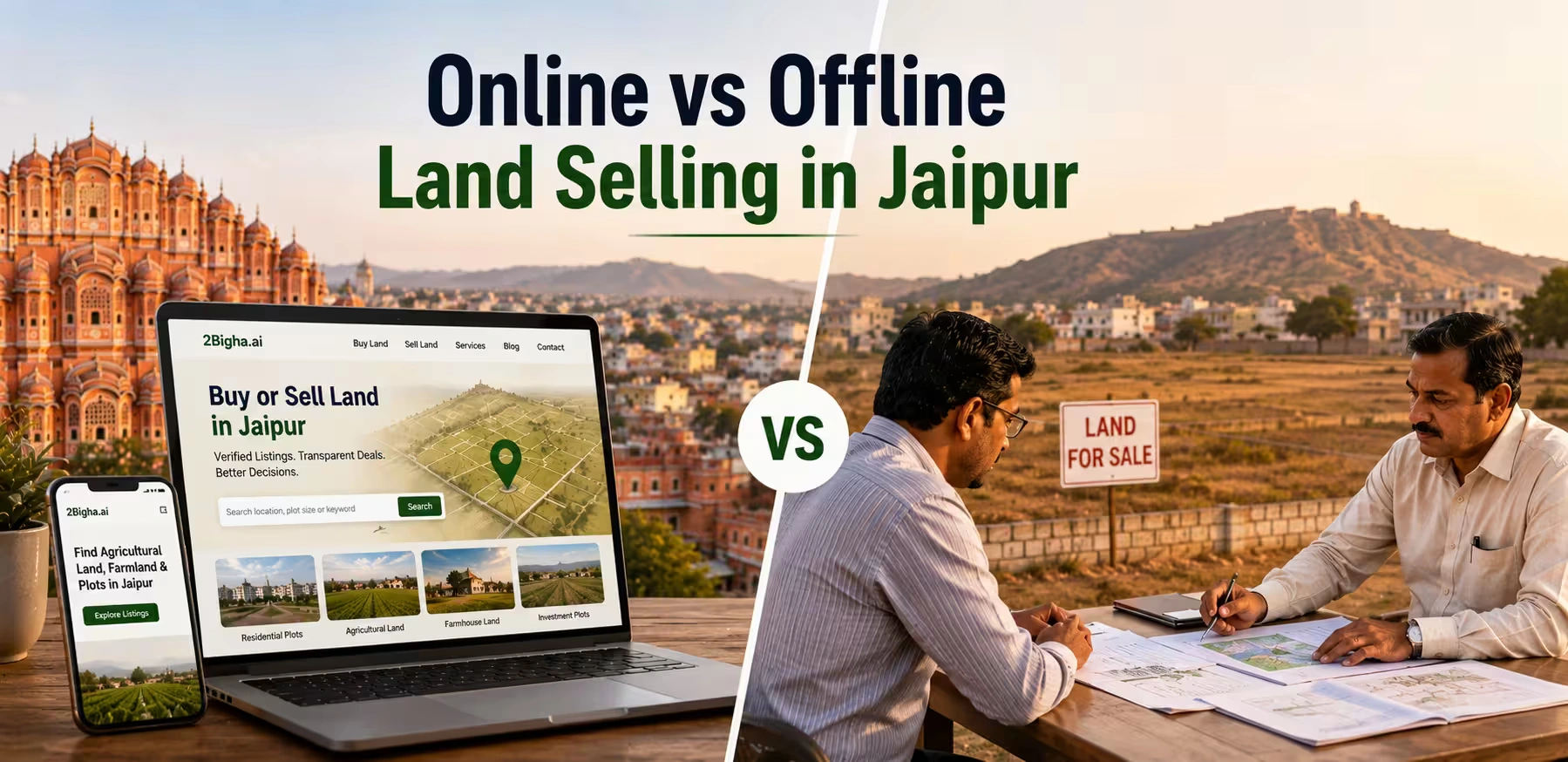
A few years back, selling land in Jaipur meant one thing. You called a local dalal, put up a hand-painted board near the plot, and waited. Sometimes for months. Today, that's only half the picture. There's a whole online world of land/plot searching happening on phones and laptops, and a lot of sellers are stuck wondering which route actually gets them a fair deal, faster. Both methods still work. Neither has completely replaced the other. But they work very differently, and picking the wrong one for your situation can cost you time, money, or both.
How Offline Land Selling Actually Works in Jaipur?
This is the method most families in Rajasthan grew up with. You know your local broker; maybe your father dealt with the same one. You trust the relationship more than the paperwork. Here's roughly how it plays out:
- You approach a local agent or dalal familiar with your area: Ajmer Road, Sikar Road, wherever the land sits
- The agent spreads the word through their own network, sometimes just word of mouth in the village or colony
- Interested buyers visit the plot in person, usually multiple times before deciding
- Price negotiation happens face to face, often over several sittings with tea involved
- Once a buyer agrees, the deal moves to registration at the local Sub-Registrar Office
This still has real advantages. Local agents know the DLC rates for their specific tehsil. They know which buyer is serious and which one's just looking. For rural land buyers who prefer to physically walk the plot boundaries before committing, offline selling still feels safer. But it comes with limits too. Your buyer pool is basically whoever the agent knows. If nobody in that network wants agricultural land right now, your plot just sits.
How Online Land Selling Has Changed the Game?
Online platforms flipped the buyer pool completely. Instead of relying on one agent's contacts, your land shows up to anyone doing land/plot searching from anywhere in India, or honestly, anywhere in the world. A basic online listing usually includes:
- Photos and sometimes drone shots of the plot
- Exact location, khasra number, and area details
- Asking price and negotiation flexibility
- Land use type, agricultural, residential, or converted
- Contact details or a direct inquiry button
This matters a lot for agricultural land for sale outside city limits. A farmer in a remote part of Rajasthan might struggle to find local buyers, but the same land could interest an NRI investor or a city-based buyer looking for long-term land appreciation, someone who'd never have heard about it through the old network.
Quick Comparison: Online vs Offline Selling
| Factor | Offline Selling | Online Selling |
|---|---|---|
| Buyer Reach | Limited to local buyers and personal networks | Nationwide and, in some cases, international audience |
| Speed | May take several months to find a buyer | Often faster due to greater property visibility |
| Cost | Broker commission, typically around 1–2% | Platform fees vary and are often lower than traditional brokerage costs |
| Trust Factor | Built through personal relationships and physical property visits | Depends on platform verification, reviews, and listing credibility |
| Documentation Help | Brokers may provide informal assistance with paperwork | Documentation support is often integrated into the platform's services |
| Price Transparency | Prices are usually negotiated privately | Comparable listings make pricing more transparent |
Where Trust Actually Comes From?
This is the part people worry about most, and honestly, it's a fair worry. Nobody wants to hand over land documents to a stranger they found on the internet. Offline, trust comes from familiarity. You've known the agent for years, or someone in your family has. That's nothing.
Online, trust has to come from somewhere else: verification. This is why verified land listings matter so much more than a random classified ad. A listing that's actually checked for clear title, correct khasra details, and accurate land use status protects both sides of the deal. Without that verification layer, online selling can feel riskier than it needs to be.
The Paperwork Doesn't Change, Only the Starting Point Does
Whether you sell through a local agent or an online platform, the final step in Rajasthan is the same. Every property transaction has to be registered through the state's e-Panjiyan system, which is run by the Inspector General of Registration and Stamps. This isn't optional. Without registration, a sale isn't legally recognized, no matter how the buyer and seller found each other. The e-Panjiyan portal handles quite a bit these days: DLC rate checks, document status tracking, e-stamp verification, and slot booking at the Sub-Registrar Office. So even a fully online deal still ends with an in-person visit for photo and thumb verification. Online selling speeds up the finding-a-buyer part, not the legal part.
Which One Should You Actually Choose?
This all depends upon what kind of land you possess and how soon you would like to get things done.
If offline is more appropriate for you, then:
- Your land comes from a compact and close rural area
- You already have a broker whom you can trust
- You’re not in a hurry to sell and like negotiating personally
If online is more appropriate for you then:
- You’d like to sell your agricultural land online
- Your land is located in a growth area near Jaipur which is being watched by external investors
- You’d like to see the prices yourself rather than just trust one agent
- You’re trying to buy land in Jaipur from outside and can’t come repeatedly
These days, many sellers are not choosing any of those options; they are opting for both: one listing online to expand their buyer list and someone from the area to do the trust thing.
How 2Bigha Bridges Both Worlds?
This is really where 2Bigha fits in. It's built specifically as a marketplace for agricultural land and farmland across India, and the whole point is to combine the reach of going online with the trust that offline deals usually rely on. Instead of a plain classified ad, 2Bigha focuses on verified land listings, so buyers aren't left guessing about title status or land use before reaching out. If you're trying to sell agricultural land online but worried about handing over details to unknown buyers, that verification step does a lot of the trust-building work automatically.
It also works well from the buyer's side. Someone doing land/plot searching for farmland for sale near Jaipur doesn't have to depend on one local agent's limited inventory. They can compare multiple verified options, check land details upfront, and only reach out to sellers whose land actually fits what they're looking for. For rural land buyers specifically, that's a real shift from how things used to work.
Conclusion
Both the offline and online channels for selling property will remain in place in Jaipur for some time to come, but the truth is that neither really needs to compete with the other. The former has an edge in the area of credibility and local connections. The latter has its advantages in reach and speed of access. Either way, the documentation through the process of e-Panjiyan is the same, and the only question is when the buyer must be found and where the search must take place. If the property happens to be located within any of the growth corridors of Jaipur, the online channel, specifically the verified listing site, would have the edge.
Disclaimer: This article is for informational purposes only and does not constitute legal, financial, investment, tax, or real estate advice. Information, including market trends, property prices, infrastructure developments, and government policies, may change over time. Readers should verify all details through official sources and consult qualified professionals before making any property-related decision.