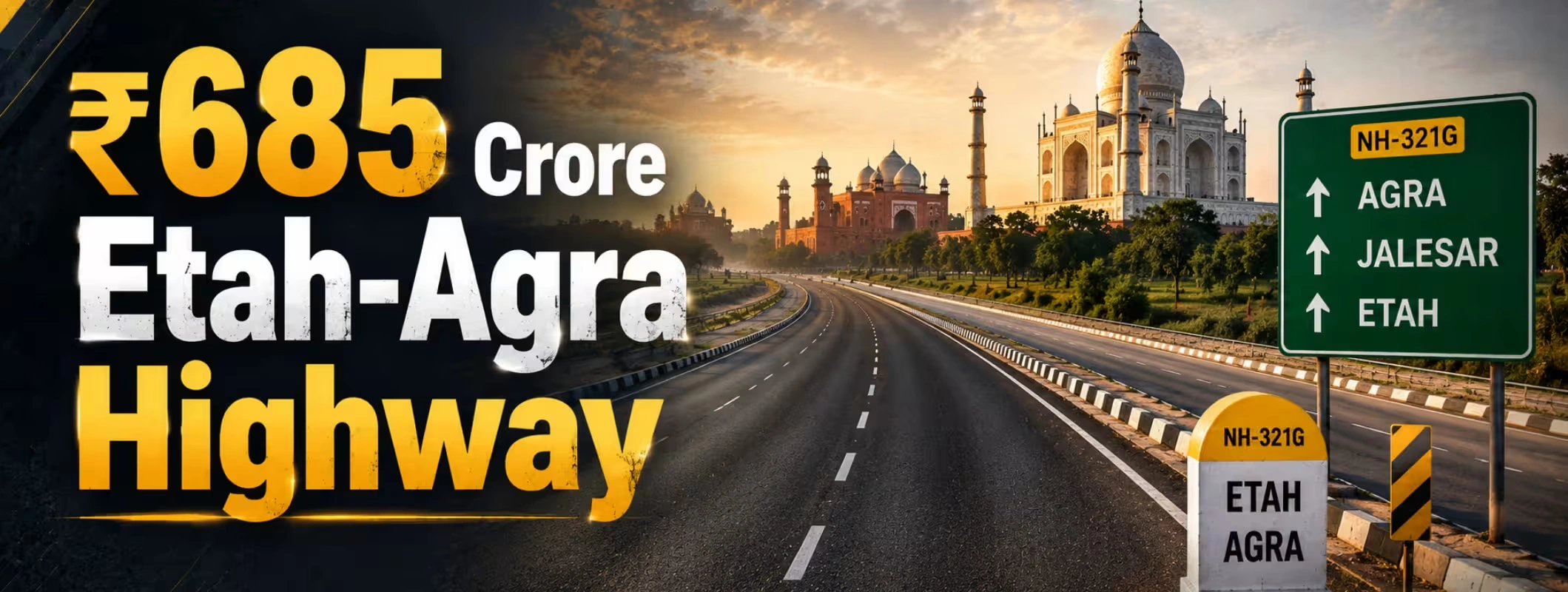
The proposed upgrade of the Etah Agra Highway, officially identified as NH-321G, has faced repeated delays because a major section passes through the environmentally sensitive Taj Trapezium Zone. Tree-felling permissions, compensatory afforestation requirements, land procedures and tender revisions have slowed the development of this strategically important road connecting Agra, Jalesar and Etah. The project is also being closely watched by stakeholders in the rural land market in Uttar Pradesh due to its potential impact on regional connectivity and future development. However, describing the entire project as permanently stalled would be inaccurate. Government records show continuing activity on different parts of the corridor. A fresh tender for the Agra-to-Nuhkhas section remained open in June 2026, land-acquisition proceedings continued, maintenance work was invited and construction expenditure had already been recorded on the Nuhkhas-to-Etah section. The practical position is therefore more nuanced: the NH-321G project update shows movement at the administrative and procurement levels, but the complete corridor is still far from delivering the seamless connectivity originally expected.
Key Takeaways
- The proposed Agra–Jalesar–Etah corridor covers approximately 75.7 kilometres and is being handled in separate construction packages.
- The widely reported ₹685.51 crore amount relates mainly to the 51.6-kilometre Agra–Nuhkhas package rather than a simple current cost for the entire highway.
- The TTZ clearance delay largely concerns tree removal, forest procedures and compensatory afforestation within the protected Taj Trapezium Zone.
- A Supreme Court-appointed committee recommended reducing the number of trees proposed for felling from 3,874 to 2,818.
- A new EPC tender for the Agra–Nuhkhas section was active in June 2026, indicating that the project has not been abandoned.
- The Nuhkhas–Etah package has recorded construction activity, although its earlier completion timelines have slipped.
- Better road access may support trade, agriculture, logistics and local property demand, but buyers should not assume automatic land-price appreciation.
- Anyone exploring land near Etah Agra Highway should verify acquisition notices, title records, road access, land use and the approved alignment before paying a token amount.
Etah Agra Highway Quick Facts
| Project detail | Current information |
| Highway | National Highway 321G |
| Main corridor | Agra–Jalesar–Etah |
| Approximate planned length | 75.7 km |
| Agra-side starting point | Junction with NH-509 near Tedhi Baghia |
| Etah-side connection | Near NH-34 and the Etah Police Line area |
| Package 1 | Agra/Tedhi Baghia to Nuhkhas, 51.6 km |
| Package 2 | Nuhkhas to Etah, 24.1 km |
| Proposed road standard | Two lanes with paved shoulders, with four-lane configurations at selected locations |
| Major environmental issue | Tree removal and compensatory afforestation within the TTZ |
| Latest broad position | Procurement, land and partial construction activity continue, but full completion remains delayed |
What Is the Latest Update on the Etah Agra Highway?
As of June 2026, the Etah Agra Highway latest update is that government activity continues on both the road and its supporting approvals, but the project has not reached full-scale, uninterrupted execution across its complete length.
A fresh request for proposal was issued for rehabilitation and upgrading of the 51.6-kilometre stretch from the NH-509 junction near Tedhi Baghia in Agra to Nuhkhas. The tender was listed with a July 2026 submission deadline. This is an important development because it confirms that the Agra-side package is being pursued through a new procurement cycle.
The government also issued an acquisition notification in February 2026 for a small parcel in Khandahat village in Agra district. Separately, a one-time improvement and maintenance tender worth approximately ₹15.56 crore was published for left-out portions between kilometre 0 and kilometre 51.6.
These activities do not mean the complete highway is ready for immediate construction. They show that agencies are attempting to keep the corridor operational and move the main upgrade through land, tender and clearance processes.
Therefore, the most accurate answer to “Is NH-321G under construction?” is:
Different parts of NH-321G are at different stages. The Nuhkhas–Etah package has seen physical work, while the larger Agra–Nuhkhas package remains tied to a fresh tender process and outstanding environmental and procedural requirements.
Understanding the NH-321G Route
The proposed NH-321G route map follows the existing Agra–Jalesar–Etah road corridor. It begins around the junction with NH-509 near Tedhi Baghia on the Agra side and moves towards Jalesar, Nuhkhas, Nidhauli Kalan and Etah, terminating near the NH-34 connection around the Etah Police Line area.
The corridor is planned as a two-lane road with paved shoulders, while certain built-up, junction or high-traffic sections may receive wider configurations. This is different from describing the entire route as a continuous four-lane expressway.
The route broadly serves:
- Outer Agra and the Tedhi Baghia side
- Settlements and agricultural areas along the Agra–Jalesar road
- Jalesar and its surrounding trade belt
- Nuhkhas
- Nidhauli Kalan
- Etah and the NH-34 connection
For residents, this is not simply another highway on a government map. It is a daily road used for farm transport, local trade, education, medical travel, passenger movement and access to Agra’s larger commercial network.
How the Etah Agra Highway Project Is Divided
Understanding the package structure is necessary because media reports sometimes combine separate budgets and progress figures.
Package 1: Agra to Nuhkhas
The first and larger package extends for approximately 51.6 kilometres from the junction near Tedhi Baghia in Agra to Nuhkhas.
A parliamentary record from 2022 listed an estimated cost of ₹685.51 crore for this section. That figure is the main reason the project is widely described as the INR 685 crore Etah Agra Highway.
This package has faced the more serious environmental and procurement complications because a substantial portion falls within the Taj Trapezium Zone. Earlier tender activity did not result in smooth execution, and the work subsequently returned to the bidding stage.
A new EPC tender issued in February 2026 shows that the authorities are once again attempting to award the package. Its tender dates were extended into July 2026.
Package 2: Nuhkhas to Etah
The second package covers approximately 24.1 kilometres from Nuhkhas to Etah. Earlier government documents placed its estimated cost at around ₹343.54 crore.
Unlike the Agra-side package, this section has seen some physical execution. A government infrastructure monitoring report published in 2026 recorded only about one-fourth physical progress as of April, despite a revised completion target falling in June 2026.
This indicates that Package 2 is also delayed. It would therefore be incorrect to treat June 2026 as a confirmed NH-321G completion date for the full road.
Why Different Project Cost Figures Are Reported
Readers may find several costs attached to the same road:
- ₹685.51 crore for the 51.6-kilometre Agra–Nuhkhas package
- Approximately ₹343.54 crore for the Nuhkhas–Etah package
- An older ₹576.85 crore estimate appearing in the forest-diversion proposal
- Different values in later tender and maintenance documents
These figures do not necessarily contradict one another. Highway costs change when agencies revise designs, split a corridor into packages, alter structures, add bypasses, update land costs or reissue tenders after several years.
The ₹685 crore figure should consequently be presented as the estimated value associated with the Agra–Nuhkhas package at a particular approval stage—not as a guaranteed final expenditure for the complete Agra–Etah corridor.
Why Is NH-321G Construction Delayed?
The main NH-321G construction delay is linked to the interaction between highway development and environmental protection in the Taj Trapezium Zone.
The TTZ is a protected region established to control environmental damage around the Taj Mahal. Infrastructure work involving tree felling within this region must satisfy stricter conditions than an ordinary road-widening project.
For NH-321G, the core issues include:
1. Permission to Remove Trees
The state initially sought approval to remove 3,874 trees for the Agra-side widening work. The Supreme Court-appointed Central Empowered Committee reviewed the proposal and concluded that fewer trees needed to be cut.
Its assessment recommended:
- Felling 2,818 trees
- Saving 818 trees
- Translocating 229 trees
- Planting tall saplings along available road margins
- Carrying out large-scale compensatory plantation
The difference between the original request and the committee’s recommendation required the project authorities to revise their environmental approach.
2. Compensatory Afforestation
The committee recommended planting 38,740 indigenous plants on approximately 42.684 hectares of identified non-forest land.
Identifying land is only one part of the process. The relevant land must also receive the required legal protection, fencing, plantation arrangements and long-term maintenance. Unless these conditions are documented properly, tree-felling permission cannot translate into immediate road construction.
3. Supreme Court and CEC Oversight
Projects within the Taj region face judicial scrutiny because road widening, industrial activity, tree removal and urban construction can affect air quality and the wider ecosystem around the monument.
This means the NH-321G environmental clearance update depends on more than an ordinary departmental approval. Compliance must satisfy the directions applicable to the TTZ, and tree-felling permission may require examination by the Central Empowered Committee or the Supreme Court, depending on the location and nature of the work.
4. Land Acquisition and Utility Shifting
Even after environmental permission, construction cannot progress smoothly unless authorities secure the necessary land and relocate utilities.
Electric lines, water pipelines, local drains, structures, access points and roadside commercial activity can all delay site handover. A long linear project may appear ready on paper while several small unresolved parcels prevent continuous construction.
5. Tender Cancellation and Re-Bidding
Earlier attempts to award sections of the project did not lead to full execution. Tender cancellation, redesign or re-bidding adds several months because agencies must update costs, prepare revised documents, invite bids, evaluate contractors and issue the final award.
The current Etah Agra Highway tender update is more positive than earlier reports: a new tender for Package 1 remained active in June 2026. Even so, an active tender is not the same as a construction award or physical commencement.
Is the Entire Etah Agra Highway Stalled?
No. The complete road should not be described as entirely inactive.
The available records show four different types of movement:
- Some construction and expenditure on the Nuhkhas–Etah package
- A fresh tender process for the Agra–Nuhkhas package
- Continuing land-acquisition proceedings
- Maintenance and one-time improvement work on existing sections
At the same time, the promised full-corridor upgrade remains delayed. The most accurate description is that the project is progressing unevenly, with environmental approvals and procurement affecting the Agra-side section more severely.
Why the Highway Matters to Agra, Jalesar and Etah
The Agra Jalesar Etah Highway project status matters because the existing road carries a mix of local vehicles, tractors, buses, goods carriers, motorcycles and agricultural traffic.
Better Regional Connectivity
A properly engineered road with paved shoulders can improve travel reliability between Etah and Agra. Wider shoulders can also provide safer space during breakdowns and reduce conflicts between slow-moving agricultural vehicles and faster traffic.
Support for Jalesar’s Metal and Bell Industry
Jalesar is known for its traditional metalwork, including bells and brass-based products. Manufacturers and traders depend on road access for raw materials and finished goods.
A dependable Jalesar Etah road widening project could reduce damage to goods, improve delivery planning and make it easier for smaller manufacturers to connect with Agra and other regional markets.
Faster Movement of Agricultural Produce
The surrounding belt has a strong agricultural character. Farmers and traders transport grain, vegetables, dairy products, inputs and machinery through local roads connected to the highway.
Road improvement does not automatically increase farm income, but it can reduce uncertainty in transport time and improve access to mandis, storage facilities and urban buyers.
Safer Local Travel
The present corridor passes through settlements where pedestrians, two-wheelers, tractors and commercial vehicles often use the same limited road space.
Better junction design, drainage, shoulders, markings and settlement treatment can provide greater safety. These elements are as important as simply adding road width.
Greater Access to Agra
Agra offers larger hospitals, educational institutions, wholesale markets, transport hubs and tourism-linked employment. Improved Agra Etah road connectivity could make these facilities more accessible to people living in Jalesar, Nidhauli Kalan and adjoining rural areas.
Existing Road Conditions and the Cost of Delay
Residents experience project delays differently from officials reading tender documents. For a commuter, delay means potholes, dust, waterlogging, broken shoulders, slow traffic and unsafe overtaking.
Incomplete widening can sometimes make conditions worse temporarily. Excavated shoulders, construction material, unmarked diversions and uneven surfaces create new risks when work proceeds in isolated patches without a continuous traffic-management plan.
Maintenance work invited in 2026 is therefore important. It may not replace the permanent upgrade, but it can provide short-term relief on sections where the main contract has yet to begin.
Authorities should prioritise:
- Pothole repair before and during the monsoon
- Dust suppression near settlements
- Safe diversion markings
- Drainage cleaning
- Shoulder restoration
- Protection around schools and market areas
- Clear public updates on active construction stretches
How Could NH-321G Affect the Local Real Estate Market?
Highways influence property markets, but their impact is rarely uniform. The property near NH-321G with the greatest potential will usually be land that combines legal clarity, usable access and genuine commercial demand.
Road-Facing Commercial Land
Plots close to major junctions or established settlements may attract interest for shops, workshops, agricultural-input stores, small warehouses, restaurants and service facilities.
However, direct highway frontage does not automatically give a property legal entry and exit. Access may be controlled, especially after widening. A plot that appears commercially attractive today may lose direct access after a service road, drain or median is constructed.
Agricultural Land
Improved connectivity may make farmland easier to reach and manage. It can also support faster movement of produce.
Yet buyers searching for agricultural land near NH-321G must verify whether the plot is affected by acquisition, whether the access path is recorded and whether non-agricultural commercial use would require permission.
Warehousing and Logistics
The corridor could support small logistics uses where it connects with established roads and demand centres. Such development is more likely near junctions, towns and existing trading clusters than beside every village along the alignment.
Large warehouses also require adequate plot depth, turning space, power, water, land-use approval and all-weather approach roads. Highway proximity alone is not enough.
Residential Demand
Improved travel may gradually support residential plots near Jalesar, Nidhauli Kalan and Etah. But scattered plotting without drainage, roads, utilities or sanctioned layouts creates long-term risks.
End users should prioritise liveable locations rather than purchasing only because a broker claims that a four-lane highway is “coming soon”.
Will the Etah Agra Highway Increase Land Prices?
The highway may support price growth in selected locations, but no responsible analyst should guarantee an increase in Etah Agra Highway land prices.
Land values depend on:
- Final highway alignment
- Distance from a junction or town
- Legal access after widening
- Acquisition boundaries
- Existing and permitted land use
- Local employment and commercial demand
- Plot shape and frontage
- Availability of electricity and water
- Clear ownership and mutation records
- Market liquidity
A roadside plot near an active market may perform differently from a larger agricultural parcel several kilometres inside a village. Similarly, land directly affected by acquisition may face uncertainty even when nearby owners expect appreciation.
Investors should distinguish between announcement-driven speculation and value created by completed infrastructure.
Location-Wise Real Estate Observations
Jalesar
Jalesar is likely to remain one of the most closely watched locations because it is an established town with local trade and manufacturing activity.
Demand for land for sale in Jalesar may increase around suitable approach roads and market connections. Buyers should still check congestion, drainage, title history and proposed road width.
Nuhkhas
Nuhkhas is important because it marks the division between the two main project packages. Construction progress, contractor mobilisation and junction design around this point may influence nearby commercial activity.
Investors should not assume that every property around the package boundary will receive direct highway frontage.
Nidhauli Kalan
Nidhauli Kalan lies on the Etah-side section and may benefit from better access when Package 2 advances. The area may attract interest from buyers looking for agricultural or roadside property, but acquisition notifications and the final right of way must be checked carefully.
Outer Agra and Tedhi Baghia
The Agra-side starting point has stronger urban influence and a connection with NH-509. Land here may command higher prices, but it also faces more complex planning, traffic and environmental controls.
Commercial development requires proper access and local authority approval. Informal roadside construction can face enforcement or removal during widening.
Etah Approach
Land closer to Etah may benefit from access to the district headquarters and NH-34. Demand is likely to be more practical where the property already has connections to local markets, neighbourhoods or institutional areas.
Property Buyer Checklist for the NH-321G Corridor
Before purchasing land near Jalesar Etah road or any property promoted using the highway announcement, complete the following checks:
- Obtain the latest khasra, khatauni and mutation details.
- Match the seller’s identity with the ownership record.
- Review the cadastral map and confirm boundaries through an on-ground survey.
- Check whether the plot falls within an acquisition notification.
- Ask for the approved highway alignment and proposed right-of-way width.
- Verify whether the property has a legally recorded access road.
- Confirm if a drain, service road, bypass or junction is proposed in front of the plot.
- Check for mortgages, court disputes, family claims and unpaid revenue.
- Verify permitted land use before planning a warehouse, shop or plotted project.
- Inspect the land during both dry and rainy conditions.
- Compare actual registered transactions instead of relying only on advertised prices.
- Avoid paying a non-refundable token based only on a proposed completion date.
What Sellers Should Do Before Listing Highway-Side Land
Sellers can improve buyer confidence by presenting accurate documents instead of making exaggerated promises about future appreciation.
A strong listing should clearly mention:
- Exact map location
- Total area in local and standard units
- Ownership details
- Road width and legal access
- Distance from Jalesar, Etah or the nearest major junction
- Current land use
- Existing electricity and water access
- Whether the property is outside notified acquisition land
- Recent photographs and a site video
- Genuine expected price and negotiation terms
Owners planning to sell land near Etah Agra Highway should avoid claiming that the road is complete or that prices will double. Transparent information attracts more serious enquiries and reduces disputes later.
Using 2Bigha to Explore Land Around Etah and Agra
Buyers and landowners can use 2Bigha to discover agricultural and farmland listings through a location-focused digital platform. Map-based exploration can help users compare properties around Etah, Jalesar, Agra and adjoining rural areas before arranging a physical visit.
For sellers, complete listing details, clear images and accurate map placement can make a property easier for genuine buyers to evaluate. Landowners who need additional support can also explore 2Bigha’s subscription plan and property management service.
A digital listing should remain the beginning of property due diligence, not the end. Buyers must still verify ownership, revenue records, boundaries, road access and acquisition status through official documents and qualified professionals.
Is Land Near NH-321G a Good Investment?
There are genuine investment opportunities near NH-321G, but the corridor should be approached as a medium- to long-term infrastructure story rather than a guaranteed short-term return.
A property may deserve closer consideration when it has:
- Clear and undisputed ownership
- Legal road access
- A practical location near an existing settlement or junction
- No known conflict with acquisition plans
- Suitable dimensions for its intended use
- Real local demand beyond highway speculation
- A purchase price supported by nearby transactions
The risk is higher when the property is sold only on verbal claims, lies directly inside a proposed right of way or has no recorded access from the main road.
The safest strategy is to buy land that remains useful even if highway completion takes longer than expected.
What Must Happen Before the Highway Is Fully Operational?
Several milestones still matter before travellers can use an upgraded road from Agra to Etah without major interruption:
- Completion of the Package 1 tender process
- Selection of the contractor and issue of the formal award
- Availability of encumbrance-free construction land
- Compliance with TTZ and tree-felling conditions
- Notification and protection of afforestation land
- Utility relocation and settlement-level traffic planning
- Acceleration of Package 2 construction
- Independent quality and safety inspections
- Completion of junctions, drainage and road-safety installations
- Formal opening of completed sections
Until these steps are visible on the ground, any specific Etah Agra Highway project completion date should be treated as provisional.
What Should Residents and Investors Track Next?
Anyone following the NH-321G latest news should watch for official developments rather than relying only on property advertisements or social-media claims.
The most important updates will be:
- Technical and financial bid results for Package 1
- Contractor appointment and agreement signing
- Supreme Court or CEC decisions regarding tree felling
- Notification of compensatory afforestation land
- Updated Package 2 progress
- New land-acquisition notices
- Utility-shifting work
- Contractor mobilisation near Jalesar and Nuhkhas
- Traffic diversions and public construction notices
The first clear sign of major progress will be a combination of legal clearance, awarded contracts and continuous site activity—not merely another announcement.
Final Outlook
The Agra Jalesar Etah Highway remains an important infrastructure project for western Uttar Pradesh. It can improve access between Agra and Etah, support Jalesar’s traditional industry, make agricultural transport more dependable and strengthen regional movement.
At the same time, the delay demonstrates why major roads cannot be assessed only through construction budgets. Environmental protection, tree conservation, afforestation, land acquisition, tender management and local safety are all part of responsible infrastructure delivery.
The fresh 2026 tender provides a reason for cautious optimism. It confirms that the government is still pursuing the Agra–Nuhkhas package. However, tendering should not be confused with completed construction, and the missed timelines on the Etah-side package remain a concern.
For rural property buyers, the sensible response is not to avoid the corridor or rush into speculative purchases. It is to identify legally secure land, understand the approved alignment and purchase only at a price that makes sense under present conditions.
Disclaimer: This article is for informational purposes only and should not be considered investment, legal, financial, or property advice. Real estate regulations, infrastructure plans, market conditions, and government policies may change over time. Readers are advised to verify information with relevant authorities and consult qualified professionals before making any investment or property-related decisions.