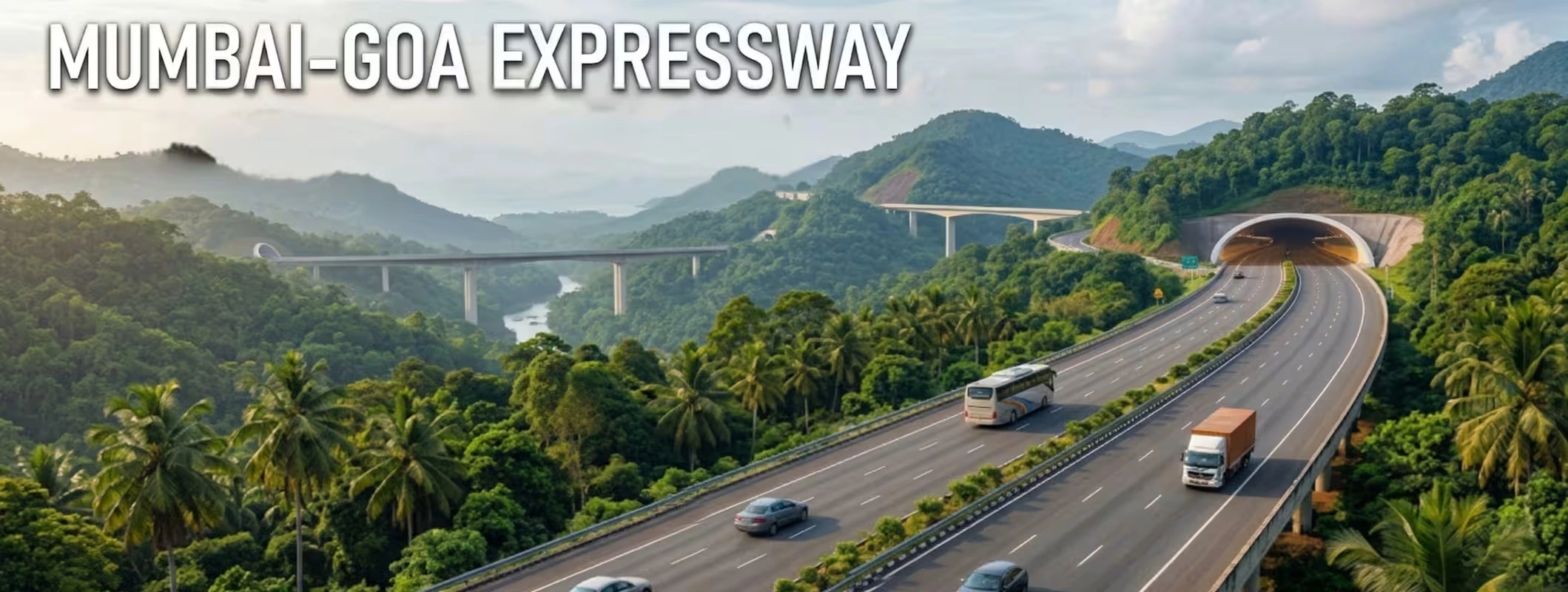
The Goa–Mumbai Highway is one of the most searched road infrastructure topics in western India right now, and for good reason. This corridor can reshape road travel, tourism, logistics, and even property demand across the Konkan belt. But there is also a lot of confusion online about its exact route, length, completion date, and real travel time. The clean way to understand it is this: most current updates are talking about the Mumbai–Goa stretch of NH-66, especially the Maharashtra side from Palaspe/Panvel toward Zarap at the Goa border. Official state updates call that core project stretch 434 km, while consumer travel explainers often quote roughly 466 km for the broader Mumbai-to-Goa road journey.
Key Takeaways
- The “Goa–Mumbai Highway” in current public discussion is mainly the upgraded Mumbai–Goa stretch of NH-66.
- The official state target had been March 31, 2026, but fresh March 14, 2026 local reports say the key Mangaon and Indapur bypasses are now being pushed for opening by June 1, 2026, which shows the last-mile bottlenecks are still not fully resolved.
- The old benchmark journey time has long been around 12 to 13 hours, while some better stretches already allow an 8 to 9 hour run; the full project promise remains about 6 hours once the corridor becomes truly free-flowing.
- The main route runs through Panvel, Pen, Mangaon, Mahad, Poladpur, Khed, Chiplun, Ratnagiri, Lanja, Rajapur, Kankavli, Kudal, Sawantwadi and then into Goa.
- For land buyers and investors, this highway matters because better connectivity can strengthen tourism, industrial movement, local commerce, and long-term micro-market visibility across the Konkan region.
Goa–Mumbai Highway at a Glance
| Metric | What it means right now |
| Corridor most people mean | Mumbai–Goa stretch of NH-66 |
| Core project stretch in state updates | 434 km Maharashtra stretch |
| Broader drive often quoted by travel/property sites | About 466 km |
| Legacy travel time | Around 12–13 hours |
| Practical current run on smoother stretches | About 8–9 hours, but not consistent across all sections |
| Full project target travel time | Around 6 hours |
| Latest state deadline previously cited | March 31, 2026 |
| Fresh March 2026 on-ground update | Mangaon and Indapur bypasses targeted for June 1, 2026 |
What Exactly is the Goa–Mumbai Highway
Let’s clear up the biggest confusion first. This is not just a casual road trip route. In today’s infrastructure-related discussions, it is assumed that the Goa-Mumbai Highway primarily pertains to the long-pending project of four-laning and improving NH-66 on the Mumbai-Goa stretch. The project was divided into 10 packages, and it is assumed that a significant portion of the time was lost due to the Panvel-Indapur stretch and other bottleneck areas in Raigad and Ratnagiri. The Goa stretch had already been mentioned as completed in previous sections, and the most difficult areas remained in Maharashtra.
That is why people hear different completion claims at different times. The project has had multiple deadlines over the years, including older promises that were not met. The more useful question in 2026 is not “Was it supposed to open earlier?” but “Which bottlenecks are still stopping a truly smooth drive today?”
Goa–Mumbai Highway Route
If you are looking at the practical road alignment, the commonly cited route runs from Panvel and moves through Pen, Mangaon, Mahad, Poladpur, Khed, Chiplun, Ratnagiri, Lanja, Rajapur, Kankavli, Kudal, and Sawantwadi before entering Goa. Wider NH-66 continues further south beyond Goa, but for this topic, the Mumbai–Goa stretch is the real focus.
This route matters not only for tourists heading to Goa. It is equally important for people tracking Konkan logistics, hospitality land, second-home demand, warehousing potential, and road-linked property growth in coastal Maharashtra. Once connectivity improves, even towns that were earlier seen as “too far” start appearing on the radar of investors, developers, and end users. That broader tourism and industrial upside has been part of the project’s public case for years.
Goa–Mumbai Highway Travel Time
Six hours is still the target, not the consistently delivered reality. Many reports still use the old 12 to 13 hour benchmark for the Mumbai–Goa drive, especially when talking about the pre-upgrade corridor. But later ground reporting also showed that several stretches had improved enough for an 8 to 9 hour run, provided you do not get trapped in the worst choke points.
The biggest issue is that travel time is no longer one single number. It depends on whether you hit congestion at Indapur, Mangaon, or active construction zones near flyovers and bypasses. In other words, the highway is improved in parts, but not yet uniformly free-flowing. That is exactly why some drivers report major gains while others still complain of jam-prone sections.
Latest Update on the Goa–Mumbai Highway in March 2026
As of March 16, 2026, the most significant information is that the aforementioned information regarding the target date for the completion of the project was March 31, 2026. This, in addition to the fact that the project had already been 95% complete in 2025. However, the situation in the local area is more complex. The most delay-sensitive section of the project is still the 84-km stretch between Panvel and Indapur, as realignments of the flyover and bypass had already slowed down the work in the area.
But then came reports from March 14, 2026. These reports indicated that the Mangaon and Indapur bypasses were being pushed for an opening by June 1, 2026. In addition to that, there were technical problems related to Konkan Railway’s infrastructure. Another local report from the same period indicated that work was proceeding at a slow enough pace to raise concerns about the project’s completion. So the latest update is not “fully done.” The latest update is “final bottlenecks are in the last stretch, but uncertainty remains.”
There is also a safety angle that buyers, commuters, and logistics operators should not ignore. On March 6, 2026, the Maharashtra Transport Department held a high-level review after a citizen-led 490-km foot inspection flagged black spots, potholes, drainage issues, and safety deficiencies across the corridor. That tells you the story is no longer just about completion dates. It is also about safe usability.
Why This Highway Matters for Real Estate
Whenever a major highway improves, the first reaction in the market is excitement. But serious investors know that better roads do not automatically make every nearby parcel valuable. What they do is expand access, shorten psychological distance, improve freight movement, and raise visibility for towns that were previously harder to reach. In the case of the Mumbai–Goa corridor, public messaging around the project has long linked it to stronger tourism and industrial development in the Konkan belt.
That can translate into stronger interest in roadside commercial land, hospitality sites, plotted developments, second-home pockets, logistics-linked land, and service clusters around growth nodes. But the smart play is not to buy just because someone says “highway touch.” The smart play is to study legal status, access road reality, local demand, flood exposure, zoning, and actual usability. Infrastructure can create opportunity, but blind speculation still burns money.
How 2Bigha Helps
This is exactly where a platform like 2Bigha becomes useful. When a major corridor like the Goa–Mumbai Highway starts changing buyer interest, the market also gets flooded with half-true claims such as “future hotspot,” “expressway-facing,” or “high appreciation guaranteed.”
2Bigha helps by making the search process more practical. Instead of chasing random broker claims, buyers can shortlist land options with better location visibility, compare surrounding areas, understand whether a plot is actually connected by a usable approach road, and evaluate opportunities with more clarity before taking the next step. For infrastructure-led buyers, that is a big advantage because the difference between “near the highway” and “benefits from the highway” is huge.
Buyer Checklist Before Investing Near the Goa–Mumbai Highway
Before buying land in any NH-66 influence zone, ask these questions:
- Is the plot truly close to an operational access point, or only close on paper?
- Is the title clean, mutation updated, and ownership trail verifiable?
- What is the land use category: agricultural, residential, resort, mixed-use, or commercial?
- Is the parcel exposed to flood risk, slope issues, or local restrictions?
- Are water, power, and internal road access actually available?
- Is there real local demand, or just future hype?
- Will this land benefit from tourism, logistics, living, or only speculation?
That checklist matters far more than glossy highway headlines.
Final Word
Clearly, the Goa-Mumbai Highway project has taken a leap into a brighter future than the highway corridor has seen in the past few years. However, the latest update in March 2026 does not read like a neat and clean one-liner. The project has improved a lot, but the final result will depend on whether the remaining bypass and bottlenecks are completed without slippage. March 2026 has been officially set as the target. Practically, March 2026 reporting shows that the last troublesome sections are still being chased toward a June 1 opening window.
For commuters, that means better days are close, but not fully guaranteed. For investors, it means this is the right time to study micro-markets carefully, not the right time to believe every hype line. And for buyers using platforms like 2Bigha, the real advantage is being able to evaluate land opportunities with more context before prices fully reset.
FAQs - Frequently Asked Questions
1. What is the latest update on the Goa–Mumbai Highway?
The state target was March 31, 2026, while March 14, 2026, reports revealed that efforts were being made to have the critical Mangaon and Indapur bypasses open by June 1, 2026. There was also a March 6, 2026, safety assessment revealing that there is continued presence of hazards and deficiencies in the corridor.
2. Which route does the Goa–Mumbai Highway follow?
The typical route used for traveling from Mumbai to Goa through NH-66 passes through Panvel, Pen, Mangaon, Mahad, Poladpur, Khed, Chiplun, Ratnagiri, Lanja, Rajapur, Kankavli, Kudal, and Sawantwadi before entering Goa.
3. How much travel time will the highway save?
In the long run, the idea is to reduce the Mumbai–Goa driving distance from 12–13 hours to around 6 hours. The existing improved parts of the highway can take the journey down to around 8–9 hours.
4. Is the Goa–Mumbai Highway good for property investment?
It can be positive for land and real estate because improved connectivity supports tourism and industrial activity. But buyers should focus on legal clarity, access, zoning, and local demand instead of buying purely on highway hype.
5. Why do different websites show different highway lengths?
Because some sources refer to the core Maharashtra project stretch of 434 km, while others describe the broader Mumbai-to-Goa road journey as roughly 466 km. Both numbers are used, but they are not measuring the exact same thing.