Key Takeaways
- Patta is the ownership document that proves you are the legal titleholder (Pattadar) of a piece of land.
- Jamabandi is the Record of Rights (RoR) that shows current ownership, land classification, area, and revenue payment status for a plot.
- Many buyers assume having a Patta copy is enough — but the Jamabandi assam record is what actually confirms who the government recognises as the current owner today.
- Both documents must be cross-checked with the Dag number and Mouza details before any land purchase in Assam.
- The Dharitri Assam jamabandi portal (also called ILRMS or Bhulekh Assam) allows free online verification of land records.
- Under Mission Basundhara, thousands of families have received digital Pattas — but not all Patta holders have updated Jamabandi entries, which can create legal complications later.
Introduction
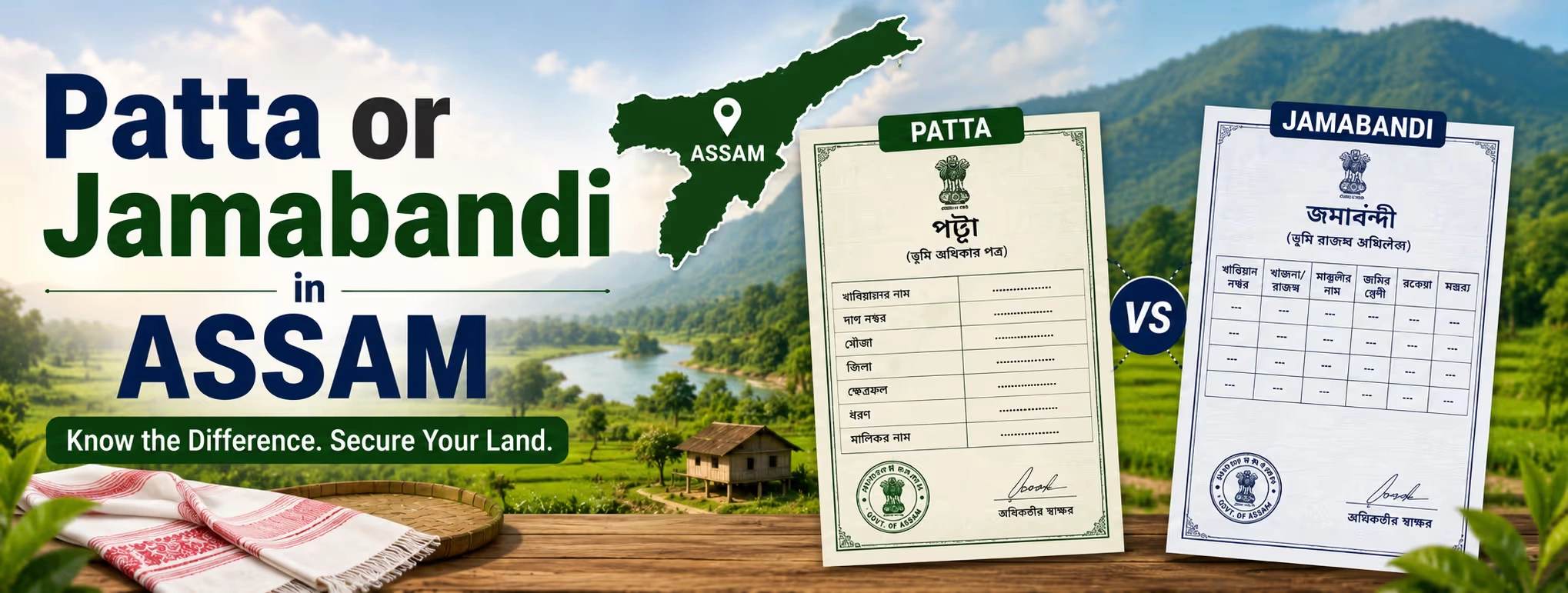
When it comes to buying land in Assam, you must be aware of two words that keep popping up in discussions — “Patta” and “Jamabandi.” Most people who want to purchase land tend to use both of these words in the same sense and take it for granted that they are synonymous terms. This has resulted in several legal battles in the state and delayed registrations of lands.
The truth is, Patta and Jamabandi serve two different — but connected — purposes in Assam's land record system. One proves ownership. The other proves current status. Understanding this difference isn't just useful knowledge; it's essential protection for your money and your future property rights.
In this guide, we break down exactly what Patta and Jamabandi mean, how they differ, and how you can verify both online before making any land purchase in Assam.
What is Patta in Assam Land Records?
A Patta is a legal ownership certificate issued by the Revenue Department of Assam, typically through the Circle Officer or Tahsildar. It formally recognises an individual — called the Pattadar — as the rightful holder of a specific plot of land.
Think of Patta as your land's "identity card." It contains:
- Name of the Pattadar (landholder)
- Patta number
- Village/Mouza details
- Land boundaries and classification
- Type of Patta (Periodic or Annual)
Types of Patta You Should Know
- Periodic Patta (PP): Granted for a long-term period, usually renewable, and considered more secure for buyers.
- Annual Patta (AP): Issued for short-term or seasonal use, common in char (riverine) areas.
- Miscellaneous Patta (MP): Issued for non-agricultural or special-purpose land.
- Settlement Patta: Given under government land settlement schemes like Basundhara Assam.
Knowing the Patta type matters because a Periodic Patta generally carries stronger, more transferable rights than an Annual Patta, which affects resale value and loan eligibility.
What Is Jamabandi in Assam?
Jamabandi, which is alternatively known as the Record of Rights (RoR) and locally as Chitha, is an agricultural village register that is kept as per the provisions of the Assam Land and Revenue Regulation Act, 1886. It is different from the Patta since it is not a one-time document but is regularly revised.
A Jamabandi entry typically includes:
- Current Pattadar's name
- Dag number (plot identification number)
- Area of land (measured in Bigha, Katha, Lessa)
- Land classification (agricultural, residential, commercial)
- Annual land revenue (Khajna) due or paid
- Any mutation history (changes due to sale, inheritance, or partition)
In Simple Terms: the Patta tells you who was granted ownership, while the Jamabandi tells you who the government currently recognises as the owner, and whether the land dues are cleared.
Patta vs Jamabandi: Key Differences Explained
| Aspect | Patta | Jamabandi |
| Definition | Ownership title document | Record of Rights (current status register) |
| Issued By | Circle Officer / Tahsildar | Revenue Department (village-level record) |
| Purpose | Proves legal ownership was granted | Shows present owner, area, tax status |
| Update Frequency | Issued once, rarely revised | Updated after mutation, sale, or inheritance |
| Legal Weight | Foundation of ownership claim | Confirms current legal standing and revenue status |
| Used For | Title verification, loans | Sale transactions, mutation, dispute resolution |
Why This Confusion Is Dangerous for Assam Land Buyers
Here's a real-world scenario that plays out often in Assam's real estate market: a buyer purchases agricultural land for sale based on a Patta copy shown by the seller. Everything looks fine — the Patta number matches, the boundaries seem correct. But when the buyer later checks the Jamabandi record, they discover the land was mutated to a different family member years ago due to inheritance, and the seller no longer holds clear rights.
This kind of mismatch is one of the most common causes of land disputes in Assam. Relying only on the Patta without cross-verifying the online Jamabandi Assam record can expose buyers to:
- Fraudulent resale by non-owners
- Pending mutation disputes among family members
- Unpaid land revenue (Khajna) that becomes the new owner's liability
- Boundary or Dag number mismatches
Why Sellers Sometimes Show Only the Patta
Some sellers show buyers only the Patta because it looks impressive and "official." However, a savvy buyer should always ask for the latest certified Jamabandi copy alongside the Patta, since this is the document that reflects the true, present-day legal status of the land.
How to Check Jamabandi and Patta Online in Assam
Thanks to digitisation, verifying land records no longer requires multiple visits to the Circle Office. The Government of Assam's Dharitri (ILRMS) portal — often searched as Dharitri Assam jamabandi — allows citizens to check land details from home.
Step-by-Step Process
- Visit the official Dharitree/ILRMS Assam portal.
- Select your District, Circle, and Mouza/Village.
- Search using the Dag number, Patta number, or the Pattadar's name.
- Enter the captcha and click "See Jamabandi."
- View or download the record.
Note: The version available directly online is generally for personal reference only. If you need a certified Jamabandi copy for legal or banking purposes, you must apply through the official Revenue Services portal, submit the latest Khajna (land revenue) receipt, and pay a nominal fee. Certified copies are usually issued within five to ten working days.
Important Terms You'll Come Across
- Dag Number: A unique plot identification number within a village.
- Mouza: A revenue village or administrative land unit in Assam.
- Mutation (Namjari): The legal process of updating ownership in Jamabandi records after sale, gift, or inheritance.
- Khajna: Annual land revenue tax payable to the government.
- Bhu-Naksha: The digital cadastral map showing plot boundaries, used alongside Jamabandi for full verification.
Also Read: Assam Stamp Duty & Registration Charges 2026: Land, Flat & House Guide
Government Initiatives Simplifying Land Records in Assam
Assam's Revenue and Disaster Management Department has taken significant steps to modernise land governance in recent years.
Mission Basundhara
Basundhara Assam is the state's flagship land reform initiative aimed at reducing pendency in land record updates and improving ease of access for citizens. Under its latest phase, Mission Basundhara 3.0, launched in October 2024, the government introduced services such as review of previously rejected applications, digital settlement for institutions, and resolution of long-pending land disputes. In early 2026, over one lakh land pattas were distributed to indigenous landless families and public institutions across the state, with the government reporting that around 80% of pending land issues have been resolved so far.
Eligibility relaxations under Mission Basundhara also matter for buyers: communities such as Scheduled Castes, Scheduled Tribes, and Tea Tribes are exempt from certain residency-proof requirements, while indigenous groups like the Koch Rajbongshi, Ahom, and Gorkha communities receive documentation relaxations too.
Why This Matters for Buyers and Investors
If you're planning to purchase land in areas with verified Jamabandi records, or considering a farmhouse land investment in rural Assam, it's worth checking whether the plot falls under a recently regularised Basundhara settlement. Freshly issued Pattas under such schemes may take time to reflect fully in the Jamabandi database, so extra diligence is advised during this transition period.
Practical Tips Before You Buy Land in Assam
- Always cross-verify both documents. Never accept a Patta copy alone as sufficient proof.
- Check the Dag number match between the Patta, Jamabandi, and the physical site boundaries using Bhu-Naksha maps.
- Confirm mutation status. If the land changed hands recently, ensure the Jamabandi reflects the new owner's name.
- Verify Khajna (revenue) payment status to avoid inheriting unpaid dues.
- Consult a local revenue lawyer or a trusted property advisor for high-value transactions, especially for plots for sale in Guwahati or peri-urban expansion zones.
This is where a platform like 2Bigha becomes genuinely useful — it helps buyers explore verified property insights, understand land record terminology, compare listings, and make more confident decisions whether you're looking to buy land in Guwahati, buy farmland in Assam, or evaluate an investment opportunity in a growing township area.
Patta and Jamabandi in Real Estate Investment Decisions
The relevance of the relationship between Patta and Jamabandi becomes significant for investors interested in land sales in Assam, be it residential plots, agricultural land, or commercial lands. Banks usually need the current Jamabandi along with Patta before approving loans for housing and land. Likewise, in case you intend to sell your agricultural land in Assam in the future, possession of these two documents makes things much easier for you.
If you're planning to sell land in Guwahati, especially near expanding infrastructure corridors, check the land classification in the Jamabandi beforehand — unresolved agricultural-to-residential conversion status is one of the most common reasons buyers back out of a deal or demand a price reduction.
Conclusion
The difference between Patta and Jamabandi may seem like a small technicality, but it can make or break a land deal in Assam. A Patta proves that ownership was granted; a Jamabandi confirms that this ownership still holds true today, along with revenue and classification details. Relying on just one document leaves buyers vulnerable to disputes, fraud, or financial loss.
Before you buy land in Assam, take the time to verify both records through the official Dharitri portal, understand the Dag number and Mouza details, and if needed, seek professional guidance. Whether you're purchasing farmhouse land, evaluating agricultural land for sale, or exploring investment opportunities through platforms like 2Bigha, informed verification is your best protection. A little diligence today can save you from years of legal trouble tomorrow.
Disclaimer: This article is for informational purposes only and should not be considered investment, legal, financial, or property advice. Real estate regulations, infrastructure plans, market conditions, and government policies may change over time. Readers are advised to verify information with relevant authorities and consult qualified professionals before making any investment or property-related decisions.