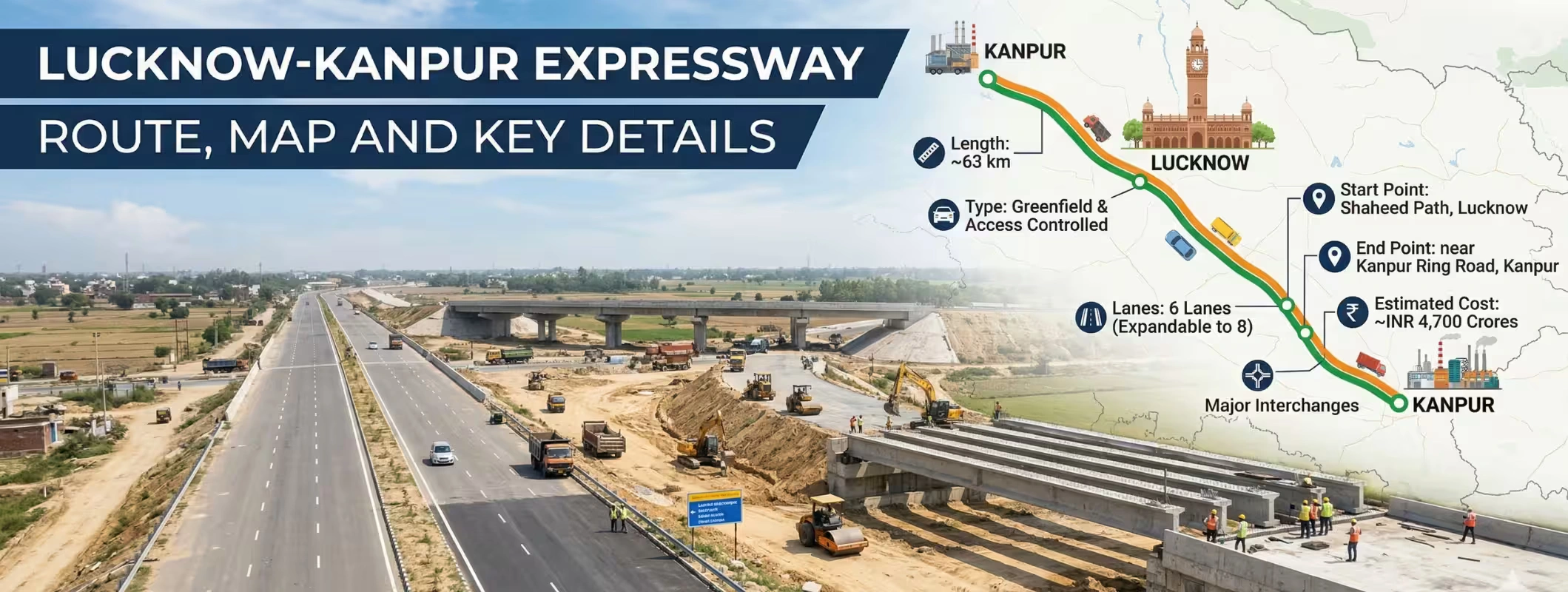
The Lucknow-Kanpur Expressway is one of Uttar Pradesh’s most important connectivity projects because it is built to cut travel time sharply, reduce pressure on the existing highway corridor, and connect the Lucknow and Kanpur ring-road systems more efficiently. As of late March 2026, the project is in its final approach phase, with recent reporting pointing to public opening around April 2026, though the exact commissioning date can still move until formal launch.
Key Takeaways
- The Lucknow-Kanpur Expressway is a 63 km-class, six-lane, access-controlled corridor, planned with future expansion to eight lanes.
- It is designed to connect the Lucknow Outer Ring Road/Shaheed Path side to the Kanpur Outer Ring Road/Azad Nagar side, improving through-movement without forcing all traffic into city cores.
- Recent updates show five proposed entry-exit points: Miranpur Pinwat, Khandedev, Bani, Amarsas, and Azad Nagar near the Shuklaganj bypass.
- Travel time is expected to come down from roughly 1.5 to 3 hours today to around 30 to 40 minutes, depending on the final operating conditions.
- For land buyers, this corridor matters because connectivity upgrades usually change where demand moves first: not only in Lucknow and Kanpur, but also in Unnao and interchange-linked pockets along the route.
What is the Lucknow-Kanpur Expressway?
The Lucknow-Kanpur Expressway, also referred to in reporting as NE-6, is an access-controlled expressway being developed to create a faster, cleaner corridor between two of Uttar Pradesh’s biggest urban centres. NHAI’s project records show it has been split into two main construction packages: a 17.52 km elevated package and a 45.244 km greenfield package, which together explain the project’s roughly 63 km length.
This is not just a road project. It is a mobility and growth corridor. Once operational, it is expected to divert through-traffic away from congested city stretches, improve freight movement, and strengthen regional access between Lucknow, Kanpur, Unnao, and onward routes connecting places like Prayagraj, Jhansi, Hamirpur, Barabanki, and Ayodhya.
Lucknow-Kanpur Expressway Route Map
If you want the route map in plain language, think of the expressway as a fast connector running broadly parallel to the older Lucknow-Kanpur corridor while tying into the ring-road systems on both sides. Recent reporting says the road will connect the Lucknow Outer Ring Road to the Kanpur Outer Ring Road, while earlier coverage also described the Lucknow-side connection from the Shaheed Path zone.
The five proposed access points currently reported are:
- Miranpur Pinwat
- Khandedev
- Bani in Lucknow
- Amarsas on the Unnao-Lalganj stretch
- Azad Nagar near the Shuklaganj bypass
That matters for buyers because land value does not move evenly across an expressway belt. It usually responds first around entry-exit points, feeder roads, ring-road junctions, and logistics-friendly parcels.
Lucknow-Kanpur Expressway vs Current Road Travel
The latest NHAI-linked and media reporting shows a very clear use-case difference between the current commute and the expressway-led commute.
| Factor | Current Lucknow-Kanpur Road Travel | Upcoming Expressway Travel |
| Typical time | Around 1.5 to 3 hours | Around 30 to 40 minutes |
| Traffic experience | City bottlenecks, toll slowdowns, mixed traffic | Access-controlled, faster through-movement |
| Route behavior | Traffic often enters urban stretches | Through-traffic can bypass core city congestion |
| Investor relevance | Broader corridor, less predictable access value | Interchange-led micro-markets become more important |
This is exactly why people searching for property near Lucknow-Kanpur Expressway, plots in Unnao, or land near Lucknow Outer Ring Road connectivity are watching the project so closely.
Latest Status of Lucknow-Kanpur Expressway
As of late March 2026, the latest update is not “fully open already,” but “very close.”A report by the Hindustan Times dated February 2026 stated that normal traffic can be expected from the first week of April. In another update dated March 20, 2026, the expressway was expected to open before May, and NHAI was preparing the first trial of its kind for Uttar Pradesh using the Multi-Lane Free Flow (MLFF) system. This means that the way to put this status update today should be: near commissioning, rollout expected soon, but dependent on official launch clearance. That is the more accurate line, especially because many older articles still show outdated dates.
Key Project Features and Design Details
The project is being built as a six-lane expressway with scope for future expansion to eight lanes. February reporting said it would initially operate with six lanes and allow speeds of up to 125 km/h. The project also includes 18 km of elevated roadway and 45 km of greenfield construction.
Other reported features include:
- 3 major bridges and 28 minor bridges
- 38 underpasses and multiple flyovers
- Five toll plazas with controlled access ramps
- Rest areas, trauma care support, and on-call ambulance response
- MLFF tolling trial, which aims to reduce stop-and-go toll congestion
- AI-based monitoring and advanced traffic systems, with NHAI’s annual report noting real-time construction monitoring and VIDES-style systems on the corridor
Why this Expressway matters for Property and Land Buyers
Infrastructure does not raise value everywhere equally. It creates new winners. In this case, the biggest upside tends to sit around access nodes, outer ring road connections, industrial movement belts, and districts that suddenly become easier to commute from.
The expressway also fits into a larger Uttar Pradesh growth story. UPEIDA’s official UP Defence Industrial Corridor page shows that both Lucknow and Kanpur are among the six corridor nodes, which strengthens the long-term case for logistics, industrial activity, and land demand across connected belts. That does not guarantee every parcel will appreciate, but it does support the view that the Lucknow-Kanpur-Unnao belt will stay on investor radar.
Therefore, if one is considering plots in the area of Lucknow Kanpur Expressway, agricultural land in Unnao, and land investment in the future in and around Lucknow and Kanpur, it is advisable to think in terms of access quality, legal clarity, and exact location advantages rather than relying solely on the marketing gimmicks of “expressway touch.”
Which Areas are likely to Stay in Focus?
Based on the latest access-point reporting, the pockets that naturally stay in focus are those linked to:
- Bani and nearby Lucknow-side access
- Miranpur Pinwat and Khandedev
- Amarsas and the Unnao-Lalganj stretch
- Azad Nagar/Shuklaganj bypass side
- Land that benefits from ring-road plus expressway connectivity
That does not mean every plot there is a smart buy. The location has to be checked against land use, title, road access, acquisition risk, and future development practicality.
How 2Bigha is different from other Platforms
This is where most buyers make mistakes. They see a listing on a generic portal, check the asking price, and assume they understand the opportunity. They usually do not.
Compared with typical classified-style portals, 2Bigha’s own positioning is more map-led and land-data-led. On its official platform, 2Bigha highlights current land prices, investment opportunities, land ownership records, property insights, map exploration, Khasra-linked information, digital land maps, and verified footage of agricultural land. Its terms also clearly say that buyers must still do their own due diligence, which is the right position in land transactions.
Why that matters for the Lucknow-Kanpur Expressway Belt
When a new corridor becomes hot, the market quickly fills with vague claims like “near expressway,” “future commercial zone,” or “best investment plot.” That is exactly where buyers need better filters.
2Bigha can help by making the search process more practical:
- You can start with a map-first view, not just a headline listing.
- You get access to Khasra numbers, digital land maps, and property mapping where available, which is far more useful for land than standard apartment-style portals. (
- The platform is built around agricultural land and land discovery, which makes it more relevant for corridor-based land searches.
- If the buyer is remote or wants post-purchase oversight, 2Bigha’s property-management side offers site visits, property pictures, video walkthroughs, drone footage on some plans, digital reports, and local monitoring support.
2Bigha vs Generic Property Portals
The comparison below reflects 2Bigha’s own product positioning and public terms.
| What Buyers usually get | Generic Portal Experience | 2Bigha Approach |
| Search style | Listing-first | Map-first and land-first |
| Land data context | Often limited | Khasra, digital maps, property insights where available |
| Listing confidence | Photo and broker-led in many cases | Verified footage and property mapping emphasis |
| Due diligence message | Often weak or unclear | Terms clearly say buyers must verify title, price, and boundaries independently |
| Post-purchase support | Usually none | Property management, visits, reports, walkthroughs, monitoring |
That is the real difference: 2Bigha is more useful when the question is not just “what is available?” but “what is actually worth checking seriously?”
Buyer Checklist Before you Purchase Land near the Expressway
Before buying any land near the Lucknow-Kanpur Expressway, check these basics:
- Verify the exact distance from an actual access point, not just from the expressway line on a brochure.
- Match the plot with Khasra details, map records, and on-ground boundaries.
- Confirm whether the seller’s quoted price is realistic, because platform terms and land portals themselves often note that listed prices can be approximate.
- Check title, disputes, encumbrances, road access, and any local acquisition or development notifications.
- Do not assume “expressway-facing” automatically means “high-return.” The access quality is what matters.
Conclusion
The Lucknow-Kanpur Expressway is no longer just a proposal people talk about. It is now a near-ready infrastructure corridor that can reshape mobility between Lucknow, Kanpur, and Unnao. The biggest shift it brings is not only faster travel. It is location reshuffling. Areas that were once secondary can become more relevant when access improves this sharply.
For buyers, that creates opportunity and risk at the same time. Opportunity, because the corridor can unlock better long-term land value. Risk, because hype rises faster than verification. That is exactly why a platform like 2Bigha becomes more useful in this topic. It is built around land search, map visibility, land records context, and practical property management support, rather than just listing inventory and pushing enquiries.
FAQs - Lucknow-Kanpur Expressway
1. What is the total length of the Lucknow-Kanpur Expressway?
The expressway is about 63 km long. NHAI project records break it into a 17.52 km elevated package and a 45.244 km greenfield package, while recent reporting rounds the corridor to 62.7 to 63 km.
2. What is the latest opening status of the Lucknow-Kanpur Expressway?
As of late March 2026, it appears to be in the final rollout stage rather than fully open. February reporting pointed to early April traffic movement, while a March 20 report said opening is expected before May with MLFF toll trials on the corridor.
3. How much travel time will the expressway save?
The expected travel time is around 30 to 40 minutes, versus roughly 1.5 to 3 hours on current routes depending on congestion and city-entry delays. That is one of the main reasons the project is seen as a major regional mobility upgrade.
4. What are the main entry and exit points on the expressway?
The latest reported proposed access points are Miranpur Pinwat, Khandedev, Bani, Amarsas, and Azad Nagar near the Shuklaganj bypass. These locations matter much more to investors than generic “near expressway” marketing language.
5. Will the Lucknow-Kanpur Expressway affect property prices?
It can influence demand, especially around interchanges, outer ring road links, and logistics-friendly stretches, but not every parcel will benefit equally. Better connectivity often lifts investor interest, yet actual value depends on title quality, access, land use, and development practicality.
6. How does 2Bigha help buyers in this corridor?
2Bigha helps by offering a map-led land search experience, access to land ownership records and property insights, and land-oriented information such as Khasra-linked and digital land map context where available. It also offers property management support for buyers who need monitoring after purchase. That makes it more useful than a basic lead-generation portal when you are seriously evaluating land near an infrastructure corridor.