List Your Land
Ask a farmer in Bathinda how big his field is, and he'll say "eight killas." Ask a property dealer in Mohali about a plot, and you'll hear "ten marla." The revenue record says something else again, usually kanal and marla with a khasra number next to it. Same country, same state, three ways of talking about area. Nobody is lying. But if you're about to put real money into land in Punjab, mixing these up is one of the easiest ways to overpay. This guide sorts out the units, the formulas to check an area yourself, and the conversions you'll use most.
The Units You'll Actually Hear
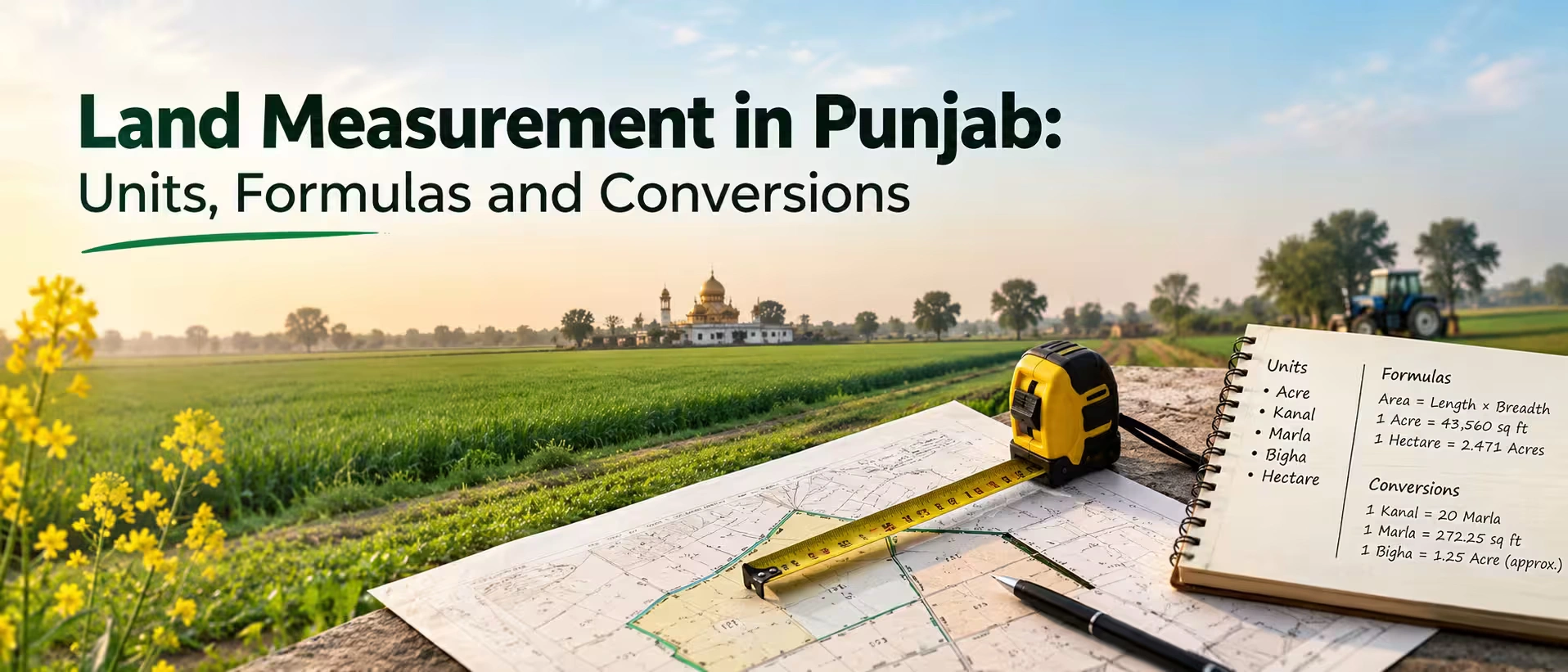
Punjab uses an ancient system based on the old revenue survey. The positive aspect of this system is that everything can be easily divided into the next level. A marla is the smallest unit that anybody cares about. It is equivalent to an old square rod, which means it is equal to a square with sides measuring 16.5 feet. This comes out to be 272.25 square feet. Twenty marlas make up one kanal, eight kanals make up one acre, which is also known as 'killa' in local and revenue jargon. Finally, twenty-five killas make up one murabba, the square that is shown on village maps.
| Unit | Equals | Square feet | Square yards | Square metres |
| 1 marla | 1/20 kanal | 272.25 | 30.25 | 25.29 |
| 1 kanal | 20 marla | 5,445 | 605 | 505.86 |
| 1 acre (killa) | 8 kanal, 160 marla | 43,560 | 4,840 | 4,046.86 |
| 1 murabba | 25 acres | 1,089,000 | 121,000 | 101,171.5 |
| 1 hectare | 2.471 acres | 107,639 | 11,960 | 10,000 |
Save that table somewhere. You'll go back to it.
What About the Bigha?
This is where the mistake comes in. The bigha is not a fixed unit of measurement. It varies depending on the district, sometimes even from village to village, and is either the smaller kacha bigha or the larger pakka bigha according to the local measuring system. When someone says "five bigha," it really does not mean much at all until the number is expressed in kanals, acres, or square yards. That is why there are many who prefer to deal in terms of acres.
Another practice that is worth knowing about is the custom of using a local "marla," which is smaller than the standard one, when selling plots of land. Thus, ten marla is not necessarily 2,722.5 square feet.
Formulas for Measuring a Field Yourself
You don't need to be a surveyor. Most fields are close to a rectangle, a triangle, or a mix of the two.
- Rectangle: area = length × width
- Triangle: area = ½ × base × height
- Four-sided odd shape: split it into two triangles, work out each, then add them
- Triangle with only the sides known: use Heron's formula. Take half the perimeter as s, then area = √(s × (s − a) × (s − b) × (s − c))
To turn square feet into local units, divide:
- Marla = square feet ÷ 272.25
- Kanal = square feet ÷ 5,445
- Acre = square feet ÷ 43,560
- Marla from square yards = square yards ÷ 30.25
Read More: Can You Buy Agricultural Land in Punjab? Legal Rules & Eligibility
Three Quick Worked Examples
A rectangular field. It measures 220 feet by 198 feet. Multiply, and you get 43,560 square feet, which is exactly one acre, or 8 kanal.
A residential plot. It's 55 feet by 99 feet. That works out to 5,445 square feet, one kanal, or 605 square yards.
A triangular corner field. Base 300 feet, height 180 feet. Half of 300 × 180 is 27,000 square feet. Divide by 272.25, and you get about 99 marla, which is roughly 5 kanal, or around 0.62 of an acre.
Do this with a tape or a phone app on the actual land, then compare it with the number in the paperwork. If the two are off by more than a rounding error, stop and ask why.
Why Paper and Ground Don't Always Match?
The documents containing the details about the area are available from the earlier surveys. Boundaries change, bunds are shifted gradually by a foot here and there, and a canal or road might have cut off a portion long ago. Details in Jamabandi, Fard, and Khasra available on the land records website of the state government, jamabandi.punjab.gov.in, give the official area of the plot.
However, they do not help you understand what you actually have. In case of any doubts, apply for demarcation, which is known as nishandehi. The revenue official demarcates the boundaries on the ground in accordance with the village plan. But do that prior to making the final payment.
Buying Farmland: Pricing and Regions
When people search for farm land for sale Punjab India, they quickly see that rates are usually quoted per killa, not per kanal. A rate that sounds low per kanal can be steep per acre, so convert everything to the same unit before comparing offers.
Punjab is also not one market. Malwa, which covers Ludhiana, Bathinda, Sangrur and Ferozepur, is the big wheat and paddy belt, with cotton further southwest. Doaba, around Jalandhar and Hoshiarpur, has smaller holdings and strong demand. Majha, around Amritsar and Gurdaspur, has its own pricing pattern. Groundwater has been dropping in several districts, so ask about tubewell depth and canal access, and don't rely on an agent's word.
Anyone browsing agri land for sale in Punjab should also know that NRIs and OCIs cannot buy agricultural land in India. For everyone else, confirm ceiling limits and any rules on non-farmers with a local revenue lawyer before paying a token.
If You Plan to Sell
Sellers lose money here too. If you want to sell agricultural land in Punjab, start by getting a fresh Jamabandi and Fard, then compare the recorded area to what's on the ground. Fix any mutation pending from an inheritance, clear any mortgage entries, and talk to co-sharers early. Quote your area in killas, kanals, and square yards so no buyer has to guess. And if the boundary is disputed, get nishandehi done before you list.
On tax, rural agricultural land beyond the prescribed distance from a municipality is generally not a capital asset. Land near a city can be treated differently, so ask a chartered accountant.
Check Land with 2Bigha
2Bigha is a marketplace built only for agricultural land and farmland in India. You can compare listings, read Background Verification Reports to see what stands behind a plot, and use Book a Visit when something looks right. Owners who want to sell agricultural land in Punjab can list their plots there and reach people already searching for farmland. For a closer look at what is checked, see the 2Bigha Land Report.
Disclaimer: This article is for informational purposes only and should not be considered investment, legal, financial, or property advice. Real estate regulations, infrastructure plans, market conditions, and government policies may change over time. Readers are advised to verify information with relevant authorities and consult qualified professionals before making any investment or property-related decisions.