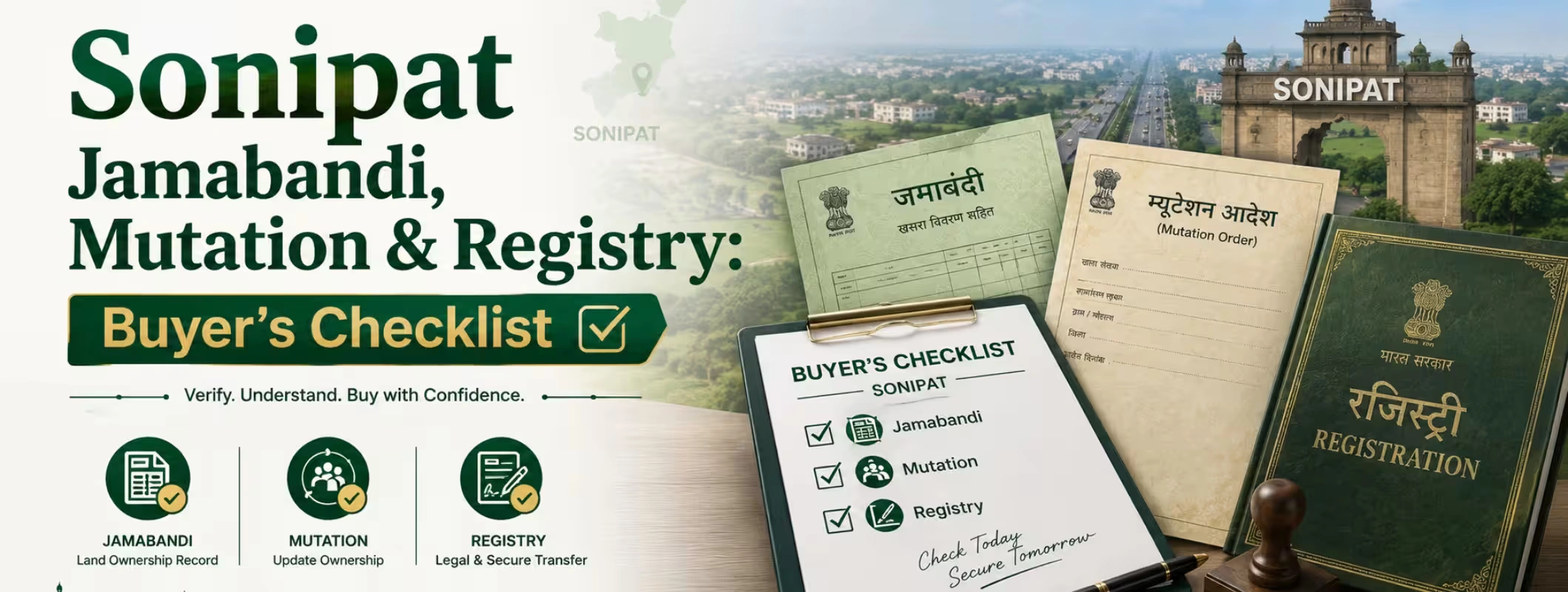
Many land disputes originate not from a quarrel with a neighbor or a property line disagreement but rather from the very beginning of the land purchase process. Specifically, verifying three key documents: Jamabandi, mutation, and registry. This might seem trivial, but these three documents can determine whether you are buying the land correctly or not. When you are purchasing a plot in Sonipat, people tend to overlook this part, as it seems boring and non-essential compared to surveying the land or even haggling. In short, you must not do that, as everything else will be fine if these three are in order.
First, Let's Clear Up the Confusion: What Do These Terms Even Mean?
A lot of buyers use these three words interchangeably, which is exactly where trouble starts. If you're planning to buy land in Haryana, understanding the difference can help you avoid legal issues, unexpected costs, and costly investment mistakes.
| Term | What It Actually Is |
|---|---|
| Jamabandi | The official Record of Rights, showing who owns the land, in what share, and how much area they hold |
| Mutation (Intkal) | The process that updates the government's revenue record to reflect a new owner after a sale, gift, inheritance, or court order |
| Registry | The legal document that formally transfers title through a registered sale deed |
Jamabandi and mutation are not the same. Jamabandi is the list of owners, while mutation is the process of updating the Jamabandi. Registry is related to both but is slightly different. The most misunderstood part about the land records in Haryana is that registry does not update the Jamabandi. This updating process is called mutation, and it has to be done separately. Thus, there are cases where a person has a registered sale deed but still does not appear in the mutated Jamabandi. It is in these cases that people commit land fraud in Haryana.
Why Jamabandi Matters More Than People Realise?
Think of Jamabandi as the land's official biography. It tells you who owns it, how much of it they own, what type of land it is, and whether there's a loan or legal claim sitting against it. It's prepared under the Punjab Land Revenue Act, 1887, which still governs land revenue in Haryana today, and entries in this record carry a legal presumption of truth. That's a heavier statement than it sounds. Courts, banks, and government offices treat the Jamabandi as the starting point for almost every land-related decision.
One detail most buyers don't know: a Jamabandi isn't updated continuously; it gets revised on a five-year cycle. So the copy someone shows you might technically be accurate, but it could also be a few years old, missing changes that happened more recently. Always ask for the latest available record before you purchase land in Sonipat, not whatever version the seller happens to be holding onto.
What to Actually Check in the Jamabandi?
- Does the owner's name match the one you are buying from?
- If the land is joint ownership, what is the share of each owner,r and have they all agreed to the sale?
- Is the area mentioned in the papers the same as what you have bought?
- Is the Khasra number mentioned in the papers the same as the one you have verified?
- Is the land agricultural or any other description?
- These are the questions you must ask yourself before buying a plot in Sonipat.
By not asking these questions, you could end up buying a land which is smaller than you thought or a jointly owned land purchased by another party without the knowledge of the other one.
Mutation: The Step Buyers Forget
Registry gets all the attention because it feels like the "real" moment of buying land: signatures, stamps, and a registered deed. Mutation, by comparison, feels like paperwork nobody bothers explaining. That's exactly why it gets skipped, and exactly why it shouldn't be, especially if you're planning to buy plots in Sonipat, where updated revenue records are essential for proving ownership and avoiding future disputes.
Mutation reflects updates in the latest Jamabandi and records ownership changes from a sale, inheritance, partition, or other legal transaction, keeping the revenue department's records accurate. Without it, your name might be on a sale deed, but government land records could still show the previous owner. That mismatch causes real problems later, during resale, during a bank loan application, or during any dispute where someone questions who actually owns the land.
How Long Does Mutation Actually Take?
Under Haryana Revenue Rules, mutation is supposed to be completed within 30 days of application, and most cases wrap up within 30 to 45 days. That window covers document verification, a field inspection by the Patwari, a mandatory 15-day public notice period, and final approval by the Tehsildar. Complicated cases, especially ones involving disputes or unclear inheritance, can take longer. If you've recently bought agricultural land in India through a registered deed, don't assume the job is done. Mutation doesn't happen automatically after registration; you have to separately apply for it, either at the Patwari's office or through the online mutation portal.
Registry: Where the Legal Title Actually Transfers
Registry is the part most people already understand reasonably well, since it involves visiting the sub-registrar's office and signing documents in front of witnesses. Still, a few things get missed even here.
- Confirm the sale deed's details exactly match the Jamabandi; names, area, and Khasra numbers should line up without contradictions.
- Check that stamp duty has been calculated and paid correctly based on the transaction value.
- Make sure there's no pending litigation or court case attached to the land before you sign anything.
- Keep certified copies of everything: the sale deed, the Jamabandi extract, and eventually the mutation record.
If you're planning to buy farmland in Sonipat as a long-term investment, this triangle of documents- Jamabandi, mutation, registry- is really your entire safety net. Miss one corner, and the whole thing gets shakier than it looks.
A Simple Checklist Before You Buy Land Near Sonipat
| Step | What To Do |
|---|---|
| 1 | Pull the latest Jamabandi Nakal and confirm ownership details match the seller's |
| 2 | Check mutation history for clean, completed past transfers |
| 3 | Verify the Khasra and Khewat numbers against the physical land |
| 4 | Confirm there's no pending loan, mortgage, or litigation on the property |
| 5 | Complete registry through the sub-registrar's office with accurate stamp duty |
| 6 | File for mutation separately after registry, and track its status until approved |
This applies whether you're eyeing residential plots, an industrial plot in Sonipat for a commercial project, or straightforward farmland on the outskirts. The document trail doesn't change much based on what you plan to build; it changes based on how carefully you check it.
For Sellers: This Cuts Both Ways
If you're trying to sell agricultural land in Sonipat or sell farmland in Sonipat, having your Jamabandi and mutation records clean and up to date isn't optional anymore. Buyers, especially ones coming from outside the immediate area, are far more cautious than they used to be. A seller who can produce a recent Jamabandi extract and a completed mutation history closes deals noticeably faster than one who says "it's all fine, trust me."
How Does 2Bigha Help With This Exact Problem?
Verifying Jamabandi, mutation, and registry records isn't something most buyers enjoy doing, and honestly, most people don't know where to start. 2Bigha was built partly to solve this; listings on the platform go through document and ownership checks before they're shown to buyers, so you're not left digging through revenue office records on your own. Whether you're comparing land for sale in Sonipat, exploring options to buy land in Sonipat as a first-time investor, or trying to purchase land in Sonipat for a specific commercial use, having verified records available upfront saves an enormous amount of back-and-forth. It also gives sellers a faster, more credible way to prove their land is exactly what they claim it is.
Conclusion
Jamabandi tells you who owns the land. Mutation makes sure that record stays accurate. Registry legally transfers the title. All three need to work together, and skipping any one of them leaves a gap that can turn into a genuine legal headache later. Whether you're buying a small residential plot or looking at agricultural land in India as a serious long-term asset, treat this document trail as non-negotiable, not as paperwork you'll "get to eventually."
Disclaimer: This article is for informational purposes only and should not be considered investment, legal, financial, or property advice. Real estate regulations, infrastructure plans, market conditions, and government policies may change over time. Readers are advised to verify information with relevant authorities and consult qualified professionals before making any investment or property-related decisions.