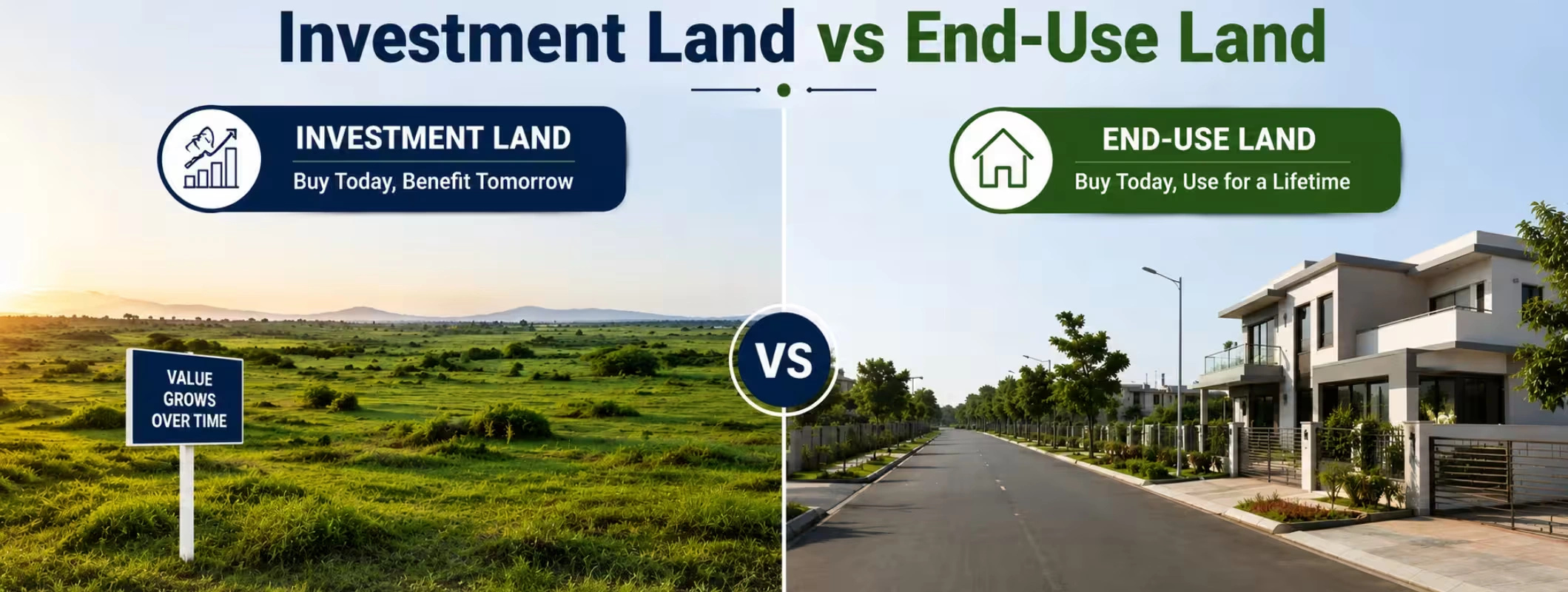
Every person who is buying land has a different reason and want behind the purchase. Some people buy it for the purpose of building a house; others might buy it for a farmhouse, or a business one day. Others might buy it purely for investment purposes, with no plan to ever set foot on it beyond the initial visit. Both are valid reasons. But they call for completely different decisions, different locations, different documents, and even a different mindset while negotiating price. Mixing the two up is one of the most common mistakes most of the first-time land buyers make. Someone buys a plot expecting quick appreciation, then figures three years later that it sits in a zone where construction isn't even allowed. Or someone who is buying the land with the objective of building a home, only to realise the area has no road access and won't have one for another decade. This blog breaks down what actually separates investment land from end-use land, so you know exactly what you're buying into before you sign anything.
What Is Investment Land?
People usually buy investment land with the primary goal: growth in value over time. You're not planning to live on it, farm it, or build anything immediately. You're expecting that the land will be worth more in five, ten, or fifteen years than it is today. This kind of buying is usually seen around expanding cities, upcoming highway corridors, or regions where industrial and infrastructure projects are in the process. The land can be in the condition of being raw, undeveloped, or even agricultural; what matters is its future potential, not its present use. People who Buy Land for Sale in Nashik or a plot for sale in Lonavala with resale in mind usually fall into this category. They're researching any growth signal such as new expressways, upcoming townships, or a nearby city expanding outward.
What Investment Buyers Actually Look For?
- Growth corridors and upcoming infrastructure projects
- Land appreciation history in that specific belt, not just the city average
- Clear title and low legal risk, since holding periods are long
- Liquidity, how easily the land can be resold later?
- Zoning flexibility, in case the land use changes down the line
What Is End-Use Land?
End-use land is bought with the purpose of using it. Maybe you want to build a farmhouse, start organic farming, set up a warehouse, or construct your family home. The purpose is already decided before making the purchase or is near-immediate, and the land needs to support that purpose from day one. This changes what you check before buying. Appreciation still matters, but it's not the deciding factor. What matters more is whether the land can legally and practically support what you want to do on it. If you're planning to Buy Land in Pune to build a weekend home, or you want to purchase land in Goa for a small resort project, you're an end-use buyer. Your checklist looks very different from someone chasing capital growth alone.
What End-Use Buyers Actually Look For?
- Road and access to utilities like water, electricity, and a usable approach road
- Soil quality and topography, mainly for farming or construction
- Local zoning and permitted land use for your specific plan
- Distance from main services such as markets, schools, or hospitals
- Whether construction or farming activity is even allowed on that land type
Investment Land vs End-Use Land: A Quick Comparison
| Factor | Investment Land | End-Use Land |
| Main goal | Value appreciation | Personal or business use |
| Time horizon | Long-term, often 5+ years | Immediate or short-term |
| Location priority | Growth potential | Livability and accessibility |
| Key documents | Title clarity, ownership records | Zoning approval, land-use permissions |
| Infrastructure needs | Can be minimal for now | Roads, water, electricity required |
| Risk factor | Market timing, resale liquidity | Usability and legal permissions |
Why the Purpose Changes Everything?
Here's the thing people miss: the same plot of land can be a great investment and a terrible end-use choice, or the other way round. A plot in a remote agricultural belt might double in value over ten years, making it a solid investment. But if you tried to build a home there today, you'd struggle with basic access to water and electricity. On the flip side, a well-connected plot near a growing town might be perfect to build on right now, but its price could already reflect most of its short-term growth, so it won't necessarily double your money. This is why the very first question before you buy land should be: am I buying this to use it, or to sell it later? Everything else- location, documents, price negotiation- follows from that one answer.
Location Still Matters, Just Differently
Whether you're chasing appreciation or planning to build, location remains the biggest factor. It just gets judged differently depending on your goal. An investment buyer looking to Sell Land in Bangalore outskirts in a few years cares about which direction the city is expanding. An end-use buyer looking for farmland for sale in Nagpur cares about soil type, water table depth, and how far the nearest market is. Both buyers, though, share one non-negotiable requirement: a verified land listing. It does not matter whether you're holding the land for ten years or moving in next month; unclear titles or disputed ownership can delay or stop either plan.
How to Decide Which One You Need?
If you're still unsure which category fits you. Try to answer this question.
- Do I have a confirmed plan for this land within the next two to three years?
- Am I comfortable holding the land for a very long period of time without using it?
- Does my budget allow me to wait for the market to move, or do I need the land to serve a purpose now?
- Am I buying alone, or is this a shared family decision where usage matters more than returns?
Your answers will point you toward one category more clearly than any market report can.
Where 2Bigha Fits Into This Decision?
Even if you are buying with the objective of investment or planning to build on your land, the starting point is the same: you need listings you can actually trust. 2Bigha is a platform built with the specific motive for buying and selling agricultural land and farmland in various parts of India. It brings together Verified Land Listings, ownership records, and location-based insights, so buyers don't have to guess whether a plot is a smart investment or a practical place to build. For investment buyers, 2Bigha's map-based search makes it easier to look for land in growth corridors and compare prices across nearby areas. For end-use buyers, the platform's focus on clear titles and documented ownership means fewer surprises after the purchase.
Sellers benefit too. Whether you want to sell land in Bangalore's growing outskirts or list farmland meant for active cultivation, 2Bigha connects you with the people who are really interested in buying land. They already understand what they're looking for, instead of random enquiries that go nowhere. In a market where investment land and end-use land often get mixed into the same listing pages, having a platform that treats agricultural land as its own category makes the entire buying and selling process simpler.
Conclusion
Investment land and end-use land aren't just two categories; they represent two completely different buying processes and the reason behind the purchase. One is about patience and market timing. The other is about practicality and immediate usability. Before you buy land in any location, get clear on why you're buying it. That one decision shapes everything else: the paperwork you need, the location you should target, and how you'll judge whether the purchase was worth it.
Disclaimer: This article is for informational purposes only and should not be considered investment, legal, financial, or property advice. Real estate regulations, infrastructure plans, market conditions, and government policies may change over time. Readers are advised to verify information with relevant authorities and consult qualified professionals before making any investment or property-related decisions.