List Your Land
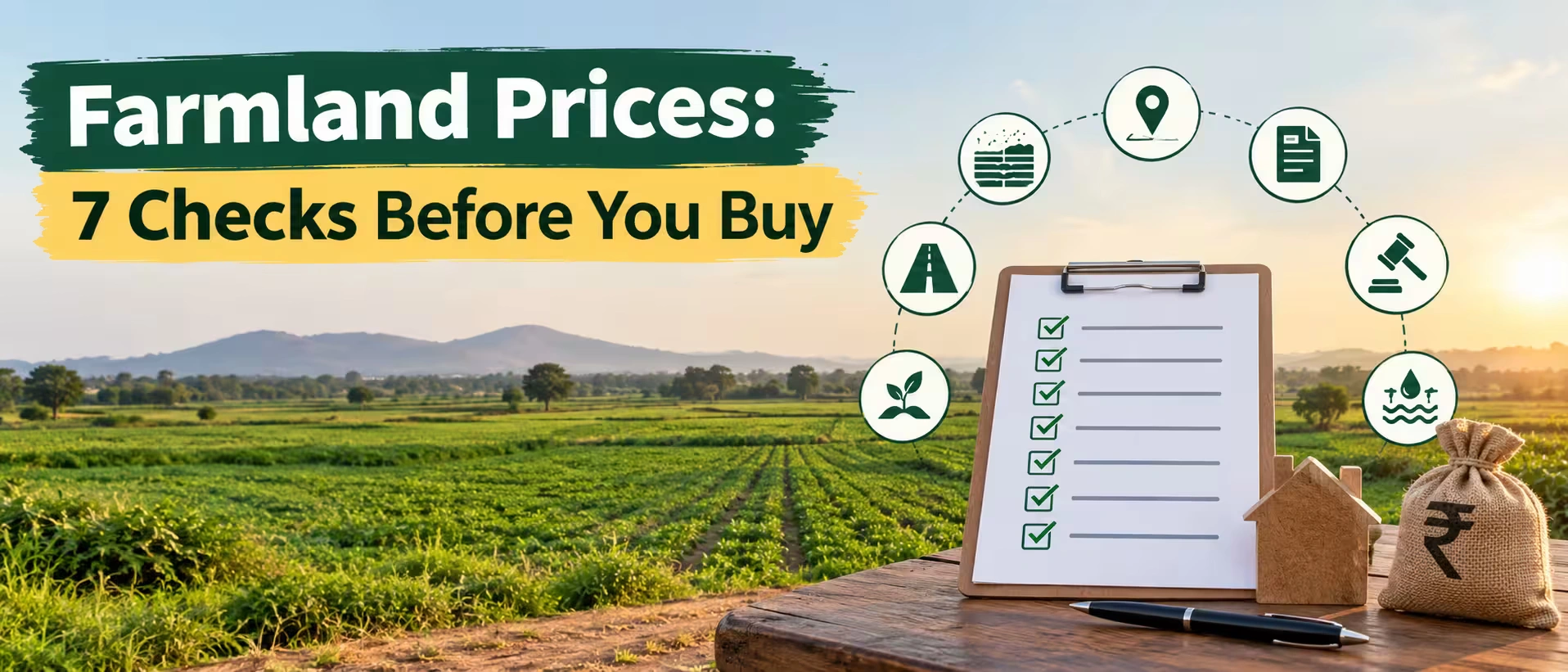
A plot looks right, the seller is friendly, and then the number arrives: ₹35 lakh an acre. Is that fair, or is the seller testing how much you will pay? Most buyers have no way to know, because farmland has no screen showing live prices.
Anyone browsing agriculture land for sale on a portal or through a local broker faces the same problem. The asking price is only the seller's opening position. The seven checks below help you work out what the land is actually worth before you commit to a farm land purchase.
1. Convert Everything to One Unit First
To be able to do the comparison, one must first convert all the rates to a rate per acre. The actual area of the land should be determined from the seller according to its measurement as per the account books (khasra or survey number).
In order to make any comparison at all, one must first express all prices in terms of price per acre. Find out the exact acreage from the seller in terms of its measurement according to the revenue records (khasra or survey number), not what he says orally.
2. Compare With Registered Sales, Not Asking Prices
The asking price is a hope; a registered sale deed is a reality. The best benchmark would be an identical piece of land, in the same village or adjacent village, that sold within the past 6 to 12 months. Here are several ways to get your hands on this information:
- You could approach the sub-registrar's office for information on registered deeds for the village (most states offer this information even online).
- Speak to two to three farmers in the area and ask for the actual price paid by the neighbor, not the one mentioned by him.
- Contact a deed writer or advocate who registers deeds in the tehsil.
Do not blindly accept the figures quoted by others. The seller may quote the highest price he has heard about, and in some areas, the registered price is much lower since the total payment is not always mentioned in the deed.
Look at listings of crop land for sale in the same area too, but only as a ceiling. If five similar plots are listed at ₹30 to 34 lakh per acre and nothing has sold above ₹26 lakh in a year, the real market is closer to the second number.
3. Know the Circle Rate, But Don't Treat It as Market Value
The circle rate (also known as guideline value or ready reckoner rate in some states) is the lowest value that is used by the state government for computing the stamp duty. It is not the market price. In most rural areas, the market price is much higher than the circle rate. In some areas, it is even higher than the actual selling price of the land.
What it does provide you with is a benchmark and an approximate cost. If the asking price is marginally higher than the circle rate in a developing area, then it is probably realistic. But if the asking price is several times higher than the circle rate with no apparent reason, then ask yourself why.
4. Price the Land's Actual Usefulness
Two plots next to each other can differ sharply in value. Walk the land and check what makes it productive:
| Factor | What to check | Effect on price |
| Water | Borewell yield, canal access, distance from a river or tank | Irrigated land usually sells at a clear premium over rainfed |
| Road | Approach by a public road, or only through a neighbour's field | No legal access can cut value sharply |
| Soil | Texture, drainage, waterlogging, salinity | Poor soil limits crops and resale |
| Electricity | Existing agricultural connection or pole nearby | Saves connection cost and delay |
| Shape | Regular block or broken, narrow strip | Awkward shapes are hard to farm and harder to resell |
| Distance | Mandi, highway, town | Closer land costs more but is easier to sell later |
A higher price can be fair if the land has assured irrigation and a proper road. The same price is hard to defend if the plot floods every monsoon.
5. Check Whether a "Cheap" or "Costly" Price Hides a Title Problem
Price and Title are related. Land available for a significantly lower price than others around is not necessarily a bargain. There might be some controversy surrounding the land, or the seller owes money against the plot, or he is the joint owner of the land without consent from the other party to sell it. Prior to any initial payment for the land, make sure the seller provides you with:
- The latest khatauni or record of rights, naming the seller as the holder of the land.
- Documents stating that the process of mutation, the changing of the record of rights after the transaction of the property, has been duly performed by the seller.
- The Encumbrance Certificate for the last 13-30 years, whichever is longer, issued from the sub-registrar's office in your state.
- Proof of the last sale deed/ inheritance documents
Regulations on purchase of agricultural land vary by state. It is limited only to citizens who earn their living through farming or are residents of that area.
6. Run the Numbers on Returns
Farmland rarely pays back like a rental flat. Prices often reflect expected appreciation, development potential, or sentiment, not farm income. That does not make them wrong, but you should know what you are paying for. Here is a simple example. These figures are assumptions for illustration, not market data. Replace them with local numbers.
| Item | Assumed value |
|---|---|
| Asking price | ₹30,00,000 per acre |
| Stamp duty and registration | 6% (varies by state) = ₹1,80,000 |
| Total acquisition cost | ₹31,80,000 |
| Net annual income if farmed or leased | ₹60,000 per acre |
| Income as a share of cost | About 1.9% a year |
At under 2% a year, most of your gain would have to come from the land's price rising. If the same plot is listed at ₹18 lakh nearby, the income share is closer to 3%, and the price already looks more defensible. If you are buying only for farming income, a high price per acre is hard to justify. If you are buying for the long term in an area where roads, industry, or towns are expanding, the extra cost may be reasonable, but you are then taking a risk on the future. Remember the holding costs too: land revenue, fencing, a caretaker if you live elsewhere, and the cost of a bad crop year.
7. Understand Who Is Selling and Why
The circumstances of the seller determine the leeway available for negotiation. It makes a difference whether the seller is a family trying to divide their inheritance, a farmer who requires money for a marriage or a loan, or an investor who has owned the property for three years. Find out how long the property has been in the possession of the seller and why he is selling. An immediate and frank response is a good sign. Anything else is an indication to proceed slowly.
Be careful with brokers too. Some quote a higher price to the buyer and a lower one to the owner, and keep the difference. This kind of land selling is common in rural markets. Ask to meet the owner directly, and pay only against a written agreement, never in cash without a receipt. It also helps to think about how the other side sees the deal. If you ever sell land yourself, you will want a buyer who has checked comparable sales and title before paying, because that makes the transaction smoother for both parties.
Putting a Fair Range Together
After conducting all the tests, you will end up with a couple of numbers; these include the circle rate, two or three registered sales, the asking price of similar plots, and your personal valuation of the land. The fair price will fall somewhere between the latest registered sales and the current asking prices, depending on the availability of water, accessibility, and title of the land.
If the seller is pricing the property above the upper end of this range, then you can have reason to haggle or even walk away from the transaction. However, if the price falls within this range, then the only thing remaining for you to do is to check whether the land is what you need. If you wish to see the listed prices before seeing the plots, 2Bigha will allow you to view the farm land listings from all over India.
Disclaimer: This article is for informational purposes only and should not be considered investment, legal, financial, or property advice. Real estate regulations, infrastructure plans, market conditions, and government policies may change over time. Readers are advised to verify information with relevant authorities and consult qualified professionals before making any investment or property-related decisions.