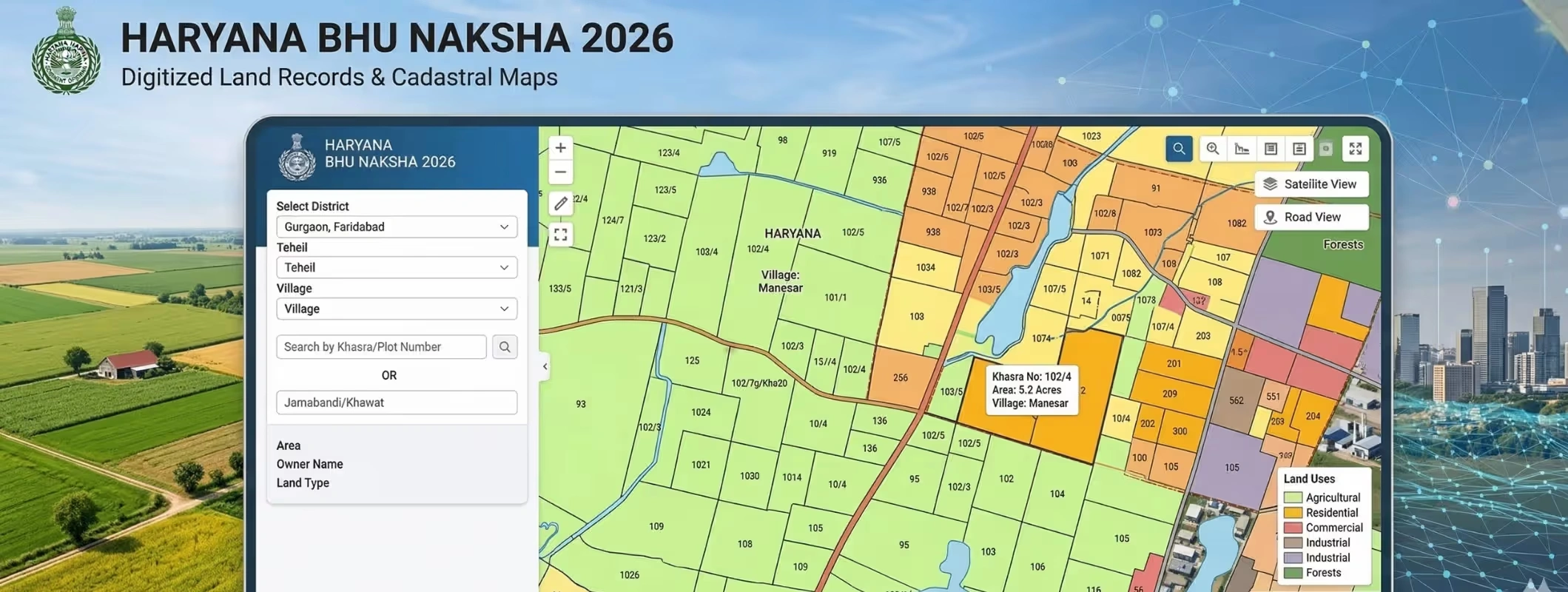
If you want to check a plot before purchase, verify ownership before sale, or simply understand Haryana land details, start with the official digital record system instead of random third-party sites. As of March 29, 2026, Haryana’s Revenue & Disaster Management Department points citizens to the Jamabandi land-records portal and a separate BhuNaksha map portal. The Jamabandi site also states that WebHALRIS is implemented in all 143 tehsils and that online revenue records are provided using real-time data.
Key Takeaways
- Haryana Bhu Naksha is the state’s digital cadastral map system for viewing parcel boundaries and geo-referenced land maps online.
- Haryana Jamabandi is the official record of the workflow. It covers ownership, cultivation, rights, mutation-related access, and multiple query options such as owner details and khewat/khatoni details.
- If you want to check Haryana land records online but do not know the exact field reference, the official portal says users can view sanctioned mutations and jamabandi details using owner name, khewat number, and khasra numbers.
- A land map alone is not enough for a safe transaction. Haryana’s registration FAQ says transfer of immovable property happens through a registered instrument, and public records or certified copies can be checked through the Sub-Registrar system.
- Once you finish the record check, 2Bigha can help you move from verification to action if you want to buy farmland in Haryana, sell land in Haryana, or need property management services in Haryana.
What is Haryana Bhu Naksha?
Haryana Bhu Naksha is the map side of Haryana’s land-record system. The official BhuNaksha platform describes itself as a digital land-mapping system for accurate cadastral maps, precise boundary identification, and easy access to spatial land data. So when people search terms like bhu naksha haryana, haryana land map online, bhu naksha online haryana, or land map haryana, this is the official system they actually need.
Haryana Bhu Naksha vs Haryana Jamabandi vs Haryana Bhulekh
In practical terms, Haryana splits land information into two parts: the map layer and the record layer. The official map layer is BhuNaksha, while the textual record layer is Jamabandi/HALRIS.
| What you need | Best for | What to Check |
| Haryana Bhu Naksha | Viewing parcel shape and location | Plot boundary, surrounding parcels, land map view |
| Jamabandi Haryana / Jamabandi Nakal | Checking record-of-right details | Ownership, cultivation, rights, land details |
| Mutation Status | Tracking ownership change after deed | Whether mutation has moved forward |
| Registration / Encumbrance check | Reducing transaction risk | Registered record trail, encumbrance status |
This comparison is based on the services listed on Haryana’s official Jamabandi portal and BhuNaksha platform, which separately list cadastral maps, jamabandi access, mutation tools, registration services, and encumbrance workflows.
If someone searches Haryana bhulekh, they are usually trying to reach one of these two official outcomes: the land record entry or the land map view. In Haryana, that workflow is handled through Jamabandi and BhuNaksha, not through a single one-page record screen.
Step-by-Step Haryana Bhu Naksha Process
How to Check Haryana Bhu Naksha Online
- Open the official Haryana BhuNaksha portal and choose View Maps from the homepage.
- Use the map interface to move to the correct area and inspect the parcel. The portal is built for digital cadastral maps and boundary identification.
- Note the parcel reference and match it with the corresponding Jamabandi Haryana entry before taking any decision. The map shows location and boundaries; the record side shows ownership and rights.
- If your purpose is sale, purchase, or dispute prevention, do not stop at the map view. Also verify Jamabandi Nakal, mutation status, and the registered deed trail.
That is the most practical step by step Haryana bhu naksha process in 2026: first view the parcel on the map, then confirm the record on Jamabandi, then verify transaction status before moving money.
How to Check Jamabandi Haryana Online
The official Jamabandi query page lets you select district, tehsil/sub-tehsil, and village, then choose from search types such as Owner Details, Kashatkar Details, Makbuja Details, Total Land, Irrigation Details, Majrua Land Details, Gair Majrua Land Details, and Khewat/Khatoni Details. The portal also says users can view sanctioned mutations and jamabandi using owner name, khewat number, and khasra numbers.
So if your goal is to check Haryana land records online, follow this path:
- Open the official Jamabandi Haryana portal.
- Select your district, tehsil, and village.
- Choose the right query type based on what information you already have.
- Search using owner name, khewat number, or khasra number.
- Open the record and, where needed, use the portal’s Get Verifiable Copy of Nakal option.
This is the fastest way to do a land record check Haryana users can trust, because it uses the official source rather than copied database pages.
How to Find Khasra Number in Haryana
A lot of people ask this only after they realise they do not have the exact parcel reference. The easiest route is to start from the official Jamabandi portal using the details you already know. Haryana’s glossary explains that khewat relates to ownership details and khatoni relates to cultivator details, which is why these searches help when the family, holding, or ownership is known but the exact field reference is not.
So, if you are searching how to find khasra number in Haryana, do this:
- start with owner details if you know the landowner’s name,
- use khewat/khatoni if you know the holding details,
- then match the result back to the Haryana land map online view on BhuNaksha.
That approach works far better than guessing the parcel on the map.
Simple Meaning of the Terms Buyers often Mix Up
The Jamabandi portal’s own glossary and document section make these revenue terms easier to understand:
- Jamabandi: the record-of-right document showing ownership, cultivation, and other land rights; it is revised every five years.
- Khewat: ownership details.
- Khatoni / Khatauni: cultivator details.
- Khasra Girdawari: a register connected with ownership, cultivation, and rent entries.
- Shajra / Map: the field boundary map layer.
Once you understand these terms, reading Haryana land records becomes much less confusing.
Can you Download the Haryana Land Map?
The official BhuNaksha homepage clearly provides a View Maps route, which confirms that the government intends the platform to be used for online land-map viewing.
For how to download land map Haryana searches, the practical answer is this: use the live BhuNaksha session first, then see whether the current viewer offers print or export controls. Interface options can change. For any serious transaction, do not rely only on a screenshot. Match the map with Jamabandi Nakal Haryana, mutation details, and the registered deed trail, because the state’s registration FAQ treats the registered instrument as the legal transfer record.
Buyer and Seller Checklist Before you Buy or Sell Land in Haryana
Before you buy land in Haryana, invest in agricultural land in Haryana, or prepare to sell land in Haryana, check these items in sequence:
| Checklist Item | Why it matters |
| Match BhuNaksha map with Jamabandi record | Confirms the parcel you are viewing matches the record you are reading |
| Check mutation status | Shows whether ownership change has progressed after registration |
| Verify registered deed trail | Registered transfer is the legal backbone of title movement |
| Check encumbrance position | Helps spot transaction-related issues |
| Review collector rates / area controls | Useful before valuation and execution |
| Inspect land physically | Verifies access, possession, encroachment, and ground reality |
This checklist reflects the official services Haryana already exposes online: cadastral maps, Jamabandi, mutation status, encumbrance workflow, collector rates, and controlled-area information.
One more useful point: the Jamabandi units page shows that in Haryana, 20 marla = 1 kanal and 8 kanal = 1 acre, while older measurement references also include bigha and killa. That matters when you compare brochure language with official record entries.
Why this Matters for Real Buyers, Sellers, and Investors
Many land deals look clear on paper until one of three things goes wrong: the map does not match the record, the mutation is still pending, or the seller’s story does not match the registered trail. That is why smart buyers do not stop at Haryana bhu naksha and smart sellers do not upload a listing without checking the record first.
If you are comparing plots for sale in Haryana, looking at land investment Haryana opportunities, checking farmland in Haryana, or even scouting land for sale near Delhi NCR or buy plots near Gurgaon, record verification is what separates a serious deal from a risky one.
How 2Bigha helps after the Record Check
Checking Haryana jamabandi, Haryana bhu naksha, and other Haryana property records is the first step. The harder part is turning record data into a practical decision.
That is where 2Bigha comes in.
If you want to buy farmland in Haryana, sell land in Haryana, or need property management services in Haryana, 2Bigha helps you move beyond raw land records. You can use the platform to discover relevant land opportunities, compare listings more confidently, and approach your next step with better clarity. For owners who live away from their property, property management support can make ownership far less stressful.
In short, the government portals help you verify. 2Bigha helps you act.
FAQs - Haryana Bhu Naksha 2026
1. What is Haryana Bhu Naksha?
Haryana Bhu Naksha is the state’s official digital cadastral map system. It is meant for viewing parcel boundaries, land-map geometry, and geo-referenced spatial land information online.
2. How to check Jamabandi Haryana online?
Go to the official Jamabandi portal, select district, tehsil/sub-tehsil, and village, then search through the available query types. The portal supports searches linked to owner details, khewat/khatoni details, and other land-record categories.
3. How can I find the khasra number in Haryana?
Start from the official Jamabandi portal using the owner name or khewat/khatoni route. Once you locate the correct record, match it with the land-map view on BhuNaksha.
4. Is Haryana Bhulekh different from Jamabandi?
In everyday search language, people often use “Haryana bhulekh” broadly. In the official Haryana system, the workflow is split between Jamabandi for land records and BhuNaksha for map-based viewing.
5. Is a Bhu Naksha map enough to prove ownership?
No. A map is useful for boundary understanding, but transfer of immovable property is tied to a registered instrument. For safe verification, also check Jamabandi, mutation, and registration records.
6. Can I check mutation status online in Haryana?
Yes. Haryana’s official Jamabandi system includes a Check Mutation Status service in its public menu.
7. What are common land units used in Haryana records?
The official units page shows 20 marla = 1 kanal and 8 kanal = 1 acre. Haryana records and local land discussions may also refer to bigha and killa in some contexts.
Disclaimer: This image is for illustrative purposes only. We do not claim ownership; all rights belong to respective owners. Contact us for credit or removal.