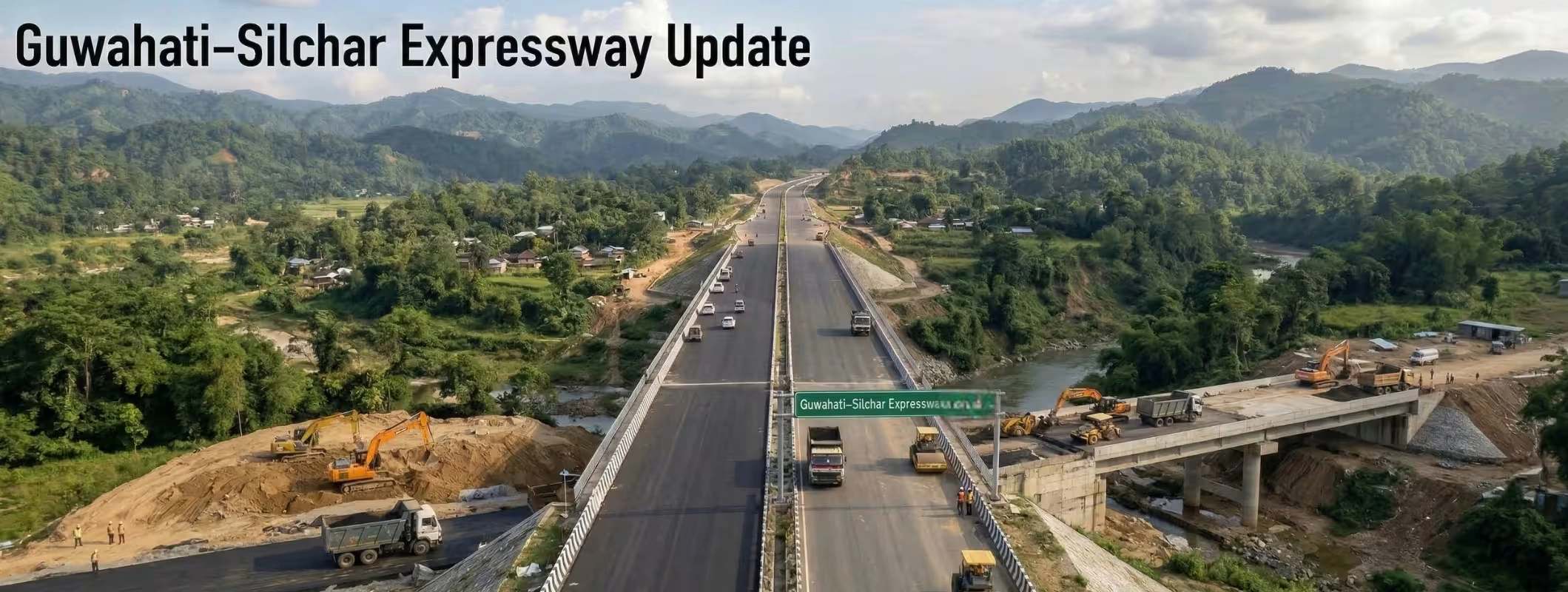
If you are on a quest to find out more about the latest update on the Guwahati Silchar Expressway, then your search is over because we are providing the straight answer: The expressway that people are talking about is the officially sanctioned greenfield high-speed corridor on NH6, connecting Shillong and Silchar, passing through 166.8 km of terrain. The latest update on this is that it has already been sanctioned by the Cabinet, the foundation ceremony has been held on 14th March 2026, and work is already underway by NHIDCL, with land acquisition still in progress.
For the people of Assam, this is a big connectivity story involving the Northeast, logistics efficiency, and PM Gati Shakti. For property buyers and land investors, this is also a corridor that should be on your watch list because improving connectivity is always a game-changer in terms of shifting focus to new growth centers, warehousing areas, tourism zones, etc. That part is an inference based on the project’s officially stated connectivity benefits and route integration.
Key Takeaways
- The project commonly called the Guwahati–Silchar Expressway is officially the Shillong–Silchar Corridor on NH-6.
- Total sanctioned length is 166.8 km, with 144.8 km in Meghalaya and 22 km in Assam.
- Total capital cost is ₹22,864 crore under Hybrid Annuity Mode (HAM).
- The government says the corridor will reduce Guwahati–Silchar travel time from about 8.5 hours to around 5 hours.
- The Bhoomi Poojan/foundation ceremony happened on 14 March 2026, so the project is now beyond the announcement stage.
- Current reporting and tender records show the project is in an active procurement and pre-construction phase, with land acquisition underway, wildlife board clearance obtained, and at least one package still visible in NHIDCL’s current tender listings.
What is the Guwahati–Silchar Expressway, really?
The common search term for this is given as Guwahati Silchar Expressway, while the actual sanctioned corridor is given as Shillong Silchar High Speed Corridor. This is important because many people assume that the entire stretch of this highway is within the city of Guwahati, while actually it starts near Mawlyngkhung and ends near Panchgram. The reason for this being connected with Guwahati is simply because this highway aims at enhancing and facilitating movement patterns involving the cities of Guwahati, Shillong, and Silchar.
In other words, this is essentially a plan for an access-controlled highway that aims at facilitating quicker movement between the Brahmaputra Valley and the Barak Valley, and also aims at enhancing connections with Tripura, Mizoram, Manipur, and other Northeast states.
Latest Status of the Guwahati–Silchar Expressway
The latest update is clear. The Union Cabinet approved the corridor in April 2025. After that, the project moved into procurement and implementation preparation. On 14 March 2026, the Prime Minister performed the Bhoomi Poojan for the corridor in Silchar, which confirms that the project has officially entered the next phase.
On the execution side, NHIDCL had already issued a Notice Inviting Tender in January 2026 for Independent Engineer services for the full 166.80 km NH-6 corridor, with an assignment structure showing 6 months of development period, 36 months of construction period, and 12 months of O&M period. That does not mean the road will open immediately, but it does show serious project structuring is in place.
NHIDCL’s tender records also show package-level bidding activity. Its current tender listings include Package-4 of the corridor with a bid due date in April 2026, and earlier tender records show Package-2 and Package-1 activity as well. Meanwhile, recent reporting says tenders have been floated, wildlife board clearance has been obtained, and land acquisition is in progress. So the honest status is this: the project is approved, launched, and in active tendering/pre-construction mode, but it is not yet an operational expressway.
Route of the Guwahati–Silchar Expressway
The official stretch of this alignment extends from Mawlyngkhung near Shillong in Meghalaya to Panchgram near Silchar in Assam. It runs through the districts of Ri Bhoi, East Khasi Hills, West Jaintia Hills, East Jaintia Hills, and then the Cachar district in Assam. It connects with NH 27, NH 106, NH 206, and NH 37. Therefore, this corridor is likely to provide greater regional connectivity as opposed to just one city-to-city trip.
The government also identified the connected cities and towns like Guwahati, Shillong, Silchar, Diengpasoh, Ummulong, Phramer, Khlieriat, Ratachera, Umkiang, Kalain, etc. This is significant from the point of view of anyone interested in the future movement of freight, tourism, city-to-city travel, or land usage near the connected cities and towns.
Corridor Snapshot Table
| Item | Details |
| Official Name | Kushok Bakula Rimpochee Airport |
| IATA / ICAO | IXL / VILH |
| Location | Leh, Ladakh, India |
| Airport type | Public / Military |
| Operator | Airports Authority of India |
| Elevation | Approx. 3,256 m / 10,682 ft |
| Runway | 07/25 |
| Runway length | Approx. 2,752 m |
| Why it matters | Tourism gateway, strategic lifeline, high-altitude operations |
The table above combines official project approvals with March 2026 status reporting and NHIDCL tender activity.
Why This Expressway Matters for Assam
This project is much bigger than a faster road trip. It is a regional economic corridor. The Centre has pitched it as a project that will enhance connectivity not just for Assam and Meghalaya, but also for the Barak Valley region, Tripura, Mizoram, and Manipur. This translates into faster movement of cargo, smoother movement of people between cities, enhanced mobility with airports, and seamless connectivity with the existing highways.
From a business perspective, the relevance of the project lies in the fact that long travel times in the hilly terrain and adverse weather conditions create business uncertainties. A more direct and controlled corridor will enhance reliability for freight movement, e-commerce, construction supplies, agri-logistics, and tourism movement. For the residents of the region, the project will mean easier movement between major urban and economic hubs of the Northeast region. This is exactly why the project is being framed as a major infrastructure growth move for the region.
Real Estate Impact: What Buyers and Investors Should Watch
Whenever a major highway or greenfield corridor is announced, the first reaction in the market is excitement. The smarter reaction is location filtering. Not every parcel near a future expressway becomes valuable. The land that usually benefits first is land near connectivity junctions, feeder roads, logistics edges, town extensions, airport-linked movement zones, and commercially usable access points. That is an inference, but it is a practical one based on the corridor’s official highway integration and city connectivity plan.
The most closely followed themes in Assam, as well as in the larger Guwahati-Shillong-Silchar corridor, will probably be road-facing land, future warehouse demand, commercial spillover, tourism-related hospitality space, and urban residential expansion where actual access improves. In the Barak Valley context, better connectivity can also improve sentiment for plotted development and service-led real estate over time.
This is where 2Bigha becomes relevant. If someone wants to track land opportunities around infrastructure-led growth, 2Bigha can help in a practical way by making the search more location-driven instead of rumor-driven. A serious buyer should use platforms like 2Bigha to compare mapped locations, study road access, shortlist parcels, review property details carefully, and then move to physical due diligence before making a decision. In corridor-led markets, the difference between a smart buy and a bad buy usually comes down to title clarity, actual approach road, land-use suitability, and future development context.
Buyer Checklist Before Investing Near the Corridor
Before buying land because of this expressway story, check these points:
- Confirm whether the parcel is actually near a usable feeder route, not just “near the project” on paper.
- Verify title, mutation, and local land records.
- Check zoning, land-use restrictions, and whether the parcel is suitable for your end goal.
- Study flood risk, slope conditions, and ground access, especially in Northeast terrain.
- Do not assume every roadside parcel will become commercial.
- Ask how far the land is from a confirmed access node, town center, or logistics point.
- Use a platform like 2Bigha to narrow options, but complete legal and on-ground verification before paying.
What Could Change Next?
The next real milestones to watch are package awards, clearer construction mobilization, land acquisition updates, and state-level implementation progress. NHIDCL’s tender pipeline already shows the project is moving through structured execution stages. So the next update cycle will likely be less about announcements and more about who wins packages, when physical work ramps up, and how quickly bottlenecks around land and terrain are resolved.
Frequently Asked Questions (FAQs)
1. Is the Guwahati–Silchar Expressway approved?
Yes. The project received Cabinet approval in April 2025. Officially, it is the Shillong–Silchar greenfield high-speed corridor on NH-6.
2. Is the Guwahati–Silchar Expressway open?
No. It is not open. The latest confirmed stage is post-foundation ceremony, active tendering, and ongoing pre-construction work including land acquisition.
3. What is the length of the project?
The sanctioned corridor length is 166.8 km.
4. How much will travel time reduce?
The government says travel time between Guwahati and Silchar is expected to come down from about 8.5 hours to around 5 hours.
5. Which districts does the corridor pass through?
It passes through Ri Bhoi, East Khasi Hills, West Jaintia Hills, East Jaintia Hills, and Cachar.
6. What is the latest status in March 2026?
As of March 2026, the project has been approved, the foundation ceremony has been completed, tenders have been issued by NHIDCL, including package bids, and reports indicate that land acquisition is underway with clearance from the wildlife board having been obtained.
Final Word
The Guwahati–Silchar Expressway update is not just another infrastructure headline. This is one of the Northeast’s most important highway stories because it combines travel time reduction, regional trade potential, Barak Valley connectivity, and future real estate interest into one corridor. But the buyer must remain grounded as this remains a project in execution rather than an expressway that has already been constructed. The opportunity exists, but the shrewd decision would be based on facts, locations, and legalities rather than hype. For land buyers looking to get a read on the corridor, 2Bigha may be useful as a discovery tool. Use it to identify promising pockets, free land listing, compare locations, and move with more confidence. But always pair that with local due diligence before you invest.