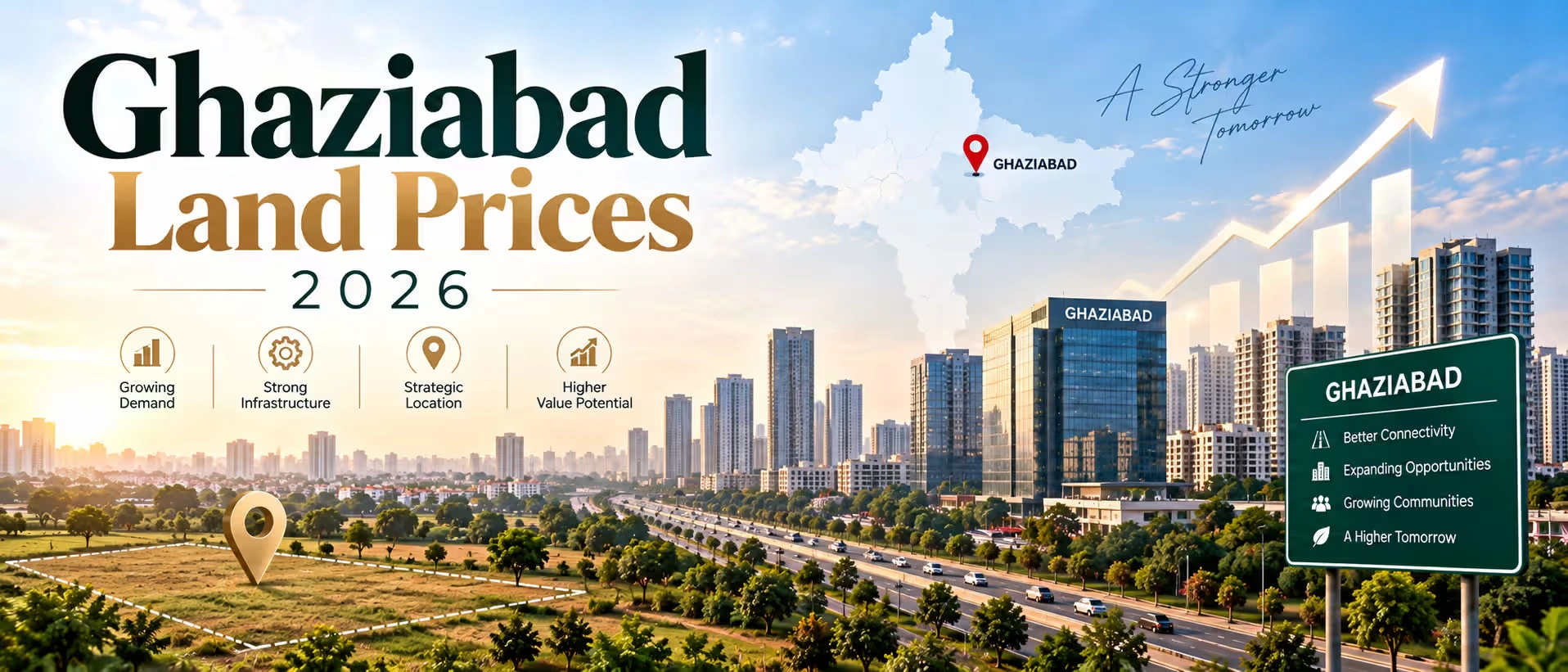
Ghaziabad has quietly become one of the more interesting land markets in the NCR belt over the last few years. It doesn't get the same spotlight as Noida or Gurugram, but that's arguably part of the appeal: prices haven't run away in the same way, and there's still room for genuine appreciation rather than buying at the top of an already-inflated cycle. Heading into 2026, the city's land story is being shaped by a mix of expressway connectivity, RRTS development, and steady industrial expansion along its outer belts. If you're weighing whether to buy a plot in Ghaziabad this year or trying to figure out where prices are actually headed, here's a grounded look at what's happening on the ground.
Why Is Ghaziabad Getting More Investment Attention?
There are certain structural reasons behind Ghaziabad's rising popularity among land buyers whose options were limited to just Noida or Greater Noida:
- The Delhi-Meerut Expressway has greatly reduced commuting time, increasing Ghaziabad's outer areas' commutable zones
- RRTS corridor running through the city area has become an additional connective element, with the result already evident in the pricing of adjacent lands
- Industries and logistics developments on NH-9 have maintained their attraction, indirectly increasing the attractiveness of land for residential purposes
- In contrast to Noida, lands in Ghaziabad continue to remain affordable even for a first-time investor
This does not mean that each part of Ghaziabad should be considered as an investment opportunity; location inside Ghaziabad is still extremely important – this is what we will discuss in the following chapter.
Best Areas to Watch in 2026
Not all of Ghaziabad is moving at the same pace. Some pockets are already fairly built out and priced accordingly, while others are still in the earlier stages of infrastructure catching up to demand. For buyers exploring land in the area, checking Ghaziabad Bhulekh Online can also help verify land records and ownership details before making a decision.
| Area | Why It's Attractive | Price Trend (2026 Outlook) |
|---|---|---|
| Raj Nagar Extension | Established residential demand, good connectivity | Stable, moderate appreciation |
| Siddharth Vihar | Newer development corridor, closer to Delhi-Meerut Expressway | Rising steadily |
| Crossings Republic | Well-planned township, strong resale demand | Stable with gradual growth |
| Wave City area | Large-scale planned development, long-term potential | Higher growth expected |
| Modinagar/Muradnagar belt | More agricultural land, lower entry cost | Early-stage growth, higher upside |
| NH-9 industrial belt | Logistics and industrial demand are driving land value | Strong commercial-linked growth |
For someone specifically looking at a plot for sale in Ghaziabad with a five-to-ten-year investment horizon, the Siddharth Vihar and Wave City belts tend to come up often in conversations with buyers, mainly because infrastructure there is still catching up to already-announced connectivity plans, which usually means prices haven't fully priced in future value yet.
What's Driving Price Movement in 2026?
The determination of land prices usually occurs due to several reasons, and Ghaziabad is a case that shows how several different factors are contributing simultaneously:
- Completion of RRTS corridor – there has been an observable rise in the prices in areas near the stations on the Namo Bharat line
- Accessibility through the expressway – plots near the Delhi-Meerut Expressway have better demand than plots located farther inside
- Expansion of master plan – as Ghaziabad Development Authority extends the approved area of its master plan, previously informal land becomes suitable for regularization, often at an increased price
- Industrial corridor effects – demand for industrial/warehousing land along NH-9 affects prices in residential and agricultural areas
- Pressure of migration from Delhi and Noida – as prices there increase, Ghaziabad appears to be an alternative in commuting distance
Farmland and Agricultural Land: A Different Kind of Opportunity
Not every buyer in Ghaziabad is looking for a residential plot. There's a steady stream of interest in farm land for sale in Ghaziabad, particularly in the outer belts toward Modinagar and Muradnagar, where land is still classified as agricultural and priced well below approved residential plots. This segment works differently from the approved-plot market:
| Aspect | Agricultural Land | Approved Residential Plot |
|---|---|---|
| Entry cost | Lower per unit area | Higher, reflects development premium |
| Conversion potential | Depends on NA permission and zoning | Already conversion-complete |
| Investment horizon | Longer, speculative on future zoning changes | Shorter, more predictable appreciation |
| Legal complexity | Higher, verify land use restrictions carefully | Lower, if from an approved layout |
| Buyer profile | Long-term investors, occasional farming use | Immediate or near-term construction buyers |
Anyone looking to sell agricultural land in Ghaziabad right now is generally in a favorable position; demand for this category has picked up as buyers look for lower entry points before the outer belts get fully absorbed into the city's approved development zones. That said, sellers should make sure land-use documentation and conversion status are clearly represented, since unclear agricultural-to-residential status is one of the most common points of dispute in this segment.
Approved Plots vs Unapproved Layouts: Why It Matters
This is one area where buyers genuinely need to slow down before committing. Ghaziabad, like most fast-growing NCR districts, has a mix of GDA-approved layouts and informal, unapproved colonies, and the price difference between the two can be deceptively small on paper while the risk difference is significant.
- Approved plots in Ghaziabad come with a clear title, sanctioned layout maps, and eligibility for home loans and construction permits
- Unapproved layouts are often cheaper upfront but carry risks around regularization, resale difficulty, and limited access to bank financing
- Buyers focused purely on short-term appreciation sometimes gamble on unapproved land near expanding zones, but this strategy carries real legal exposure if regularization doesn't happen as expected
- For anyone buying with construction or long-term resale in mind, sticking to GDA-approved layouts remains the safer path, even at a modest price premium
Investment Outlook for 2026 and Beyond
Taken altogether, it appears that 2026 presents an opportunity in Ghaziabad's real estate market, not in terms of early opportunities or late-stage opportunities, but as a mid-cycle event. The price levels of today represent a marked increase over what they were even a few years ago, especially those near the RRTS stations and along the expressway route, yet they show signs of a runway when compared to comparable areas in Noida and Gurugram.
The neighborhoods that warrant keeping an eye on are the ones where the infrastructure has been planned and constructed but is not yet operational; these are the spots where Ghaziabad land for sale is sold at below-market prices prior to connectivity being completed. Of course, agricultural land farther away poses some risks but also some rewards for long-term investment.
Where 2Bigha Fits In?
Land searches in fast-moving markets like Ghaziabad often run into the same problem: listings move quickly, pricing is inconsistent across sources, and verifying whether a plot is actually GDA-approved or genuinely eligible for agricultural-to-residential conversion takes real effort. 2Bigha is built to close that gap specifically for land and farmland transactions.
Whether you're comparing a plot in Ghaziabad against other NCR options, trying to sell agricultural land in Ghaziabad without relying entirely on local brokers, or verifying whether a listing for approved plots in Ghaziabad actually holds up on paper, the platform's verification layer checks ownership and approval status before a listing gets surfaced to buyers. That matters even more in a market like this one, where the gap between approved and unapproved land can make or break an investment.
Disclaimer: This article is for informational purposes only and should not be considered investment, legal, financial, or property advice. Real estate regulations, infrastructure plans, market conditions, and government policies may change over time. Readers are advised to verify information with relevant authorities and consult qualified professionals before making any investment or property-related decisions.