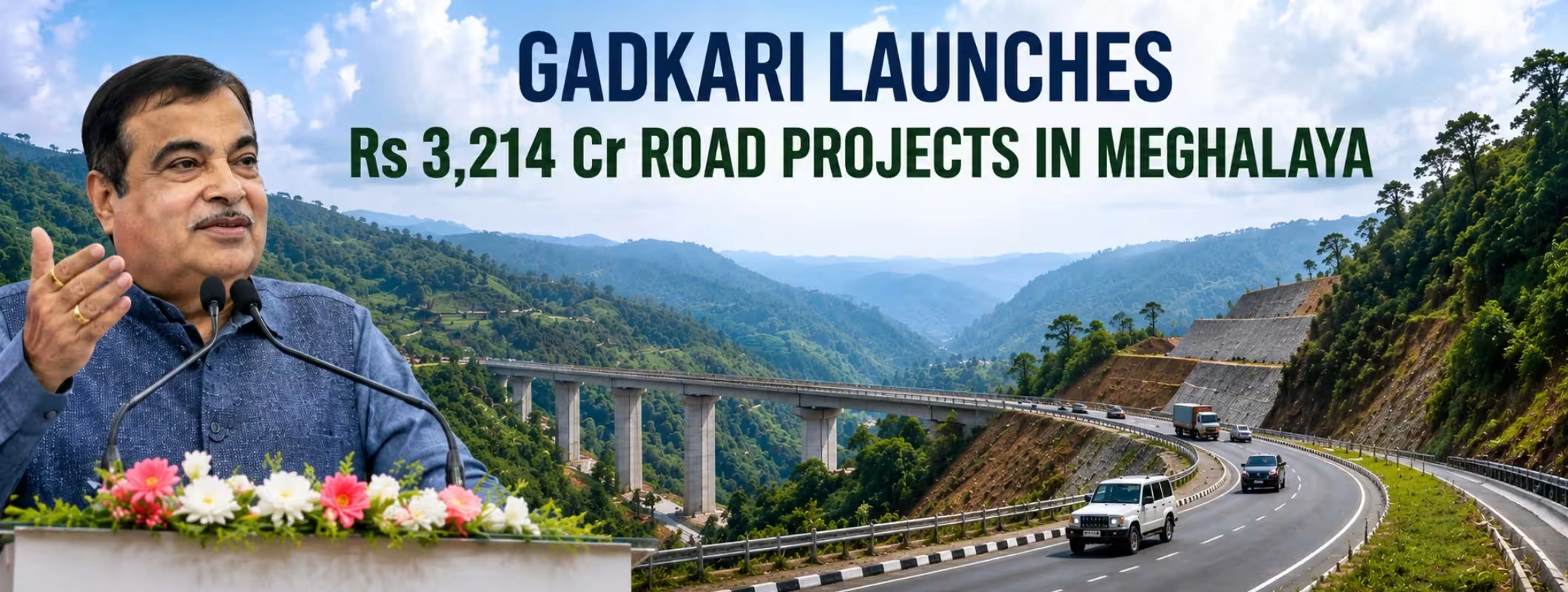
On June 15, 2026, Union Minister for Road Transport and Highways Nitin Gadkari introduced six new major road projects costing around 3,214 crore in Meghalaya. The launch was conducted during the North East India Infrastructure Summit & Exhibition (NEIINFRA) 2026 in Shillong. This event brings together various parties such as policymakers, industry leaders and investors to talk about infrastructure and investment in the region. With infrastructure investments growing across the state, interest in Buying land in Meghalaya is also growing among investors looking at long-term development corridors.
Chief Minister Conrad K. Sangma has officially announced the line-up a day earlier, briefly explaining the package as a combination of four new National Highway developments and the upgrade of two existing corridors. These projects touch some of the state's busiest travel routes, connecting links to Tura, Dhubri, Pynursla, Selsella, Shillong, Dawki and Jowai.
For a hill state where road connectivity directly impacts how goods, tourists and daily commuters move, an investment of this size is really considered to be important. It also fits into a larger pattern: the Centre has been continuously pushing highway spending across the Northeast, and Meghalaya has been one of the focus areas for several years now.
Key Takeaways
The table below gives a very important idea about the six major projects, their cost, and what each one is meant to deal with.
| Project | Cost | What It Does |
| Tura Bypass | Rs 951 crore | New bypass to ease traffic through Tura town |
| Dhubri-Phulbari Bridge–Selsella Road | Rs 737 crore | Improves the Assam-Meghalaya link via the Dhubri-Phulbari Bridge |
| Pynursla Bypass | Rs 564 crore | New bypass on the Shillong-Dawki route near Pynursla |
| Selsella-Goeragre Road | Rs 504 crore | Upgrades the Selsella to Goeragre stretch |
| Shillong-Dawki Highway | Part of the overall outlay | Improvement works on this key tourist and trade route |
| Jowai Bypass | Part of the overall outlay | Improvement works to reduce traffic in Jowai |
- The total package is sums upto Rs 3,214 crore.
- It mainly includes four new National Highway projects plus upgrades to two existing corridors.
- The launch event, the NEIINFRA 2026 summit, was conducted in Shillong.
- One of the biggest single projects is the Tura Bypass at Rs 951 crore.
- Routes connect Meghalaya to Assam and to the India-Bangladesh border near Dawki.
- The push is one of the major part of the Centre's continuing focus on Northeast connectivity.
What Are These Road Projects About?
The Rs 3,214-crore package covers the six very important road projects in Meghalaya: Tura Bypass, Dhubri-Phulbari Bridge–Selsella road, Pynursla Bypass, Selsella-Goeragre road, and improvement works on the Shillong-Dawki highway and Jowai Bypass, launched by Nitin Gadkari on June 15, 2026, during NEIINFRA 2026 in Shillong.
Four of these are entirely new highways, while the Shillong-Dawki and Jowai works are upgrades to roads that already carry very heavy traffic. Officials say the goal is very simple and clear to reduce the travel time, reduce narrow roads around towns, and make it easier for goods and people to move within Meghalaya and across to neighbouring Assam.
Why Is This Launch Important?
These projects matter because Meghalaya's hilly roads have long been slow and unpredictable, and better highways directly affect how farm produce, coal, limestone and tourists move through the state. The improved connectivity could also benefit property owners looking to Sell land in Meghalaya as more areas become available to buyers and investors.
Shillong-Dawki road is the main route for tourists moving toward Dawki and the India-Bangladesh border area, a route that sees heavy seasonal traffic. Tura Bypass and the Dhubri-Phulbari Bridge–Selsella road improve the link between Garo Hills districts and Assam, which matters for trade and for moving agricultural produce to bigger markets.
How Much Is Being Invested, and Where Does It Fit?
Below is a short and concise table that shows how this Rs 3,214-crore package compares with past Northeast highway announcements and helps put the numbers in context.
| Announcement | Year | Amount |
| Rs 68,000 crore for Assam, Meghalaya, Nagaland, Sikkim (combined) | 2022 | Rs 68,000 crore |
| Rs 9,000 crore allocated to Meghalaya alone | 2023 | Rs 9,000 crore |
| Phulbari-Tura Road Enhancement | 2023 | Rs 1,241 crore |
| Current Six-Project Package | 2026 | Rs 3,214 crore |
Meghalaya has been part of a major Rs 9,000 crore allocation announced for the state a few years ago. And this latest Rs 3,214-crore package is a continuation of that allocation coming to ground.
What Is the Economic Impact?
Improved roads will directly result in lower transport costs for farm produce and minerals, faster movement for tourists heading to Dawki, Mawlynnong and other destinations. It will also result in easier daily travel for people living around Tura, Jowai and Pynursla.
Meghalaya's economy entirely depends on agriculture, horticulture, coal and limestone, and a growing tourism sector. All four of these mainly depend on roads that don't turn into single-lane traffic jams every monsoon. Bypasses around Tura and Jowai, in particular, are expected to reduce through-traffic delays in town centres that have grown well beyond what the old roads were built for.
What Does This Mean for Land and Property in Meghalaya?
New bypasses and highway changes tend to increase the level of interest in land along the new alignment, especially near towns like Tura, Jowai and Pynursla, where a bypass changes how people enter and exit the area.
When a bypass comes up, land along the new road often becomes attractive for fuel stations, warehouses, small businesses and roadside services, simply because that's where the traffic now flows. Shillong-Dawki corridor, given its tourist footfall, is also one to watch, since better road conditions usually bring more visitors and more demand for stays, eateries and parking along the way.
How does 2Bigha.ai Helps Track These Opportunities?
Projects like these don't change land values overnight, but they do set the direction over the next few years. 2Bigha.ai helps people keep track of this by listing verified land listings in various regions where highway and bypass work is underway, including parts of the Northeast.
If you're looking at agricultural land investment near a route like Selsella-Goeragre, or thinking about land for sale near highway stretches such as the new Tura Bypass, the platform lets you compare locations, check listings, and follow areas that fall under infrastructure-led growth. Owners with land along these corridors can also post property online and reach buyers directly, while a membership plan gives access to additional listing tools for both buyers and sellers. The idea is simple: as roads improve, so does the case for looking closely at the land around them.