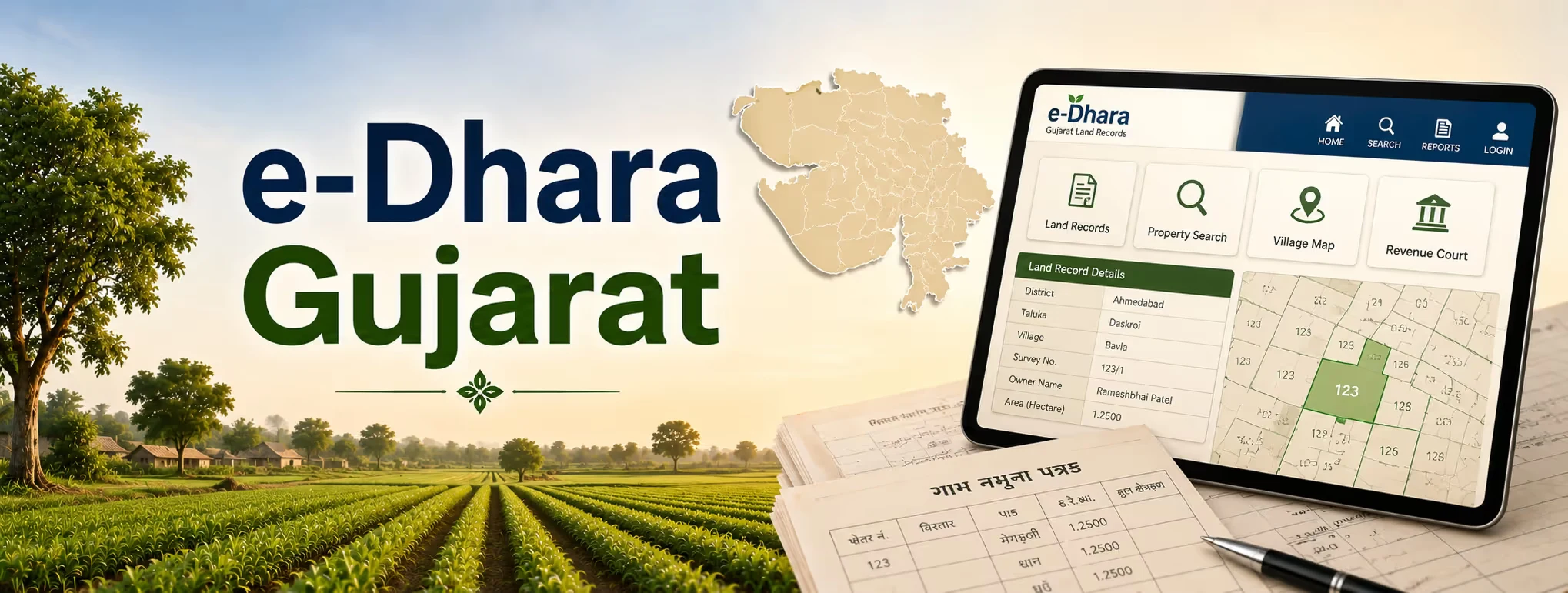
There's a particular kind of panic that hits when a land deal is almost done, and someone asks, "Did you check the 7/12 extract?" If you've bought property in Gujarat, or you're about to, you've probably heard that term thrown around without anyone really explaining it. e-Dhara is the system behind that document, and skipping it is one of the fastest ways to end up in a mess you didn't see coming. This piece walks through what e-Dhara actually does, how to pull records yourself, and what a buyer needs to double-check before any money changes hands.
So What Is e-Dhara, Really?
Gujarat digitised its land records fairly early compared to a lot of other states. e-Dhara is the government portal and record-keeping system that maintains ownership details, mutation history, and crop information for agricultural plots across the state. Before this system existed, all of it sat in paper registers at the taluka office, and anyone who's dealt with those registers knows how easy it was for entries to go missing or get quietly altered. Now most of that lives online, tied to a village and survey number. That doesn't mean fraud has disappeared; it hasn't, but it does mean a buyer has a much easier way to cross-check what a seller is telling them.
| What e-Dhara Tracks | Why It Matters to a Buyer |
| Ownership (Form 7/12 and 8A) | Confirms who legally holds the land |
| Mutation entries | Shows transfer history — inheritance, sale, gift |
| Crop and cultivation details | Relevant for agricultural land classification |
| Encumbrance status | Flags pending loans or disputes tied to the plot |
| Land type and zoning | Tells you if conversion (NA) has happened or is needed |
How to Get Your e-Dhara Gujarat 7/12 Online?
Here's the part people actually want to know. You don't need to visit a government office for a basic check anymore.
- Go to the AnyROR Gujarat portal (anyror.gujarat.gov.in)
- Choose "Rural" or "Urban" depending on the plot's location
- Select district, taluka, and village
- Enter the survey number or the owner's name
- View or print the 7/12 (Saat Baar) extract
Doing an e dhara gujarat 7 12 online check takes maybe five minutes once you know the survey number. Compare that to the half-day it used to take standing in line at a taluka office, and it's obvious why this shift mattered. One catch, though: not every record has been fully migrated or updated in real time. If something looks off, or a mutation seems missing, that's when a visit to the local office actually helps.
When You Still Need to Visit an e-Dhara Kendra?
Online access covers most day-to-day needs, but it doesn't cover everything. Certified copies for legal proceedings, corrections to erroneous entries, or fresh mutation requests after a sale usually still require a trip to the e-Dhara Kendra in your taluka. These centres are staffed by revenue department officials who can process changes the portal itself won't let you make directly. If you're finalising a purchase, it's worth getting a fresh certified extract from the Kendra rather than relying purely on a printout, especially for high-value agricultural land for sale in Gujarat where a small clerical error can turn into a costly dispute later.
What Buyers Often Get Wrong?
I'll be honest, most disputes over land in Gujarat don't come from dramatic fraud. They come from small oversights. A seller who forgot to mutate the record after inheriting land from a parent. An NA (non-agricultural) conversion that was applied for but never completed. A survey number that got subdivided years ago, so the plot boundary on paper doesn't quite match what's physically fenced off. None of these are catastrophic on their own. But if you don't catch them before registration, you're the one stuck sorting it out afterward. A few things worth checking beyond the basic 7/12:
- Confirm the mutation entry actually reflects the current seller as owner
- Check whether the land is classified as NA or still agricultural; this affects what you can legally build
- Ask for a village map reference to confirm the physical plot matches the survey number on paper
- Look for any pending litigation flags tied to the khata
For a broader look at how village-level survey maps tie into all this, our Gujarat Village Maps Guide covers boundary verification in more depth if you want to go further down that rabbit hole.
Buying in Ahmedabad or Elsewhere in Gujarat? The Checks Don't Change
Whether you're browsing a plot sale in Ahmedabad or looking at farmland two hours outside the city, the verification steps stay the same. Urban buyers sometimes assume city plots are "cleaner" because they're closer to municipal oversight, but that's not really true; urban land disputes over inherited or subdivided plots are just as common, if not more so, given how fragmented ownership tends to get near expanding cities.
Searching Farmlands Near Me? Do This Before You Get Attached to a Plot
It happens to almost everyone: you search farmlands near me, find a plot with a great location and a fair asking price, and start imagining what you'll do with it before you've even pulled the records. Try to resist that a little. Confirm the e-Dhara details first, then let yourself get excited. It saves a lot of heartbreak.
If You Want to Buy Agricultural Land in Gujarat, Start Here
For anyone serious about wanting to buy agricultural land in Gujarat, treat the e-Dhara check as step one, not step three. Get the 7/12 and 8A, verify the mutation, confirm the classification, and only then move to price negotiation. Doing it in the wrong order is how people end up emotionally committed to a plot that has a paperwork problem nobody wants to walk away from.
Selling Property Online in Gujarat? Keep Your Records Ready
If you're on the other side of this, selling property online, buyers today ask for e-Dhara extracts almost immediately, sometimes before they'll even schedule a visit. Sellers who keep their mutation records current and their 7/12 extract ready tend to close faster, simply because there's less back-and-forth over documentation.
How Does 2Bigha Make This Easier?
This is genuinely where a lot of buyers get stuck, and it's exactly the gap 2Bigha was built to close. On 2bigha.ai, listings go through background verification before they're shown to a buyer, with ownership records, encumbrance checks, and classification details included. So instead of chasing down a 7/12 extract yourself after you've already fallen for a plot, you get that groundwork done upfront. Whether you're hunting for a plot sale in Ahmedabad or farmland further out, 2Bigha's verified listings cut down the guesswork considerably.
Disclaimer: This article is for informational purposes only and should not be considered investment, legal, financial, or property advice. Real estate regulations, infrastructure plans, market conditions, and government policies may change over time. Readers are advised to verify information with relevant authorities and consult qualified professionals before making any investment or property-related decisions.