My uncle once spent an entire Tuesday standing in three different government offices just to get one certified copy of a land document. The first office sent him to the second. The second office said he needed a stamp from the first before they'd even look at his file. By the time he got back to the office, it had shut for lunch. That was maybe eight years ago, and honestly, a lot of India's property system still worked that way not too long ago.
It doesn't have to anymore, at least not entirely. Digital KYC and online documentation have crept into land transactions in a way that's easy to miss unless you're actually in the middle of buying or selling right now. So let's talk about what's actually different, not in a vague "technology is changing everything" way, but specifically, what changes for you if you're trying to sell land or hunt down a decent plot.
Okay, But What Is Digital KYC in This Context?
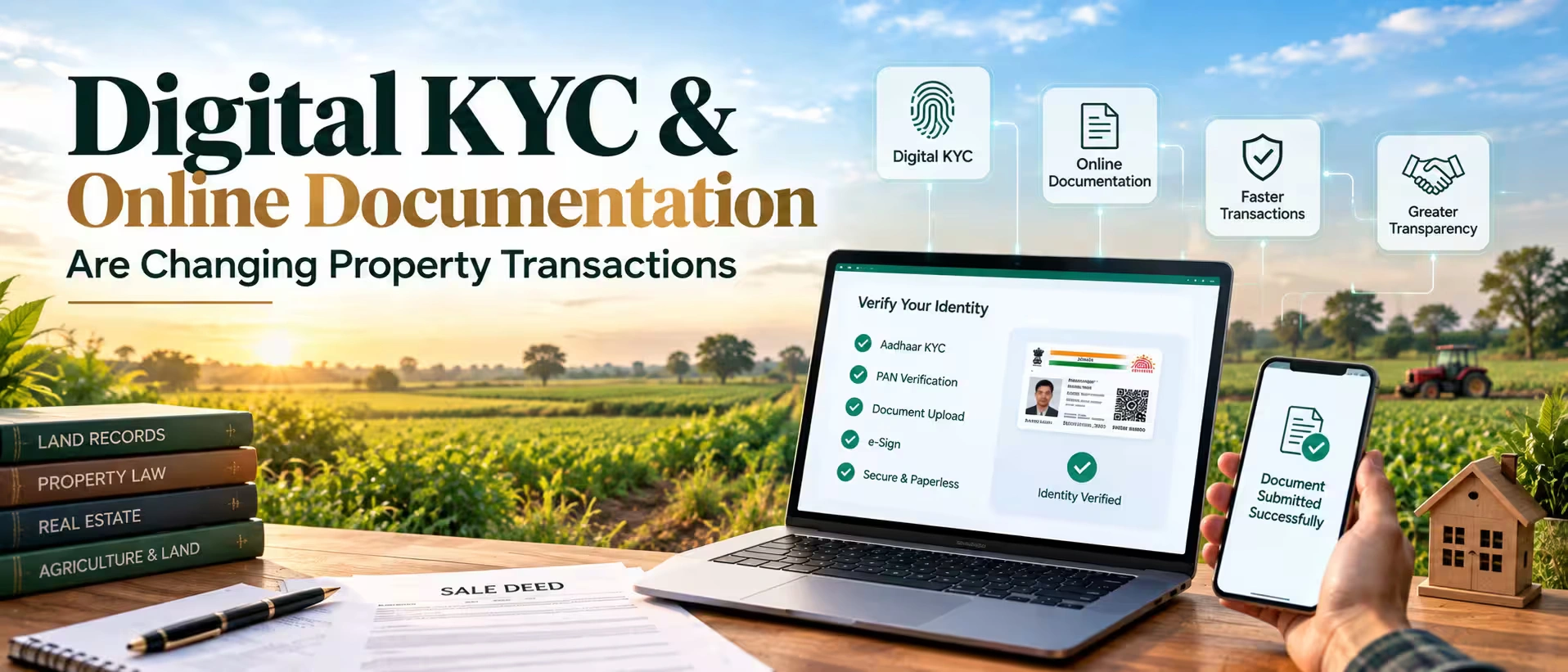
KYC used to be a banking word. Now it's a land-deal word too. Instead of hauling photocopies of your Aadhaar and PAN card to a registrar's desk and waiting while a clerk squints at them under a tube light, verification happens through Aadhaar-linked digital checks, sometimes a quick video call, sometimes just an upload that gets matched against government databases automatically. For sellers, this is honestly a relief. You're not meeting every curious buyer three times just to prove you are who you say you are. A verified profile handles a chunk of that before anyone even discusses price.
| Step | How It Used to Work | How It Works Now |
|---|---|---|
| Identity check | Photocopies, in-person visit | Aadhaar-linked digital verification |
| Address proof | Notarized copies, utility bills | Document upload, matched against records |
| Meetings needed | Several, spread over weeks | Often just one, for final signing |
| Time taken | Days, sometimes longer | Usually under an hour |
Farmland Deals Feel This Shift the Most
City property transactions were modernized first. Farmland and rural land, not so much. The paper trails are older, the parties involved aren't always local, and honestly, a lot of registrars in smaller towns are still catching up. But it's moving.
If you've searched farm land for sale near me or agriculture land for sale near me lately, you've probably noticed some listings now carry a "KYC verified" tag. That's not just a badge for show. It means the seller's already gone through digital identity checks, which shaves real time off the deal.
This helps out-of-town buyers more than anyone. Say you live in Pune and you're eyeing farm land for sale somewhere in, I don't know, Madhya Pradesh. You used to need two or three trips just to confirm the seller was even legitimate before getting into serious negotiation. Now, a good chunk of that groundwork happens before you book a train ticket.
It's Not Just KYC, the Paperwork Itself Went Digital Too
Identity verification is one part of this. The bigger change, honestly, is what happened to the documents themselves. Encumbrance certificates, mutation records, sale deeds, stamp duty payments — a lot of states have put these online now, meaning a buyer can pull most of what they need to verify before setting foot on the property.
For anyone listing agricultural land for sale, attaching this stuff upfront isn't optional anymore, not if you want serious inquiries. Buyers comparing five listings side by side will skip past the vague ones and gravitate toward whoever's already transparent about paperwork.
| Document | Where You'd Find It Now |
|---|---|
| Encumbrance Certificate | State registration portal |
| Mutation record | Revenue department's online system |
| Sale deed draft | E-stamping platform |
| Property tax receipt | Municipal or panchayat portal |
| Land classification | District land records site |
Selling Property Online Looks Nothing Like It Did
Remember when selling property online meant posting one blurry photo and your phone number, then answering the same three questions over and over on calls? That's mostly gone. Platforms now nudge sellers toward attaching verified documents, finishing KYC before listing, sometimes even recording a short video walkthrough, all before a single buyer picks up the phone.
And it pays off. Listings with complete documentation get fewer "just window shopping" calls, and more people who actually mean business, because half the screening buyers used to do over a phone call now happens the moment they open the listing. A handful of things genuinely help here:
- Finish KYC before you list, not after someone's already interested and waiting
- Upload the encumbrance and mutation records directly; don't just write "available on request." It reads as a red flag now
- Mention land classification clearly if it's agricultural land
- Reply fast once a verified buyer messages, online deals move on momentum, and slow replies lose people
For Buyers — Don't Let Clean Paperwork Replace Common Sense
Digital documents make life easier, sure, but they don't remove the need to actually check things. They just moved the checking earlier. A few habits worth keeping:
Cross-check anything sent to you against the actual government portal; a screenshot forwarded on WhatsApp proves nothing on its own. Make sure a "verified" badge on a listing site actually means government ID verification and isn't just something the seller ticked themselves. If you're looking at agricultural land on sale, remember KYC confirms who the seller is, not what the land's classification status is; check that separately. And please, don't skip visiting the plot in person just because everything looked tidy on a screen. Paper can't show you a drainage problem or a boundary that doesn't quite match the sketch.
Then vs Now, Quickly
| What Changed | Before | Now |
|---|---|---|
| Finding a buyer or seller | Local agents, word of mouth | Online listings, much wider reach |
| Verifying who you're dealing with | In-person, slow | Digital, often instant |
| Getting documents | Multiple office visits | Mostly downloadable online |
| Closing a deal | Weeks, sometimes months | Days, depending on the state |
Where This Seems to Be Going
More states are linking their land records to centralized digital systems, bit by bit. The gap between "here's a listing" and "here's something legally verifiable" keeps shrinking. That's a genuinely big deal for rural land specifically; someone hunting for farm land for sale from three states away can now check title, classification, and seller identity without a single in-person visit, right up until it's time to actually walk the land and sign.
Though I'll be honest, it's not equally fast everywhere. Some districts are still slow to update their online records, and rural agricultural land tends to lag behind urban property in how thoroughly it's been digitized. Worth checking your specific district's portal before assuming everything's just a click away.
Final Thought
Digital KYC hasn't just sped things up; it's changed who gets to participate at all. A buyer doesn't need to be local anymore to seriously evaluate land. A seller doesn't need three agents running around town to find someone interested. If you're trying to sell land, browsing agricultural land for sale near me, or weighing a few options for agricultural land on sale, the deals closing fastest right now are the ones where the paperwork was sorted before the first phone call. The process hasn't gotten shorter exactly. It's just stopped wasting everyone's time.
Disclaimer: This article is for informational purposes only and should not be considered investment, legal, financial, or property advice. Real estate regulations, infrastructure plans, market conditions, and government policies may change over time. Readers are advised to verify information with relevant authorities and consult qualified professionals before making any investment or property-related decisions.