Key Takeaways
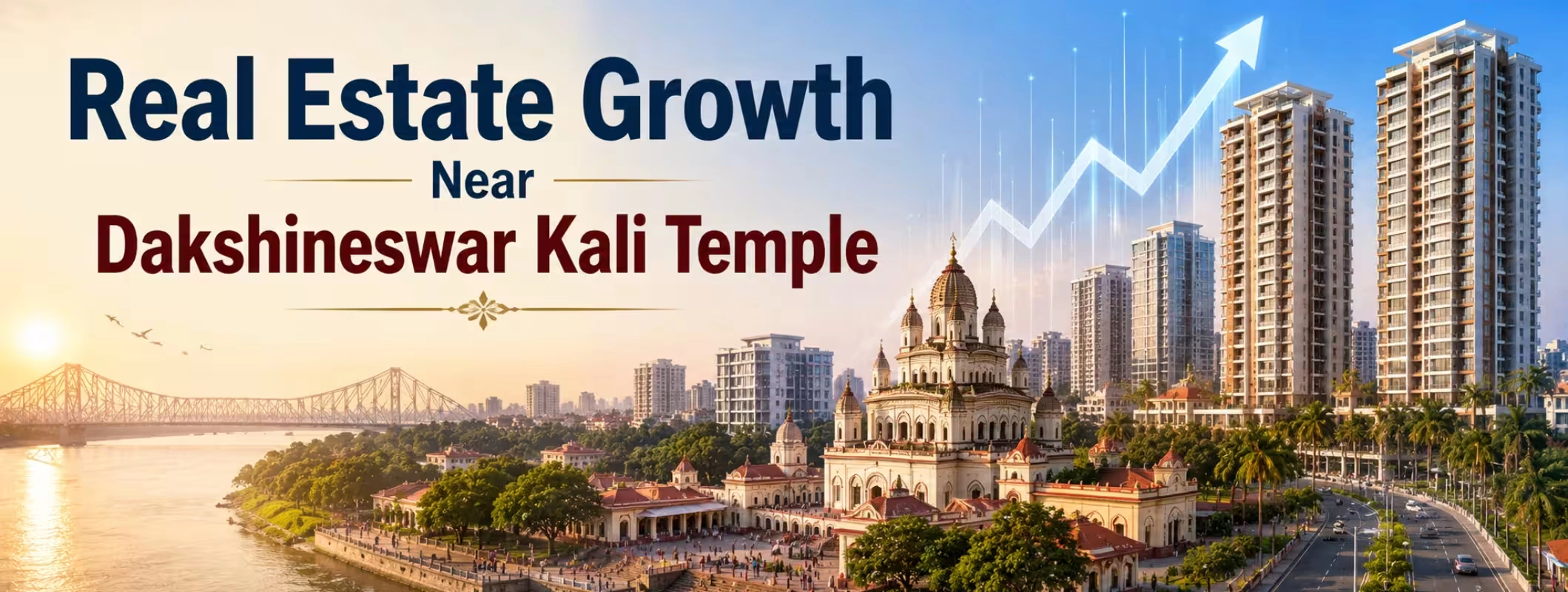
Dakshineswar Kali Temple is not just a spiritual landmark. It is also one of the strongest local demand drivers for Dakshineswar Kali Temple real estate, especially because the area combines religious tourism, metro access, riverfront identity, local housing demand, and steady commercial movement.
For homebuyers, property near Dakshineswar Kali Temple offers a mix of affordability, cultural value, and daily connectivity. For investors, the area works better as a long-term, practical real estate market rather than a fast-speculation zone.
Current online listing data shows that Dakshineswar property market prices vary widely depending on location, property type, age of construction, access to metro, and proximity to the temple. Housing.com shows an average property price of around ₹3,440 per sq. ft. for Dakshineswar, while Magicbricks listings show flats, houses, and land across a very wide price range. These are asking/listing prices, not guaranteed transaction values.
The biggest real estate impact comes from four factors: temple footfall, Hooghly riverfront appeal, Dakshineswar Metro access, and nearby localities like Baranagar, Belgharia, Dunlop, Bally, and Uttarpara.
Introduction: Why Dakshineswar Is More Than a Temple Locality
Anybody from Kolkata would immediately say Maa Kali, the Hooghly River, and the temple that has hosted thousands of devotees through the ages when asked anything related to Dakshineswar. However, viewing the locality through a real estate perspective makes the locality even more interesting.
This place is a pilgrimage site, an important transport hub, a residential locality, an area connected with the river, and a zone of movement for business purposes. This blend provides a special property value to the locality.
The Real Estate Impact of Dakshineswar Kali Temple cannot be judged by flat rates and property rates alone. One needs to study the reasons for coming to this locality, the frequency of visits, surviving businesses, change in movement due to metro rail, and the interest shown by end-users and investors in the surrounding localities.
Dakshineswar Kali Temple is located on the eastern bank of the Hooghly River. West Bengal Tourism describes it as a famous Hindu temple built by Rani Rashmoni in 1855 and associated with Sri Ramakrishna Paramhansadeva. This heritage value gives the area a permanent identity, something many ordinary residential localities do not have.
That identity directly affects land near Dakshineswar.
People do not search for Dakshineswar only because of square footage. They search because the name already carries trust, familiarity, religious emotion, and connectivity.
Quick Answer: What Is the Real Estate Impact of Dakshineswar Kali Temple?
The Dakshineswar Kali Temple increases real estate demand by creating constant religious footfall, improving commercial activity, strengthening local rental demand, and giving the area a strong cultural identity. The temple also supports demand for homes, shops, guest accommodations, small businesses, and land parcels around Dakshineswar, Baranagar, Belgharia, Dunlop, and nearby Hooghly-side locations.
In simple words, the temple acts like an anchor. It keeps the locality active throughout the year.
Some places have become popular because of IT parks. Some grow because of highways. Dakshineswar grows because of a mix of faith, transport, heritage, and everyday residential needs. That makes Dakshineswar property investment different from pure commercial speculation.
The Temple as a Real Estate Anchor
In Indian real estate, some landmarks do more than guide directions. They create demand.
A temple like Dakshineswar Kali Temple works as a “permanent demand generator”. Unlike a temporary market trend, a centuries-old religious destination does not disappear. Festivals, weekend visits, family rituals, tourist movement, local vendors, priests, flower sellers, food stalls, transport operators, and small hotels all create a living economy around the temple.
This is why temple tourism's impact on property is important in places like Dakshineswar.
A religious landmark can influence real estate in five ways:
Impact Area | How Dakshineswar Kali Temple Influences It |
Residential Demand | Families prefer known, connected, culturally active localities |
Rental Demand | Visitors, workers, students, and small business staff create rental movement |
Commercial Demand | Shops, eateries, puja-item stores, parking, lodging, and service businesses benefit |
Land Value | Land near key access roads, metro, and temple-side routes attracts attention |
Local Identity | The temple gives Dakshineswar a strong address recall across Kolkata and Bengal |
This does not mean every property near the temple will automatically give high returns. Real estate still depends on title clarity, road width, building condition, drainage, parking, noise level, access, and legal approvals. But the temple gives the locality a strong base demand.
That is the real strength of Dakshineswar Kali Temple real estate.
How Dakshineswar Metro Connectivity Changed the Property Story
Before metro connectivity, Dakshineswar was already important because of the temple, railway access, and road links. But the Metro added a new layer of value.
Metro Railway Kolkata states that the North-South axis extends from Dakshineswar towards the southern part of Kolkata, and its official portal identifies Dakshineswar as part of the Metro Railway network. For real estate buyers, this matters because metro access reduces travel friction.
A family buying a flat does not only ask, “How beautiful is the property?” They ask:
- Can I reach the office easily?
- Can my parents travel safely?
- Can children commute to school or college?
- Will guests find the location easily?
- Will resale buyers value the address later?
This is where Dakshineswar metro real estate impact becomes visible. Metro access makes the locality more usable for daily life. It further helps to widen the buyer base, as even non-local people will be interested in buying the flat.
For example, a person employed in central Kolkata, Dum Dum, Shyambazar, or Esplanade or in metro connected areas can think of purchasing the flat in proximity to Dakshineswar Temple, depending on factors like budget, travel time, and needs of the family.
Further, some recent ridership figures also highlight the significance of Kolkata’s Blue Line as the commuter corridor. A TOI report suggests that the Blue Line has recorded around 5 lakh commuters per day during FY 2025-26, which is the highest among all lines in Kolkata Metro.
Property Demand Around Dakshineswar: Who Is Buying and Why?
The Dakshineswar property market is not driven by one buyer group. It attracts different profiles.
1. End-Use Homebuyers
Many buyers look at Dakshineswar because it offers a known address, good religious and cultural value, and access to North Kolkata and nearby suburban belts. For middle-class families, the area can feel more grounded compared to newly developing zones where social infrastructure is still catching up.
They usually search for:
- buy flat in Dakshineswar
- 2 BHK resale flat
- ready-to-move apartment
- independent house
- property near metro station
- family-friendly residential pocket
The demand is practical. Buyers are not always chasing luxury. Many want a livable home with transport, schools, markets, medical access, and community familiarity.
2. Small Investors
Investors look at Dakshineswar for rental and resale stability. The temple, metro, railway, and nearby commercial movement create a base level of demand. However, smart investors should avoid emotional buying. A property may be close to the temple but still face issues like congestion, poor parking, narrow lanes, or unclear title.
The best investment property in Dakshineswar is usually not just the closest property to the temple. It is the one with better access, cleaner paperwork, usable layout, resale demand, and realistic pricing.
3. Land Buyers
Land demand around Dakshineswar is more complex. Proper land parcels inside dense urban pockets may be limited, and prices vary sharply by road access, land use, title status, size, and redevelopment potential.
Searches for land near Dakshineswar Kali Temple, plot for sale in Dakshineswar, or land for sale near Dakshineswar Temple usually come from people who want either long-term appreciation, small development potential, or a property with emotional and location value.
Here, due diligence becomes very important. Buyers must check title history, mutation records, land classification, encumbrance, municipal approvals, access road, and whether the land can legally be used for the intended purpose.
4. Commercial Buyers and Tenants
A religious destination always creates small business opportunities. Around Dakshineswar, commercial interest may come from food outlets, sweet shops, puja-item sellers, small lodges, guest services, parking-related operations, local retail, and travel-linked businesses.
This is why commercial property near Dakshineswar Temple can attract attention. But again, the exact location matters. A shop on a high-footfall route and a shop inside a low-visibility lane will perform very differently.
Also Read: Top Posh Areas in Kolkata for Luxury Living & Property Investment
Current Property Price Picture in Dakshineswar
Property pricing in Dakshineswar is not uniform. One listing may show a modest resale flat, another may show an independent house, and another may show land at a completely different rate.
Housing.com’s 2026 price trend page lists Dakshineswar’s average property price at around ₹3,440 per sq. ft., with starting prices around ₹3,090 per sq. ft. and the most expensive listed property around ₹11,904 per sq. ft. Magicbricks shows a much wider listing spread, with flats, houses, and land varying significantly by property type, size, and location.
For flats specifically, Housing.com search data shows average flat rates around ₹3,440 per sq. ft. with a price range of roughly ₹2,500 to ₹3,900 per sq. ft. in its available listings. Magicbricks also shows ready-to-move and resale flat options in Dakshineswar, with many listings mentioning proximity to Dakshineswar Metro Station and Dakshineswar Railway Station.
Indicative Property Snapshot
| Property Type | Market Observation | Buyer Note |
| Flats | Affordable to mid-range resale inventory appears in listings | Check building age, maintenance, lift, parking, and metro distance |
| Independent Houses | Available but highly varied by size and lane quality | Verify title, structure condition, and renovation cost |
| Land/Plots | Limited and price-sensitive due to location and legal factors | Check land use, access road, mutation, and encumbrance |
| Shops/Commercial Units | Demand depends heavily on footfall route | Avoid buying only on emotion; study daily movement |
| Riverfront/Hooghly-side Property | Strong lifestyle and emotional appeal | Check flood risk, access, approvals, and maintenance |
The key point is simple: property price in Dakshineswar should always be judged micro-location-wise. The average price gives direction, but it does not replace ground verification.
Why the Hooghly Riverfront Adds Emotional and Property Value
The Hooghly River is part of Dakshineswar’s identity. For many buyers, river proximity creates emotional value. For others, it gives a sense of openness in a city where many areas feel congested.
This is why Hooghly riverfront property Kolkata searches attract interest. River-linked locations often create stronger lifestyle appeal, especially when paired with religious heritage and connectivity.
But riverfront or river-adjacent property needs practical checking. Buyers should look at:
- Drainage and waterlogging history
- Approach road condition
- Building foundation and age
- Municipal approvals
- Flood-prone concerns
- Maintenance cost
- Actual view versus marketing claim
In Kolkata, “near river” and “river view” are not the same thing. A property may be near the Hooghly but not actually offer usable riverfront value. Buyers should physically visit at different times of the day before making a decision.
Commercial Growth Near Dakshineswar: Small Businesses Matter
The commercial growth near Dakshineswar is not only about large malls or premium office spaces. It is more local, more footfall-driven, and more service-oriented.
Temple visitors create demand for:
- Flower shops
- Prasad counters
- Food stalls and restaurants
- Sweet shops
- Travel counters
- Local transport
- Parking support
- Guest accommodation
- Small retail
- Religious products
- Photography and local guide services
This type of economy supports micro-commercial real estate.
For example, a small shop near a visitor route may generate better practical return than a bigger unit in a low-footfall lane. That is why buyers searching for commercial shops for sale near Dakshineswar should study footfall patterns carefully.
Visit the area on a weekday morning, weekend evening, festival day, and normal afternoon. You will understand the real commercial rhythm much better than any brochure can show.
Nearby Localities Benefiting from Dakshineswar’s Growth
Dakshineswar does not work in isolation. Its real estate influence spreads into nearby pockets.
Important nearby areas include:
- Baranagar
- Belgharia
- Dunlop
- Bally
- Uttarpara
- Agarpara
- Noapara
- BT Road belt
- Hooghly-side neighbourhoods
This is why searches like property near Belgharia Dakshineswar, real estate near Bally Bridge, and property near Baranagar and Dakshineswar make sense.
Many buyers do not insist on being exactly next to the temple. They prefer a nearby location with better road access, less congestion, larger homes, or better pricing. For investors, this wider catchment may offer better value than the most crowded temple-adjacent pockets.
How Religious Tourism Supports Long-Term Property Demand
Religious tourism behaves differently from leisure tourism. A leisure destination may rise and fall with trends. A religious destination usually has repeat visitors across generations.
Dakshineswar receives visitors for puja, family rituals, festive occasions, weekend trips, and spiritual visits. Because the temple is deeply linked with Bengal’s cultural and devotional identity, the locality benefits from consistent recall.
This supports pilgrimage destination real estate in three ways:
First, it protects local relevance. People know the area.
Second, it supports small business demand. Visitors spend on food, transport, offerings, and services.
Third, it gives sellers an easier story to tell. “Near Dakshineswar Temple” is a strong location marker.
Still, buyers should not assume that religious importance alone guarantees high appreciation. Real appreciation needs infrastructure, livability, planned development, and clean property documentation.
Buyer’s Checklist Before Buying Property Near Dakshineswar Kali Temple
Buying property near Dakshineswar Kali Temple can be a good decision when the property is legally clean, fairly priced, and suitable for your use. But do not buy only because the address sounds powerful.
Use this checklist before paying token money:
Checklist Point | What to Verify |
Title Clarity | Check ownership documents, sale deed, mutation, and legal history |
Encumbrance | Ensure there is no loan, dispute, or legal claim |
Building Approval | Verify sanctioned plan and completion/occupancy status where applicable |
Metro Distance | Check actual walking distance, not just broker claims |
Road Width | Narrow lanes can affect resale, parking, and emergency access |
Waterlogging | Visit during or after rain if possible |
Parking | Do not assume parking is included |
Noise Level | Temple-side and market-side areas may be busy |
Rental Potential | Check realistic rent, not inflated promises |
Resale Demand | Speak to local agents and residents before finalising |
This checklist is especially important for resale flats in Dakshineswar, independent houses, and older properties.
Seller’s View: Why Dakshineswar Properties Need Better Positioning
If you want to sell property in Dakshineswar, your biggest advantage is location recall. But many sellers waste that advantage by listing their property poorly.
A good property listing should clearly mention:
- Distance from Dakshineswar Kali Temple
- Distance from metro and railway station
- Road width
- Floor number
- Age of building
- Parking status
- Water supply
- Nearby schools and markets
- Legal status
- Renovation condition
- Actual usable area
- Clear photos and videos
This is where a platform like 2Bigha can help landowners and property sellers present their asset with better trust and visibility. In a locality where buyers care about authenticity, a verified-style listing approach matters. Owners who are holding land or property for the long term can also explore 2Bigha’s subscription plan and property management service to keep the asset better positioned.
For sellers, the message should not be only “near temple”. It should be “near a temple, well-connected, legally clear, practical for living or investment.”
That is what converts interest into serious enquiries.
Is Dakshineswar Good for Residential Buyers?
Yes, Dakshineswar can be a good residential choice for buyers who want a culturally rooted, connected, and relatively practical North Kolkata location. It works especially well for families who value metro access, temple proximity, established neighbourhoods, and daily-use infrastructure.
But it may not suit everyone.
You should be careful if you want very wide roads, gated luxury townships, large club amenities, or a quiet low-footfall environment. Some pockets near the temple can be crowded, especially during weekends and festivals.
For residential buyers, the best approach is to compare three circles:
- Temple-proximate properties
- Metro-proximate properties
- Quieter nearby residential pockets
Sometimes the best home is not the closest one to the temple. It is the one that balances access, peace, price, and resale value.
Is Dakshineswar Good for Real Estate Investment?
Dakshineswar property investment can work well for long-term buyers, small investors, and people looking for stable demand rather than overnight returns.
The area has multiple demand supports:
- Temple footfall
- Metro connectivity
- Railway access
- North Kolkata residential demand
- Nearby commercial activity
- Hooghly-side location value
- Strong address recall
However, investors should be realistic. Dakshineswar is not a blank-canvas township where large new supply can reshape the entire skyline quickly. It is an established locality with older structures, resale inventory, limited land, mixed-use activity, and micro-market differences.
So the investment strategy should be selective.
A ready-to-move flat near the metro may work for rental stability. A small commercial unit may work if footfall is strong. A land parcel may work if title and access are clean. An independent house may work if redevelopment potential exists.
The wrong property, even in a good locality, can become a burden. The right property, even slightly away from the temple crowd, can perform better over time.
The Role of Festivals and Peak Footfall in Property Value
Dakshineswar’s real estate story becomes more visible during festivals and special religious days. During peak periods, the temple area sees higher movement, stronger local business activity, and heavier transport demand.
For commercial property owners, these are high-opportunity days. For residents, these days also reveal the practical side of living near a major religious destination.
Buyers should observe:
- Traffic congestion
- Parking pressure
- Noise levels
- Crowd management
- Police and civic arrangements
- Shop activity
- Public transport availability
This ground reality helps you judge whether a property is suitable for residence, rental, shop use, or long-term holding.
A good real estate decision in Dakshineswar requires both emotion and practicality.
Dakshineswar vs Nearby Areas: Where Should Buyers Look?
Here is a simple comparison for buyers considering Dakshineswar and nearby localities.
| Area | Best For | Practical Observation |
| Dakshineswar | Temple proximity, metro access, cultural value | Strong identity but some pockets can be crowded |
| Baranagar | Residential access, established locality, metro connectivity | Good alternative for families wanting wider choices |
| Belgharia | Budget housing and suburban connectivity | May offer better affordability depending on property |
| Dunlop/BT Road Belt | Road access and commercial movement | Useful for buyers needing transport connectivity |
| Bally/Uttarpara | Hooghly-side living and cross-river access | Good for buyers open to Howrah/Hooghly-side options |
| Agarpara/Noapara | Suburban residential demand | Value depends heavily on micro-location |
For many buyers, the winning option may be a property close enough to Dakshineswar to enjoy the location benefit but far enough to avoid daily congestion.
What Buyers Should Know About Land Near Dakshineswar
Interest in land near Dakshineswar Kolkata is natural because land feels safer and more flexible than flats for many Indian buyers. But land is also where mistakes can be costly.
Before buying any land near Dakshineswar Kali Temple, check:
- Ownership chain
- Mutation status
- Land classification
- Municipal or panchayat jurisdiction
- Conversion requirement, if any
- Access road
- Dispute history
- Boundary clarity
- Development restrictions
- Nearby infrastructure plans
Online listing platforms can show you asking prices, but land value must be verified on-ground. A plot with clear access and clean papers will command a different value from a plot stuck in a narrow lane or legal complication.
For agricultural or larger land assets around wider Kolkata-region belts, 2Bigha can support better discovery and visibility for owners and buyers who want a more organised land search experience.
Practical Advice for NRI and Outstation Buyers
Dakshineswar has emotional appeal for many Bengalis living outside West Bengal. Some want a home near the temple for parents. Some want a retirement base. Some want to hold property in a familiar cultural location.
But outstation and NRI buyers should be extra careful.
Do not rely only on video calls. Send a trusted local representative. Verify the title through a lawyer. Check whether the seller has full authority to sell. Visit the property during busy hours. Confirm the actual distance from the temple and metro. Check local maintenance culture.
Also, avoid paying large advances before documentation review. In older localities, paperwork can sometimes be layered through inheritance, family partition, or informal possession history. Clean documentation is more important than a slightly cheaper price.
Future Outlook: What Can Shape Dakshineswar Real Estate Next?
The future of Dakshineswar real estate growth will likely depend on three major factors.
1. Better Connectivity
Metro access has already improved the locality’s reach. If future transport improvements strengthen movement between religious, residential, and commercial nodes, Dakshineswar may benefit further. Recent reports also mentioned a West Bengal government plan for a tram route linking Dakshineswar and Kalighat temples, aimed at improving heritage and devotee connectivity. Because this is a reported plan, buyers should treat it as a future possibility, not a current pricing guarantee.
2. Better Civic Management
Crowd control, parking, cleanliness, drainage, road upgrades, and pedestrian movement can directly influence livability. If civic management improves around the temple and station areas, both residential and commercial property appeal can improve.
3. Redevelopment and Upgradation
Older houses and small buildings may gradually see renovation or redevelopment interest. In established Kolkata neighbourhoods, redevelopment often becomes a major value unlock. But it depends on legal clarity, plot size, road width, local rules, and owner consent.
Final Verdict: Should You Buy Property Near Dakshineswar Kali Temple?
You should consider buying property in Kolkata if you want a location with strong cultural identity, metro connectivity, local demand, and long-term relevance. The area is especially suitable for end-users, small investors, shop buyers, and landowners who understand local dynamics.
But do not buy blindly.
The temple creates demand, but the property must still pass legal, practical, and financial checks. The best opportunities are usually found where spiritual value, connectivity, clean documents, and livability meet.
For buyers, Dakshineswar offers more than an address. It offers familiarity, faith, and functional connectivity. For sellers, it offers a strong story. For investors, it offers steady demand if the asset is chosen wisely.
That is the true Real Estate Impact of Dakshineswar Kali Temple.
Disclaimer: This article is for informational purposes only and should not be considered investment, legal, financial, or property advice. Real estate regulations, infrastructure plans, market conditions, and government policies may change over time. Readers are advised to verify information with relevant authorities and consult qualified professionals before making any investment or property-related decisions.