List Your Land
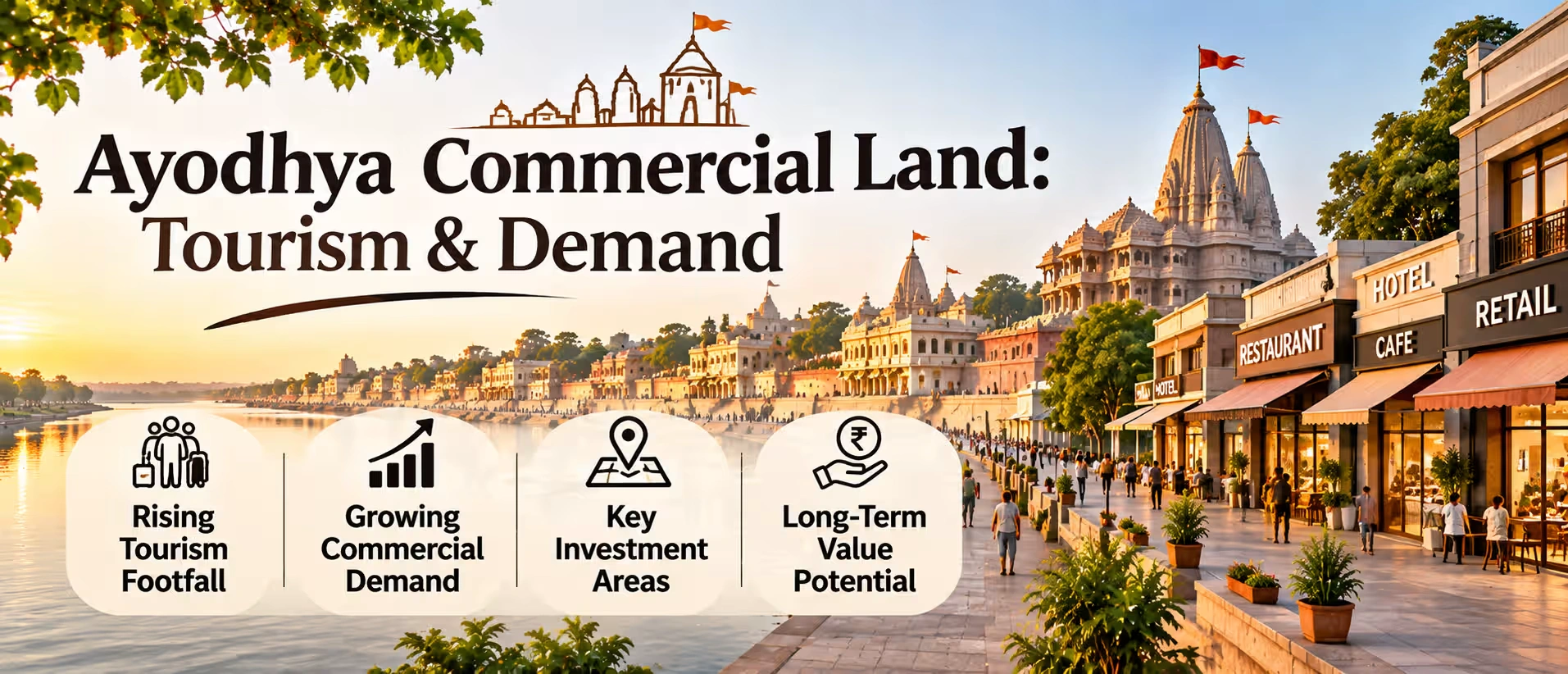
Ayodhya used to be a quiet temple town. Today it is one of the most watched land markets in Uttar Pradesh, and the reason is simple. Millions of people now arrive every year, and every one of them needs a place to stay, eat, shop, and park. That demand is what pushes commercial land prices, and it is also why prices here can mislead a buyer who only reads headlines.
This guide covers where commercial land sits, what it costs per square foot, acre, and bigha, how the Ram Mandir area works, and which approvals to check before you pay.
Why Commercial Land in Ayodhya Is in Focus?
Land in Ayodhya moved from a local market to a national one after the Ram Mandir consecration in January 2024. The city has a new airport, a rebuilt railway station, widened roads, and a fresh master plan, and all of it adds to commercial demand.
The Ayodhya Development Authority (ADA) governs growth through its Master Plan 2031, approved in December 2022. It covers about 133.67 sq km and plans for roughly 12 lakh people. A second phase has since been notified over a much larger area across three districts, which tells you the city is expected to keep spreading outward. For a commercial buyer, that means two things. Land inside the plan has a clear use and a path to approvals. Land outside it is cheaper and carries much more risk.
Tourism-Led Demand Behind the Prices
Tourism is the engine, so look at the numbers. According to the Uttar Pradesh Tourism Department, Ayodhya received about 5.76 crore visitors in 2023, 16.44 crore in 2024, and 23.82 crore in just the first six months of 2025. Some of these figures include repeat visits and festival crowds, so read them as footfall rather than unique people. Even so, the jump is huge. This rising footfall is creating opportunities for hotels, restaurants, transport services, retail outlets and other tourism-related businesses. It is also attracting interest in nearby property markets, including agricultural land for sale in Uttar Pradesh, as investors explore land opportunities around emerging tourism and infrastructure corridors.
- Hotels, guesthouses, dharamshalas and homestays
- Restaurants, sweet shops and food courts
- Pooja items, souvenir and retail stores
- Parking, taxi and transport services
- Wellness, wedding and event venues
The best commercial land in Ayodhya for tourism-led demand is land that sits on a route pilgrims already use, not land that merely sounds close to the temple. A plot on a busy approach road earns from day one. A plot in an empty pocket can wait years.
Ram Mandir Commercial Land in Ayodhya: What Is Possible Near the Temple
Many buyers ask whether they can buy land in Ayodhya near the Ram Mandir, and the honest answer is that very little is available. The core zone around the temple is already built up, acquired for the temple complex and corridors, or held by owners who are not selling. What does appear is small, expensive, and often legally complicated. If you find Ram Mandir commercial land in Ayodhya on offer, check these first:
- Is it inside a road widening or corridor plan?
- Does the seller have a clean, registered title?
- Are there rules on the activity you plan to run?
The area also has restrictions linked to its religious character, including limits on liquor and non-vegetarian sales within defined zones. These rules can decide whether a restaurant or hotel business model works, so confirm the current position with the local administration before buying.
Best Locations for a Plot in Ayodhya
When people look for a plot in Ayodhya for business use, a few belts come up again and again.
| Location | Why buyers look here | Best suited for |
| Ram Path and temple approach roads | Highest footfall | Retail, small hotels, food outlets |
| Panchkosi Parikrama Marg | Pilgrim route, wide roads | Hotels, dharamshalas |
| Airport Road and Navya Ayodhya belt | New township, air arrivals | Hotels, offices, mixed use |
| Deokali and Raebareli Road | Balanced prices, growing population | Retail, clinics, showrooms |
| Ring road corridors | Plan-backed industrial and mixed use | Warehousing, logistics |
| Nayaghat and Sohawal | Lower entry, linked to main roads | Smaller commercial plots |
No single belt is best for everyone. A hotel wants frontage and parking. A warehouse wants highway access. A clinic wants residential density. Choose the belt after you decide the business.
Commercial Land in Ayodhya Price: Area-wise Rates
The commercial land in Ayodhya price depends heavily on distance from the temple and road width. These are asking rates gathered from market sources, so treat them as a guide and not a quote.
| Zone | Approx. asking rate per sq ft |
| Core temple zone | ₹12,000 to ₹20,000, with some claims up to ₹25,000 |
| Prime approach roads (live listing examples) | ₹8,000 to ₹13,000 |
| Mid city belt (3 to 8 km) | ₹5,000 to ₹9,000 |
| Airport Road and Navya Ayodhya | ₹8,000 to ₹10,000 in sold or offered pockets |
| Outer belts like Raebareli Road | ₹3,000 to ₹5,500 |
| Fringe areas | ₹1,500 to ₹3,500 |
For reference, one commercial plot of about 6,000 sq ft on a 75 ft wide road near the Parikrama Marg was listed at ₹13,000 per sq ft, which comes to roughly ₹7.8 crore.
Circle rates are a different number. After the 2025 revision, rates in prime localities such as Rakabganj, Devkali and Awadh Vihar rose to about ₹26,600 to ₹27,900 per sq metre, which is about ₹2,500 per sq ft. Stamp duty is calculated on the higher of the circle rate and deal value, so keep both in view.
Cheap Commercial Land and Low Budget Rates Near Ram Mandir
Everyone asks about cheap commercial land in Ayodhya, and the answer is that cheap exists, but not next to the temple. A low-budget land rate near Ram Mandir usually means one of three things: a small plot, a narrow road, or a legal issue. If your budget is limited, these options make more sense:
- Move to the 8 to 15 km belt where roads are improving
- Look at corner plots on secondary roads in Deokali or Raebareli Road
- Buy a smaller plot instead of a larger one on a weak road
- Consider land near the ring road bypass sections that are under construction
The two bypass roads are still being built, with completion targeted for around 2027 and 2028, so the benefit is not instant. Cheap land that is a long way from any approved road is cheap for a reason.
Commercial Land in Ayodhya for Sale: Where Listings Appear
Commercial land in Ayodhya for sale shows up through owners, local dealers, and developers. The same plot can appear several times at different prices, so do a little groundwork.
- Shortlist five plots in the same belt.
- Convert every price to per sq ft so you can compare.
- Ask for the khasra number and the land use shown in the records.
- Visit on a pilgrim peak day and on a quiet day.
- Talk to nearby shop owners about footfall and parking.
Owner listings can be cheaper but need closer checking. Developer plots are easier to buy, and they need a careful read of what the price actually includes.
1 Acre Land Price in Ayodhya
The 1 acre land price in Ayodhya swings widely because an acre in the core zone and an acre of outer farmland are almost different products. One acre is 43,560 sq ft, so the maths is simple.
| Rate per sq ft | Price per acre (approx.) |
| ₹3,000 | ₹13 crore |
| ₹5,000 | ₹21.8 crore |
| ₹8,000 | ₹34.8 crore |
| ₹10,000 | ₹43.6 crore |
Farmland on the outer ring is priced very differently. Reports have put outer agricultural land at around ₹1.6 to ₹2 crore per acre, while developers in prime pockets quote an average near ₹5 crore per acre. Large parcels rarely sell at the per sq ft rate of a small plot, so negotiate large land on its own terms.
Agriculture Land for Sale in Ayodhya
Listings for agriculture land for sale in Ayodhya are common on the outskirts, and they attract buyers who want a lower entry price and a land bank. They also attract the most risk.
Agricultural land is cheaper because you cannot freely build on it. Before it becomes commercial or residential, it needs a declaration of non-agricultural use under Section 80 of the UP Revenue Code, and a fee is charged on the circle rate. Sellers sometimes market farmland as if it were already a plot, which is where buyers lose money. Ask these questions about any farmland:
- What does the khatauni record say about land use?
- Does the parcel fall inside the ADA master plan?
- Is there road access, and what is the road width?
- Are there co-owners, a pending case, or a loan on it?
1 Bigha Land Price in Ayodhya Today
People often search for the 1 bigha land price in Ayodhya today, but no honest single number exists. A bigha is not a fixed size in India. It changes by state and even by district, so one seller's bigha can be a very different area from another's. Use this method instead:
- Find the area of the bigha in acres or sq ft from the land record.
- Take the per-acre or per sq ft rate for that belt.
- Multiply the two.
As an example, if outer farmland is quoted at ₹1.6 to ₹2 crore per acre and a local bigha is about half an acre, that bigha would come to roughly ₹80 lakh to ₹1 crore. This is only an illustration, and the real price depends on the road, the zone, and the paperwork. Always get live quotes for the exact village.
ADA-Approved Plots in Ayodhya
ADA-approved plots in Ayodhya are the safest plotted option because the layout has been sanctioned by the authority. That means roads, open space, and plot sizes follow set rules, and building plans can be passed. Check approval in a few steps:
- Ask for the ADA layout approval letter and the sanctioned map
- Match the plot number and khasra with the map
- Confirm the colony sits inside the master plan area
- Check that the developer has registered the project where RERA applies
Be careful with a common trick. A small approved layout is sometimes used to market a much larger unapproved colony next to it. If a seller waves an approval letter, make sure it covers the exact plot you are buying.
Buy Farmland in Ayodhya: Rules and Conversion
If you plan to buy farmland in Ayodhya, treat it as a long-term holding and not a quick flip. Uttar Pradesh has rules on who can buy agricultural land and how much, so confirm your eligibility with a local lawyer before you pay a token amount. Keep these points in mind:
- Conversion takes time and costs money, and approval is not guaranteed
- Recent changes let development authorities approve land-use changes for smaller plots faster, but the details depend on the parcel
- Land along planned roads may be acquired, which can cut your plot size
- Farmland brings little rent unless it is leased out for cultivation
Also look at the road plans. Several bypass and highway projects around Ayodhya are still at the construction or proposal stage. A project that exists on paper does not raise land value until work is done.
Legal Checks Before You Pay Anything
Most disputes in Ayodhya come from paperwork. Use this table before you transfer any money.
Document or check | What it tells you |
| Khatauni and ownership record | Who owns the land and how it is classified |
| Registered sale deed history | A clean chain of ownership |
| ADA master plan zone | What you are allowed to build |
| Layout approval letter | Whether the plot is legally sanctioned |
| Land use conversion order | Agricultural land has been converted |
| Encumbrance and dispute check | No loan, case, or other claim |
| Circle rate and stamp duty calculation | Your real total cost |
Hire a local property lawyer who knows Ayodhya records. In a market that moved this fast, a small fee for verification is cheap insurance.
Selling Agricultural Land in Ayodhya
Owners who want to sell agricultural land in Ayodhya have a strong market, but a clean file decides the price. Buyers are careful now because of the number of stalled and disputed deals in the area. Prepare in this order:
- Update the land record and clear any family or co-owner claims
- Find out which master plan zone the land falls in
- Decide whether to sell as farmland or convert first, after weighing cost and time
- Compare recent deals nearby to set a realistic price
- Use verified channels and avoid agents who ask for upfront fees
- Take payment through banking channels and complete the registration
Mention the exact area, the road width, and the record details in your listing. If the land sits near a planned road or the ring road, say so, since buyers value that. Check the capital gains tax position before signing.
Risks to Keep in Mind
A hot market hides weak deals. These are the problems that show up most:
- Paying a token for land that has no approval or conversion
- Believing a "near Ram Mandir" label that means 10 km away
- Buying only because prices went up last year
- Ignoring road width, parking, and drainage
- Assuming tourist numbers mean steady sales for every shop
- Relying on one agent for both price and paperwork
Another real risk is timing. Prices rose sharply after 2024, and some market watchers expect a period of slower growth after the spike. Buy for the business you can run, not for a price you hope to see.
Ayodhya vs Vrindavan
Ayodhya vs Vrindavan is a fair comparison, since both are major pilgrimage towns in Uttar Pradesh. They differ in scale and stage.
| Factor | Ayodhya | Vrindavan |
| Growth stage | Newer surge after 2024, large planned expansion | Older, steady devotee base |
| Planning | New master plan and big infrastructure push | Mature town with tighter space |
| Entry cost | Rising fast near the core | Varies, check current local quotes |
| Footfall pattern | Very high, event- and festival-driven | Steady through the year with peaks |
| Main risk | Prices already high near the temple | Less room for new commercial land |
Ayodhya offers more room to grow and more new projects. Vrindavan offers an established market with a long record. If you want planned expansion, look at Ayodhya. If you want a proven devotee base, compare it with Vrindavan using current local quotes for the same kind of plot.
Find Verified Land Listings with 2Bigha
2Bigha is an AI-powered land marketplace for India. You can browse farmland and plot listings at 2bigha.ai/farms and list your own land for sale too. Before you commit to a parcel, the 2Bigha Land Report helps you check the key details so you are not depending on one agent's word. If you are shortlisting land around Ayodhya, start there and compare options side by side.
Conclusion
Ayodhya has a real, tourism-led demand story, and the footfall numbers back it up. But prices near the temple already reflect much of that story, and outer land needs patience and paperwork. Decide your business first, pick the belt that fits it, check ADA approval and land use, and compare live rates before you agree on a price. Buy slowly, verify twice, and let the tourists do the rest.
Disclaimer: This article is for informational purposes only and should not be considered investment, legal, financial, or property advice. Real estate regulations, infrastructure plans, market conditions, and government policies may change over time. Readers are advised to verify information with relevant authorities and consult qualified professionals before making any investment or property-related decisions.