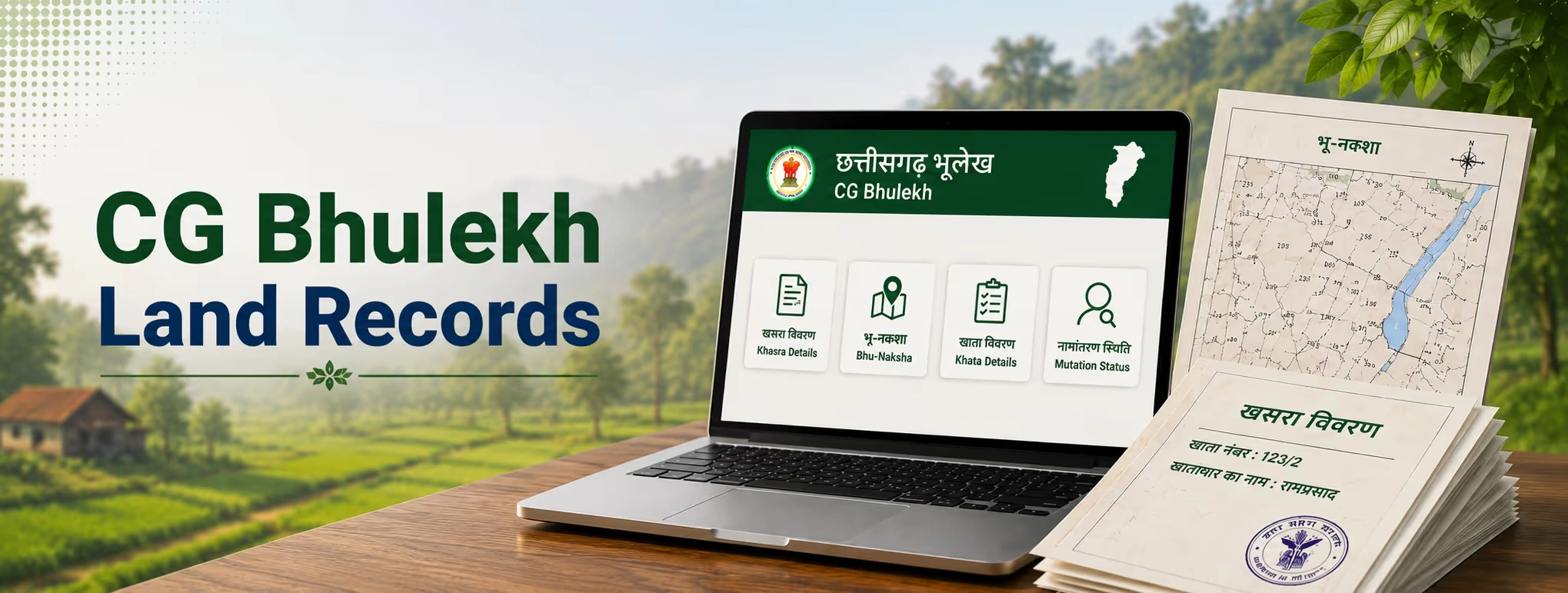
Not too long ago, checking land records in Chhattisgarh meant a trip to the local Patwari's office, a wait that could stretch across weeks, and a fair amount of guesswork about whether the paperwork you got back was even current. That's changed. The state now runs everything through a digital system, and once you know your way around it, pulling up a land record takes minutes instead of days. Whether you're verifying a property or searching for farmland near me in Chhattisgarh, knowing how to read official land records is an essential first step. This guide covers how to check CG Bhulekh records online, what the different documents actually mean, and what else you should verify before agreeing to any land deal in the state.
What Is CG Bhulekh (Bhuiyan)?
Chhattisgarh Bhulekh, officially called the Bhuiyan portal, is the state's digital land records system, run by the Revenue Department along with NIC. It replaced the old process of relying entirely on Patwaris for every land query, and today it covers Khasra numbers, ownership records, mutation status, and revenue details for land across all 33 districts.
| Document | What it shows | Where to access |
| Khasra (P-II) | Plot-level data — area, land use, crop details | bhuiyan.cg.nic.in |
| B-1 Khatauni | Consolidated Record of Rights (ownership) | bhuiyan.cg.nic.in |
| CG Bhunaksha | Digital plot map with boundaries | bhunaksha.cg.nic.in |
| Mutation status | Whether ownership transfer is officially recorded | bhuiyan.cg.nic.in |
Two documents matter most here. The Khasra tells you what the land is, its size, its classification, what's growing on it. The B-1 Khatauni tells you who owns it, and it's the document banks, courts, and sub-registrar offices actually ask for during loans or registrations.
How to Check Land Records on the CG Bhulekh Portal?
Here's the step-by-step process:
- Go to bhuiyan.cg.nic.in
- From the menu, select either Khasra Details (P-II) or B-1 Khatauni, depending on what you need.
- Choose your district, tehsil, and village from the dropdown lists
- Enter the Khasra number, or search by the landowner's name instead
- Click Find; the record will load on screen
- Print or save it for reference
Keep in mind that this online version is fine for a preliminary check, but it isn't the legally certified copy. For anything formal, you'll need a digitally signed copy through the Bhuiyan mobile app, which also lets you scan a QR code printed on the document to confirm it's genuine.
Using CG Bhuiyan Naksha to View Land Maps
Where Bhuiyan handles ownership and Khasra details, CG Bhuiyan Naksha, more commonly accessed through the separate Bhunaksha portal, handles the visual side. This is the digital map tool that shows plot shape, boundaries, and how a parcel sits relative to its neighbors. As explained in this legal guide to buying land in Chhattisgarh, verifying the plot map alongside ownership records is an important step before purchasing any property. To use it:
- Visit bhunaksha.cg.nic.in
- Select district, tehsil, and village
- Enter the plot or Khasra number
- View the plot highlighted on the map
- Click on it to see area, ownership, and survey details
- Export or print the map if needed for legal or agricultural purposes
It's worth noting that Bhunaksha and Bhuiyan serve different functions even though people often use the names interchangeably. Bhunaksha gives you the shape; Bhuiyan gives you the ownership record. You generally need both before finalizing any purchase.
Getting a Certified Copy for Legal Use
If you need the record for a bank loan, a court matter, or property registration, the online printout won't cut it. You'll have to:
- Visit the Collectorate (Bhu-Abhilekh) office covering the land's district
- Fill in an application with the Khasra number, village, and tehsil
- Attach identity proof
- Pay a small processing fee at the counter
- Collect the certified copy, usually within 3 to 7 working days
Alternatively, the Bhuiyan mobile app's QR-code-enabled document works for most legal purposes without the office visit, provided you're using a recent version of the app.
What to Check Before Buying Land in Chhattisgarh?
Anyone actively searching for agricultural land for purchase in the state should treat the online record as a starting point, not the final word. A few things worth confirming beyond the basic Khasra and Khatauni:
| Check | Why it matters |
| Mutation status | Confirms the seller's name is actually updated after any past transaction. |
| Tribal land classification | Transfers to non-tribals are restricted in many notified areas. |
| Land use category | Agricultural land often needs diversion approval for non-farm use. |
| Encumbrance or loan status | Flags whether the land is mortgaged or under dispute. |
| RS/LR survey number match | Older survey numbers sometimes don't align with current records. |
Chhattisgarh's land laws largely follow the framework of the MP Land Revenue Code, given the state's shared administrative history with Madhya Pradesh before its formation. That means diversion rules, ceiling limits, and protections around tribal land all still apply, and skipping them is a common way buyers end up in disputes years after a sale is done.
A Legal Guide to Buying Land in Chhattisgarh: Quick Points
If you're weighing up land in Chhattisgarh for the first time, here's a condensed version of what actually matters:
- There's generally no blanket rule barring non-farmers from buying agricultural land in plains districts with low tribal population
- Land in Scheduled Areas or with significant tribal population often carries restrictions on transfer to non-tribal buyers.
- Ceiling limits apply, and each district may interpret local rules slightly differently
- Diversion permission is required before converting agricultural land to non-agricultural use.
- A local lawyer's review is genuinely worth the cost given how much these rules vary district to district.
Making Land Selling and Buying Simpler
Piecing together a Khasra, a Khatauni, and a Bhunaksha map across separate portals, and then figuring out whether any of it has legal gaps- takes more patience than most buyers have. This is exactly where a more organized approach to land selling and buying makes a real difference. If you're running a farmland search in Chhattisgarh, Bigha verifies Khasra records, ownership status, and mutation history before a plot is listed, so you're not the one cross-referencing three different government portals before making an offer. Whether you're comparing land in Chhattisgarh against options elsewhere or narrowing down a specific district, having that verification done in advance saves a lot of back-and-forth once you're actually negotiating a price.
Disclaimer: This article is for informational purposes only and should not be considered investment, legal, financial, or property advice. Real estate regulations, infrastructure plans, market conditions, and government policies may change over time. Readers are advised to verify information with relevant authorities and consult qualified professionals before making any investment or property-related decisions.