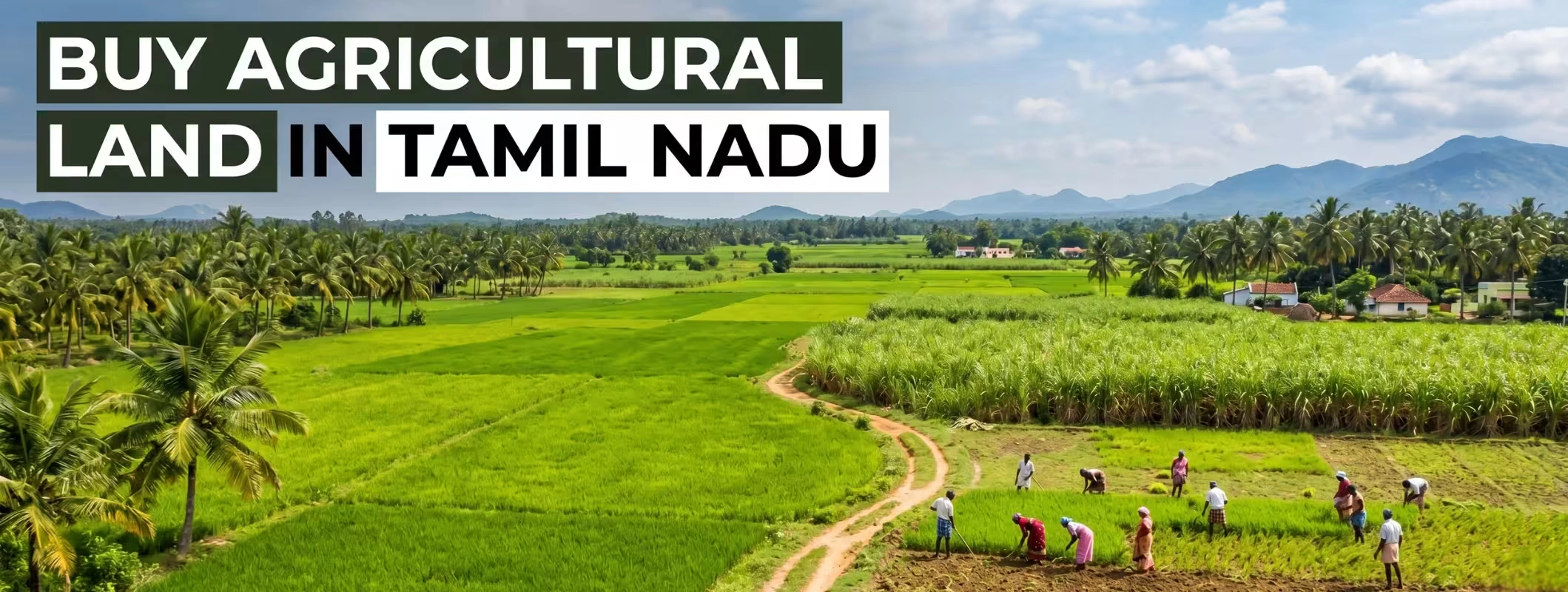
Buying agricultural land in Tamil Nadu can be a smart move for farming, long-term holding, orchard development, or future rural asset creation. But this is not a deal you should close on brochure language, broker confidence, or a nice site visit alone. In Tamil Nadu, the real risk is usually not the listing. It is the paperwork, land classification, title trail, access, and whether the land can legally be used the way you intend.
Key Takeaways
- For agricultural land in Tamil Nadu, the safest legal approach is to focus on title documents, revenue records, encumbrance status, patta transferability, land classification, and permitted land use before paying token money. Tamil Nadu’s official portals let buyers check EC, guideline value, Patta/Chitta, FMB, A-Register, and related land records online.
- If you are an NRI or OCI, you cannot purchase agricultural land, plantation property, or a farmhouse in India under RBI/FEMA rules. Inheritance routes and certain transfers are treated differently, but direct purchase is not generally allowed.
- If your real goal is a resort, villa plot, warehouse, layout, or non-farm commercial use, you cannot assume agricultural land will automatically work for that purpose. Tamil Nadu has formal change-of-land-use procedures through DTCP or CMDA, with document requirements and fees.
- For a standard sale deed in Tamil Nadu, the currently published stamp duty for conveyance is 7%, and the registration fee is 4% of the market value. Buyers should still verify the latest amount on TNREGINET before execution.
- Patta matters, but patta alone is not enough. Tamil Nadu’s own planning and land administration systems treat ownership documents, patta/TSLR, FMB, and supporting records as separate checkpoints.
Why this Topic Matters
Searches for Buy Agricultural Land in Tamil Nadu are rising because buyers want more than city apartments now. Some want active farming income. Some want a second asset outside urban volatility. Some want to hold land near growth corridors. Others want a farmhouse dream. The problem is simple: many people view farmland as a lifestyle purchase, while the law views it as a title-and-land-use transaction.
That gap is where most mistakes happen.
If you want to buy agricultural land in Tamil Nadu legally, you need to think like a careful investor, not an emotional buyer. You need to verify what the land is, who owns it, whether it is free from claims, whether it is actually agricultural in the records, and whether your intended use is allowed.
Who Can Buy Agricultural Land In Tamil Nadu
This is the first question most buyers ask, and it deserves a straight answer.
For Indian resident buyers, the safer legal approach is not to rely on blanket broker statements like “anyone can buy” or “only farmers can buy.” The official Tamil Nadu sources reviewed here are clear on land administration, ceiling law, patta transfer, land records, registration, and land-use conversion, but they do not present a simple one-line resident-buyer eligibility page the way RBI does for non-residents. That means your transaction should be evaluated on title, land classification, record accuracy, land ceiling exposure for larger holdings, and intended use. Tamil Nadu’s land-reforms framework continues to regulate ceiling-related issues, and the land administration system remains document-heavy.
For NRIs and OCIs, the position is much clearer. RBI’s FAQ states that an NRI/OCI purchase is allowed for immovable property other than agricultural land, farmhouse, or plantation property. They may acquire agricultural land through inheritance in some cases, and agricultural land can be transferred to a resident in India under the applicable rules, but direct purchase of agricultural land is not the general route available to them.
So, if you are a resident Indian buyer, the real question is not only “Can I buy?” The real question is, “Can I buy this specific parcel safely, register it properly, and use it the way I intend without a future dispute?”
That is the right question.
Tamil Nadu Agricultural Land Rules That Actually Matter
1. Ownership and Title come first
Before anything else, you need the title chain. Ask for the parent deeds, the latest sale deed, the partition deed if applicable, the settlement deed if applicable, and supporting ownership documents. Tamil Nadu’s planning and land-use systems themselves distinguish between ownership documents and revenue extracts like patta/TSLR and FMB, which is a strong practical sign that one document cannot replace the others.
If a seller tells you, “Patta is there, so everything is clear,” that is not enough. Patta helps. It does not cure a bad title by itself.
2. Check Patta, Chitta, FMB, A-Register and Adangal
Tamil Nadu’s official land-record portals allow the public to view or verify multiple records, including Patta/Chitta/FMB, A-Register extract, and even government/private land status. The eAdangal system also lets users search agricultural land details using district, taluk, village, patta number, and survey number.
In practical terms, these records help you answer basic questions:
- Is the survey number correct?
- Is the land shown as agricultural in the records?
- Is the owner’s name matching the deal documents?
- Is the extent matching the ground reality?
- Is the parcel private land, or is there any poramboke/government land issue?
This is where many “cheap land deals” start looking less attractive.
3. Take the Encumbrance Certificate seriously
Tamil Nadu’s Registration Department portal allows buyers to search and view/download EC, and the department specifically highlights EC access as a public-facing service. The older departmental handbook also explains that EC is meant to be obtained by giving full property particulars and that guideline values and fee information are available through the website and the registering officer.
An EC does not replace a full legal opinion, but it is one of the first filters for spotting registered transactions and red flags.
4. Check the guideline value before negotiating
The TNREGINET portal provides a guideline value search, and the Registration Department notes that statewide guideline values are available on the website.
Why does this matter? Because buyers often think they are getting a bargain, but registration exposure, valuation disputes, and payment planning all depend on the recorded value environment around that parcel. If you are comparing multiple parcels in the same belt, the guideline value is one of the first numbers you should check.
5. Registration is not optional paperwork
Tamil Nadu’s registration guidance states that for sale deeds, both seller and buyer should sign the document and appear before the registering officer. The departmental handbook also notes that documents should generally be presented within four months from execution.
That means if the seller is evasive about personal appearance, chain documents, or execution details, slow the deal down immediately.
6. Patta transfer after purchase is part of the job, not an afterthought
The Commissionerate of Land Administration states that patta transfer applications are handled through the online system and mentions disposal timelines of 15 days for cases not involving subdivision and 30 days for cases involving subdivision.
A buyer who finishes registration but ignores mutation and patta transfer leaves the job incomplete.
7. Non-agricultural use needs a separate legal path
This is where many farmland buyers get trapped.
If you are buying agricultural land in Tamil Nadu for future plotting, a warehouse, institutional use, hospitality, commercial activity, or even certain built-up plans, you need to understand the state’s land-use change framework. Tamil Nadu’s DTCP and CMDA procedures for change of land use require Form A1, title documents, Patta/TSLR, FMB-related records, and site plans with GPS coordinates. The CMDA process also includes scrutiny, publication, objections, local-body remarks, and possible NOCs from agencies, depending on the case.
So no, you should not assume agricultural land can be casually converted later just because a broker says “farmhouse possible.”
Documents Required To Buy Agricultural Land In Tamil Nadu
Use this as a working checklist before you commit money:
- Latest registered title deed of the seller
- Parent title chain for a reasonable prior period
- Encumbrance Certificate
- Patta / Chitta / TSLR, depending on location type
- FMB sketch and survey details
- A-Register extract where relevant
- Adangal or cultivation-related record where relevant
- Seller identity proof and PAN/Aadhaar details
- Tax receipts and utility records, if applicable
- Access-road proof and physical boundary confirmation
- Legal opinion from a Tamil Nadu property lawyer
- If future non-agricultural use is planned, document feasibility for DTCP/CMDA land-use change before purchase
The government-side record stack is not random. Tamil Nadu’s own portals and planning systems repeatedly point buyers to ownership documents, Patta/TSLR, FMB, EC, and related land records.
Also Read: Patta Chitta Verification Checklist in Tamil Nadu: A Simple Buyer’s Guide
Tamil Nadu Land Purchase Process: Step-by-Step
Step 1: Identify the parcel properly
Do not begin with seller promises. Begin with the district, taluk, village, survey number, subdivision number, patta number, and extent. If those basics are fuzzy, the deal is already weak.
Step 2: Pull land records online
Use the official Tamil Nadu portals to view Patta/Chitta/FMB, A-Register extract, EC, and guideline value. This gives you a first-level legal picture before you spend on deeper due diligence.
Step 3: Verify ground reality
Walk the site. Check road access. Check boundary stones. Check whether the neighbouring occupation matches the records. A clean PDF and a messy site often do not match.
Step 4: Get legal verification
Have a local property lawyer review title continuity, inheritance issues if any, partition risks, pending disputes, access rights, and whether the land is suitable for your intended use.
Step 5: Check if your use is truly agricultural
If your real plan is to hold a farm, orchard, or cultivation project, that is one thing. If your real plan is to build, subdivide, commercialise, or rezone, that is another. Tamil Nadu’s change-of-land-use route is structured and fee-based, not casual.
Step 6: Execute the sale deed correctly
The Registration Department’s guidance makes it clear that the document must contain full party details, property details, and sale consideration, and that both buyer and seller should sign and appear for the sale deed registration.
Step 7: Pay stamp duty and registration charges
Published schedules list sale/conveyance at 7% stamp duty and 4% registration fee on market value. Before final execution, verify current figures on TNREGINET or with the Sub-Registrar’s office.
Step 8: Apply for patta transfer
Registration is not the end. Mutation and patta transfer are what align the revenue records with the registered transaction. Tamil Nadu’s CLA system provides the patta transfer route and timelines.
Stamp Duty and Registration Charges in Tamil Nadu
For a conveyance or sale deed, the currently published rate is:
- Stamp duty: 7% of market value
- Registration fee: 4% of market value
That means your total transaction outflow is not just the negotiated price. Add legal fees, survey expenses, document checks, travel, mutation follow-up, and any compliance costs. If land-use change is part of your plan, that is another cost layer altogether. DTCP currently lists a lump-sum scrutiny fee of Rs. 20,000 for its change-of-land-use procedure, while the CMDA route lists scrutiny and publication-related charges separately.
Common Mistakes Buyers Make
- Believing patta alone proves everything: It does not. Even official planning systems ask for ownership documents separately from the patta/TSLR and FMB. That is a clear warning sign for buyers to do full title verification.
- Buying a farmhouse without checking land-use rules: A green parcel is not automatically a legally buildable leisure asset. If your target use is not agricultural, study the conversion route first.
- Ignoring access and survey mismatch: A plot can look large on paper and shrink badly on the ground once boundaries are measured.
- Assuming NRI rules are flexible: They are not flexible in the way many brokers suggest. RBI’s position on agricultural land purchase by NRI/OCI is clear.
- Registering first and cleaning paperwork later: That is backwards. The records, title, and use case should be checked before the token, not after registration.
A Practical Note On Using Digital Platforms Like 2Bigha
If you are comparing agricultural land for sale in Tamil Nadu, a platform like 2Bigha can help you reduce the first layer of chaos. It can make shortlisting easier, especially when you want to compare location, parcel size, and early listing quality without wasting weekends on random broker calls.
But keep this clear: listing discovery is step one, not legal clearance.
A smart buyer can use 2Bigha, local brokers, referrals, and even a listing alert or subscription workflow to track new opportunities. But the final decision should still depend on EC, title verification, patta/chitta consistency, FMB check, land use, and registration readiness. Convenience is useful. Compliance is non-negotiable.
Final Word
If your goal is to buy farm land in Tamil Nadu legally, do not chase only low prices, scenic views, or future stories like “this area will become a hot market soon.” Farmland deals become good deals only when the land is legally clean, correctly classified, properly accessible, and aligned with your actual use.
Tamil Nadu gives buyers a strong digital trail through TNREGINET, land-record e-services, eAdangal, and formal DTCP/CMDA planning pathways. That is a big advantage. Use it. Verify first. Pay later. Register properly. Transfer patta. Then move ahead.
FAQs - Buy Agricultural Land In Tamil Nadu
1. Can I buy agricultural land in Tamil Nadu if I am from another state in India?
If you are a resident of India, the bigger legal issues are usually title, land classification, permitted use, records, and transaction compliance rather than a simple “Tamil Nadu resident only” question. For non-resident buyers, RBI/FEMA restrictions become much more important.
2. Can an NRI buy agricultural land in Tamil Nadu?
Generally, no. RBI states that an NRI/OCI purchase is not allowed for agricultural land, farmhouse, or plantation property under the normal purchase route. Inheritance is treated differently under the rules.
3. What documents should I check before buying farmland in Tamil Nadu?
Check the title deed chain, EC, Patta/Chitta, FMB, A-Register, Adangal, where relevant, tax receipts, identity documents, survey details, and access records. For future land-use change, planning authorities also ask for ownership documents, patta/TSLR, FMB-related documents, and site plans.
4. Is a Patta enough to prove ownership?
No. Patta is important, but Tamil Nadu’s own planning and administrative systems treat ownership documents and patta-related extracts as separate requirements. That is why buyers should not rely on patta alone.
5. How much are stamp duty and registration charges in Tamil Nadu for land purchase?
For a sale or conveyance deed, the currently published rate is 7% stamp duty and 4% registration fee on the market value. Always confirm the latest figures on TNREGINET before final execution.
6. Can I convert agricultural land in Tamil Nadu for non-agricultural use later?
You cannot assume automatic conversion. Tamil Nadu has formal DTCP and CMDA procedures for change of land use, with document requirements, scrutiny, and fee payment.
7. Where can I check land records in Tamil Nadu?
Tamil Nadu’s official portals provide access to Patta/Chitta/FMB, A-Register extract, EC, guideline value, and eAdangal-related information.
8. How long does the Patta transfer take after purchase?
Tamil Nadu’s CLA notes disposal timelines of 15 days for patta transfer cases not involving subdivision and 30 days for cases involving subdivision. Actual timelines can vary in practice, but those are the stated targets.