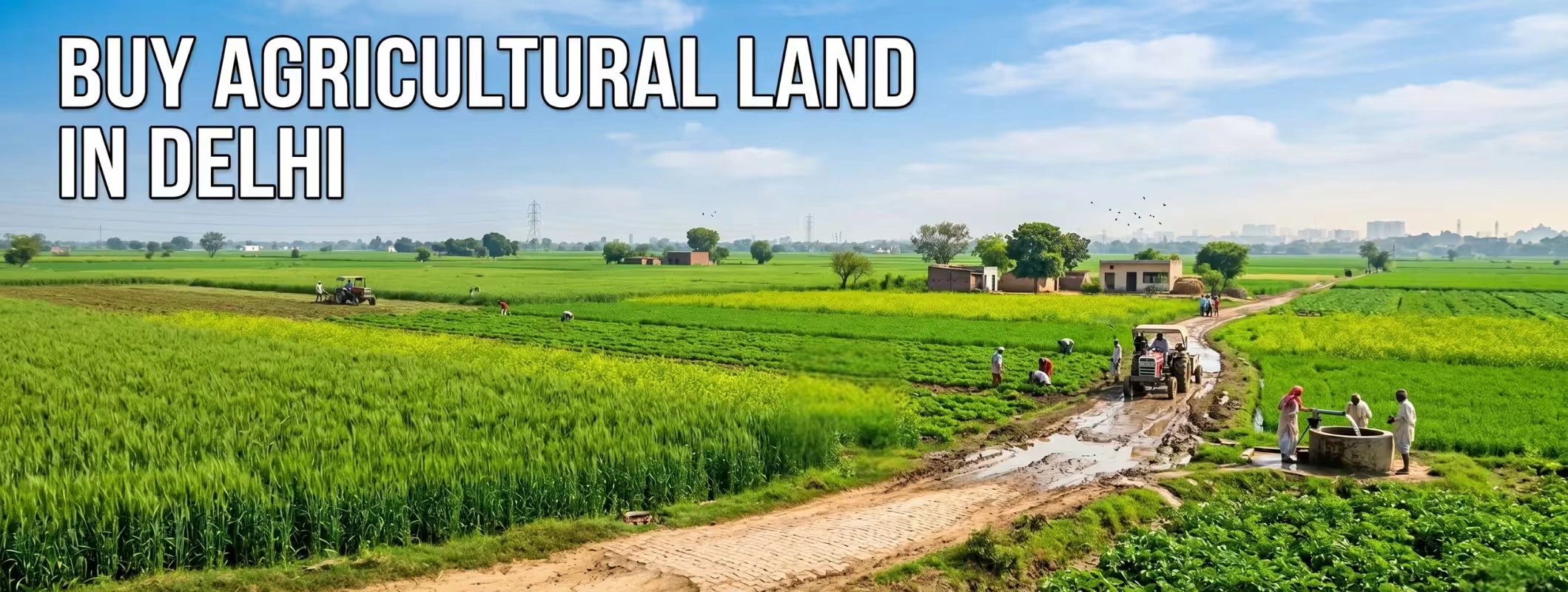
Buying agricultural land in Delhi is not a simple “find a plot, pay token, do registry” transaction. Delhi has a layered land system. You have the Delhi Land Reforms Act, revenue records, village status, master-plan controls, stamp duty rules, registration requirements, mutation formalities, and land-use risks all operating at once. So, before you search for agricultural land for sale in Delhi or farmland near Delhi, you need to know one thing clearly: the real deal is not just finding land, it is finding land that is legally transferable, properly recorded, and safe to use for the purpose you actually have in mind.
Key Takeaways
- Delhi agricultural land is governed heavily through revenue law, record verification, and land-use controls, not just market practice. A land parcel can look attractive on paper and still be risky if its title, village status, transferability, or usage history is weak.
- For resident Indian buyers, the bigger legal filters in Delhi are usually transfer validity, ownership status, land classification, and intended use. For NRI/OCI buyers, purchase of agricultural land or farmhouse property is not allowed under the general FEMA route.
- In Delhi, stamp duty on sale deeds is 6% for male buyers and 4% for female buyers, calculated on the consideration amount or applicable circle rate, whichever is higher. Registration fee is 1% plus ₹100 pasting fee.
- Registry is not the end of the process. Mutation in revenue records, checking Khatauni/Khasra Girdawari, deed searches, encumbrance searches, prohibited-property checks, and cadastral map review are all part of safe due diligence.
- Do not assume agricultural land in Delhi can be used for residential, commercial, plotting, or farmhouse-style development just because a broker says so. Section 81 of the Delhi Land Reforms Act allows ejectment for use other than agriculture, horticulture, or animal husbandry.
Why Buying Farmland in Delhi is Different from Buying Farmland in other States
Delhi is not a typical farmland market. The Delhi Land Reforms Act applies to the Union Territory of Delhi, but it does not apply to areas included in a municipality or notified area, cantonment areas, certain estates owned by the Central Government or local authority, and land held for public purpose or utility. That is why a buyer cannot treat all “Delhi agricultural land” as one uniform category. The first legal question is always: What exactly is the status of this parcel and which regime applies to it?
That question matters even more because Delhi also has officially notified urbanised villages, and many village names that appear in old revenue discussions may now sit inside a very different planning context. On top of that, the Master Plan for Delhi provides for agricultural land as part of the Green Belt along Delhi’s border. In plain terms, a buyer must verify whether the parcel is in a revenue village, an urbanised village, a green-belt area, or another controlled planning zone before moving ahead. This is one of the biggest reasons people make expensive mistakes while trying to buy farm land in Delhi NCR.
Can you Legally Buy Agricultural Land in Delhi
Yes, agricultural land transactions do happen in Delhi, but legality depends on the specific parcel, not on the advertisement headline. Under the Delhi Land Reforms Act, a bhumidhar’s interest is transferable subject to the conditions in the Act. The law also says an asami’s interest is not transferable except as expressly permitted. It further restricts certain transfers by a bhumidhar, and transfers made in contravention of the chapter can expose the transferee to ejectment and can be void.
The practical reading is this: Delhi does not operate like every farmer-only state law, but it also does not give buyers a free pass. Your legal eligibility is tied to whether the seller has the right status, whether the land is lawfully transferable, whether the transaction structure is valid under the Act, whether the parcel is free from dispute, and whether the intended use remains lawful. That conclusion is an inference from the Delhi Land Reforms Act’s transfer and ejectment provisions, and it is exactly why buyer-side legal verification is essential before paying even a booking amount.
Also Read: Delhi Introduces 14-Digit Aadhaar Number for All Land Parcels
Eligibility to Buy Farmland in Delhi
For a resident Indian buyer, the real checks are not just “Am I interested in farmland?” but:
- Is the seller the lawful bhumidhar or otherwise recorded owner?
- Is the land still agricultural in the records?
- Is the transfer valid under the Delhi Land Reforms Act?
- Is the parcel free from encumbrances, disputes, and prohibited-entry problems?
- Is the intended use compatible with revenue law and Delhi planning controls?
For NRI and OCI buyers, the rule is much stricter. RBI’s current FAQ framework under FEMA says NRIs/OCIs may purchase immovable property in India other than agricultural land, farmhouse, or plantation property. They may inherit immovable property, and they may sell agricultural land to a resident, but general purchase of agricultural land is outside the normal permitted route. So if someone is planning to buy agricultural land in Delhi legally while holding NRI/OCI status, that is a red-flag area needing specialist advice before any deal is signed.
Delhi Agricultural Land Legal Criteria Buyers Should Check First
1) Check whether the land is genuinely agricultural in the records
Do not rely only on a broker brochure, location pin, or “farm plot” marketing term. Delhi’s land records system tracks core revenue documents such as Khatauni, Khasra Girdawari, field books, mutation entries, and proceedings under important provisions of the Delhi Land Reforms Act. That means the official record can tell a very different story from the sales pitch.
2) Verify the seller’s title and right to transfer
Housing’s due-diligence guidance and 99acres’ legal tips both point to the same core rule buyers ignore at their own risk: verify the title deed, past ownership chain, encumbrance position, and revenue records, not just the latest photocopy handed over by the seller. In Delhi, this matters even more because a transfer that violates the Delhi Land Reforms Act can backfire after the deal.
3) Check whether the land falls in a sensitive planning or zoning category
Before buying Delhi agricultural land for future construction, farmhouse use, subdivision, or long-term investment, check the applicable master-plan and zoning position. Housing’s land-buying guidance stresses checking zoning restrictions and notified plans. The Delhi Master Plan itself recognises agricultural land within green-belt planning. So a parcel can be agriculturally recorded yet still sit in a zone where your future use expectations are unrealistic.
4) Check for non-agricultural use risk
Section 81 of the Delhi Land Reforms Act is one of the most important sections buyers overlook. It states that a bhumidhar or asami can be liable to ejectment for using land for purposes other than agriculture, horticulture, or animal husbandry, including pisciculture and poultry farming. That means buying agricultural land in Delhi with a hidden residential or commercial intention is not smart planning. It is legal exposure.
5) Confirm mutation and record-updation path
Delhi’s district revenue guidance explains mutation as the recording of transfer of rights in revenue records. The application goes to the Tehsildar/Naib-Tehsildar, is supported by the document on which mutation is sought, invites objections, and is normally handled within about 30 days in uncontested cases. If your post-registry mutation does not move, your paper ownership and revenue ownership trail can drift apart.
Documents for Buying Agricultural Land in Delhi
A clean agricultural land deal in Delhi should usually involve review of the following:
- title deed and previous chain documents
- sale deed or conveyance basis of ownership
- Khatauni / Jamabandi / Khasra Girdawari or equivalent revenue extracts
- mutation order or latest mutation entry
- encumbrance and deed-search results
- seller identity proof, PAN, and authority documents if acting through PoA or heirs
- cadastral map / sajra and survey details
- land revenue or tax payment receipts
- court-case, prohibited-property, and dispute checks where relevant
Delhi Revenue’s property-registration page is especially useful here because it gives buyers access points for deed searches, encumbrance searches, prohibited-property checks, cadastral maps, and links to court-case verification. It also says there is no fee for searching past registration details through the official system. That is a gift to serious buyers, and most people still skip it.
Delhi Land Registry Process for Agricultural Land
The Delhi registration side is more straightforward than the legal due diligence side.
For a sale deed, Delhi Revenue states that stamp duty and transfer duty are 6% if the buyer is male and 4% if the buyer is female. Registration fee is 1% of the deed value plus ₹100 pasting charge. Both vendor and vendee must be present with identification documents, and two witnesses with ID documents must also be present. The department says response time is normally within 15 days.
The broader property-registration information page clarifies that stamp duty is payable on the consideration amount or the applicable circle rate, whichever is higher, and the same “whichever is higher” logic applies to registration fee calculation. It also points buyers to appointment booking, e-valuation, e-search, encumbrance search, and deed-document systems. In other words, Delhi gives buyers a digital due-diligence trail. Use it.
Delhi Agricultural Land Price: What Actually Drives it
When buyers search for “Delhi agricultural land price” or “farm land near Delhi for sale,” they often look only at the asking price. That is the wrong starting point. In Delhi, the more relevant benchmark for registry cost is the official circle-rate system, because stamp duty and registration fee are tied to the higher of consideration or circle rate. That gives you the legal floor for transaction cost, not necessarily the final negotiated price.
The real market value of farmland for sale in Delhi NCR usually moves with title clarity, road access, village status, litigation risk, planning restrictions, future infrastructure pressure, and whether the parcel is actually usable for your stated objective. Housing’s due-diligence guidance strongly advises buyers to study zoning, title, legality, and exact measurement before treating a land parcel as an investment. In Delhi, that advice is not optional. It is survival.
Can Agricultural Land be Converted in Delhi
Treat this as a high-risk question, not a casual checkbox. General real-estate guidance is clear that converting agricultural land for non-agricultural use requires authority approval, land-use verification, and supporting records. In Delhi, the risk is sharper because Section 81 directly targets non-agricultural use on agricultural land, while master-plan and zoning controls can separately restrict what you do next. So never buy agricultural land in Delhi assuming you can later “manage” conversion informally.
This is also why many buyers who start with “I need agricultural plots in Delhi NCR” eventually shift their search to nearby NCR districts outside Delhi’s tighter framework. That can open more supply, but the law then changes state by state. Delhi rules stop at Delhi’s border. Your due diligence should not.
A Practical Buyer Checklist before you pay token Money
Do these in order:
- Verify the exact village, khasra details, and whether the parcel is in a rural or urbanised setting.
- Pull title chain, deed history, and encumbrance results from official systems.
- Check Khatauni/Khasra Girdawari and mutation status with the local revenue office.
- Confirm the seller’s recorded right to transfer and whether any DLR restrictions can affect the deal.
- Check whether the land is in a planning-sensitive or green-belt context.
- Ask whether any non-agricultural use, plotting, or structures already exist, because Section 81 risk is real.
- Calculate acquisition cost using circle rate, stamp duty, registration fee, and legal due-diligence cost, not just seller quote.
- Register first, then push mutation without delay.
Where 2Bigha Fits into the Process
For discovery, comparison, and early filtering, 2Bigha gives buyers a practical front end. Its website positions the platform around searching land anywhere, exploring current land prices, and using map-based discovery before deeper due diligence begins. That makes it useful for buyers comparing agricultural land in Delhi, farmland near Delhi, or broader Delhi NCR opportunities.
For sellers, 2Bigha also has a dedicated subscription offering built around seller plans, visibility, and buyer reach. So if your goal is not only to buy agricultural land in Delhi but also to sell agricultural land in Delhi or list farmland with stronger exposure, the platform gives you a cleaner starting point than random broker chains and WhatsApp forwards. It also offers an area converter, which helps when local land measurements start getting messy.
Final Word
Buying agricultural land in Delhi legally is possible, but the smart buyer treats it as a revenue-law transaction first and a real-estate purchase second. Title, transferability, village status, land-use compliance, registry cost, and mutation are the real pillars. If you ignore them and focus only on “good location” or “cheap deal,” you are not investing. You are gambling.
The safest approach is simple: shortlist carefully, verify aggressively, register properly, mutate quickly, and never assume agricultural land can be used for something else later. Buyers and sellers who want a practical starting point can use 2Bigha to explore options, compare parcels, and use subscription-led listing support before stepping into legal closure.
FAQs - Buying Agricultural Land in Delhi
1) Can anyone buy agricultural land in Delhi?
A resident Indian buyer may be able to buy, but the real issue is whether the parcel is lawfully transferable and whether the seller holds valid transferable rights under the Delhi Land Reforms Act. Delhi’s rules focus heavily on transfer validity, land status, and usage, not just buyer intent.
2) Can an NRI buy agricultural land in Delhi?
Under RBI’s current FEMA FAQ framework, NRI/OCI buyers cannot purchase agricultural land or farmhouse property through the general permitted route. Inheritance and certain transfers are treated differently, but direct purchase is restricted.
3) What documents should I check before buying farmland in Delhi?
Check title deed, previous deeds, Khatauni/Khasra records, mutation status, encumbrance results, deed-search history, cadastral map, and dispute/prohibited-property checks. Do not rely only on seller-shared copies.
4) What is the stamp duty on agricultural land in Delhi?
Delhi Revenue states 6% for male buyers and 4% for female buyers on sale deeds, with the value based on the consideration amount or circle rate, whichever is higher. Registration fee is 1% plus ₹100 pasting fee.
5) Is registry enough after buying agricultural land in Delhi?
No. Registry completes document registration, but mutation updates the revenue record to reflect transfer of rights. Delhi’s revenue process explains that mutation is a separate step handled through the Tehsildar/Naib-Tehsildar.
6) Can I build a farmhouse or house on agricultural land in Delhi?
Do not assume you can. Section 81 of the Delhi Land Reforms Act allows ejectment for non-agricultural use, and Delhi’s planning/zoning controls can independently restrict development.
7) How do I verify whether land is disputed or risky?
Use official deed search, encumbrance search, prohibited-property search, court-case checks, cadastral maps, and land-record verification. Delhi Revenue provides official access points for these checks online.
8) How long does the Delhi registry usually take?
Delhi Revenue says property-registration response time is normally within 15 days. Mutation response is normally around 30 days in routine cases, subject to objections and verification.
9) Is Delhi agricultural land a good investment?
It can be, but only for buyers who understand title, planning, and compliance risk. In Delhi, a cheap parcel with weak legal standing is usually more expensive than a costly parcel with clean records. That is why due diligence matters more than headline price.
10) Where can I search and compare land before going into legal checks?
A platform like 2Bigha can help buyers explore land listings, map views, prices, and comparison options before legal review starts. Sellers can also use its subscription based listing tools for stronger visibility.