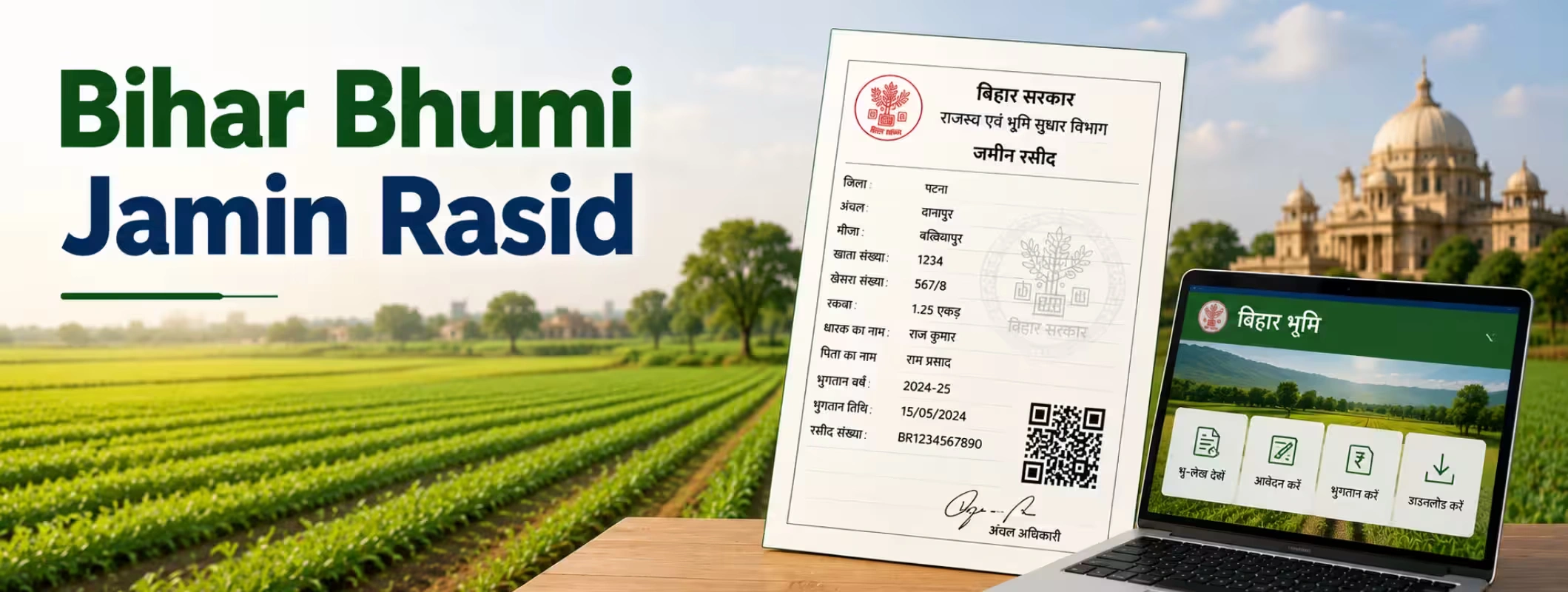
Bihar Bhumi Jamin Rasid is the land tax payment receipt generated after paying Bhu-Lagaan online. It is the receipt that shows the government land tax has been paid for a landholding recorded under a particular Jamabandi.
In Bihar, people often use different words for the same document. Some call it Jamin Rasid, some say Lagan Rasid, while others call it Bhu-Lagaan receipt. For practical use, all of these refer to the land revenue payment receipt.
This receipt is useful when you are:
- Selling agricultural land in Bihar
- Buying Agricultural Farmland
- Applying for mutation after purchase or inheritance
- Checking family land records
- Handling Bihar Land Partition and Mutation Laws
- Preparing documents for bank loan or verification
- Resolving basic land ownership confusion
- Updating revenue records after registration
The receipt alone does not prove full ownership. Ownership depends on registered deeds, Jamabandi, mutation, khata-khesra records, possession, and other documents. But Jamin Rasid does show that the land revenue record is active and tax payment has been made.
Why Is Land Tax Payment Important in Bihar?
Land tax, or lagaan, may look like a small amount, but it carries big importance in rural land matters. In Bihar, many land disputes start because records are not updated for years. One brother pays tax, another brother keeps the old deed, and the third person claims possession. After 10 or 15 years, the next generation struggles to understand who owns what.
Regular land tax payment helps maintain a cleaner revenue trail. It supports Jamabandi verification and makes future work easier when you need mutation, partition, sale, or land record correction.
For buyers, especially those looking for agricultural land in Bihar, the latest Jamin Rasid is one of the first documents to check. If a seller cannot provide the latest land tax receipt, it does not automatically mean fraud, but it is a signal to verify the land more carefully.
Bihar Bhumi and Bhu-Lagaan: What Is the Difference?
Many people get confused between Bihar Bhumi and Bhu-Lagaan.
Bihar Bhumi is the main gateway for land and revenue services in Bihar. It connects users to services like online mutation, Jamabandi, LPC, Bhu-Naksha, Parimarjan, e-Mapi, and land revenue-related services. The portal lists online mutation and online Bhu-Lagaan payment as official services under the Revenue and Land Reforms Department.
Bhu-Lagaan is the specific service used for online land tax payment. When you want to pay land revenue and download Jamin Rasid, you use the Bhu-Lagaan option.
So, think of it like this:
Bihar Bhumi is the main land services platform. Bhu-Lagaan is the land tax payment section.
Details You Need Before Paying Bihar Land Tax Online
Before paying Bihar land tax online, keep your land details ready. The process becomes smoother when you already know the basic revenue information.
You may need:
- District name
- Anchal or circle
- Halka
- Mauza
- Khata number
- Khesra or plot number
- Jamabandi number
- Raiyat name
- Mobile number
- Online payment option
- Previous payment details, if available
The Bihar Jamabandi report page allows users to search land records using details such as Raiyat name, plot number, khata number, Jamabandi number, and computerized Jamabandi number.
Step-by-Step Process to Pay Bihar Land Tax Online
Step 1: Visit the Bihar Bhu-Lagaan Service
Go to the Bhu-Lagaan section from the Bihar Bhumi portal or directly open the online land tax payment service. Choose the option for Pay Online Lagaan.
The official Bhu-Lagaan page includes options for online payment and failed transaction status checking.
Step 2: Select Your District and Land Location
Choose your district, anchal, halka, and mauza carefully. This step is important because many villages have similar names. A small mistake in mauza or circle selection can show the wrong land record.
Step 3: Search Your Jamabandi
You can search the land record using available details such as Jamabandi number, khata number, plot number, or Raiyat name. If you are not sure, match multiple details before moving ahead.
Do not make payment just because the name looks similar. Check the father’s name, village, plot number, and khata details properly.
Step 4: Check Land Tax Dues
Once the correct Jamabandi appears, the system will show the land revenue details. Review the amount, pending dues, and payer details.
Step 5: Make Online Payment
Proceed with online payment through the available payment method. Use your own mobile number and keep the transaction details safe.
Step 6: Download Bihar Jamin Rasid
After successful payment, download and save the land tax receipt. Take a printout and keep a digital copy. This receipt may be needed during sale, mutation, family partition, or verification.
What to Do If Bihar Land Tax Payment Fails?
This is a common issue. Sometimes the amount gets debited, but the receipt is not generated immediately. Many people panic and pay again. That is not the right step.
The official Bhu-Lagaan portal clearly advises users to check the status of failed or pending payments before making another payment. It says users can check failed transaction status using Transaction ID, and if they do not have the Transaction ID, they can search their Jamabandi and use the previous payment option to find earlier Depositor ID and Transaction ID.
So, if your payment fails:
Do not pay again immediately. First, check the pending payment status. Use Transaction ID if available. If you do not have it, search your Jamabandi and check previous payment details. If the payment is successful, the receipt should be generated.
Is Jamin Rasid Proof of Ownership?
This is one of the most important questions.
No, Jamin Rasid is not complete ownership proof by itself. It is a land tax payment receipt. It supports the revenue record, but it does not replace the sale deed, partition deed, gift deed, inheritance document, mutation order, Jamabandi, or court order.
For example, if someone is paying lagaan for land, it shows that the person is connected to the revenue record. But final ownership must be checked through registered documents and updated land records.
Before buying any land for sale in Bihar, especially agricultural farmland, always check:
- Registered sale deed or title document
- Current Jamabandi
- Latest Jamin Rasid
- Khata and Khesra details
- Bhu-Naksha or map
- Mutation status
- Encumbrance Certificate
- Possession status
- Road access
- Land use
- Family partition history
- Court case or dispute, if any
Bihar Land Partition and Mutation Laws: What Buyers Should Understand
Many buyers make one common mistake. They see a family member selling land and assume the land is clear. But in Bihar, a large portion of rural land is ancestral or family-owned. This makes partition and mutation very important.
Partition means the division of land among legal owners or family members. It may happen through family settlement, registered partition deed, revenue partition, or court process.
Mutation, known as Dakhil-Kharij, means updating the land revenue record after ownership changes due to sale, inheritance, gift, partition, or court order. Bihar Bhumi provides an online mutation service and mutation status-checking facility.
Here is the simple difference:
Partition decides who gets what share. Mutation updates the government revenue record after ownership changes.
If land is inherited but mutation is not done, the revenue record may still show the old owner’s name. If family partition is done orally but not properly documented, future buyers can face objections from other heirs.
That is why buyers of agricultural land in Bihar should not depend only on the seller’s words. They should verify whether partition is legally clear and whether mutation is updated.
Encumbrance Certificate (EC) in Bihar: Why It Matters Before Buying Land
An Encumbrance Certificate in Bihar helps buyers check whether a property has registered liabilities or transactions for a specific period. It may show whether the property has a mortgage, registered sale, gift deed, or other recorded transaction history. Independent property guides describe EC as a document used to verify registered transactions and liabilities against a property.
For agricultural farmland buyers, EC is useful because it helps answer one basic question: Is this land legally clean from registered financial or ownership burdens?
However, EC should not be the only check. Some disputes may not appear clearly in EC, especially if the issue is related to possession, family claim, boundary conflict, or unregistered agreement. So, use EC along with Jamabandi, Jamin Rasid, mutation order, deed verification, and local due diligence.
Stamp Duty and Registration Charges in Bihar: Land Tax Is Different
Many people mix land tax with stamp duty. These are not the same.
Land tax or Bhu-Lagaan is the revenue paid periodically for land.
Stamp duty and registration charges are paid when a property transaction is legally registered, such as sale deed, gift deed, partition deed, or transfer deed. These charges depend on the type of transaction, property value, ownership category, and current government rules.
For any property purchase, stamp duty and registration charges should be checked from the official registration system or local registration office before final payment. Third-party finance and property sources also note that stamp duty and registration charges vary by buyer category and transaction type, so buyers should verify the current applicable amount before registration.
For a buyer looking at agricultural farmland in Bihar, this point is very important. The price you agree with the seller is not your final cost. You also need to budget for stamp duty, registration charges, documentation, legal verification, mutation, measurement, and other related expenses.
Common Mistakes People Make While Paying Bihar Land Tax Online
Many landowners make small mistakes that create confusion later.
The first mistake is selecting the wrong mauza or wrong Jamabandi. Bihar has many similar village names, and one wrong selection can lead to incorrect payment.
The second mistake is paying again when the first payment is pending. As mentioned earlier, the official Bhu-Lagaan portal advises checking failed or pending payment status before making another payment.
The third mistake is assuming that Jamin Rasid proves full ownership. It does not. It only shows land tax payment.
The fourth mistake is ignoring mutation after buying land. Registration transfers ownership through deed, but mutation updates revenue records. Without mutation, future sale, bank loan, compensation, or family transfer can become difficult.
The fifth mistake is buying agricultural land without checking land use rules, road access, boundary, possession, and family claims.
Buyer Checklist Before Purchasing Agricultural Land in Bihar
If you are searching for agricultural land in Bihar or comparing verified land for sale, use this checklist before paying token money.
Check the seller’s identity and ownership documents. Match the sale deed with Jamabandi and khata-khesra details. Ask for the latest Bihar Bhumi Jamin Rasid. Verify mutation status. Check whether the land came through sale, inheritance, gift, or partition. If it is family land, confirm that all legal heirs agree to sell.
Also, visit the land physically. Check the approach road, irrigation source, soil condition, boundary, nearby disputes, and actual possession. Many farmland deals look good on paper, but the real issue appears only during site inspection.
For serious buyers, also check the Encumbrance Certificate, Bhu-Naksha, local revenue records, and registration value. If the land is being sold after family partition, review the partition document carefully.
Why Bihar Bhumi Jamin Rasid Is Important for Sellers
For sellers, an updated Jamin Rasid builds buyer confidence. It shows that you have not ignored the revenue record. It also helps during document verification.
If you are planning to list agricultural farmland for sale, keep these documents ready:
- Latest Jamin Rasid
- Jamabandi copy
- Sale deed or title document
- Mutation document
- Khata and Khesra details
- Land map or Bhu-Naksha
- EC, where required
- Identity documents
- Family consent documents, if land is ancestral
A seller who keeps documents ready usually gets better buyer trust and faster negotiation.
How Bihar’s Digital Land System Helps Rural Landowners
Earlier, even a simple land tax receipt meant travel, waiting, and paperwork. For many rural families, the process depended heavily on middlemen. Online land services have changed that experience.
Now, landowners can check Jamabandi, apply for mutation, pay Bhu-Lagaan, track status, and apply for correction services online. The Bihar Bhumi portal also mentions Parimarjan Plus for correction of incorrect entries in digitized Jamabandi records.
This does not mean every land problem is solved online. Boundary disputes, inheritance conflicts, illegal possession, and title issues still need proper legal and revenue handling. But digital access has made basic verification much easier.
Practical Example: How One Receipt Changed the Deal
Let us go back to Ramesh Mahto.
When the buyer asked for the latest Jamin Rasid, Ramesh first got worried. Then his nephew helped him search the Jamabandi online, pay the pending Bhu-Lagaan, and download the receipt. During the process, they also noticed a spelling mistake in the landholder’s name. That small error could have created a bigger issue during sale.
They applied for correction and kept the buyer informed. The deal did not close immediately, but it became more transparent. The buyer trusted the seller because the documents were being handled properly.
This is the real value of Bihar Bhumi Jamin Rasid. It is not just about paying a small tax. It is about keeping land records clean before a bigger transaction happens.
Conclusion: Pay Land Tax, But Also Verify the Land Properly
Bihar Bhumi Jamin Rasid is a small document, but it carries strong practical value. It helps landowners maintain updated revenue records and gives buyers more confidence during land verification.
For anyone dealing with agricultural land in Bihar, especially Agricultural Farmland, land for sale, family partition, mutation, or property registration, the right approach is simple: do not rely on one document. Check Jamin Rasid, Jamabandi, mutation, deed, EC, Bhu-Naksha, possession, and local records together.
Land is emotional in Bihar. It is often connected with family, farming, income, and future security. So before buying or selling, take one extra step. Verify the papers, pay the dues, download the receipt, and keep everything documented. A clean land record today can save your family from a dispute tomorrow.
Disclaimer: This article is for informational purposes only and should not be considered investment, legal, financial, or property advice. Real estate regulations, infrastructure plans, market conditions, and government policies may change over time. Readers are advised to verify information with relevant authorities and consult qualified professionals before making any investment or property-related decisions.