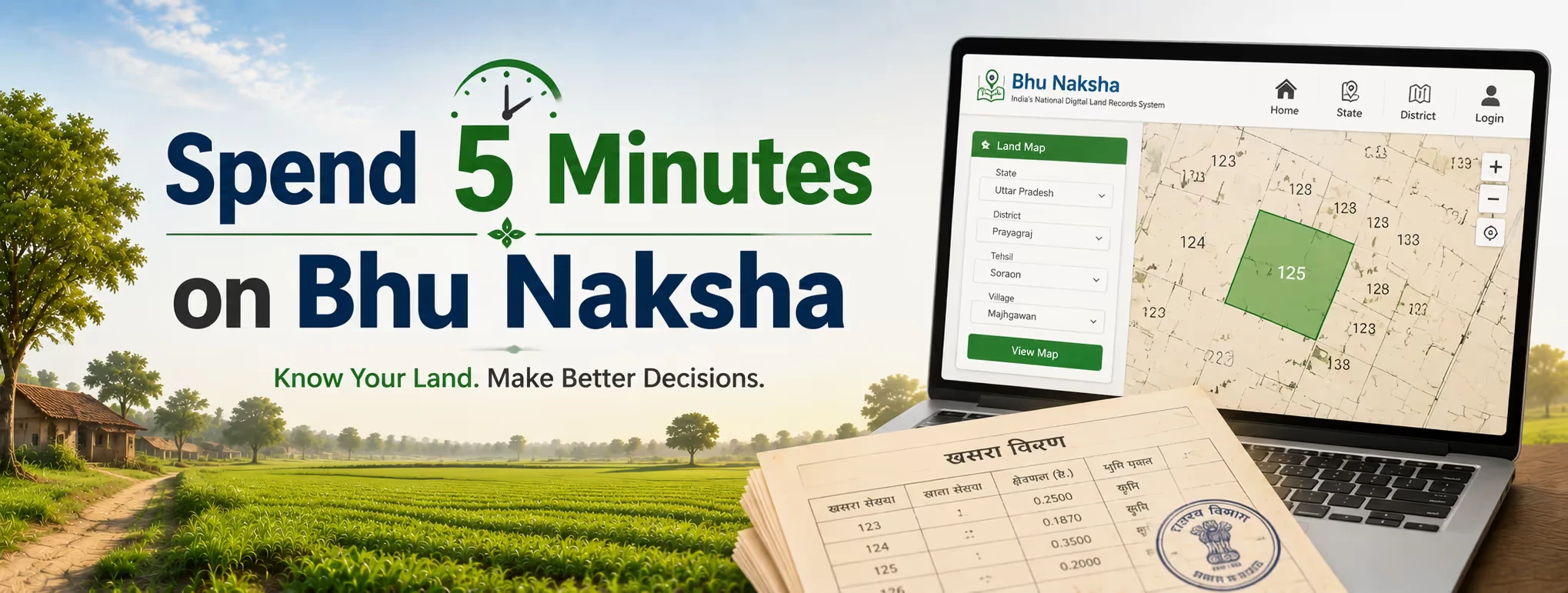
Most land buyers in Assam spend hours visiting sites, negotiating prices, and reviewing documents — but skip one check that takes just five minutes and can reveal problems that no other document will show you. That check is 5 minutes on Bhu Naksha — Assam's online cadastral map system that visually shows you exactly where a plot sits, what surrounds it, and whether the boundaries match what the seller is claiming.
Whether you want to buy land in Assam for farming, investment, or a homestead, this one online tool has quietly become the most underused protection available to land buyers in the state. This blog explains what Bhu Naksha is, how to use it, and why skipping it has cost buyers across Assam far more than they ever imagined.
What Is Bhu Naksha Assam and Why Does Every Land Buyer Need It
Bhu Naksha Assam online is the digital cadastral mapping system maintained by the Revenue Department of Assam. A cadastral map is simply a large-scale map that shows individual land parcels — their boundaries, shapes, sizes, and Dag numbers — within a village or Mouza. It is the visual counterpart to the text-based Jamabandi and Patta records that most buyers are familiar with.
When you do 5 minutes on Bhu Naksha, you are essentially pulling up a government-verified map of the plot you are considering buying. You can see its exact location within the village, the shape of the plot, what land surrounds it — whether it is another private plot, a road, a water body, a government reserve, or forest land — and whether the actual boundaries on the map match what the seller has shown you physically. No other document gives you this kind of visual verification from the comfort of your home before you even visit the site.
The Legal Rules to Buy Land in Assam: What Bhu Naksha Helps You Verify
Assam has a specific and layered set of legal rules to buy land in Assam that govern who can buy what type of land, where, and under what conditions. Tribal land under specific Pattas cannot be sold to non-tribals. Land in certain reserved or protected zones cannot be purchased for residential or commercial use. Riverine land in Char areas changes shape with the river course and has its own classification challenges. Forest-adjacent land has restrictions on construction and development.
The legal rules to buy land in Assam means the specific criteria that need to be followed or checked upon at the time of buying land in Assam. Bhu Naksha is the tool that visually maps these boundaries. If a plot sits adjacent to a reserved forest, a government wasteland, or a riverbed — things that may not be explicitly stated in the Patta — Bhu Naksha will show you. Spending 5 minutes on Bhu Naksha before visiting any land for sale in Assam can reveal location-based legal risks that no text record alone will tell you about.
How to Access Revenue Assam Bhu Naksha Online in 5 Minutes
Accessing revenue Assam Bhu Naksha online is straightforward. The government has made the system available through the Dharitree portal and the dedicated Bhu Naksha interface. Here is the exact process:
- Open your browser and go to the official Assam Bhu Naksha portal — bhunaksha.assam.gov.in
- On the left panel, select your District from the dropdown
- Select your Circle (Revenue Circle)
- Select your Mouza (village-level administrative unit)
- The map of that Mouza will load on screen showing all land parcels with their Dag numbers
- Click on the specific Dag number of the plot you are evaluating
- The plot will highlight in colour on the map and basic details — Dag number, owner name, area — will appear in a side panel
- You can zoom in and out to see surrounding plots, roads, water bodies, and boundaries clearly
- Download the map view as a PDF or take a screenshot for your records
The entire process takes under five minutes once you have the Dag number of the plot handy. This is why spending 5 minutes on Bhu Naksha before any site visit or payment is one of the simplest and smartest habits any land buyer in Assam can develop.
What Bhu Naksha Reveals That Other Documents Cannot
This is the core reason why 5 minutes on Bhu Naksha is so valuable. Here is what the map shows you that Patta and Jamabandi records simply cannot:
- Whether the plot is landlocked: A plot with no road access shown on the Bhu Naksha map means you may never be able to develop it without acquiring right of way — a costly and time-consuming process.
- Whether it borders government or forest land: If one side of the plot touches reserved forest or government wasteland, any encroachment in that direction — even unintentional — creates serious legal problems.
- Whether the plot shape matches what the seller showed you: Sellers sometimes walk buyers around a larger area than the actual plot. Bhu Naksha shows the exact shape and size as per government records.
- Whether the plot is near a riverbed or flood zone: For land in Assam specifically, proximity to rivers is a major risk factor given the state's flood history. Bhu Naksha shows water bodies adjacent to the plot.
- Whether the Dag number the seller gave you matches the physical location: Sometimes sellers reference a Dag number that corresponds to a different or better plot in the same village to attract buyers.
- Whether surrounding land use is compatible: If you are looking agricultural land for sale for farming but surrounding plots are classified as government reserve or industrial, that context matters for your plans.
Bhu Naksha Assam: What Each Colour Code on the Map Means
One thing that confuses first-time users of Bhu Naksha Assam online is the colour coding on the cadastral map. Different colours represent different land classifications. Here is a general guide:
| Colour on Map | Land Classification | What It Means for Buyers |
| Light Yellow / Cream | Private Agricultural Land | Standard farmland — most common for buyers |
| Green | Forest / Reserved Land | Cannot be purchased or developed privately |
| Blue | Water Bodies — Rivers, Ponds | Not available for private ownership |
| Orange / Red | Government Land / Wasteland | Cannot be sold privately — verify carefully |
| Pink / Light Purple | Homestead / Residential Land | Suitable for residential development |
| Grey | Roads and Public Infrastructure | Not available for private purchase |
| White / Unshaded | Undetermined or Under Survey | Needs additional verification at Circle Office |
Always check which colour your target plot and its immediate surroundings appear in before finalising any land selling in Assam transaction. A plot that looks great in photos but sits surrounded by green forest on the Bhu Naksha map carries restrictions that will affect everything you want to do with it.
Basundhara Assam and Bhu Naksha: How the Land Rights Programme Connects
Basundhara, Assam is the state government's initiative to provide land rights — Pattas — to landless residents and those with informal land occupation. Under Basundhara, Assam, land that was previously unrecorded or occupied without formal documentation gets regularised and assigned Patta status. This is a significant programme that has brought thousands of land parcels into the formal land record system across the state.
For buyers, the connection to Bhu Naksha is direct. Land that has been regularised under Basundhara, Assam will appear on the cadastral map with its assigned Dag number. Verifying such land on Bhu Naksha confirms that the regularisation has been properly recorded in government maps — not just on paper. If a seller claims their land was regularised under Basundhara, Assam but the plot does not appear clearly on Bhu Naksha or shows a different classification, that needs investigation before any purchase.
Farmland Search in Assam: Using Bhu Naksha as Your First Filter
For buyers doing a farmland search in Assam across multiple plots before shortlisting which ones to visit physically, Bhu Naksha works perfectly as a first filter. Here is how to use it systematically:
- Start with the seller's Dag number and pull up the Bhu Naksha map for each plot you are considering.
- Immediately eliminate any plot that shows forest, government, or water body adjacency that was not disclosed by the seller.
- Check the shape — irregular or narrow plots may have access problems that wide, regular-shaped plots do not.
- Verify the area shown on Bhu Naksha matches the area stated in the Patta and Jamabandi.
- Shortlist only the plots where everything on the map is consistent with what the seller has told you.
- Plan your physical site visits only for the shortlisted plots — this alone can save you multiple unnecessary trips across the state.
Using 5 minutes on Bhu Naksha for each plot during your farmland search in Assam turns a potentially exhausting and expensive search process into something far more structured and efficient.
Real Risks That Bhu Naksha Has Helped Buyers Avoid
Here are the types of situations where a quick check on revenue Assam Bhu Naksha has helped buyers avoid serious financial losses:
- A buyer was shown a large plot bordering a river in upper Assam. Bhu Naksha revealed that more than a third of the plot fell within the river's recorded boundary — meaning it was not private land at all.
- A buyer looking at agricultural land for sale near Guwahati discovered through Bhu Naksha that the plot's Dag number on the Patta corresponded to a plot in a completely different part of the village than where the seller had taken them for a site visit.
- A buyer doing a farmland search in Assam found that a plot they were considering had no road access on any side — all four boundaries were adjacent to other private plots with no public road touching the parcel.
- A buyer interested in land in Assam near a forest zone found that one full boundary of the plot on Bhu Naksha was marked as reserved forest — a fact the seller had not mentioned and which would have prevented any construction on that side.
Each of these situations involved buyers who were moments away from making payments before a five-minute Bhu Naksha check changed everything.
Property Management Service and Bhu Naksha: Why It Matters for Investors
For investors using a property management service to manage land for sale in Assam or land selling in Assam on their behalf, Bhu Naksha is equally relevant. A good property management service will include Bhu Naksha verification as a standard step in their due diligence process — both when acquiring land for clients and when preparing listings for sale. If a property management service you are working with does not routinely check Bhu Naksha before presenting land options to you, that is a gap in their process worth raising directly.
For remote investors managing land in Assam from other cities or from abroad, Bhu Naksha provides a level of visual oversight that is otherwise only possible through physical visits. It does not replace site visits but it makes every site visit more purposeful and every remote evaluation more reliable.
How Bhu Naksha Works Alongside Other Assam Land Records
Bhu Naksha is most powerful when used alongside — not instead of — the other key land records in Assam:
- Patta: Confirms legal ownership right — check this first to know the seller is legitimate.
- Jamabandi: Confirms ownership details, area, classification, and encumbrances — check this for the full rights picture.
- Dag Number: The link between all records — the same Dag number must appear consistently across Patta, Jamabandi, and Bhu Naksha.
- Intkal / Mutation Certificate: Confirms ownership was properly transferred to the current seller — check this to ensure the chain of title is clean.
- Bhu Naksha: Visually confirms the plot's location, shape, boundaries, and surroundings — the one check no text document can replace.
Using all five together gives you the most complete picture possible before you commit to any land in Assam purchase.
Final Thoughts: Five Minutes That Could Save You Lakhs
The title of this blog is not an exaggeration. Spending 5 minutes on Bhu Naksha before finalising any land deal in Assam is one of the simplest, fastest, and most effective forms of due diligence available to any buyer. The tool is free, it is online, it is government-maintained, and it shows you things no seller's document will ever voluntarily reveal.
Whether you are looking at land for sale in Assam in the Brahmaputra valley, doing a farmland search in Assam in the upper hills, or evaluating plots near Guwahati as part of a broader investment — make Bhu Naksha your first step. Pull up the map, check the Dag number, look at the surroundings, and verify the shape. Five minutes of this has saved buyers across Assam from mistakes that would have taken years and lakhs of rupees to undo.
Disclaimer: This article is for informational purposes only and should not be considered investment, legal, financial, or property advice. Real estate regulations, infrastructure plans, market conditions, and government policies may change over time. Readers are advised to verify information with relevant authorities and consult qualified professionals before making any investment or property-related decisions.