It doesn’t take much effort looking through any current real estate ads to realize that almost half of the platforms operate the same way as they did ten years ago: infinite scrolling, old photos, and phone numbers that nobody is answering. The remaining half began to rely on artificial intelligence for all the hard work, from matching buyers’ intentions to predicting potential land disputes, even before asking for your help. But then, what strategy is more effective when buying/selling land?
Two Very Different Ways of Searching for Land
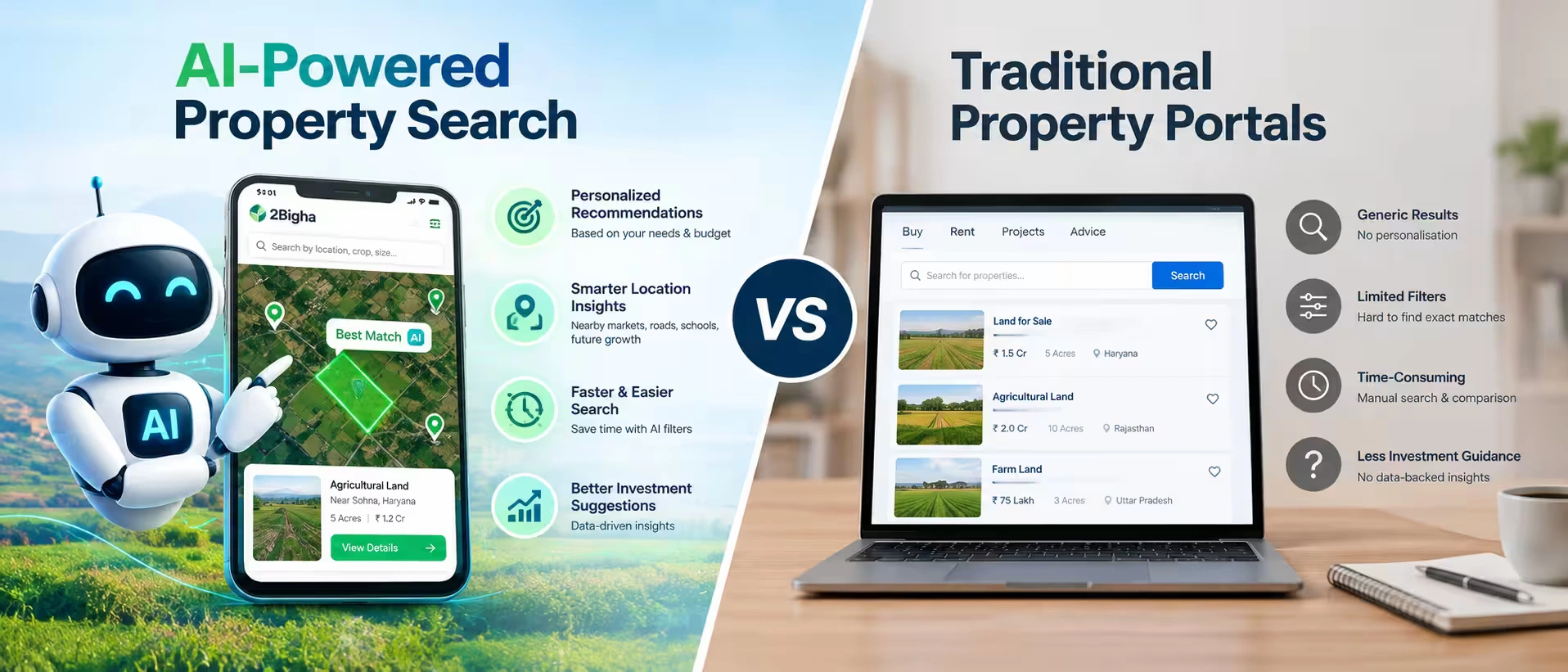
Traditional portals were built around a simple idea: list as many properties as possible and let the buyer filter through them manually. That worked fine when property search meant a handful of newspaper classifieds. It works a lot less well now, when someone typing "agriculture land for sale near me" expects results that are actually near them, verified, and current.
AI-powered platforms flip that model. Instead of dumping every listing on you, they use buyer behavior, location data, and property history to surface what's genuinely relevant, whether that's a small crop land for sale near a canal or a larger parcel meant for industrial land for sale zoning. The difference isn't just cosmetic; it changes how much time and risk sit between "I want to buy land" and "I've actually bought it."
Feature-by-Feature Comparison
| Feature | Traditional Portals | AI-Powered Platforms |
| Search relevance | Keyword-based, often generic | Behavior and context-based matching |
| Listing verification | Rarely checked, self-reported | Cross-checked against land records |
| Update frequency | Listings often stale for months | Real-time or near real-time updates |
| Price transparency | Inconsistent, negotiable, blind | Market-benchmarked pricing |
| Fraud risk | Higher — duplicate or fake listings are common | Lower — flagged and filtered automatically |
| Personalization | None or basic filters | Learns preferences over repeated farm searches |
| Support for niche categories | Weak (e.g., organic or specialty land) | Stronger, tags land type precisely |
Where Do Traditional Portals Still Fall Short?
All one has to do is ask any person who has attempted to sell land through a classified portal to get an almost identical story – the ad gets posted and is soon lost among hundreds of ads that have nothing to do with land sales; and the only responses to the ad are from brokers trying to find their commission. The following issues appear consistently:
- Lack of any verification of ownership and/or land title prior to posting the ad
- Multiple postings for the same land plots, sometimes at different prices
- Mismatch between the pictures and the description of the land in question, with its present condition
- No provision for searching for specific types of land, such as land to be used for farming with irrigation possibilities
- It is not even clear whether the land-for-sale ad reaches the right people or not
This does not mean that regular portals are ineffective since some buyers find land in this way, but the process is largely manual and relies a lot on luck.
What AI-Powered Search Actually Changes?
The appeal of AI in property search isn't that it's flashy; it's that it removes a lot of the guesswork on both sides of a transaction. A buyer running a farm search doesn't just get a list of "agricultural land" tagged loosely; they get results filtered by soil type, water access, road connectivity, and legal clarity, ranked by how closely they match what was actually searched for.
For sellers, this works the other way, too. Instead of hoping the right buyer scrolls past a listing, AI systems match crop land for sale or industrial land for sale with buyers actively looking for that exact category, cutting down the noise considerably. A few concrete advantages worth pointing out:
- Smarter matching — buyer intent and land attributes are compared automatically, not manually filtered.
- Verified records — ownership and title details are checked against available government data before a listing is trusted.
- Dynamic pricing insight — instead of guessing at a number, sellers see what similar plots in the area have actually closed at.
- Fraud detection — duplicate or suspicious listings get flagged early, protecting both buyers and sellers.
- Category-specific search — whether it's organic farmland, industrial-zoned land, or residential plots, AI tagging keeps categories from bleeding into each other.
Is AI Search Always Better?
And that is not always the case, and one must be fair in this regard. First of all, AI-based services rely greatly on the quality of the data at their disposal. And in those places where digitization of the land registry data leaves much to be desired, an intelligent service cannot do anything except what it is given. At the same time, traditional platforms continue to have the upper hand regarding the quantity of listings available, as they are older and are used by more sellers who are used to them. However, for a person engaged in selling land seriously, not just looking for it, it is much more important.
What You're Prioritizing | Better Fit |
The sheer number of listings to browse | Traditional portals |
Verified ownership and title clarity | AI-powered platforms |
Fast, targeted farm search results | AI-powered platforms |
Familiarity, long-established user base | Traditional portals |
Reduced fraud risk | AI-powered platforms |
Where Does 2Bigha Fit Into This Shift?
This is essentially the gap 2Bigha was built to close. Rather than functioning like a static classifieds board, the platform applies verification and matching specifically for agricultural and farmland transactions, so a search for farm land for sale returns plots that are actually checked against ownership and legal records, not just self-listed by whoever uploaded them.
For sellers looking to sell plots without wading through unqualified inquiries, or buyers running a focused agriculture land for sale near me search, 2Bigha's approach means less time spent filtering noise and more time spent evaluating land that's already been through a verification layer. It's a meaningful shift from how land selling has traditionally worked in India, where trust was built slowly through brokers and word of mouth rather than data.
Disclaimer: This article is for informational purposes only and should not be considered investment, legal, financial, or property advice. Real estate regulations, infrastructure plans, market conditions, and government policies may change over time. Readers are advised to verify information with relevant authorities and consult qualified professionals before making any investment or property-related decisions.