List Your Land
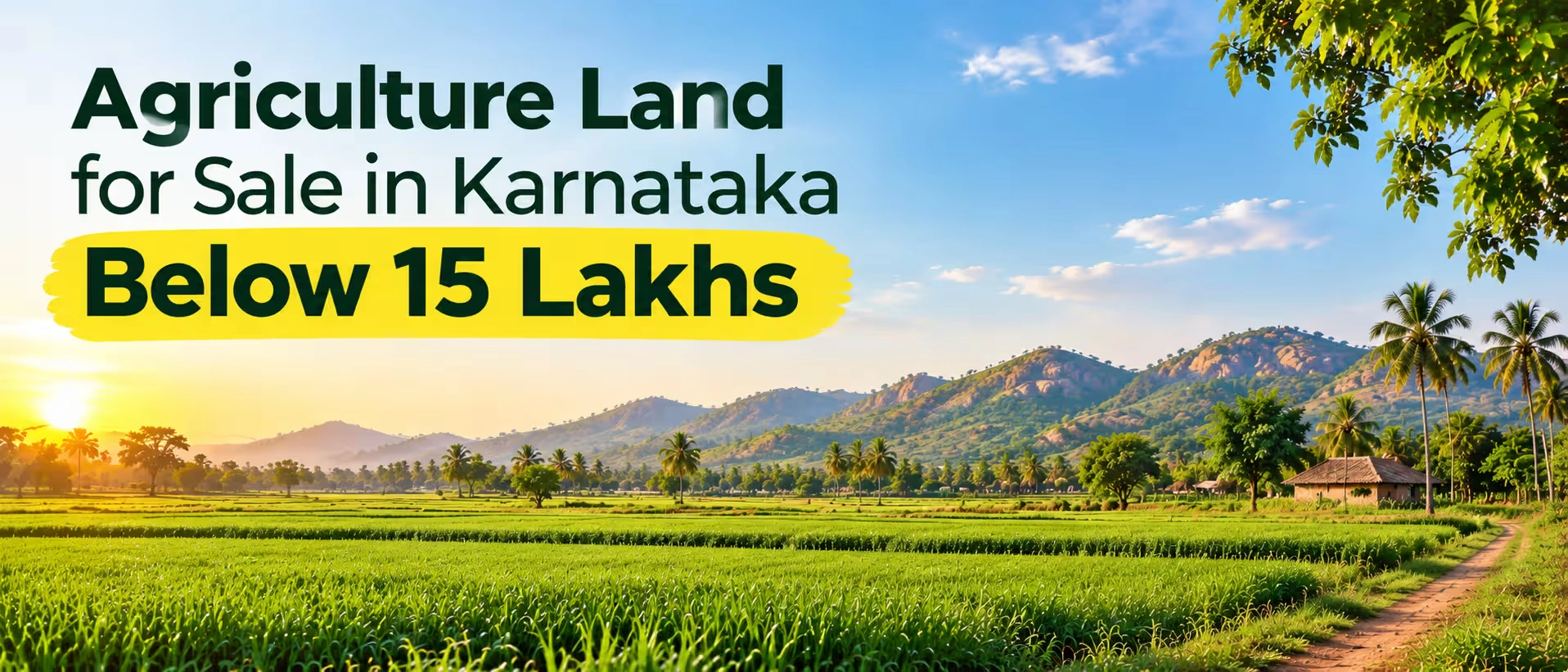
Fifteen lakhs sounds like a decent amount until you start asking what it buys. Near Bengaluru, not much. A couple of guntas, maybe, if the road is bad. Go a few hours north or east, and the answer changes completely. That's the thing about agriculture land for sale in Karnataka under this budget: the state is big enough that the same money gets you very different things depending on where you point your finger on the map. So this guide is about being realistic. What you can expect, where to look, and the paper checks that matter more when your budget is tight, because a small buyer has the least room to absorb a mistake.
First, The Units
Karnataka measures land in terms of acres and guntas. The measurement is such that forty guntas equal one acre, and one gunta equals 1,089 square feet. You will come across the measurements known as "anas," where sixteen anas equal one gunta. If the person you are dealing with gives you a measure like "two acres ten guntas," this is equivalent to 2.25 acres.
What 15 Lakhs Can Realistically Buy?
Prices swing wildly with water, road access, and distance from towns, so treat the table below as a rough feel and not a rate card. Check live listings before you make any decision.
| Area | Example districts | What this budget may stretch to | The catch |
| North and northeast dry belt | Raichur, Koppal, Yadgir, Bidar, Kalaburagi, Vijayapura | Often a few acres of dry land, sometimes more | Rainfed soil, thin water, remote roads |
| Central Karnataka | Chitradurga, Davanagere, Haveri, Gadag | Roughly one to a few acres depending on irrigation | Borewell yield can vary a lot |
| South interior | Tumakuru, Kolar, Chikkaballapur | Smaller parcels, often under an acre to a couple of acres | Groundwater has been dropping |
| Cauvery and canal belt | Mandya, Mysuru outskirts, Hassan | Usually a fraction of an acre to maybe an acre | Irrigated land costs far more |
| Near Bengaluru, Mysuru, Mangaluru | Peri-urban areas | A few guntas at best | Price reflects the future, not the farming |
If you're after farm land for sale in Karnataka that you can actually cultivate and still stay inside 15 lakhs, the dry districts of the north and centre are where most buyers end up. Fertile, well-watered land with a good road is a different price bracket altogether.
Who Can Buy, and a Rule About Small Plots?
Non-farming persons having high income levels were not allowed to purchase agricultural land in Karnataka. This restriction was lifted by the 2020 amendment to the Land Reforms Act, and now in principle everybody can buy, subject to a ceiling on total holding. Given that this act is newsworthy and could potentially be amended in the future, check the current position through a local lawyer before making a token payment.
NRIs and OCIs are exceptions. FEMA regulations do not allow them to purchase agricultural land. Another regulation that you should pay attention to, if you have a tight budget, is a Karnataka regulation prohibiting breaking up of farmland into small portions. In the case of a seller who is trying to cut away a small portion from a larger survey number, you might encounter a problem while registering.
Which Records to Pull?
Everything starts with the Bhoomi portal. It carries the RTC, or Record of Rights, Tenancy and Crops, which is the single most useful paper for a buyer. It shows the owner, the survey and hissa number, the area, the soil and crop details, and any loans. The mutation extract shows how ownership changed over time.
When you read the RTC, look for three things. Does the owner's name match the seller's ID? Is there a loan or charge noted against the land? Do the crop entries, called pahani, show the seller actually cultivating it? If a tenant's name appears, you need to know why. Then get an encumbrance certificate. Registration and EC searches run through the state's Kaveri portal. It tells you about mortgages and earlier transactions. Also ask for the survey sketch, often called a tippani, and compare the boundary on paper with what's on the ground.
The Ground Checks That Matter on a Small Budget
A cheap plot is often cheap for a reason. Under Karnataka land purchase rules, walk it. Specifically:
- Check for a legal approach road. A field with no right of way is a prisoner of its neighbours.
- Ask to see the borewell, how deep it is, and what it yields in summer. A dry borewell is an expensive hole.
- Find out if there's an electricity connection for the pump, or how long one would take.
- Talk to the farmers on either side. They know the water, the flooding, and the family disputes.
- Look at the soil. Black cotton soil, red soil, and laterite behave very differently.
What Will the Deal Really Cost?
Add stamp duty and registration to the price. Karnataka charges around 5% stamp duty and 1% registration, with some cesses on top. The figure depends on whichever is higher, the sale price or the government guidance value, so a cheap-looking deal can still be taxed on a bigger number. A 14 lakh plot can quickly turn into 15 lakh once you add legal fees, survey costs, and registration. Leave room. Always register through the proper channel and apply for mutation afterwards. A sale deed without a mutation leaves the old name sitting in the record.
If You're the One Selling
Many owners wish to sell their land in Karnataka without getting their documents in order. Get that done first. Update your RTC, settle your crop loans and society loans, complete your mutation due to any inheritance, and get your co-owners to agree in writing. Then get a new EC and organize all your old sale deeds. Your buyer will have no tolerance for any surprises if his budget is 15 lakhs, so it will be easier if you have your documents in order. Regarding tax, rural agricultural land outside the prescribed distance from any municipality is not a capital asset.
Browse Verified Land on 2Bigha
Scrolling through forwarded messages and calling brokers one by one takes weeks. 2Bigha is an AI-powered marketplace built only for agricultural land and farmland in India. You can browse agri land for sale in Karnataka, compare options by budget, and read Background Verification Reports to see what stands behind a listing. When one looks right, use Book a Visit and see it with your own eyes. You can also look at what a 2Bigha Land Report covers. Owners can list too. If you want to sell land in Karnataka, you reach buyers who are already searching for farmland, which beats waiting for a phone call.
Disclaimer: This article is for informational purposes only and should not be considered investment, legal, financial, or property advice. Real estate regulations, infrastructure plans, market conditions, and government policies may change over time. Readers are advised to verify information with relevant authorities and consult qualified professionals before making any investment or property-related decisions.