List Your Land
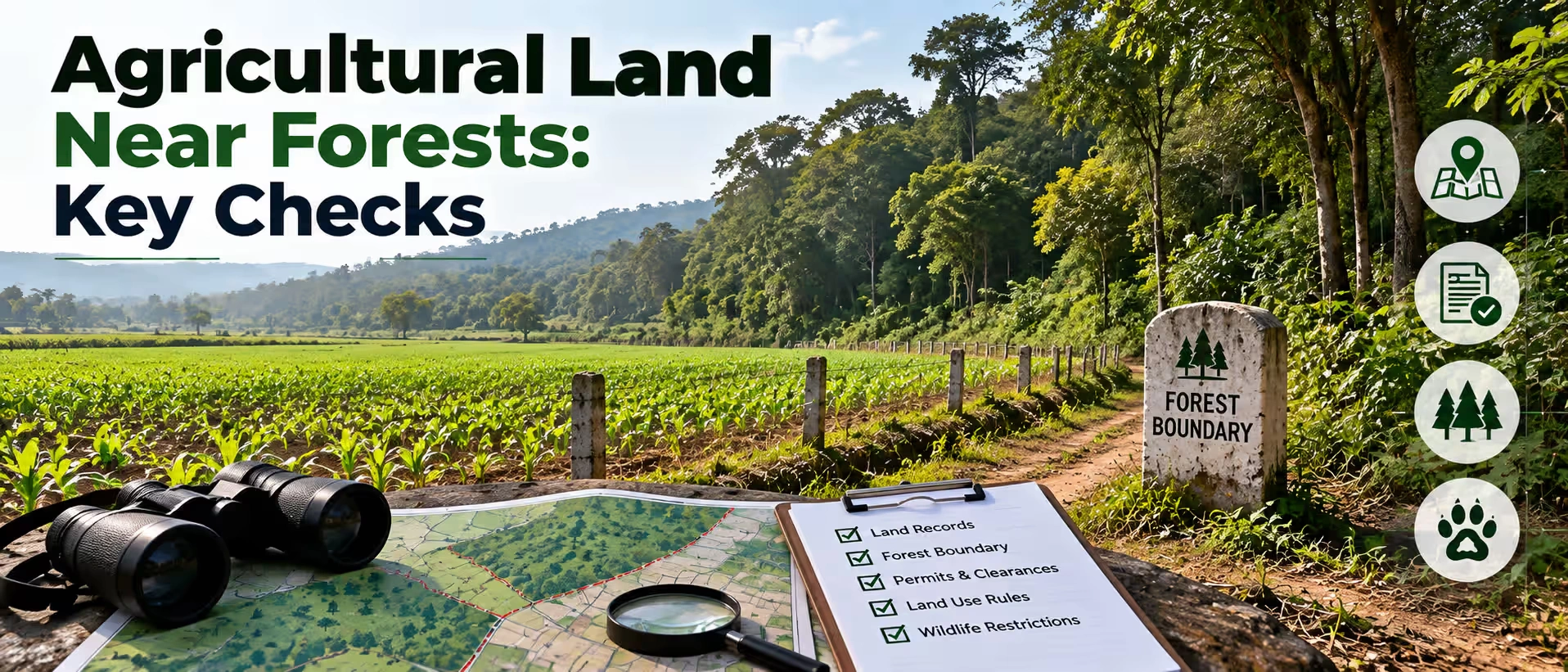
There are certain good reasons why land close to a forest is attractive to buy. Such land will generally be green, less noisy, and cheaper compared to the land near highways and cities. The problem here is that forests, sanctuaries, and national parks are accompanied by some restrictions that may even go beyond their own boundaries. One can acquire a piece of land with certain restrictions on construction, felling of trees, bore wells, or any commercial activity just from looking into the sale deed.
Why Forest Proximity Changes the Rules for Agricultural Land?
Most agriculture land in India is governed by state revenue and land-use laws, and many buyers stop reading there. Land near a forest has a second layer of rules from forest and wildlife laws, which are enforced by the forest department and not by the revenue office. A plot can look like ordinary cultivable land in the village record and still sit inside a protected buffer, a wildlife corridor or an area where the forest department has a claim. The difference matters in four ways:
- What you can build, such as a farmhouse, shed, or boundary wall
- Whether you can cut trees, dig a borewell, or level the land
- Whether commercial activity like a resort or farm stay is allowed
- How easily the land can be resold or financed later
What Counts as Forest Land and an Eco-Sensitive Zone?
These two terms are often confused; hence, it will be beneficial to distinguish them.
Forest land is land declared as forest land or treated as forest land by the courts and authorities due to its intrinsic nature. Any use of forest land for a non-forest purpose usually requires approval from the central government according to the Forest Conservation Law, amended and renamed in 2023.
An eco-sensitive zone (ESZ) is a ring around the national park or wildlife sanctuary. The ESZ is created according to the Environment Protection Act, 1986, and it acts as a buffer between the protected core and the surrounding land. Thus, a single tiger reserve may include a core area, a buffer under the Wildlife Protection Act, and an ESZ around it.
Remember that an ESZ is not always a fixed distance. The old guideline of 10 km was meant as a general principle, and the actual width can differ for each protected area; some areas have a very uneven boundary. The Supreme Court also changed its stand in 2023, and it said ESZs cannot be uniform across the country and must be set for each protected area. The only reliable source for your plot is the final notification for that specific park or sanctuary.
Restrictions That Can Apply to Land Near Forests
Anyone who searches for farm lands in India near forest belts, hills, or sanctuaries should look at the actual notification before the price. The restrictions differ by area, but these are the usual categories:
| Activity | Typical position in an ESZ or forest edge |
| Farming and regular crops | Mostly allowed, sometimes with limits on chemicals or crop type |
| Farmhouse or residence | Often allowed with limits on height, area, and design |
| Commercial buildings, resorts | Often regulated or prohibited |
| Mining and heavy industry | Prohibited. The Supreme Court has clarified that mining is not permitted in an ESZ even when the zone extends beyond one kilometre. |
| Tree felling | Needs permission in most states |
| Borewells and water use | Can be regulated, depending on the zone |
| Fencing and walls | May be restricted if they block animal movement |
It would also be helpful to learn about the court’s take on overlapping rules. In case the ESZ provided for by the legislation goes beyond one kilometre, the larger margin will apply. A piece of land that was previously considered safe due to its location may happen to be within the larger notified ESZ area. On the other hand, according to one source, the amendment for 2023 did not apply to settlements and infrastructure that were built prior to the relevant notification.
Records and Documents to Verify Before Buying
Begin with the documents since it is less expensive to identify issues on paper than on the ground.
- Latest Land Record Document (Jamabandi/Khatauni/7/12)
- Mutation document with history of ownership for at least 30 years
- Encumbrance Certificate
- Village Map along with location of Survey Number
- Status of the land use and conversion order (if any)
- Letter/ NOC from the Forest Department that the land is not forest land
- Copy of ESZ Notification pertaining to the nearest protected area along with distance of the plot from the protected area
- Permission for felling trees or others if already obtained
If the seller does not have NOC from Forest Department, you may seek information about the Survey Number from Forest Range Office as to whether it is mentioned in forest record or not.
Forest Land Hiding Inside Revenue Records
This is what catches buyers off-guard. Land can be represented as agricultural in the revenue records and yet be classified as forest by the forest department since the two departments maintain independent records which may differ from each other. The courts have long maintained that the classification of the land as forest can be based on its actual nature rather than its classification as mentioned in the document. While surveying the agricultural land plots adjacent to a forest area, watch out for these red flags:
- Presence of dense natural tree cover or vegetation on the plot
- Survey numbers that feature in forest department maps
- Records indicating "jungle," "van," "reserved," or "protected" in the use of land column
- Presence of boundary markers or notice put up by the forest department
- Claims pending or disputes under forest rights or tribal land law
If even a single red flag comes up, halt the transaction and seek a written clarification prior to paying the advance amount.
Key Risks of Buying Near Forests and Eco-Sensitive Zones
| Risk | Why it matters | How to reduce it |
| Plot is inside a notified ESZ | Construction and commercial use are limited | Get the notification and mark the plot on its map |
| Plot is recorded as forest | Sale or use can be challenged | Ask for the forest NOC |
| Tree cutting needed | Permission is slow or refused | Check tree rules in your state before buying |
| Wildlife movement | Crop damage, fencing limits, safety concerns | Visit in different seasons and talk to nearby farmers |
| Access blocked | The approach road may cross forest land | Verify the road status in the record |
| Future notification | A new ESZ can be declared later | Ask the forest office about pending proposals |
| Resale difficulty | Banks and buyers avoid doubtful records | Keep clean documents and written clearances |
Step-by-Step Verification Checklist
- Find out the nearest national park, sanctuary, or reserve.
- Get the ESZ notification, draft or final, for that location.
- Get a surveyor to demarcate the plot with respect to the ESZ boundaries.
- Match up the survey number with the forest department.
- Ascertain the land use along with permissions on the revenue side.
- Make sure that there is an approach road, forest gate, or checkpoint.
- Survey the plot in more than one season, especially the monsoon.
- Speak to two or three owners of adjacent plots regarding their experiences.
- Take legal advice on the title and all clearances received in writing.
- Make your payments in installments following the receipt of documents.
If you are considering a commercial plot for sale near a forest or tourist belt, there is one more step to take. Ask explicitly if the zone permits the activity you plan, like a resort or restaurant, and get the response in writing from the competent authority. In most ESZs, commercial construction is the first thing to be banned, and the plot that was sold as a hospitality plot may not be worth much more than farming land.
What Sellers Should Check Before Listing?
Owners who want to sell land near a forest get better offers when the papers are ready in advance. Buyers in this segment are careful, and they will ask about ESZ status in the first call. Keep these ready before listing:
- Revised record and mutation certificate
- Forest Department's document stating that it is not forest land
- ESZ map depicting the location of the plot
- Details of any felling or construction permission
- Detailed information about access roads and nearby forest boundary
The seller who discloses all this will save precious time by weeks, and the buyers left behind will be the serious ones.
How 2Bigha Helps You Buy and Sell Land Near Sensitive Areas?
Lands that are near forests require more diligence beyond the regular listing. And this gap is what 2Bigha hopes to address. 2Bigha lists agricultural lands and farmlands across India. 2Bigha’s verification report checks ownership history and more before listing it on their platform. Users can easily check out these lands on the platform to make bookings without going through a broker.
Listers will be able to access the market of potential buyers interested in purchasing farmland with their documentation well-organized.
Disclaimer: This article is for informational purposes only and should not be considered investment, legal, financial, or property advice. Real estate regulations, infrastructure plans, market conditions, and government policies may change over time. Readers are advised to verify information with relevant authorities and consult qualified professionals before making any investment or property-related decisions.