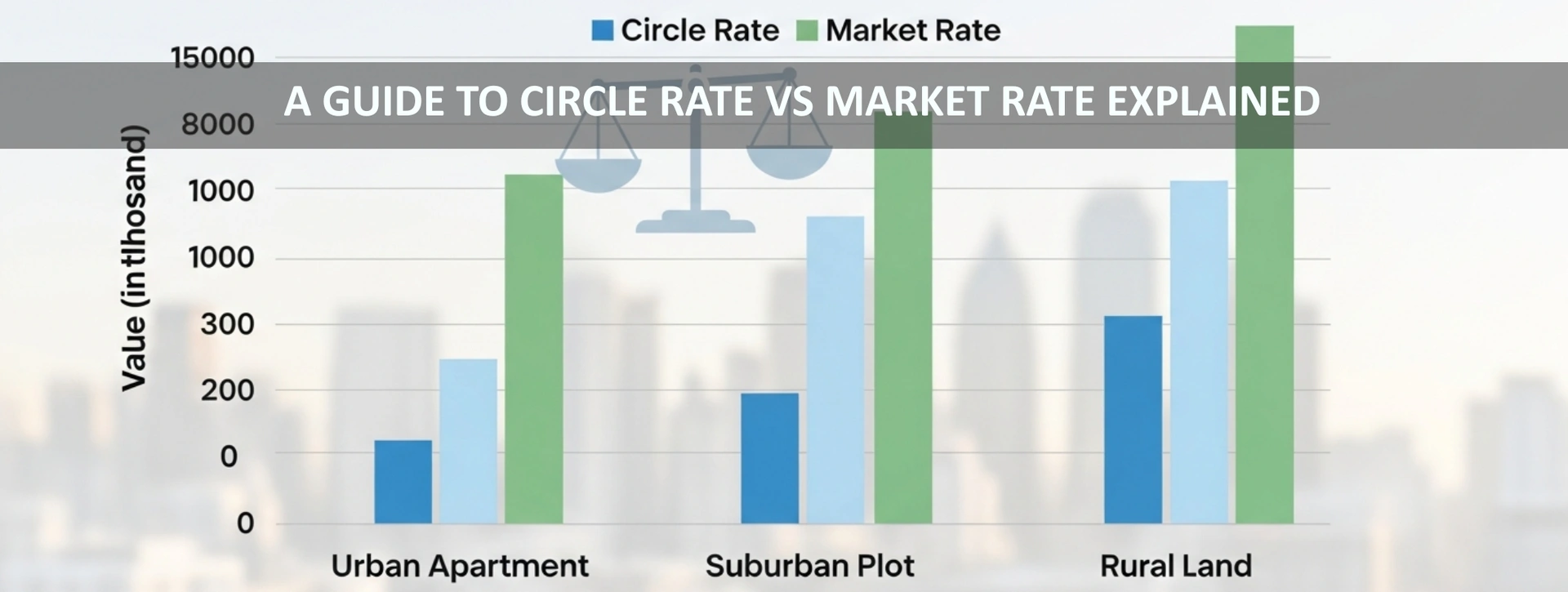
When you are purchasing or selling land in India, one of the most confusing aspects is learning the difference between the Circle Rate and Market Rate. Both play an integral part in setting a property's value, taxation, and ultimate sales price. Whether you are a land investor, a first-time buyer, or merely researching the real estate market, learning how these rates function can help you less and avoid confusion.
In this guide, we’ll explain what Circle Rate and Market Rate mean, how they impact your land transactions, and how platforms like 2Bigha make property research and comparison easier for you.
What Is a Circle Rate?
Circle Rate, or Guideline Value or Ready Reckoner Rate, is the lowest rate fixed by the government for property registration within a specific area. It is the base value for the computation of stamp duty and registration fees whenever you purchase or sell land.
Every state government in India formulates these rates for various localities based on issues such as:
- Location of the property (urban or rural)
- Type of property (residential, commercial, or agricultural)
- Nearest proximity to roads, markets, or infrastructure
- Area development potential
For instance, if the Circle Rate in Jaipur's outskirts is ₹3,000/sq. ft., and you wish to sell land there for ₹2,800/sq. ft., the registration will still be at ₹3,000, the government-mandated minimum rate.
What Is the Market Rate?
The market rate, on the other hand, is the actual price at which a property is bought or sold between a buyer and a seller. It reflects the current demand, location advantage, and market trends.
Market rates fluctuate based on:
- Infrastructure projects (like highways or airports)
- Local demand and supply
- Connectivity and amenities
- Land use regulations
- Future development potential
For instance, if a new industrial zone or metro line is being developed nearby, the market rate of that area can increase significantly, often going much higher than the government’s circle rate.
Circle Rate vs Market Rate: The Key Difference
| Factor | Circle Rate | Market Rate |
|---|---|---|
| Definition | Government-declared minimum rate for property registration | Actual price agreed upon between buyer and seller |
| Purpose | Used to calculate stamp duty and registration fees | Reflects real-world demand and property value |
| Control | Fixed by the local government or revenue department | Decided by market forces |
| Fluctuation | Updated periodically | Changes frequently based on demand |
| Impact on Transactions | Ensures fair taxation | Determines actual profit or investment return |
Why Do Circle Rate and Market Rate Matter When You Buy or Sell Land?
Understanding both rates is essential to make informed real estate decisions:
- Helps in Fair Valuation: If you are planning to buy or sell land, comparing the Circle Rate with the Market Rate helps you understand whether the property is overpriced or undervalued.
- Tax Calculation: Stamp duty and registration charges are based on the higher value between the two rates. Knowing this helps you estimate your total investment accurately.
- Avoiding Legal Issues: If you sell land below the Circle Rate, it may attract scrutiny from tax authorities, as the transaction could be seen as undervalued.
- Investment Insights: When market rates are significantly higher than circle rates, it indicates strong growth potential, a good signal for long-term land investors.
Example: Circle Rate vs Market Rate in Real Life
Imagine you’re buying one acre of land near Alwar, Rajasthan.
- Circle Rate (as per government): ₹50 lakh per acre
- Market Rate (as per current market trends): ₹70 lakh per acre
Here’s what happens:
- The stamp duty will be calculated based on ₹70 lakh (the higher rate).
- You will pay more registration fees, but you’ll also acquire land with higher resale potential.
- If you were to sell this land later, your returns would depend on future market growth.
How to Check Circle Rate and Market Rate
Checking circle and market rates used to mean visiting government offices or local property dealers. Now, with digital platforms like 2Bigha, property insights are available at your fingertips.
You can explore:
- Locality-wise Circle Rates for different Indian cities
- Current Market Trends in rural, agricultural, and urban areas
- Historical Price Data to analyze growth potential
This helps both buyers and sellers make smart, transparent, and data-backed land decisions.
How Does 2 Bigha Help in Land Buying and Selling?
When it comes to buying and selling land, 2Bigha offers a simplified and transparent approach.
Here’s how it helps:
- Locality-Based Insights:
You can explore Circle Rate and Market Rate comparisons for multiple regions, helping you evaluate real-time property worth.
- Land Trend Analysis:
The platform provides detailed insights into land value appreciation, helping investors identify profitable locations across India.
- User-Friendly Experience:
2Bigha simplifies complex real estate data into easy visuals and tables, so even first-time land buyers can make confident choices.
- Smart Decision Making:
Whether you’re investing for future growth or planning to sell land for profit, the platform gives you the clarity needed to make sound decisions.
Why Knowing the Difference Helps You Invest Better
If you only look at the market rate, you might overpay for a property. If you only depend on the Circle Rate, you may underestimate a location’s growth potential.
The best investors use both understanding how the government’s benchmark value and market-driven price interact. This dual understanding helps in:
- Negotiating better deals
- Planning long-term investments
- Avoiding legal and tax issues
- Estimating actual ROI on land investments
Final Thoughts
In India, the market for land is active, but prices differ depending on location, infrastructure, and government policy. Knowing the Circle Rate vs Market Rate difference is the basis for intelligent land investment.
Sites like 2Bigha facilitate this process by providing clear data, current trends, and place information. If you are looking to purchase land, sell a parcel, or seek investment, 2Bigha equips you with the necessary knowledge to make informed decisions.
So, before you make your next move, compare both Circle and Market Rates because informed investors always make smarter land choices.