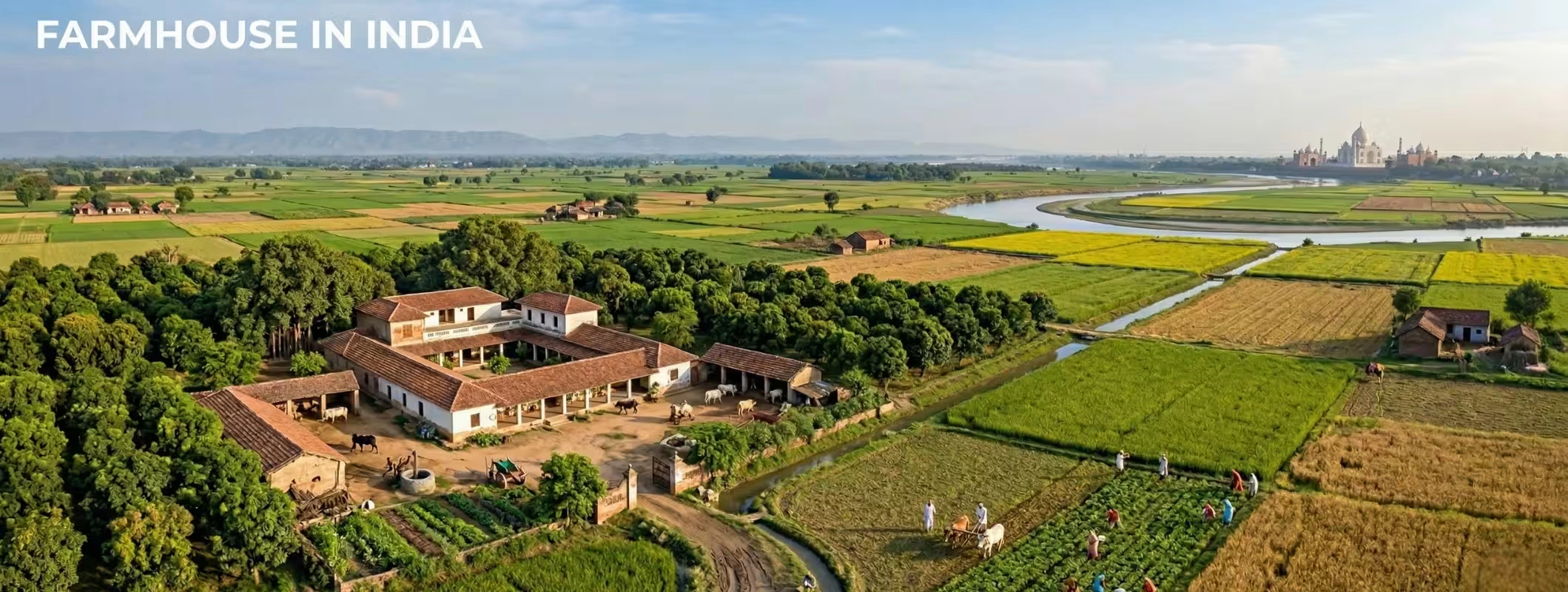
A farmhouse sounds simple, but in India, it can mean two very different things. In everyday property language, a farmhouse usually means a home in a green, low-density, agricultural setting, often used as a second home, weekend escape, or lifestyle property. In legal and planning terms, though, the meaning can be much narrower and can depend on the state, zoning rules, land classification, and local authority approvals.
That is why buyers should not treat every “farmhouse” listing the same way. Some are genuine farm-attached properties. Some are leisure homes on approved land. Some sit on agricultural parcels with strict use limits. And some can become risky purchases if the buyer checks only the photos and not the land-use rules.
Key Takeaways
- In common Indian real estate usage, a farmhouse is usually a residential property in an agricultural or green setting, often used as a second home or weekend retreat.
- In official legal language, the definition can be stricter. Karnataka’s law, for example, defines a farmhouse as a house attached to a farm on agricultural land, used for the agriculturist’s residence or for keeping agricultural equipment and cattle, and says it should not be let out for commercial activities.
- There is no single all-India farmhouse rulebook. That is an inference from the fact that Delhi, Goa, Karnataka, and NOIDA all apply different norms for farmhouse land, built-up area, height, or location.
- Before buying a farmhouse in India, always verify land title, land-use category, zoning, conversion status where relevant, building approval, access, and whether commercial use is allowed.
- If you want a better shortlist first and verification second, platforms like 2Bigha can make farmhouse and farmland discovery easier, but government records and local approvals should still be your final checkpoint.
What is a Farmhouse in India?
In practical real estate language, a farmhouse is a property in an agricultural or semi-rural setting that combines open land with a built structure. Many buyers see it as a lifestyle asset: a place for weekend stays, small-scale farming, family time, greenery, and distance from city density. Housing.com describes a farmhouse in India as a property in an agricultural setting used for residential purposes and often used as a vacation-style home with a rural feel.
But that common-market meaning is not the same as a legal definition everywhere. Karnataka’s statute defines a farmhouse much more narrowly: a house attached to a farm on agricultural land, used for the residence of the agriculturist or for keeping agricultural equipment and tethering cattle, and not for commercial letting. NOIDA’s formal planning context, as cited in a CAG audit, defined a farmhouse as a plot in an area demarcated for agriculture use.
So the straight answer is this: a farmhouse in India is usually understood as a house on or beside agricultural land, but what you are actually allowed to build or use depends on the local rulebook, not just the listing title.
Why Farmhouses appeal to Indian Buyers
Farmhouses attract buyers because they offer something urban housing often cannot: land, privacy, greenery, and breathing space. In market terms, they are commonly bought as second homes, retirement plans, family retreats, or lifestyle investments. Housing.com notes that urban buyers have increasingly looked at farmhouses as rural or semi-rural getaway homes amid greenery.
For Indian buyers, the appeal usually comes down to five things: more open land, lower-density living, emotional value, flexible personal use, and the long-term attraction of owning a hard asset.
What legally counts as a Farmhouse?
This is where most buyers make mistakes.
There is no one universal farmhouse standard across India. Different states and planning bodies set different conditions around land classification, size, permitted use, ground coverage, FAR, height, road access, and whether the land falls in an agricultural zone, green belt, or restricted category. That conclusion follows directly from how different official documents define or regulate farmhouses in Karnataka, Delhi, Goa, and NOIDA.
For example, Karnataka’s law ties the farmhouse directly to agricultural land and the agriculturist’s own use, and explicitly says it should not be let out for commercial activities. Delhi’s DDA norms for farmhouse developments cap built-up area and height. Goa’s regulations allow farmhouses in specified agricultural zones but impose land classification and area limits, and cap built-up area and height. NOIDA’s planning framework treated farmhouses as agriculture-use-zone land and discussed farmhouse activity outside abadi areas.
That means you should never assume that a farmhouse listing is automatically legal because it looks finished, fenced, landscaped, or “resort-like.”
Farmhouse vs Villa vs Agricultural Plot
| Type | What it usually means | Best for | Main caution |
| Farmhouse | Built structure in a green or agricultural setting | Lifestyle use, family retreat, long-term land holding | Must verify land use, approvals, and local farmhouse rules |
| Villa | Residential house in a plotted or gated project | Easier residential use and amenities | Usually higher ticket size and less land freedom |
| Agricultural Plot | Raw agricultural land without a finished dwelling | Farming, future use, long-term land investment | Building permissions and usage can be tightly regulated |
This comparison is a buyer-friendly lens, not a statutory definition. In real life, the legal difference matters more than the marketing label. A “farmhouse” sold like a villa may still sit on agricultural land with restrictions that a regular residential villa does not carry.
Can you Build a Farmhouse on Agricultural Land in India?
Sometimes yes, but not automatically, and not under one standard national rule.
Official documents show that farmhouses can be linked to agricultural land, but the conditions vary sharply. Karnataka explicitly defines the farmhouse as attached to a farm on agricultural land and limits commercial use. Goa permits farmhouses in certain agricultural zones, with conditions tied to land classification, minimum parcel size in some cases, coverage, height, and maximum built-up area. Delhi’s DDA norms apply development controls such as maximum built-up area and height. Karnataka’s law also separately penalises sale of agricultural land for non-agricultural purposes without conversion or prior approval from the competent authority.
So the real answer is: you must check your state’s revenue rules, planning authority rules, zoning map, and conversion framework before building or buying. Do not rely on broker language like “farmhouse approved” unless the documents support it.
What Should You Check Before Buying a Farmhouse?
Use this checklist before you pay a token amount:
| Checklist | Why it matters |
| Title and ownership chain | Confirms who actually owns the land |
| Land classification | Agricultural, residential, green belt, or mixed-use changes your risk |
| Farmhouse permissibility in that zone | Rules differ by authority and state |
| Conversion status, where relevant | Critical if non-agricultural use needs approval |
| Building approval and sanctioned plan | Finished construction alone proves nothing |
| Road access and approach width | Many authorities tie development to access norms |
| Water, power, drainage, and fencing | Farmhouse upkeep depends heavily on infrastructure |
| Commercial-use restrictions | Short-stay or rental use may not be freely allowed everywhere |
This checklist is not theory. It is exactly the type of practical caution buyers need because official rules already show differences in permitted use, buildable area, height, zoning, and commercial restrictions across states.
Is a Farmhouse a Good Investment in India?
A farmhouse can be a strong asset, but only for the right buyer.
It suits people who value land ownership, lower-density living, future family use, and long holding periods. It also works for buyers who want a personal retreat rather than a quick flip. But it becomes a weak investment when the buyer ignores approval risk, overestimates rental income, or buys far from access roads, utilities, and growth corridors.
A smart farmhouse investment usually combines three things: usable land, legal clarity, and a location people can actually reach without stress. If any one of those is missing, the “dream farmhouse” can quickly become a paperwork problem.
Common Myths About Farmhouses in India
Myth 1: Every farmhouse is a legal residential home
Not true. The legal status depends on land use, zoning, and local authority rules.
Myth 2: If it is already built, it must be approved
Wrong. Existing construction does not replace the need to verify sanctioned use and approvals.
Myth 3: You can always run commercial stays from a farmhouse
Not safe to assume. Karnataka’s legal definition specifically says the farmhouse should not be let out for commercial activities.
Myth 4: Farmhouse and villa are basically the same
No. A villa is generally a residential product; a farmhouse may carry agricultural-land and zoning conditions that a villa does not.
How 2Bigha helps you Explore Farmhouse Opportunities Better
Buying a farmhouse in India usually starts with one problem: scattered information. The buyer sees beautiful photos, vague location descriptions, and incomplete clarity on land use, access, and nearby development.
That is where 2Bigha becomes useful.
2Bigha can help buyers discover land and farmhouse-style opportunities with better location clarity, compare options faster, and move from random browsing to structured shortlisting. Instead of jumping from one unverified lead to another, you can focus first on the right region, land type, and use-case, then do the legal and planning checks before committing money.
That is the right order for a farmhouse purchase:
discover better, shortlist smarter, verify properly, then decide.
Who Should Buy a Farmhouse?
A farmhouse usually makes sense for:
- families who want a second home near nature
- buyers planning long-term land ownership
- people who value open space over apartment amenities
- investors who understand land risk and can hold patiently
- end users who want private weekend use, not just speculative resale
It may not suit buyers who want instant liquidity, low maintenance, or apartment-style convenience.
FAQs: What People also ask about Farmhouses in India
1. What is a Farmhouse?
A Farmhouse is generally a home in an agricultural or green setting, often used as a second home or lifestyle property. In legal terms, though, the exact meaning depends on local rules and planning authority definitions.
2. Is a farmhouse the same as agricultural land?
No. Agricultural land is the land category. A farmhouse is the built or intended farmhouse use on or linked to that land. Whether that use is permitted depends on local rules.
3. Can I use a farmhouse for commercial rentals?
Do not assume yes. Some jurisdictions explicitly restrict commercial use. Karnataka’s legal definition says the farmhouse should not be let out for commercial activities.
4. Is buying a farmhouse in India a good investment?
It can be, but only when the land title, use permissions, access, and approvals are clear. A visually attractive farmhouse without legal clarity is not a smart investment.
5. What is more practical: farmhouse or raw agricultural plot?
A farmhouse is more lifestyle-ready, while raw agricultural land is usually more flexible for long-term land holding. The better choice depends on whether your priority is immediate personal use or future land strategy.
Final Word
A farmhouse in India is not just a pretty house in the middle of greenery. It is a property type where lifestyle, land law, planning rules, and investment intent all meet at once. Market language may describe it as a peaceful retreat, but the real decision should rest on title clarity, permitted use, zoning, and buildability.
So before you buy, do not ask only, “How does it look?” Ask, “What is the land type, what is allowed here, and what do the documents say?”
And when you want to start your search the smarter way, start with 2Bigha—because better farmhouse decisions begin with better land discovery.