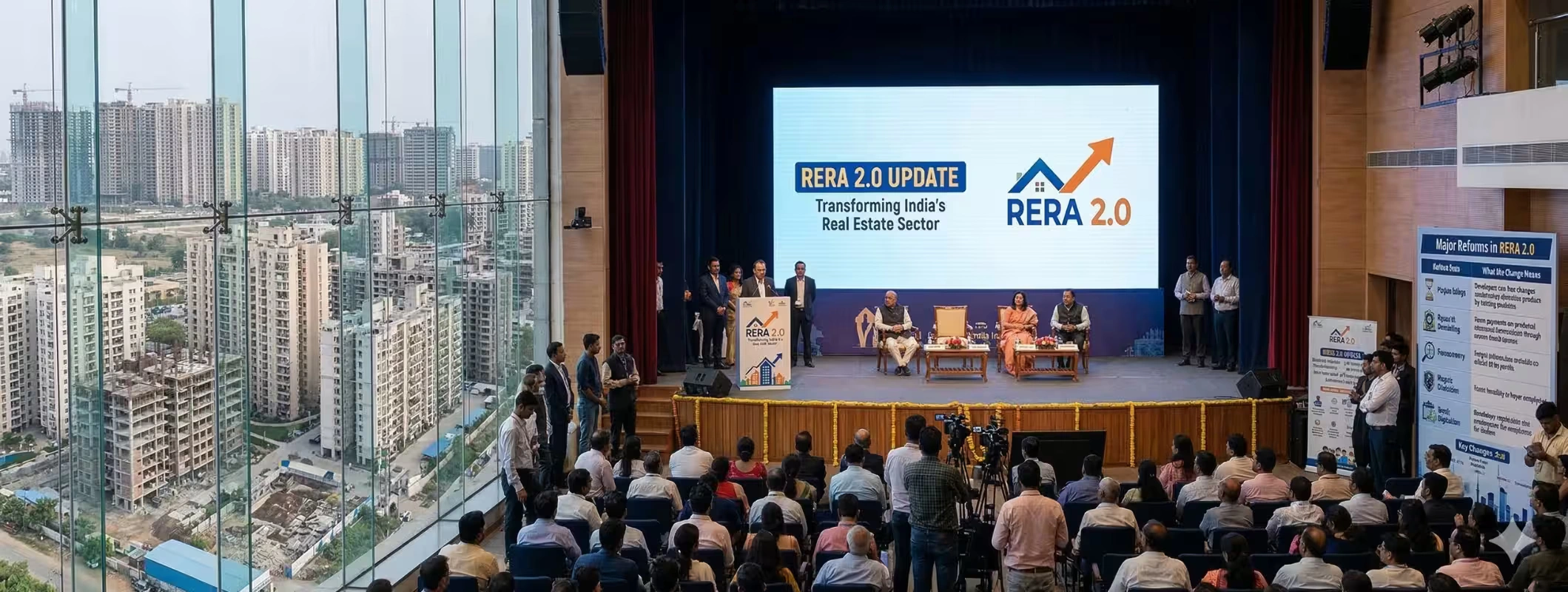
India’s real estate sector is moving into a stricter, more transparent, and more digital phase of regulation. What many in the market are calling “RERA 2.0” is not just about another round of paperwork. It reflects a bigger shift toward stronger enforcement, cleaner project data, better buyer visibility, faster complaint handling, and tighter oversight on delayed or stalled projects. The official reform push became clearer in September 2025, when the Ministry of Housing and Urban Affairs launched the Unified RERA Portal and called for next-generation reforms, stronger order enforcement, greater uniformity across states, and measures to curb misleading advertisements.
Key Takeaways
- India’s RERA framework is becoming more digital, data-driven, and enforcement-focused, not just registration-focused.
- The central government has pushed for a Unified RERA Portal, better nationwide project data, stronger compliance of RERA orders, and more uniform rules across states.
- Existing buyer protections such as project registration, 70% fund escrow discipline, quarterly updates, delay compensation, and 60-day complaint disposal target remain the backbone of the law.
- State regulators are already moving toward more digital compliance through tools like hybrid hearings, project lifecycle modules, and stricter ad-display norms.
- For buyers, this means one thing: verification matters more than ever. Listings, promises, delivery timelines, approvals, and complaint history should all be checked before making a payment.
What is RERA 2.0, Really?
In practical terms, RERA 2.0 means the next stage of RERA implementation in India. The original law already created strong protections: projects must register before sale, 70% of buyer funds must stay ring-fenced for that project, promoters must disclose project information online, developers cannot freely alter sanctioned plans, and buyers have rights to refund, interest, compensation, and disclosures. What is changing now is the push to make these rights work more consistently and more visibly on the ground.
That distinction matters. Earlier, many buyers knew RERA as a legal shield. Now the system is being pushed to act more like a live monitoring framework for project progress, compliance, dispute resolution, and public transparency. The September 2025 Central Advisory Council discussion made that direction explicit by calling for a nationwide project database, stronger enforcement of orders, faster registration, clearer definitions, and reform measures to strengthen RERA further.
Why This Update Matters for India’s Real Estate Sector
The sector has already seen major institutional progress. As of 1 September 2025, all states and UTs except Nagaland had notified rules and established authorities; more than 1.51 lakh projects, 1.06 lakh agents, and over 1.47 lakh disposed complaints were recorded across India. That tells you two things: RERA is no longer a side regulation, and scale now demands better data systems and stronger enforcement.
This is exactly why the latest reform direction matters. Once project registrations, quarterly updates, complaints, and state portals grow at that scale, buyers need cleaner and more standardised information. Regulators need better tracking. Developers need clearer compliance pathways. And the market needs fewer grey zones around advertisements, delayed possession, and project-level accountability.
The Biggest Changes Driving the RERA 2.0 Conversation
1. Unified RERA Portal and stronger public visibility
One of the most important developments is the launch of the Unified RERA Portal by MoHUA in September 2025. The stated goal is to build a common platform, create a nationwide database of projects, help buyers make informed decisions, and even use data analysis and AI tools to anticipate delays and reduce stalled projects. That is a big shift from isolated state-by-state checking toward broader transparency.
For property buyers, this means the future of due diligence is becoming more digital. Instead of depending only on brochures, broker claims, or verbal assurances, the market is moving toward structured project data, ongoing disclosures, and easier cross-checking.
2. Stronger enforcement, not just better registration
The central reform discussion did not stop at transparency. It specifically highlighted the need for effective implementation of RERA orders, faster compliance, and rules that stay aligned with the parent Act. That matters because a law protects buyers only when orders are actually enforced. The official RERA FAQ also makes clear that unpaid interest, penalty, or compensation can be recovered like arrears of land revenue, which underlines the enforcement side of the framework.
This is where the sector is changing. The conversation is shifting from “Is the project RERA-registered?” to “Is the promoter complying, updating, and delivering under RERA?” That is a much healthier question for the market.
3. Tighter scrutiny on misleading advertisements
Misleading ads have long been one of the biggest pain points in Indian real estate. The central advisory discussion in September 2025 specifically called for measures to curb them. That is in line with existing RERA obligations: promoters are responsible for the truthfulness of advertisements and prospectuses, and registered projects must carry a RERA registration number in ads.
State regulators are also tightening execution. In Maharashtra, the regulator’s order list shows specific norms around QR code and font size of the MahaRERA registration number in advertisements, along with digital lifecycle management and complaint SOP measures. That signals the direction clearly: compliance is becoming easier to verify and harder to mask.
4. More real-time project disclosures and lifecycle monitoring
RERA already requires promoters to update project information on the authority website and provide quarterly disclosures so buyers can make informed decisions. The new policy direction is clearly pushing this toward more systematic monitoring instead of static compliance.
Again, Maharashtra offers a useful signal. Its official order list includes guidelines for a Project Lifecycle Management Module, showing how regulators are moving toward more technology-led tracking rather than only file-based oversight.
5. A more serious framework for stalled housing projects
This is one of the most important parts of the new reform wave. The Central Advisory Council discussed legacy stalled projects and referred to the Amitabh Kant committee recommendations, noting that Uttar Pradesh had already implemented them and other states should take them forward where projects are stalled.
The official expert committee report goes deeper. It recommends a model package for financially distressed incomplete projects, including a three-year completion timeline, quarterly targets under RERA supervision, limited financial relief measures, and no additional cost to homebuyers in projects using the rehabilitation package. If a developer does not complete the project satisfactorily, the report proposes a RERA-led administrator framework, transparent contractor selection, homebuyer participation in decision-making, and a time-bound resolution process targeted within six months from administrator appointment to bid award.
That is a major shift. It shows RERA is evolving from a disclosure regulator into a more active recovery and completion framework for legacy distress.
What Stays the Same Under RERA
Even with these new updates, the core protections remain critical and unchanged. Projects above the threshold must register before launch. Promoters cannot take more than 10% advance without an Agreement for Sale. Seventy percent of collected buyer money must be maintained separately and withdrawn only in proportion to project completion with engineer, architect, and CA certification. Buyers can seek refund with interest and compensation in case of delay, or stay in the project and claim monthly interest till possession. Authorities are expected to dispose of matters within sixty days, while promoters must provide quarterly updates and remain liable for structural defects for five years from possession.
That is why the real story is not that RERA is being replaced. The real story is that its original promises are being pushed toward deeper execution.
What This Means for Homebuyers
For buyers, the RERA 2.0 phase should improve trust, but it does not remove the need for caution. You still need to verify the registration number, possession timeline, approved plans, quarterly progress, carpet area, and promoter history before paying even a token amount. The law gives strong rights, but good buying decisions still depend on proper verification.
This is where property discovery platforms can be useful, but only when used correctly. A platform like 2Bigha can help buyers discover opportunities, compare locations, and shortlist options faster, especially in a market where decisions often begin online. But the smart move is to use that shortlist as the starting point, then validate every serious option through the relevant state RERA portal, project disclosures, and legal paperwork before moving ahead. That approach keeps the process practical without turning it into blind trust.
Buyer Checklist for the New RERA Era
Before you book any property, check these:
- Is the project registered on the relevant state RERA portal?
- Does the ad or listing clearly show the RERA registration number?
- Are sanctioned plans, carpet area, and completion timeline visible?
- Are quarterly updates being filed regularly?
- Has the promoter faced repeated complaints or delays?
- Are you being asked for more than 10% before signing an Agreement for Sale?
- Are promises in marketing material matched by RERA disclosures?
- If the project is delayed, do you know your refund and interest rights?
Final Word
The biggest change in India’s real estate sector is not just a new buzzword like “RERA 2.0.” The bigger change is that regulation is becoming more visible, more measurable, and more difficult to bypass. The Unified RERA Portal, stronger enforcement push, stricter ad scrutiny, state-level digital compliance tools, and more serious stalled-project resolution frameworks all point in one direction: a market where transparency is no longer optional.
For buyers, this is good news. For serious developers, it is also good news. And for the sector as a whole, it could be the shift that separates genuine real estate growth from the old model of hidden risk and vague promises.
FAQs - RERA 2.0 Update
1. What is RERA 2.0 in India?
RERA 2.0 refers to the next phase of RERA implementation focused on stronger enforcement, a unified digital portal, better project monitoring, cleaner public data, stricter ad compliance, and more practical solutions for stalled projects.
2. Has India passed a completely new RERA law?
The current official push is toward next-generation reforms within the RERA framework, including uniformity, enforcement, and digital integration through the Unified RERA Portal.
3. What are the main benefits of RERA for homebuyers?
RERA gives buyers access to project information, protects funds through ring-fenced accounts, limits advance collection before sale agreement, provides delay-related refund and interest rights, requires quarterly updates, and aims for time-bound dispute resolution.
4. Can buyers get compensation for delayed possession?
Yes. Under Section 18, buyers can either withdraw and claim refund with interest and compensation, or continue with the project and receive interest for every month of delay until possession.
5. Why is the Unified RERA Portal important?
It is meant to create a common platform, build a nationwide project database, help buyers make informed decisions, and support data-led identification of delays and stalled projects.