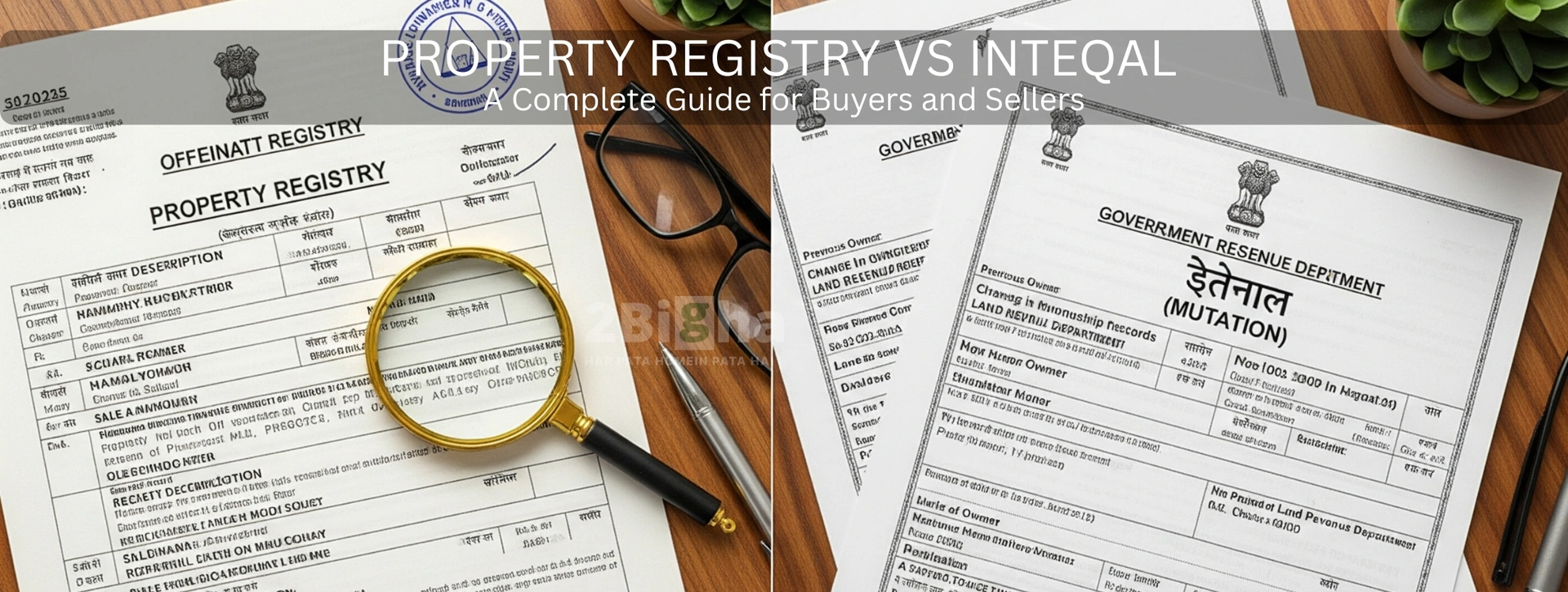
In the growing real estate landscape of India, every buyer and seller needs to understand property ownership and, more importantly, legal documentation. Among those terminologies that mostly lead to confusion are Property Registry and Inteqal, commonly known as Mutation. While both processes are very essential in establishing ownership, they mean different things in the land record system. This guide explains to you the difference between the two and why they matter before you invest or sell property in India.
What is Property Registry?
A property registry is the official process of registering a property in the buyer’s name with the Sub-Registrar of Assurances. It’s the first and most critical step in transferring property ownership legally.
When you buy land, flats, commercial properties, or anything, you must register the sale deed to make the transaction legally valid. The registration fee and stamp duty depend on the property’s market value or circle rate, whichever is higher.
Key Points About Property Registry
- It provides legal proof of ownership.
- Registration must be completed within four months of the sale deed execution.
- Without registration, the buyer cannot claim ownership rights in court.
- It includes payment of stamp duty and registration fees, which vary from state to state.
What is Inteqal (Mutation)?
After the property is registered, the next step is Inteqal, also known as Mutation.
Mutation is the process of updating land or property records in government revenue departments to reflect the new owner’s name.
Simply put, the registry proves ownership, while the mutation helps the government recognize the buyer as the official taxpayer for that property.
Key Points About Inteqal
- It transfers the property record to the revenue and municipal departments.
- It ensures property tax and revenue records are updated with the new owner’s name.
- It is done at local Tehsil offices or online via portals like e-Mitra Rajasthan.
- Mutation is not proof of ownership but is necessary for property management and taxation.
Property Registry vs Inteqal: Key Differences
| Feature | Property Registry | Inteqal (Mutation) |
|---|---|---|
| Purpose | Legal transfer of ownership | Updating land/revenue records |
| Authority | Sub-Registrar Office | Local Municipal or Revenue Office |
| Proof of Ownership | Yes | No |
| Mandatory | Yes | Recommended |
| When Done | At the time of purchase | After registration |
| Documents Required | Sale Deed, ID proof, PAN card | Registered Sale Deed, Application Form, ID proof |
| Outcome | Buyer becomes legal owner | Buyer becomes a recorded taxpayer |
Both are interconnected; registration gives you ownership, and mutation validates it in public records.
Why Do Both Processes Matter?
Many property disputes in India arise due to incomplete documentation. Skipping Inteqal after Registry may lead to confusion in ownership records, especially during resale or inheritance. Ensuring both steps are properly completed protects your legal rights and secures your investment.
Before any real estate purchase, especially land, it’s wise to check registry and mutation records online.
States like Rajasthan, Haryana, and Uttar Pradesh now offer online verification portals that simplify the process for buyers and investors.
Tips Before Completing Property Registry or Inteqal
- Verify land title and ensure no disputes are recorded.
- Check encumbrance certificates for pending loans or liabilities.
- Match Khasra/Khata details in both registry and mutation records.
- Use e-Mitra or online record portals for quick verification.
- Keep all receipts and documents for future reference.
A small documentation error can delay ownership transfer or cause legal issues later, so attention to detail is key.
Final Thoughts
Understanding the difference between Property Registry and Inteqal is important in order to have safe and transparent property transactions.
While both are complementary in this context, registration gives you ownership rights, and mutation provides your name on government records.
Whether you are buying, selling, or investing in land, doing your due diligence today ensures that your property will be secure tomorrow.
FAQs About Property Registry and Inteqal
1. What is the difference between Registry and Inteqal?
The registry legally transfers ownership from the seller to the buyer, while Inteqal (mutation) updates the government land records to show the new owner for taxation purposes.
2. Is Inteqal mandatory after property registration?
While not legally mandatory everywhere, mutation is strongly recommended. It ensures your name is recorded in revenue and municipal records, preventing future disputes.
3. How long does the Inteqal process take?
Usually, it takes 15–30 working days, depending on the state and completeness of documents.
4. Can a property be sold without mutation (Inteqal)?
Yes, you can sell property even if the mutation is not done. However, it’s not advisable. Without mutation, the buyer may face issues during resale or while paying property tax. Completing Inteqal ensures the government recognizes the new owner in official land records.
5. Can Inteqal be done for inherited property?
Yes, Inteqal is mandatory for inherited property as well. In such cases, you’ll need to submit the death certificate of the owner, legal heir certificate, and an application for mutation of inheritance. This ensures land records reflect the rightful heirs.