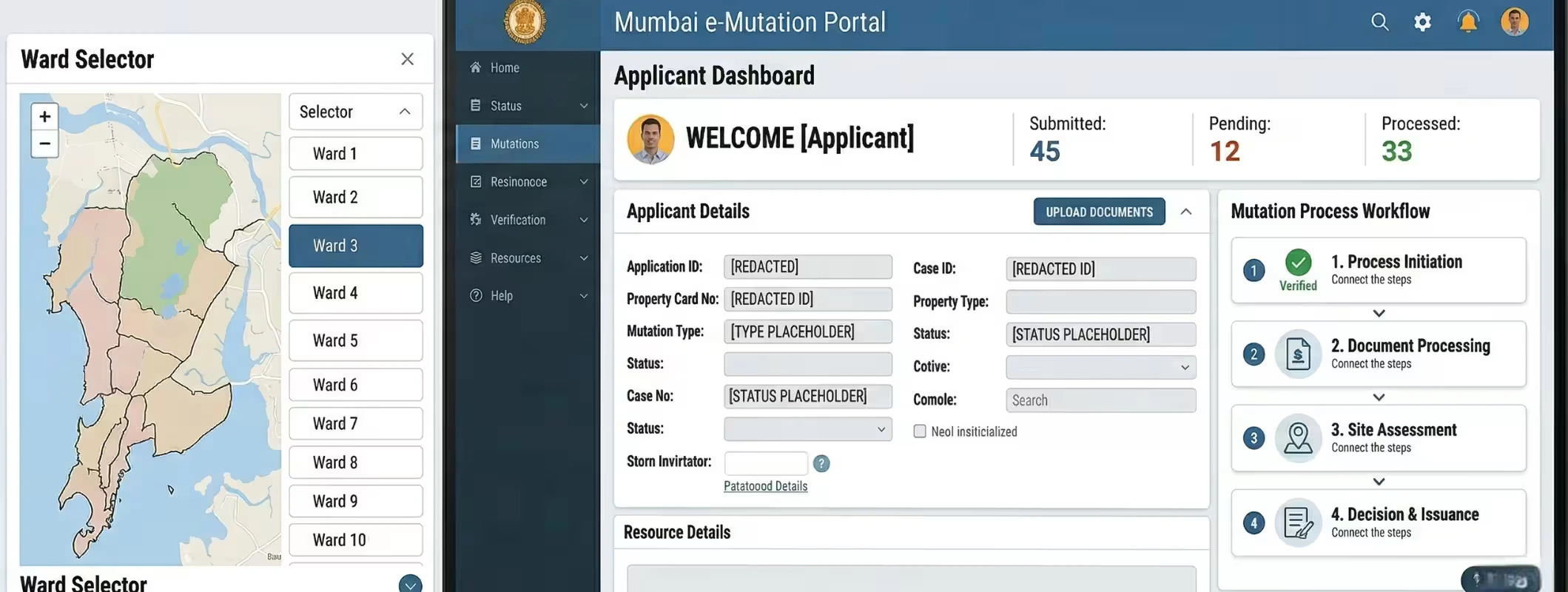
Property mutation in Mumbai has entered a new phase. In March 2026, Mumbai City district rolled out a new eMutation-PropertyCard platform under the Maharashtra Revenue Department, and recent reporting says the service is designed for both residents and NRIs, with online applications for 45 categories of property-record changes. That is a big shift, because mutation in Mumbai has traditionally been treated as a paperwork-heavy post-registration step.
But let’s be clear from the start: property mutation is not the same as registration, and it is not the same as a society transfer either. In Mumbai, people often mix up the registered deed, the property card update, and the MCGM property-tax name change. That confusion is exactly where delays, rejected applications, and future disputes begin.
Key Takeaways
- Mumbai City district now has a dedicated online property card mutation portal called eMutation-PropertyCard [Mumbai City], linked from the official Mumbai City district administration website.
- Recent reporting says the new system supports 45 types of property changes and is meant to work for property owners, including NRIs, with online tracking and reduced in-person dependency.
- Mutation does not by itself create a title. The Supreme Court has reiterated that mutation entries are for fiscal/revenue purposes and do not confer ownership rights on their own.
- In Mumbai, MCGM property-tax record updates are a related but separate layer. MCGM’s own circular says many registered-transfer cases are automated, and other cases can move through the citizen portal.
- For NRIs, one more point matters: residential and commercial property acquisition in India generally does not require RBI permission, but the rules are different for agricultural land, farmhouse, and plantation property.
What Property Mutation actually means in Mumbai
Mutation means updating the government’s revenue or municipal records after a legal change in property ownership or occupancy rights. That change may happen because of a sale deed, inheritance, gift deed, release deed, will, lease, mortgage, court order, or other recognised trigger. The purpose is administrative and fiscal: the right person should appear in the records for notices, assessment, and future reference. It is important, but it is not a substitute for the underlying legal transfer document.
The Supreme Court’s position is blunt and useful: a mutation entry is summary in nature and exists for fiscal purposes; it does not itself confer right, title, or interest. So if a buyer or heir says, “My name is mutated, therefore I am owner,” that is not legally complete thinking. The registered conveyance, inheritance basis, probate, or other valid legal instrument still matters.
Mumbai’s new Online Mutation system changes the process
The official Mumbai City district administration website now carries a dedicated section titled “New digital platform for property card mutation application in Mumbai city” and links directly to the eMutation-PropertyCard [Mumbai City] portal. The portal itself shows login, new registration, and application-related options, which confirms that Mumbai City has moved this process into a digital workflow.
Recent reports add the operational detail: the platform is being positioned as a zero-physical-interface system for Mumbai City district, covering 45 categories of property changes, with support for NRIs and real-time status visibility. That matters because NRIs and outstation owners have historically struggled with follow-up visits, local coordination, and document submission. The rollout is being described as specific to Mumbai City district for now, not the entire state or all of Mumbai metropolitan records in one shot.
Do not confuse these three things
The cleanest way to understand Mumbai property paperwork is this:
| Process | What it does | Main System Involved |
| Registration of deed | Legally records the transaction document | Department of Registration & Stamps |
| Property card mutation | Updates revenue/property-card records after the legal change | Mumbai City eMutation-PropertyCard / Revenue Department |
| Property-tax name change | Updates municipal billing / assessment-side owner records | MCGM Property Tax Citizen Portal |
This distinction is drawn from Maharashtra’s Registration & Stamps system, the Mumbai City mutation portal, and the MCGM property-tax citizen portal.
MCGM’s own circular is especially useful here. It says that for certain registered transfer cases, the transferee does not need to separately apply to the Assessment & Collection department for change of name in property-tax records, because the update is automated in real time. For other cases handled through the portal, the circular says the timeline was reduced to three days, and it also states that there is no requirement of a property card just to change the property-tax record name in those cases.
Who usually needs Mutation in Mumbai
The older official Mumbai City mutation form is still useful because it clearly shows the common triggers for mutation. It lists cases such as inheritance/legal heir claims, purchase, gift deed, release deed, will, mortgage deed, lease deed, court orders, government orders, society/bank directions, and other reasons. That means mutation is not only for sale-purchase transactions. It is equally relevant when a property changes hands within a family or through succession.
That is exactly why residents and NRIs should treat mutation as a post-transaction record hygiene step, not as an optional clerical task. If the deed is registered but the records stay stale, future resale, municipal compliance, tax notices, and even basic verification can become unnecessarily messy. That practical conclusion follows directly from the way Mumbai’s registration, revenue, and municipal record systems are structured.
Documents you should keep ready
Mumbai’s published mutation form shows that the required documents depend on why the mutation is being sought. For example, the form indicates that purchase cases rely on the registered sale document; gift and release cases rely on the corresponding registered deed; inheritance cases need a death certificate, self-declaration, and details of legal heirs; and will-based cases may require a probate order where the will is not registered. It also lists residence-proof options such as passport, driving licence, PAN, municipal assessment extract, telephone bill, and electricity bill.
So before starting an online property mutation in Mumbai, keep your file clean: registered deed or succession basis, ID proof, address proof, and trigger-specific papers. Inheritance and NRI-led cases usually fail not because the portal is difficult, but because the document stack is incomplete or inconsistent. That is an inference from the official document categories and the way the form is structured.
What NRIs must know before starting Mutation
The first NRI-specific point is positive: the newly reported Mumbai City system is explicitly said to support NRI applicants, which is a major practical improvement for owners handling Mumbai property from abroad.
The second point is legal. Official RBI and MEA guidance says NRIs/OCIs do not need RBI permission to acquire residential or commercial property in India, and there is no numerical cap mentioned there for such acquisitions. But the same official guidance also makes it clear that agricultural land, farmhouse, and plantation property are treated differently. So an NRI handling mutation for a Mumbai flat and an NRI looking at non-urban land are not operating under the same acquisition framework.
The third point is procedural. RBI’s FAQ says payment for immovable property in India must come through banking channels in India and may be made from NRE, FCNR(B), or NRO accounts where permitted. That matters because mutation is a record-update step, but the file behind it still needs a legally clean transaction trail. If the underlying acquisition paperwork is weak, mutation becomes harder, not easier.
A practical Online Mutation workflow for Mumbai Owners
A sensible workflow now looks like this. First, confirm whether your property falls within the Mumbai City district workflow now visible on the official district website. Second, identify the correct mutation trigger: sale, inheritance, gift, release, will, court order, or something else. Third, gather the document set that matches that trigger. Fourth, create access on the eMutation-PropertyCard [Mumbai City] portal and file the application digitally. Fifth, separately verify whether your MCGM property-tax record also reflects the correct ownership/billing name.
That last step is where many owners slip. They assume that once the sale deed is registered, every downstream record magically updates in perfect sync. Sometimes that happens on the municipal tax side through automation; sometimes you still need to check and follow through. In Mumbai, blind assumptions are expensive paperwork habits.
Common Mistakes Residents and NRIs should avoid
The first mistake is assuming mutation equals ownership proof. It does not. The second is ignoring the difference between property card mutation and MCGM billing-name change. The third is filing under the wrong mutation trigger or uploading incomplete inheritance papers. The fourth is not checking whether the current online route applies to your exact jurisdiction, especially when owners loosely say “Mumbai” but their property record falls into a different district or suburban workflow.
Where 2Bigha Fits in
2Bigha is not the government mutation portal, and it does not replace the official filing process. But it can still be useful before and during a property decision. On its official platform, 2Bigha says users can search land anywhere, discover current land prices, review property insights, and explore locality insights, price trends, verified lands, and digital Khasra maps in many markets.
That matters because property mutation problems usually start earlier, at the buying or inheritance stage, when people do not verify enough. A platform like 2Bigha can help buyers and investors compare locations more intelligently, understand price context, and take a more document-first view before a deal closes. Then, once the transaction happens, the actual mutation must still be completed through the official government system. That is the honest division of roles.
Final Word
Online property mutation in Mumbai is getting easier, especially for residents and NRIs dealing with Mumbai City records. But easier does not mean casual. The smart sequence is simple: get the legal transfer right, update the property card, verify the municipal tax record, and preserve a clean document trail. That is how you avoid future friction in resale, succession, tax notices, and ownership verification.
If your goal is not just paperwork completion but better real estate decision-making overall, 2Bigha can help at the discovery and due-diligence stage. For the mutation itself, though, stay with the official Mumbai and Maharashtra systems. That is the part you should not outsource to assumptions.
Frequently Asked Questions (FAQ)
1. Is online property mutation available in Mumbai now?
Yes, Mumbai City district now shows an official eMutation-PropertyCard platform on the district administration website, and recent reporting says the system is live for digital applications, including for NRIs.
2. Is mutation the same as registration of a sale deed?
No. Registration records the transaction document through the Registration & Stamps framework. Mutation updates revenue or municipal records after that legal change. They are linked, but they are not the same step.
3. Does mutation prove legal ownership?
No. The Supreme Court has reiterated that mutation entries are for fiscal purposes and do not by themselves confer title, right, or interest.
4. Do NRIs need RBI permission to buy a flat in Mumbai?
Official RBI and MEA guidance says NRIs/OCIs do not need RBI permission to acquire residential or commercial property in India, but the rules are different for agricultural land, plantation property, and farmhouse assets.
5. Is MCGM property-tax name change separate from mutation?
Yes, it is a related but separate record layer. MCGM’s property-tax portal has its own citizen services, and MCGM’s circular says some registered-transfer cases are automated while others move through the portal.
6. How can 2Bigha help if mutation itself happens on a government portal?
2Bigha can help with the earlier stages: comparing locations, free property listing, understanding price trends, checking property insights, and reviewing verified-land and map-based context. The official mutation filing, however, still needs to happen through the government system.