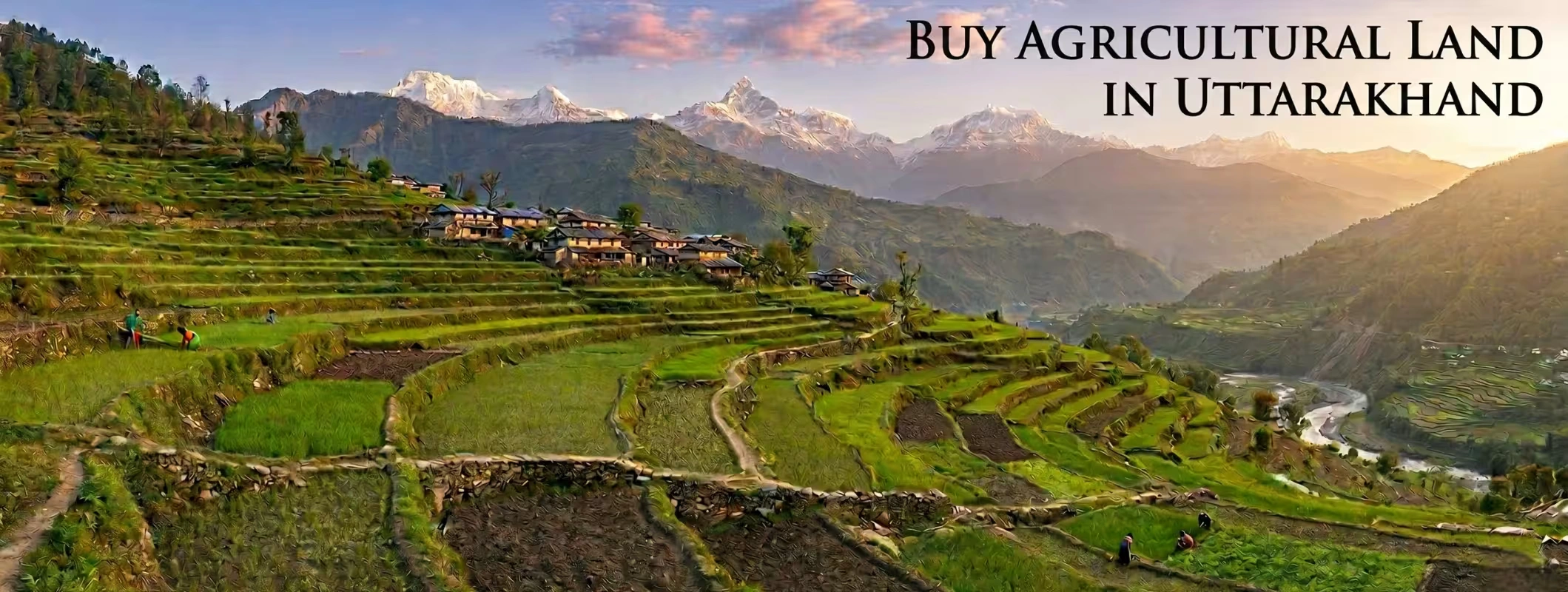
Uttarakhand is still one of the most searched states for hill land, orchard plots, farm parcels, and long-term land investment. But anyone planning to buy agricultural land in Uttarakhand today needs to understand one hard truth first: this is no longer a simple “find a plot and register it” market. The 2025 amendment to the state’s land law tightened non-resident purchases, restricted agricultural and horticultural land buying in most districts, kept residential purchases under tighter affidavit-based control, and pushed buyers to take title, land use, and permission issues far more seriously than before.
If your goal is to buy farmland in Uttarakhand legally, this guide will help you understand who can buy, where restrictions apply, what records to verify, how the registry process works, what fees to expect, and why platforms like 2Bigha should be used for discovery and comparison, not blind commitment.
Key Takeaways
- The 2025 amendment bars non-residents from buying agricultural and horticultural land in 11 of Uttarakhand’s 13 districts; public reporting after the law’s passage says the practical exceptions are Haridwar and Udham Singh Nagar, and even there agricultural/horticultural purchase requires state government sanction and a use affidavit.
- The amendment text itself says it applies across Uttarakhand except areas inside municipal corporations, nagar panchayats, municipal councils, and cantonment boards, which means buyers must first understand whether the parcel falls in rural/revenue land or urban local-body limits.
- Residential land purchases up to 250 square metres continue, but the buyer must furnish an affidavit that neither the buyer nor family has already purchased more than that limit elsewhere in the state for residential use; false declarations can void the transfer and trigger government takeover consequences.
- Uttarakhand’s official systems already give buyers practical tools for verification: e-Search, e-Valuation, GIS rate list, e-Stamp, Bhulekh/Public ROR, and property-wise search including Khasra, Khatauni, party name, cadastral map, and even prohibited/banned khasra/property checks.
- If you want to build, plot, commercialise, or shift land away from agriculture, do not assume that registration is enough. Uttarakhand has official workflows for land-use change under Section 143 and other land purchase permission routes under Section 154, which means use, permission, and title must be checked together.
- NRIs and OCIs cannot treat Uttarakhand as a loophole. RBI guidance does not generally permit purchase of agricultural land, plantation property, or farm house by NRI/OCI buyers under the normal route.
Why Buyers Still Look at Agricultural Land in Uttarakhand
Demand has not disappeared. Real-estate platforms still show active agricultural land listings across Uttarakhand, including Dehradun, Haridwar, Udham Singh Nagar, Mussoorie-side belts, and hill locations, with a huge spread in parcel size and asking price. That is exactly why buyer interest remains strong: some people want genuine farming land, some want orchard or hospitality-linked holding, some want long-term appreciation, and many simply want “hill land” without understanding the legal category they are entering.
But listing activity is not the same as legal eligibility. A portal can show you agricultural land for sale in Uttarakhand India, but it cannot by itself tell you whether you are allowed to buy that exact parcel, whether the land falls in a restricted area, whether the title is clean, whether non-agricultural use is possible later, or whether a recent legal change has made your original investment plan useless. That is where most buyers go wrong.
The Big Legal Reality: Uttarakhand Changed the Rules in 2025
Anyone writing about Uttarakhand land today without mentioning the 2025 amendment is not giving you a serious answer. The state government publicly describes the law as a strict land law that prohibits non-residents from purchasing agricultural and horticultural land in 11 hill districts. The Indian Express explanation on the amendment adds two critical buyer-level points: it applies to land purchases outside municipal limits, and the exclusion in practice leaves Haridwar and Udham Singh Nagar outside the 11-district ban framework.
The official gazette text adds another layer that many blogs skip: the amendment extends across the whole state except areas included in municipal corporations, nagar panchayats, municipal councils, and cantonment boards. That means you cannot discuss Uttarakhand agricultural land rules as if all land in the state is treated the same way. Revenue land, rural land, peri-urban land, and urban local-body land are not one bucket.
Who Can Buy Agricultural Land in Uttarakhand?
1. Uttarakhand Residents
The 2025 amendment is primarily aimed at restricting non-resident purchases, not ordinary in-state buyers. That does not mean residents get a free pass. They still have to satisfy title, revenue record, land-use, permission, and registration requirements. In simple terms, being from Uttarakhand helps on the eligibility side, but it does not clean up a bad title, an illegal subdivision, a prohibited khasra, or an unusable parcel.
2. Buyers from outside Uttarakhand
This is where the law tightened sharply. Public reporting on the passed amendment says non-residents cannot buy agricultural or horticultural land in 11 of the state’s 13 districts. The remaining two districts referenced in post-enactment reporting are Haridwar and Udham Singh Nagar, but even there the Indian Express notes that purchase for agricultural or horticultural purposes requires state government sanction and an affidavit stating the land will be used only for those purposes. So the plain-language answer to “buy land in Uttarakhand without a domicile” is not a simple yes or no. For agricultural land, the law is restrictive, and for outsiders it is far stricter than many old blogs still suggest.
3. Buyers seeking only Residential use
The law preserved a limited route for residential purchase up to 250 sq m, but it is not casual. News on Air reported that residential purchases up to 250 square meters now require an affidavit, and the amendment text shown in the gazette makes clear that the buyer must state that neither the buyer nor family has purchased more than 250 sq m elsewhere in Uttarakhand for residential use during their lifetime; false declarations can void the transfer. That is a major compliance point for second-home buyers and repeat investors.
4. NRI / OCI Buyers
This point is national, not state-specific, and many buyers miss it. RBI guidance says NRIs/PIOs/OCIs may buy immovable property in India other than agricultural land, farm house, or plantation property under the normal route. So if you are abroad and researching farmland purchase Uttarakhand India, do not assume the state law is the only barrier. FEMA/RBI restrictions matter first.
Uttarakhand Agricultural Land Rules Buyers Should Understand Before Paying Token Money
The first rule is simple: land category matters more than marketing language. A broker may call a parcel farm land, future resort land, investment land, orchard land, or farmhouse plot. None of that changes the entry in revenue records or the legal position under the amended law. If the parcel is recorded as agricultural land and you are an outsider, your purchase path may be blocked or tightly controlled.
The second rule: registration does not replace permission. Uttarakhand’s official systems separately reflect land-use change under Section 143, land purchase permission under Section 154, and mutation workflows. That alone tells you the state treats title transfer, land use, and record updating as separate compliance layers. If your plan is not pure agriculture, your due diligence has to go beyond the sale deed.
The third rule: use the land for the purpose you declare. The Indian Express reporting on the amendment says buyers from outside the state who purchase land for commercial, industrial, cultural, medical and similar specified purposes must use it for that purpose within three years, or the transfer becomes void and the state gets ownership. Buyers who treat purpose declarations as paper formalities are taking a real legal risk.
The fourth rule: land conversion is not automatic. Uttarakhand has official digital entry points for land-use change, and the Town and Country Planning Department explicitly states that it regulates land-use changes, including conversion from agricultural to residential or commercial use. So anyone buying farm land with a hidden plotting or construction plan should stop and verify first.
A fresh warning also came from the courts. In March 2026, the Uttarakhand High Court directed the Haridwar-Roorkee Development Authority to withdraw permissions for plotting and group housing on agricultural and orchard land in that matter before it. That is not a blanket statewide ban on every future case, but it is a strong reminder that buying agricultural land with a speculative plotting mindset can blow up later.
How to Check Land Legally Before You Buy
The state has already given buyers enough digital tools to avoid many basic mistakes. The Stamps and Registration Department portal offers e-Search, e-Valuation, Public Data Entry, GIS rate list, and e-Stamp services. This means you do not need to rely only on a broker’s photocopies or verbal claims.
The e-Search system is especially useful because it allows search by village, property number, khasra number, khatoni number, khewat number, house/flat number, buyer name, seller name, registration number, and registration date. It also shows utilities like property-wise transactions, prohibited/banned khasra/property, and cadastral map. For a farmland buyer, that is not a fancy feature. It is basic risk control.
For revenue-side checks, Uttarakhand’s official Bhulekh/Public ROR portal lets users search land records through district, tehsil, village, khasra/gata, khata number, account-holder name, buyer, seller, mutation date, and registry-linked entries. The portal states that content is owned by the Board of Revenue. If the seller’s story and the Bhulekh trail do not match, stop the deal.
After registration, mutation still matters. Invest Uttarakhand’s service listing separately shows Mutation of land as an online service, which is a useful reminder that the record trail should be updated after the sale deed instead of being ignored. A registered deed without proper mutation follow-up can still create future trouble.
Step-by-Step: How to Buy Agricultural Land in Uttarakhand Legally
Step 1: Identify your buyer category first
Before location, before price, before negotiation, ask the only question that matters first: are you an in-state resident buyer, an outside-state buyer, or an NRI/OCI? That one answer changes your eligibility.
Step 2: Identify the district and exact land type
Do not ask only “where to invest in land in Uttarakhand.” Ask whether the land is in one of the districts where outsider agricultural purchase is effectively blocked, whether it falls outside municipal limits, and whether the parcel is genuinely agricultural in records.
Step 3: Pull title and transaction history
Use e-Search and Bhulekh to verify seller name, khasra, khatauni, prior transaction trail, and whether any prohibited or flagged property issue appears.
Step 4: Check intended use before agreement
If you want a farmhouse, plotting, resort, warehouse, school, or commercial outcome, verify whether you need Section 143 land-use change or Section 154 permission first. Registration alone will not cure land-use violations.
Step 5: Calculate charges through the state system
The state’s registration portal offers e-Valuation and GIS rate-list tools. Use them instead of guessing. Buyer-facing secondary guidance currently cites stamp duty around 5% for male buyers, 3.75% for female buyers, 4.37% for male-female joint buyers, with registration charges around 2% subject to a ₹25,000 cap, but you should still confirm the live payable figure through the official system before execution.
Step 6: Check whether any concession applies
The Uttarakhand Stamps and Registration Department’s notification archive includes a 25% discount in stamp duty, twice in a lifetime, on transfer of immovable property worth up to ₹25 lakh to a female buyer. That concession may matter for small-ticket deals, though exact applicability should be confirmed for your deed type and current value band.
Step 7: Register properly and update records
Complete the deed through the official registration workflow, then follow through on mutation and revenue record updating. A sloppy post-registration trail creates unnecessary disputes later.
Best Place to Buy Land in Uttarakhand: The Honest Answer
There is no single “best place to buy land in Uttarakhand.” There is only the best legally workable parcel for your buyer category and purpose.
If you are a genuine Uttarakhand resident buying for agriculture, orchard use, or long-term family holding, hill districts may still make sense, but slope, water, road access, fragmentation, title continuity, and land-use restrictions matter far more than postcard beauty. Listings on Magic Bricks and 99acres show the market is active in both plains and hill regions, but those portals do not certify legal suitability.
If you are an outsider looking for agricultural land investment in Uttarakhand, the law pushes you toward a much narrower and more careful path. As of the 2025 framework described above, agricultural and horticultural purchase is barred for outsiders in 11 districts and limited in Haridwar and Udham Singh Nagar only through state-sanction routes. So anyone pitching you easy hill-district farmland as an immediate outsider purchase is either oversimplifying or misleading you.
If your real goal is not farming but future use, you may be looking at the wrong asset class entirely. In that case, approved residential or non-agricultural land can be far more sensible than trying to force an agricultural parcel into a use it was never meant to support.
Also Read: Uttarakhand Land Compensation 2026: 2x in Cities, 4x in Villages Explained
Common Mistakes Buyers Make
One common mistake is assuming that cheap agricultural land in Uttarakhand for sale is a bargain. Cheap land often becomes expensive after road development, boundary issues, slope correction, record cleaning, legal fees, and permission trouble. That is not a portal issue. It is a due-diligence issue.
The second mistake is using “farmhouse” as a harmless word. In legal reality, many farmhouse-style plans mean non-agricultural use, construction, subdivision, or tourism use. That shifts the deal from a simple farmland buy into a permission-heavy transaction.
The third mistake is ignoring affidavit-based restrictions. The new framework made affidavit compliance central for residential purchases and use-based approvals. A false declaration is not a minor paperwork defect here. It can collapse the transfer.
The fourth mistake is trusting only the broker’s chain of documents and not checking Bhulekh, e-Search, banned khasra flags, and property-wise transaction history. Uttarakhand already gives you the tools. Use them.
Where 2Bigha Fits in the Buying Journey
If you are serious about buying or comparing agricultural land, 2Bigha fits best at the discovery and shortlisting stage. It helps you organise options, compare land opportunities, and screen parcels before you spend money on legal verification. That is the right order. First comparison. Then verify. Then negotiate.
For active buyers, investors, or land consultants who keep tracking multiple parcels across locations, a subscription-based workflow on platform like 2Bigha makes even more sense. It keeps your search structured and saves time. But remember the sequence: platform discovery helps you find opportunities; only document verification helps you buy safely.
Final Verdict
Yes, you can still buy agricultural land in Uttarakhand. But the real answer depends on who you are, where the parcel is located, what the land is in revenue records, and what you plan to do with it. That is the only serious answer after the 2025 law.
If you are an in-state resident, your path is broader but still document-heavy. If you are from outside Uttarakhand, the law is far tighter than many brokers and old articles admit. If you are an NRI or OCI, RBI rules create an additional restriction before state-level issues even begin. And if your hidden plan is plotting, tourism, commercial use, or farmhouse development, then land-use permissions matter just as much as title and registry.
So do not buy farmland in Uttarakhand based on scenery, urgency, or “last plot left” pressure. Buy only after matching the parcel to the law, the records, and your actual use case.
FAQs - Buy Agricultural Land in Uttarakhand
1. Can outsiders buy agricultural land in Uttarakhand?
In general, not freely. After the 2025 amendment, non-residents are barred from buying agricultural and horticultural land in 11 of 13 districts. Reporting after enactment says the remaining two districts are Haridwar and Udham Singh Nagar, but agricultural/horticultural purchase there still requires state government sanction and a use affidavit.
2. Can I buy land in Uttarakhand without domicile?
For agricultural land, the real issue is not just the word “domicile” but whether you are treated as a non-resident under the amended law. For outsiders, agricultural purchase is now heavily restricted. Residential purchase up to 250 sq m continues with affidavit conditions.
3. Can an NRI buy farmland in Uttarakhand?
Normally no. RBI guidance does not generally permit NRI/OCI purchase of agricultural land, plantation property, or farm house in India under the normal route.
4. What are the stamp duty and registration charges in Uttarakhand?
Use the official e-Valuation tool for the live payable figure. Current buyer guidance commonly cites about 5% stamp duty for male buyers, 3.75% for female buyers, 4.37% for male-female joint buyers, and registration charges around 2% subject to a ₹25,000 cap.
5. Is there any stamp duty benefit for women buyers?
Yes, the Uttarakhand Stamps and Registration Department notification archive shows a 25% discount in stamp duty, twice in a lifetime, for transfer of immovable property up to ₹25 lakh to a female buyer.
6. How do I verify land records in Uttarakhand?
Use the official Bhulekh/Public ROR portal and the registration department’s e-Search tools. You can check khasra, khatauni, buyer/seller history, cadastral maps, and even prohibited or banned property flags.
7. Is mutation necessary after land registration?
Yes, it should not be ignored. Uttarakhand’s official service listings separately show mutation as an online workflow, which reflects its practical importance after transfer.
8. Can I convert agricultural land to residential or commercial use later?
Not automatically. Uttarakhand has official land-use change workflows under Section 143, and the Town and Country Planning Department states that it regulates land-use conversion from agricultural to residential or commercial use.
9. Is buying agricultural land online in Uttarakhand safe?
Online portals are useful for shortlisting, price comparison, and discovering inventory. They are not substitutes for legal verification, land-use checks, permission review, and record inspection.
10. What is the safest way to start?
Start with buyer-category analysis, district-level eligibility, Bhulekh/e-Search verification, intended-use review, and official fee calculation. Discover first, verify second, commit last.