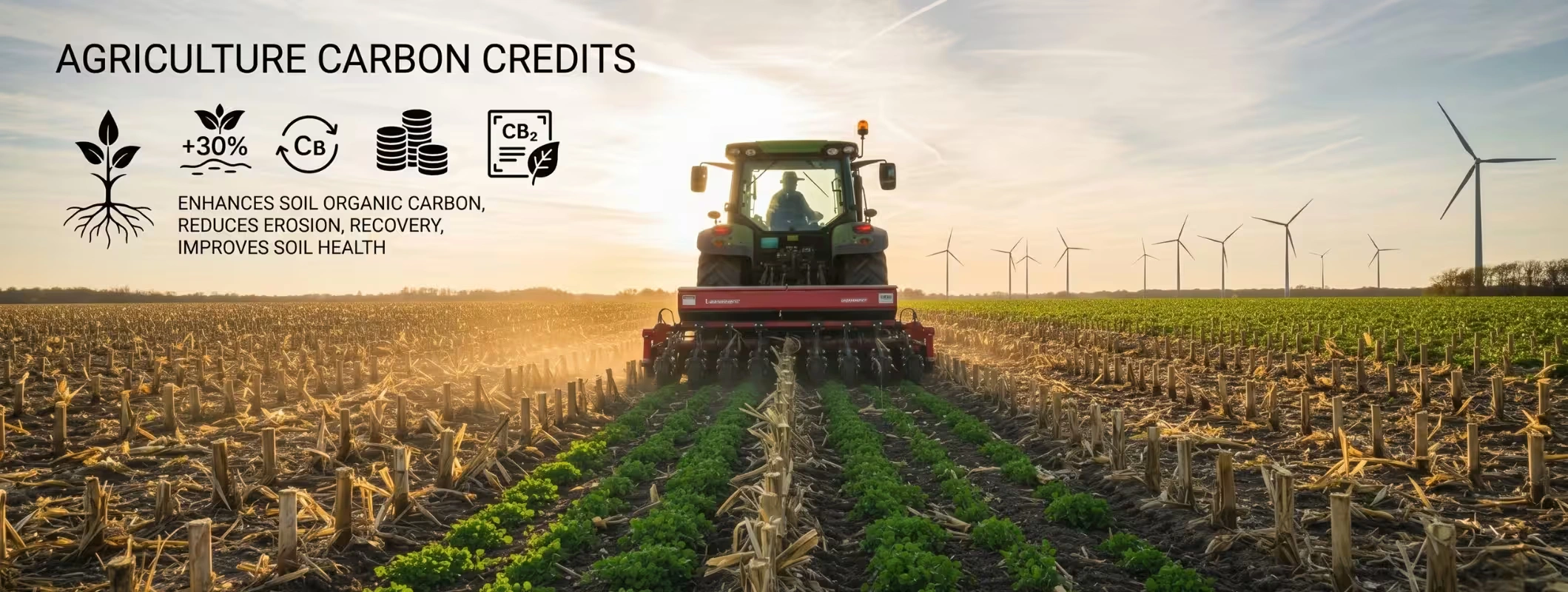
Agriculture is no longer seen only as a sector that produces food, fibre, and rural livelihoods. It is now entering a new phase where farmland can also create environmental value. Across the world, governments, businesses, investors, and climate-focused organisations are looking for practical ways to reduce carbon emissions and remove carbon from the atmosphere. That is where agriculture is gaining serious attention.
For farmers, landowners, agri-investors, and rural real estate stakeholders, this shift opens a new opportunity. Farms can do more than grow crops. With the right practices, they can store carbon in the soil, protect biodiversity, improve water retention, and generate carbon credits. Farmland can start functioning like a climate asset.
This matters because the future of land value is changing. Earlier, farmland was evaluated mostly on yield, water access, location, and legal clarity. Now, sustainability potential is becoming part of the conversation too. Land that supports regenerative farming, agroforestry, soil conservation, and low-emission practices may become more attractive in the long run. That is why agriculture as a carbon credit opportunity is not just an environmental topic. It is also a real estate, investment, and land-use topic.
Key Takeaways
- Farms can create carbon credits by adopting practices that reduce emissions or increase carbon storage in soil and vegetation.
- Carbon credits can turn agricultural land into an income-generating climate asset, beyond traditional crop revenue.
- Regenerative farming, agroforestry, cover cropping, reduced tillage, and better nutrient management are some of the common pathways.
- Not every farm qualifies automatically. Measurement, verification, project design, and long-term commitment matter.
- For landowners and investors, sustainability-ready farmland may hold stronger long-term value and market relevance.
- In India, the idea is still growing, but the potential is large due to the country’s vast agricultural base and rising climate focus.
Why Carbon Credits Matter in Agriculture
Carbon credits are becoming an important part of the global climate economy. A carbon credit generally represents one metric tonne of carbon dioxide, or its equivalent in greenhouse gases, that has been reduced, avoided, or removed from the atmosphere. Companies and organisations buy these credits to offset a part of their emissions or to support climate-positive projects.
Traditionally, people connected carbon credits with forests, renewable energy, or industrial emission reduction projects. But agriculture is now becoming a major area of interest because farmland has a direct relationship with soil carbon, methane emissions, fertiliser use, and land management practices.
This is where the opportunity becomes practical. If a farmer or land manager changes the way land is used and managed, that land can start absorbing more carbon or releasing less carbon. Over time, the improvement can be measured and converted into carbon credits, depending on the project model and standards being followed.
For the real estate and land investment space, this changes the way farmland can be viewed. Agricultural land is not only a productive asset anymore. It can also become a sustainability-linked asset with environmental and financial value.
What Makes a Farm a Climate Asset
A climate asset is any asset that contributes to environmental improvement while also creating long-term value. In agriculture, a farm can become a climate asset when it actively supports carbon sequestration, lower emissions, and better ecological performance.
This can happen in several ways. Soil can store more organic carbon when farmers reduce excessive tillage, use cover crops, rotate crops properly, add organic matter, and improve moisture retention. Trees integrated into farmland through agroforestry can capture carbon above ground and below ground. Better livestock management can reduce methane intensity. Smarter irrigation systems can cut energy use and preserve resources. Efficient nutrient management can lower nitrous oxide emissions caused by overuse of fertilisers.
When these practices are adopted consistently and documented properly, a farm starts delivering more than produce. It starts delivering climate outcomes. That is why the idea of turning farms into climate assets is gaining momentum.
How Carbon Credits Work in Farming
A farm or group of farms adopts climate-friendly agricultural practices. These practices must create measurable environmental benefits compared to the earlier baseline. A project developer, aggregator, or carbon programme then helps assess the land, establish baseline data, track changes, and verify the carbon impact. Once the changes are validated under an accepted framework, the project may generate carbon credits. These credits can then be sold in carbon markets.
1. Baseline Assessment: The project first studies the current condition of the land. This includes soil health, farming methods, crop cycles, land history, emissions profile, and existing carbon levels.
2. Practice Change: The farm adopts approved practices that improve carbon storage or reduce greenhouse gas emissions.
3. Monitoring and Data Collection: The land and farming activity are monitored over time. This step is critical because carbon projects depend on evidence, not assumptions.
4. Verification: A third party or approved body verifies whether the carbon benefits are real, measurable, and additional.
5. Credit Issuance and Sale: Once verified, carbon credits may be issued and sold to interested buyers in voluntary or compliance-linked markets, depending on the project structure.
Carbon credit income does not usually happen overnight. It takes planning, data, time, and discipline. But for the right type of farm, it can become an additional revenue stream.
Agricultural Practices that can Support Carbon Credit Generation
Not every farming activity qualifies, and not every land parcel will generate carbon credits in the same way. But several proven agricultural approaches are widely discussed in the carbon economy.
1. Regenerative Agriculture
Regenerative agriculture is one of the biggest drivers behind farm-based carbon opportunities. It focuses on improving soil health, increasing biodiversity, reducing disturbance, and making the land system more resilient.
Practices often include reduced tillage, cover crops, crop rotation, organic inputs, residue retention, and better grazing systems. These methods can help store more carbon in the soil while improving fertility and moisture balance.
From a land-value perspective, regenerative agriculture can also improve long-term productivity. That makes it attractive not only from a climate angle but also from a farmland quality angle.
2. Agroforestry
Agroforestry combines trees with crops or livestock systems. This approach supports carbon sequestration because trees absorb and store carbon over time. At the same time, they can provide shade, wind protection, fruit, timber, or additional farm income.
For Indian agriculture, agroforestry can be especially relevant because it allows environmental improvement without always taking land fully out of production. It can be adapted to different farm sizes and agro-climatic conditions.
3. Soil Carbon Sequestration
Soil is one of the most important natural carbon sinks. When farming practices improve soil organic matter, carbon gets stored underground instead of being released into the atmosphere.
This is one of the strongest reasons why agriculture is entering the carbon credit discussion. Healthy soil does not only support crops. It also improves water infiltration, reduces erosion, and increases resilience during weather stress.
4. Improved Nutrient Management
Excessive or unbalanced fertiliser use contributes to greenhouse gas emissions, especially nitrous oxide. Smarter nutrient application, precision farming, bio-inputs, and balanced fertilisation can reduce this emission intensity.
While this may sound like a purely technical improvement, it has direct economic relevance too. More efficient input use can reduce unnecessary costs for the farmer.
5. Rice Cultivation and Methane Reduction
In some agricultural systems, especially paddy cultivation, methane emissions are a major concern. Water management changes, alternate wetting and drying methods, and improved field practices can help reduce emissions.
For regions where paddy dominates, this can become a meaningful carbon project pathway if supported by the right framework and technical guidance.
6. Livestock and Grazing Improvements
Livestock-linked carbon projects often focus on better manure handling, rotational grazing, improved feed strategies, and grassland restoration. These approaches can improve land health and lower the carbon footprint of animal-based agriculture.
Why this Matters for Farmland Owners and Real Estate Investors
This topic is not only for farmers. It is also becoming relevant for landowners, farmland aggregators, institutional investors, rural developers, and property platforms dealing with agricultural land.
Earlier, farmland investment discussions focused on location, productivity, irrigation, title clarity, and appreciation potential. Those points still matter. But climate-readiness is now emerging as an additional lens.
A parcel of land that can support sustainable agriculture may attract more interest in the future because it aligns with:
- long-term soil health
- lower environmental risk
- diversified income potential
- climate-conscious investment themes
- stronger appeal to sustainability-driven buyers
In simple terms, farmland with carbon potential may eventually be seen as smarter land. It can support farming income, ecological improvement, and climate-linked value creation at the same time.
For the real estate sector, this opens a broader conversation around how agricultural land is bought, evaluated, managed, and marketed.
Can Carbon Credits Become a Revenue Stream for Farmers
Yes, but the answer needs honesty. Carbon credits can become an additional income source, but they are not a quick-fix or guaranteed income model for every farm.
- farm size
- project aggregation model
- land history
- type of crops
- location
- monitoring costs
- verification costs
- credit price
- contract terms
- permanence and compliance requirements
Small farmers may find it difficult to enter carbon markets alone because measurement and verification can be expensive or complex. This is why project aggregators, cooperatives, FPOs, and carbon programme partners often play an important role. By combining many farms into one programme, the economics can become more practical.
So yes, the income opportunity is real, but it depends on structure. Carbon credits should usually be seen as a supplementary revenue opportunity, not as the only reason to own or operate farmland.
Challenges Farmers and Landowners Should Understand
There is a lot of excitement around carbon credits, but there are also real challenges. Any serious blog on this topic should address them clearly.
1. Measurement Is Not Simple: Carbon in soil is not as visible as a crop yield. It takes data, testing, modelling, and long-term monitoring to estimate changes properly. That makes carbon projects more technical than many people expect.
2. Verification Takes Time: Carbon markets rely on proof. A farm cannot simply claim climate benefit without verification. This creates a time gap between adopting practices and actually earning from credits.
3. Income Is Not Always Immediate: Unlike selling produce after harvest, carbon credit monetisation often takes longer. Farmers need patience, support, and realistic expectations.
4. Project Terms Must Be Reviewed Carefully: Some carbon agreements involve long-term commitments, land-use conditions, or revenue-sharing structures. Landowners and farmers should understand the contract properly before signing.
5. Local Suitability Matters: Not every farm should blindly follow the same model. Soil type, climate, water access, crop economics, and community realities matter. A good carbon strategy must fit the land, not just the market trend.
Why this Opportunity is Worth Watching
India has a massive agricultural base, wide agro-climatic diversity, and increasing pressure to make farming more sustainable. At the same time, the country is facing climate challenges such as irregular rainfall, soil degradation, groundwater stress, and rising input costs.
That is why the conversation around agriculture and carbon credits is highly relevant in India.
If structured well, carbon-focused farming can support multiple objectives together:
- better soil health
- improved water retention
- lower chemical dependency in some systems
- stronger resilience against climate stress
- additional income opportunities
- more sustainable rural land use
India also has a growing ecosystem of agri-tech players, sustainability platforms, climate-finance discussions, and land-focused digital marketplaces. Over time, this can improve awareness and access for both farmers and farmland investors.
Still, adoption will depend on trust, awareness, transparent project design, and practical implementation at the grassroots level.
How Agricultural Land value may Change in the Future
In the coming years, land valuation may become more layered. Productive value will remain important, but ecological value may start gaining weight too.
For example, future farmland assessment may increasingly consider:
- soil organic matter and health
- water efficiency
- regenerative readiness
- tree cover potential
- biodiversity value
- carbon project suitability
- resilience to climate shocks
This does not mean every land deal will suddenly revolve around carbon credits. But it does mean that land with sustainable management potential may enjoy stronger positioning over time.
For buyers, this creates a smarter due diligence approach. For sellers, it creates a new narrative around land value. For real estate platforms and land advisors, it opens a new category of agricultural asset storytelling.
What Farmers Should do before Exploring Carbon Credit Projects
Before entering any carbon credit programme, farmers and landowners should take a practical and informed approach.
- Start with Land and Soil Understanding: Know the current condition of your soil, farming system, water access, and productivity challenges.
- Review Existing Farming Practices: Identify which practices are already climate-friendly and which ones may need improvement.
- Check Legal and Ownership Clarity: Clear land records and operational rights matter, especially when entering long-term programmes.
- Evaluate the Financial Model: Understand costs, payment timelines, revenue-sharing structures, and project duration.
- Seek Technical Guidance: Work with credible experts, agronomists, programme developers, or institutions that can explain the framework clearly.
- Think Long Term: Carbon projects usually reward consistency, not short-term experimentation.
Why the Real Estate Industry Should Pay Attention
Many people still separate agriculture from real estate strategy. That is a mistake. Agricultural land is real estate, and its future value will increasingly depend on how well it fits changing environmental, legal, and economic realities.
Developers, consultants, land advisors, agri-investors, and rural property platforms should watch this trend closely because it can influence:
- farmland demand patterns
- investor expectations
- land-use planning
- sustainable asset marketing
- portfolio diversification
- rural wealth creation
In a market where buyers are becoming more informed, carbon-ready farmland may stand out as a forward-looking asset class. It blends productivity, sustainability, and future relevance in one story.
Final Thoughts
Agriculture as a carbon credit opportunity is more than a climate buzzword. It reflects a larger shift in how we understand land. Farms are no longer viewed only as production units. They are increasingly being recognised as living systems that can restore soil, store carbon, support biodiversity, and contribute to the climate transition.
For farmers, this can mean a chance to diversify income and improve land health together. For investors, it can mean a more resilient and future-facing view of agricultural land. For the real estate industry, it can mean a new way to position farmland as a valuable long-term asset.
The road is not effortless. Carbon credit projects need science, transparency, verification, and patience. But the direction is clear. As climate concerns grow and sustainable land use becomes more important, farms that can deliver both agricultural productivity and environmental value may hold a stronger place in the future economy.
FAQs - Frequently Asked Questions
1. What are carbon credits in agriculture?
Carbon credits in agriculture are generated when farms adopt practices that reduce greenhouse gas emissions or increase carbon storage in soil and vegetation. These verified improvements can be monetised in carbon markets.
2. Can small farmers earn from carbon credits?
They can, but usually through aggregation models, cooperatives, or project partners. For many small farms, joining a larger programme is more practical than trying to enter alone.
3. Which farming practices help create carbon credits?
Common practices include cover cropping, reduced tillage, agroforestry, rotational grazing, improved fertiliser use, methane reduction methods, and soil health improvement practices.
4. Are carbon credits guaranteed income for farmers?
No. Income depends on project eligibility, carbon measurement, verification, market pricing, and programme structure. It should be treated as an additional opportunity, not guaranteed profit.
5. Why is this important for farmland investment?
Because farmland with sustainability and carbon potential may attract stronger long-term interest. It can combine productive use, environmental value, and future-facing asset positioning.